
Pharmacokinetics and Bioequivalence Study of Two Formulations of Favipiravir 200 mg Film-Coated Tablet in Healthy Indonesian Volunteers
This study objective was to determine the bioequivalence of two Favipiravir 200 mg Film-Coated Tablet formulations (test and reference formulation). This study was an open label, randomized, single-dose, two-period, two-sequences, crossover study under fasting condition which included 30 healthy Indonesian volunteers. The participants were informed about this study and provided written consent. Subjects were fasted for at least 8 hours before receiving the test and reference drugs. Blood samples were collected at 17 different time points, including prior to drug administration and at various intervals up to 24 hours after drug administration. Favipiravir plasma concentrations were determined using an LC-MS/MS method. The main pharmacokinetic parameters calculated, namely the area under the plasma concentration-time curve (AUC0-t) and maximum plasma concentration (Cmax), are expected to demonstrate bioequivalence. The bioequivalence acceptance range is 80.00%- 125.00% for the 90% confidence interval of the geometric least square means ratio for AUC0-t and Cmax. The mean ± SD values for AUC0-24 and Cmax of the test drug were 15,756.77± 4,773.47 ng·mL-1·hr and 7,237.49 ± 1,441.07 ng/mL, respectively. The mean ± SD values for AUC0-24 and Cmax of the Reference drug were 15,491.62 ± 4,288.43 ng·mL-1·hr and 7,218.51 ± 1,896.11 ng/mL, respectively. The geometric mean ratio of the test drug to the Reference drug (90% CI) was 101.27% (96.89-105.86) for AUC0-24 and 101.22% (96.80-105.84) for Cmax. The results of this study in healthy indonesian volunteers indicate that Favipiravir 200 mg Film-Coated Tablet manufactured by PT Kimia Farma Tbk are bioequivalent to the reference product — Avigan® 200 mg mg Film-Coated Tablet manufactured by Fujifilm Toyama Chemical Co., Ltd.
Introduction
Favipiravir is an antiviral medication used to treat various influenza viruses, including influenza A (avian and swine flu), influenza B, and influenza C. It is also under investigation as a potential treatment for COVID-19. Favipiravir (T705), a purine nucleic acid analog, is being considered as an antivirus candidate in clinical trials to assess its safety and effectiveness in patients with New Coronavirus Pneumonia (NCP). Approval for clinical trials of Favipiravir (formulation: 0.2g tablets) in adult NCP patients has been announced by the National Medical Products Administration (NMPA) in China [1].
Favipiravir, classified as a broad-spectrum antiviral, is a carboxamide pyrazine derivative (IUPAC name: 5-fluoro-2- oxo-1H-pyrazine-3-carboxamide) with the chemical formula C5H4FN3O2. It has received approval for the treatment of influenza in Japan. Favipiravir combats RNA viruses by inhibiting the polymerase enzyme, thereby thwarting viral replication. Intracellularly, it undergoes ribosylation and phosphorylation processes to transform into its active form, ribofuranosyl phosphate (favipiravir-RTP). Within the cell, favipiravir-RTP binds to and impedes the RNA- dependent RNA polymerase (RdRp) activity of the virus, ultimately obstructing viral transcription and replication. Various hypotheses exist regarding how favipiravir-RTP interacts with viral RdRp, including its binding to newly formed RNA chains, which hinders RNA chain elongation and viral proliferation. In addition to its effectiveness against influenza, Favipiravir also exhibits inhibitory effects on a range of RNA viruses, such as arenavirus, bunyavirus, flavivirus, and filovirus, which are associated with hemorrhagic fever [1, 2].
In oral administration, Favipiravir is absorbed through the intestinal mucosa and reaches its peak concentration in the plasma within 2 hours. The Favipiravir levels decline relatively quickly with a half-life of approximately 2-5.5 hours. In humans, about 54% of Favipiravir is bound to plasma proteins. Among these bindings, 65% is bound to serum albumin, while the remaining 6.5% is bound to alpha 1-acid glycoprotein. Favipiravir undergoes metabolism in the liver with the assistance of aldehyde oxidase enzymes and partly by xanthine oxidase enzymes, resulting in an inactive oxidative metabolite called T-705M1, which is subsequently excreted through the kidneys [2, 3, 4].
Subjects, Materials and Methods Subjects and Study Design
A total of 30 subjects (19 males and 11 females) were enrolled in the study. Their ages ranged from 22 to 51 years, with body weights between 47 and 72 kg, heights ranging from 143 to 172 cm, and BMIs falling between 18.47 and 24.94 kg/m2. All subjects were provided with and consented to the study’s information by signing informed consent forms. Comprehensive physical health screenings and medical examinations were conducted on all subjects, following predefined inclusion and exclusion criteria. These evaluations included COVID-19 testing, vital signs (blood pressure, pulse/heart rate, respiratory rate, saturation and body temperature), routine haematological assessments, liver and kidney function assessments, blood glucose measurements, urinalysis, hepatitis B (HBsAg) and hepatitis C (anti-HCV) testing, HIV (anti-HIV) testing, as well as electrocardiogram (ECG) examinations. A pregnancy test was conducted on female participants during both the screening phase and prior to drug administration in each study period.
This study was an open label, randomized, single- dose, two-period, two-sequences, crossover study under fasting condition which included 30 healthy Indonesian volunteers. The participants were informed about this study and provided written consent. Subjects were fasted for at least 8 hours before receiving the test and reference drugs [5, 6]. This study also received approval from the Indonesian Food and Drug Regulatory Authority and the Ethics Committee.
Treatment Phase and Blood Sampling
This study consists of two periods (Period 1 and 2), each lasting for 24 hours. Subjects arrive at the EQuitrust Laboratory on the evening before drug administration and conducted COVID-19 antigen rapid testing in each period. A team of study assesses the subjects for any health issues experienced since their last visit. Subjects are queried about their compliance with prohibitions, including smoking, alcohol consumption, dairy, coffee, tea, cola, chocolate, bread, fruit juice, medications/traditional remedies, and engaging in strenuous or excessive physical activities such as sports [7]. Subjects are provided with a predetermined dinner portion. Following that, subjects fast for a minimum of 8 hours and are only allowed to drink water, except for 1 hour before and 2 hours after taking drug administration. A single film-coated tablet of the investigational drug, whether it’s Favipiravir or the Avigan® medication, is administered at 7 a.m. along with 240 mL of water. Subjects are instructed to maintain an upright position, either standing or sitting, for 1 hour after drug administration.
Blood samples were collected 17 times at the following time points: before drug administration (0 hours), at 0.25, 0.5, 0.75, 1, 1.33, 1.67, 2, 2.5, 3, 3.5, 4, 5, 6, 8, 12, and 24 hours after drug administration for each period with a seven-day washout period.
Statistical Analysis
The main pharmacokinetic parameters calculated, namely the area under the plasma concentration-time curve (AUC0-t) and maximum plasma concentration (Cmax), are expected to demonstrate bioequivalence. Pharmacokinetic analysis was performed using the Ms. Excel program, and statistical analysis was conducted using the R program. The drug products compared (Test and Reference), drug administration periods (I and II), subjects, and sequences (TR and RT) were considered. The difference in mean values of Cmax and AUC0-t between the test product (T) and reference product (R) met the bioequivalence criteria the ratio of geometric mean values (AUC)T/(AUC)R= 1.00 with 90% CI= (80–125%) (α: 0.05) and (Cmax)T/(Cmax)R= 1.00 with 90% CI= (80–125) % (α: 0.05) [7].
Assay Methodology and Validation
The concentration of Favipiravir in plasma was determined using the Liquid Chromatography tandem with Mass Spectroscopy (LC-MSMS) method. The validation of the bioanalytical method has been evaluated for its selectivity, carryover, calibration curve and Lower Limit of Quantification (LLOQ), precision and accuracy, matrix effect, dilution integrity, and stability (i.e., freeze- thaw stability, short-term stability at room temperature, post-preparative/integrity batch autosampler, stock solution and internal standard stability, and long-term stability). The LLOQ was determined based on the maximum plasma concentration (Cmax) obtained from previous study, which was 5,002.171 ± 1,231.177 ng/ mL or equivalent to 3,770.994 ng/mL. According to the Guideline on Bioanalytical Method Validation, the LLOQ is 1/20 of Cmax. The validated LLOQ data is 50 ng/mL [8, 9].
Sample Preparation and Analysis
Prior to the study, health screening is conducted to evaluate the subjects’ health condition based on inclusion and exclusion criteria. Within 7 days before their first study drug administration, subjects undergo a medical examination, which includes an assessment of physical examination, vital signs (such as blood pressure, pulse rate, and body temperature), and ECG conducted by the Responsible Physician at Equitrust Lab. Routine haematology, liver function, kidney function, blood glucose, and urinalysis laboratory values are tested by the Clinical Laboratory. Immunology tests for HBsAg, HCV, HIV, and Rapid Test Antigen Covid-19 are conducted at Equitrust Lab. Approximately 10 mL of blood samples are drawn from each subject during the screening and immunology tests.
Result
A total of 30 subjects (19 males and 11 females) were enrolled in the study. The demographic data of the subject are tabulated in Table 1.
| MIN | MAX | |
|---|---|---|
| Age (Year) | 19 | 51 |
| Body Weight (kg) | 45 | 74 |
| Body Height (m) | 147 | 174 |
| BMI (kg/m2) | 18.8 | 24.9 |
Table 1: Demographic Data of 30 subjects.
There was two adverse event during this bioequivalence study, i.e. nausea (test drug) and headache (reference drug). All of these adverse events were recorded in the CRF and the deviation during the study is reported in protocol deviation point at full study report.
Mean plasma concentration versus time profile of Favipiravir in subjects (n = 30) after the administration of a single oral dose of Favipiravir 200 mg Film-Coated Tablet (Test) manufactured by PT Kimia Farma Tbk was compared to that of Avigan® 200 mg Film-Coated Tablet (Reference) produced by Fujifilm Toyama Chemical Co., Ltd. Figure 1.
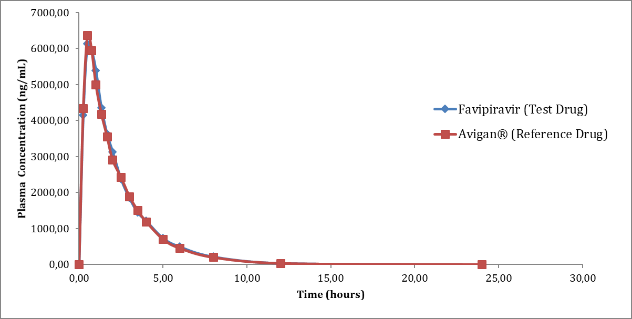
The primary parameters for evaluating the bioequivalence between the test (Favipiravir 200 mg Film-Coated Tablet) and reference (Avigan® 200 mg Film- Coated Tablet) drugs are AUC0-24 and Cmax. Based on the bioequivalence criteria with a 90% Confidence Interval, the ratio of the geometric mean values (AUC)T/(AUC)R should equal 1.00, with a 90% CI range of (80–125)% (α: 0.05). Similarly, (Cmax) T/ (Cmax) R should also equal 1.00, with a 90% CI range of (80–125) % (α: 0.05). This refers to the criteria set in accordance with the standard guidelines for bioequivalence studies [7, 10]. Pharmacokinetic parameters AUC0-24, AUC0-inf, Cmax, tmax, and t1/2 were calculated from the data of 30 subjects single oral dose administration of test drug and reference drug is shown in Table 2. Whereas, statistical calculations for AUC0-24 and Cmax is shown in Table 3.
| Test Drug | Reference drug | |||
|---|---|---|---|---|
| Parameter | Arithmetic Mean | Standard Deviation | Arithmetic Mean | Standard Deviation |
| AUC0-24 (ng.h.mL-1) | 15,756.77 | 4,773.47 | 15,491.62 | 4,288.43 |
| AUC0-inf (ng.h.mL-1) | 16,061.22 | 4,900.70 | 15,790.31 | 4,364.66 |
| Cmax (ng.mL-1) | 7,237.49 | 1,441.07 | 7,218.51 | 1,896.11 |
| t½ (h) | 1.43 | 0.28 | 1.41 | 0.25 |
| tmax (h)* | 0.56 (0.25-1.00) | 0.61 (0.25-2.50) |
Table 2: Pharmacokinetic Parameters of Favipiravir after a Single-Dose Oral Administration of Favipiravir 200 mg Film-Coated Tabl
*mean (range) Table 2: Pharmacokinetic Parameters of Favipiravir after a Single-Dose Oral Administration of Favipiravir 200 mg Film-Coated Tablet (Test Drug) & Avigan® 200 mg Film- Coated Tablet (Reference Drug).
| Parameter | % Ratio of Geometric Means (T/R) | 90% Confidence Interval (T/R) | % CV | Power (%) | |
|---|---|---|---|---|---|
| Lower Limit | Upper Limit | ||||
| AUC0-24 | 101.27 | 96.89 | 105.86 | 10.1 | >99 |
| Cmax | 101.8 | 94.49 | 109.67 | 17.1 | >99 |
Table 3: Statistical calculations for AUC0-24 and Cmax.
Discussion
AUC0-24 and Cmax were designated as the primary parameters to evaluate potential bioequivalence between both formulations. The statistical results obtained from this study indicate that the estimated values with a 90% confidence interval for the test-to-reference (T/R) geometric mean ratios of AUC0-24 and Cmax all fall within the equivalence criteria of 80.00-125.00%. The geometric mean ratios (90% confidence intervals) of the test drug/reference drug for Favipiravir were 101.27% (96.89–105.86%) for AUC0-24 and 101.80% (94.49 – 109.67%) for Cmax.
The mean values ± SD of AUC0-24, AUC0-inf, Cmax, tmax, and t½ for the test drug were 15,756.77± 4,773.47 ng·mL- 1·hr, 16061.22± 4,900.70 ng·mL-1·hr, 7,237.49 ±1,441.07 ng/mL, 0.56 ± 0.26 hours, and 1.43 ± 0.28 hours, respectively. The mean values ± SD of AUC0-24, AUC0-inf, Cmax, tmax, and t½ for the reference drug were 15491.62 ± 4,288.43 ng·mL- 1·hr, 15790.31 ± 4,364.66 ng·mL-1·hr, 7,218.51 ± 1,896.11 ng/mL, 0.61 ± 0.46 hours, and 1.41 ±0.25 hours, respectively.
In the present study, the intra-subject coefficient of variance (%CV) obtained from the ANOVA for the Favipiravir AUC0-24 was 10.11% and Cmax 17.08%. Hence, the number of subjects in this study (30 subjects) was adequate to ensure that this study has an adequate 80% power to confirm a statistical conclusion.
During this bioequivalence study, two adverse events were reported, namely nausea (associated with the test drug) and headache (associated with the reference drug). All of these adverse events were documented in the Case Report Form (CRF), and any deviations from the study protocol are detailed in the full study report in the section on protocol deviations.
Conclusion
Based on the results of the single dose study above, it was concluded that the PT Kimia Farma Tbk.’s formulation of Favipiravir 200 mg Film-Coated Tablet was bioequivalent to the Reference drug (Avigan® 200 mg Film-Coated Tablet manufactured by Fujifilm Toyama Chemical Co., Ltd).
References
-
Du YX, Chen XP (2020) Favipiravir: Pharmacokinetics and Concerns About Clinical Trials for 2019-nCoV Infection. Clinical Pharmacology & Therapeutics 108(2): 242-247.
-
National Center for Biotechnology Information (2021) Pubchem compound Summary.
-
The Indonesian Food and Drug Authority (2020) Informatorium of Covid-19 Drugs in Indonesia.
-
Favipiravir (2021) Drugbank. Diakses dari.
-
Hayden FG, Shindo N (2019) Influenza Virus Polymerase Inhibitors in Clinical Development. Current Opinion in Infectious Diseases 32(2): 176-186.
-
World Health Organization (2016) Bioequivalence - General Considerations.
-
Badan Pengawas Obat dan Makanan (2015) Pedoman Uji Bioekivalensi. Jakarta: BPOM.
-
Sağlam O, Demiray G, Güney B, Dogan-Kurtoglu E, Ulusoy MG, et al. (2020) Single Dose, Two-way Crossover Bioequivalence Study of Favipiravir Tablet in Healthy Male Subjects. Journal of Pharmacy and Drug Development 2(2).
-
European Medicines Agency (2011) Guideline on Bioanalytical Method Validation. European Medicines Agency: Science medicines health, pp: 1-23.
-
ASEAN (2015) ASEAN Guidelines for the Conduct of Bioequivalence Studies, pp: 1-43.
- Effects of 5-HTP and Melatonin on the Sleep Cycle of Medical Students
- Adsorption of Bisphenol A on NH4OH- Modified Rice Husk and Sugar Cane Bagasse Biochar
- Comparative Assessment of the Reinforcement Efficiency of Palm Fruit Fibre and Coconut Fibre in High Density Polyethylene (HDPE) Matrix Composite
- Importance of Bio Compounds Naturally Present in Food with Functionality in Animal Metabolism
- Sub-Acute Study on the Cardiotoxic Effects of Monosodium Glutamate Ingestion in Albino Rat
- Weight Management and Its Natural Solutions: A Review