
In Vitro Anticancer and Cytotoxic Activity of Ethanolic Extract of Phyllanthus reticulatus Poir. Against Hela Cell Line and Vero Cell Line
The present study was designed to investigate the anticancer activity of Phyllanthus reticulatus Poir. against HeLa cell line and to predict the therapeutic potential by investigating the cytotoxicity of the extract against Vero cell line and determining the selectivity index (SI). Phytochemical screening of the ethanolic extract of Phyllanthus reticulatus Poir. was employed by using standard methods. Anticancer and cytotoxic activities were investigated from Centre for Advanced Research in Science using their commercial services. MTT assay was employed for the evaluation of the activities. The concentrations of the extract was 5 mg/ml, 2.5 mg/ml, 1.25 mg/ml and 0.625 mg/ml. From the survival rate % inhibition was calculated and graphically the IC50 value was determined by plotting the % inhibition against the concentration of the extract investigated. Finally, the selectivity index was calculated from the IC50 values of the extract against HeLa cell line and Vero cell line. Glycoside, tannin, alkaloid, flavonoid, phenol, coumarin were present in the ethanolic extract of Phyllanthus reticulatus Poir. The IC50 value of the extract against HeLa Cell and Vero Cell were 1.00 mg/ml and 8.09 mg/ml respectively. The selectivity index was 8.09. This value indicates that the cancer cell (HeLa cells) will be killed at higher rate than normal ones i.e. the extract is more toxic for cancer cells.
Introduction
Uncontrolled cell proliferation is known as cancer where the apoptosis is failed [1]. Around the world many people died in cancer [2]. It is the cause of death of eight million people annually [3]. It has been estimated that in 2030 worldwide death will be over 11 million [4]. Cervical cancer is the second most cancer in relatively young women around the world, mostly in the poor and developing countries. It is caused by human papilloma virus (HPV) which manifests pelvic pain and abnormal vaginal bleeding at later stage. Cell cycle, antitumor immune response, gene expression and micro RNA expression etc are found to be altered during the progression. Recurrent and metastatic malignancy may be the cause of death across the word [5].
Effective treatment of cancer has not been established yet and the mortality rate is also high. It is required to explore natural sources of effective anticancer agents and use them commercially as the healthy cells are also destroyed beside cancer cell by the use of conventional cancer treatment such as chemotherapy [2, 4].
Modern medicine is based on medicinal plants since the beginning of human history. The risk of cancer can be reduced by the use of bioactive components of medicinal plants [4]. More than 3000 plants possess anticancer property. From various plants anticancer drug molecules are identified and isolated. Numerous plant derived compounds are being tested clinically for being used to treat cancer [6]. People depend on medicinal plants due to their safety and efficacy [7]. Treatment based on the plant source doesn’t show any serious complications [8]. Because of having therapeutic properties about 500 plants have been established as medicinal plants in Bangladesh. For the treatment of various diseases Bangladeshi people rely on medicinal plants. Scientific studies are available for only a few medicinal plants [9]. Phyllanthus reticulatus Poir. is a plant of euphorbiaceae family. It is a climbing shrub [10]. It is widely distributed all over Bangladesh [11, 12]. In order to cure different diseases, such as diarrhoea, asthma, inflammation etc, various parts of this plant is used traditionally. It has been also found to possess antidiabetic, antiviral, anticancer, antiplasmodial, antibacterial, hepatoprotective activity.
Tannic acid, terpenoids, flavonoids, phenolic compounds and steroids are present in Phyllanthus reticulatus Poir. as main chemical constituents [13]. 57 compounds have been isolated by chromatographic procedures from this plant. Terpenoids, steroids, flavonoids, phenolic, lignin, arylnaphthalene lignin, lignin glycosides, tannins, megastigmane, purine, abscisic and geraniinic acid derivatives, glycosides and alcoholic compounds were the main compounds [14].
The genus Phyllanthus is less explored for anticancer activity. Hypophyllanthin isolated from Phyllanthus amarus an active anticancer effect agaist HeLa cell line compared to NIH/3T3 cells [15]. Phyllanthus emblica showed least sensitivity to HeLa cells compared to other cell lines tested. Toxicity to noncancerous Vero cells of this extract was decreased [16]. In the previous study the anticancer activity of Phyllanthus reticulatus _Poir._was conducted against colon cancer cell line [3].
This present study is designed to examine the anticancer activity of this plant against HeLa cell line as well as to examine and compare with the cytotoxicity on Vero cell line. The oldest and most commonly used HeLa cell line was obtained from cervical cancer cells received from an African- American woman Henrietta Lacks [17]. It is the first immortal human cell line. Before this, cells cultured from other human wouldn’t survive for more than a few days. HeLa cells proliferated in cultures and used by the researcher around the world [18]. From the kidney of an adult African green monkey Vero cell line was initiated on 1962 [19].
Materials and Methods
Sample Selection and Collection
With extensive literature review Phyllanthus reticulatus Poir. was selected and fresh mature leaves were collected from Narsingdi, Bangladesh to study the anticancer activity on HeLa cell line. After collection the plant was authenticated by a taxonomist from Bangladesh National Herbarium, Dhaka, Bangladesh. The accession number was 87899.
Sample Preparation for Extraction
After collection of the fresh mature leaves adhering dirt was cleaned and the leaves were then shade dried until complete removal of moisture from the leaves. After drying the leaves were converted into fine powder by using a suitable blender. 162 gm dry powder was obtained. The powder was stored in an airtight container and kept in a cool dark place until the extraction.
Extraction Procedure
Maceration was used to separate the medicinally active chemical constituents from the dried leaves. 162 gm powder was dissolved in 800 ml ethanol in a suitable stoppered container and allowed to stand at room temperature for 7 days with occasional shaking in order to facilitate the solubilization of the secondary metabolites into the solvent. After 7 days the mixture was filtered by using a cotton piece which was followed by filtration using filter paper in order to clarify the solvent containing the chemical constituents. After this the solvent was evaporated to dryness to get the crude extract. 7.68 gm i.e.4.74 % crude extract was obtained. The extract was stored and was used to investigate the preliminary phytoconstituents present in the extract and anticancer activity of this extract in HeLa cell line.
Preliminary Phytochemical Screening
The crude extract obtained from maceration process was analyzed for the investigation of the presence or absence different chemical constituents. Among the large variety of qualitative phytochemical screening of medicinal plants the standard tests were performed based on the availability of the reagents in the laboratory. Test for carbohydrate (Molisch’s test), test for reducing sugar (Fehling’s test, Benedict’s test), test for steroid (Salkowski’s test), test for glycoside (General test), test for tannin (Ferric chloride test, Lead acetate test), test for alkaloid (Mayers test), test for resin (General test), test for saponin (Frothing test), tests for flavonoid (Alkaline reagent test), test for phenol (FeCl3 test) and test for coumarin (NaOH test) [20, 21].
Cytotoxic Activity
Used Instruments: Biological Bio Safety Cabinet (Model: NU-400E, Nuaire, USA), Carbon dioxide Incubator (Nuaire, USA), Trinocular microscope with camera (Optika, Italy) and Hemocytometer.
Used Consumables: 48-well plate, 96- well plate, 15- ml tubes, Tips, Gloves, Culture flask, Cell culture media, Antibiotics (P+S), Gentamycin, Serological pipette and Trypsin etc.
Sample Preparation: In order to evaluate anticancer activity 50 ml solution was prepared by taking 49 ml distilled water and 1 ml Dimethyl sulfoxide (DMSO) in a beaker. From this solution 4ml solution was taken in another beaker. Then 20mg sample (crude extract of Phyllanthus reticulatus poir.) was added in the beaker to make the final concentration of solution 5 mg/ml to be used in qualitative anticancer activity evaluation against HeLa cell. For the quantitative evaluation of anticancer activity the stock solution of 5 mg/ml was diluted serially to have the solutions having 2.5 mg/ml, 1.25 mg/ml, 0.625 mg/ml concentration. The final concentration of DMSO in the test solution was less than 1%. 100% DMSO was used as a control. Same procedure was used for the determination of cytotoxic activity of the extract against Vero cell line.
Maintenance of the Cell Lines: Anticancer and cytotoxic activity was examined in Centre for Advanced Research in Science using their commercial services. In brief, HeLa, a human cervical carcinoma cell line was maintained in DMEM ( Dulbecco’s Modified Eagles medium) containing 1% penicillin- streptomycin (1:1) and 0.2% gentamycin and 10% fetal bovine Serum (FBS). Vero cell line, a kidney epithelial cells extracted from an African green monkey, was maintained in the same condition like HeLa cell line.
Procedure of Qualitative Anticancer Activity Against Hela Cell Line: HeLa Cells (4.0× 10^4 / 200 µl) were seeded onto 48-well plate and incubated at 37°C + 5% CO2. Next day, 50µl sample (filtered) was added each well. Cytotoxicity was examined under an inverted light microscope after 48h of incubation. Duplicate wells were used for the sample.
Procedure of Quantitative Anticancer Activity Against Hela Cell Line: MTT assay was used to determine quantitative anticancer activity against HeLa cells. The cells (2.0× 10^4 / 100 µl) were seeded onto 96-well plate and incubated at 37°C + 5% CO2. Next day, 25µl sample (filtered) was added each well. Cell viability was examined after 48h of incubation using a colorimetric cell proliferation assay kit (Cell Titer 96® Aqueous One Solution Cell Proliferation Assay, Promega, USA) following the manufacturers protocol. This colorimetric method can determine the number of viable cells in proliferation. The quantity of formazan product is directly proportional to the number of living cells in culture. Assays are performed by adding a 20 µl of the CellTiter 96® AQueous One Solution Reagent directly to culture wells, incubating for 3 hours and then recording the absorbance at 450 nm with a 96-well plate reader. Duplicate wells were used for sample concentration.
Procedure for Quantitative Cytotoxic Activity against Vero Cell Line: Vero cells (1.5× 10^4 / 100 µl) was seeded onto 96 well plate and incubated at 37°C + 5% CO2. Next day, 25µl sample (filtered) was added each well. Cell viability was examined after 48h of incubation using a colorimetric cell proliferation assay kit (Cell Titer 96 Non- Radioactive Cell Proliferation Assay kit (Promega, USA) following the manufacturers protocol. Duplicate wells were used for sample concentration.
Determination of IC50 value From the absorbance % viability was calculated. Inhibition rate (%) was determined from the following equation.
live cell in the control live cell in the test group Inhibition rate % 100 live cell in the control − = × ( ) After determination % Inhibition it was plotted against concentration in Microsoft Office Excel and IC50 was graphically calculated.
Determination of Selectivity Index The selectivity index was calculated by using the following formula.
IC for normal cell line Selectivity index, SI IC for cancerous cell line =
50
50
Results
Preliminary Phytochemical Screening
The result of qualitative phytochemical analysis of ethanolic leaves extract of Phyllanthus reticulatus poir. is represented in Table 1.
| Phytoconstituents | Observation |
|---|---|
| Carbohydrates | + |
| Glycosides | + |
| Steroids | - |
| Tannin | + |
| Alkaloid | + |
| Resin | - |
| Saponin | - |
| Flavonoid | + |
| Phenol | + |
| Coumarin | + |
Table 1: Chemical constituents of Phyllanthus reticulatus poir. ethanolic extracts.
Here plus(+) sign and and minus(-) sign indicates the presence and absence of phytoconstituents respectively. Table 1: Chemical constituents of Phyllanthus reticulatus poir. ethanolic extracts.
Anticancer Activity
The effect of Phyllanthus reticulatus on HeLa cell line as well as Vero cell line are represented in the following. The selectivity index of the extract is also determined
| Sample ID | Survival of cells (HeLa) |
|---|---|
| Solvent - | 100% |
| Solvent + | >95% |
| Phyllanthus reticulatus Poir. | <5% |
Table 2: Survival of cells on qualitative assay.
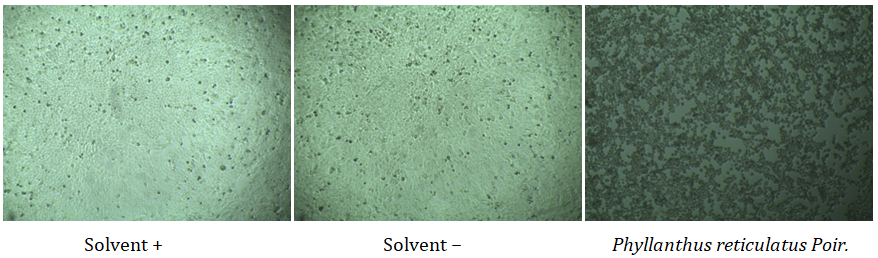
and presented here. Phyllanthus reticulatus Poir. showed qualitative cytotoxicity against HeLa cell line. Here prominent cell rupture was observed in Phyllanthus reticulatus Poir. compared to the control under Trinocular microscope with camera (Table 2 & Figure 1).
Negative control = solvent + (survival rate 100%); Positive control = solvent - (survival rate >95%); Ethanolic extract of Phyllanthus Reticulatus Poir. (survival rate <5%). Table 2: Survival of cells on qualitative assay.
It was observed that HeLa cell proliferation was significantly inhibited by the Phyllanthus reticulatus extract. The result indicates the sensitivity of human cancer cell line for the extract (Figures 2-5).
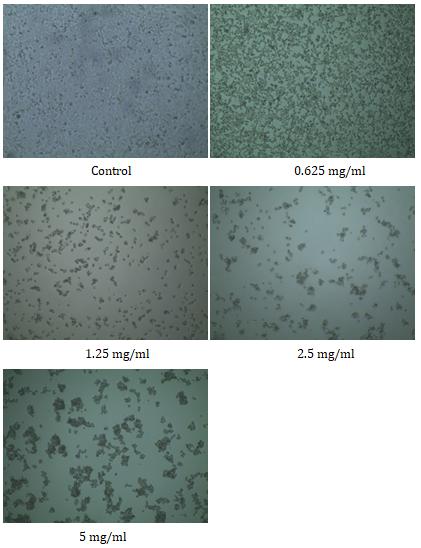
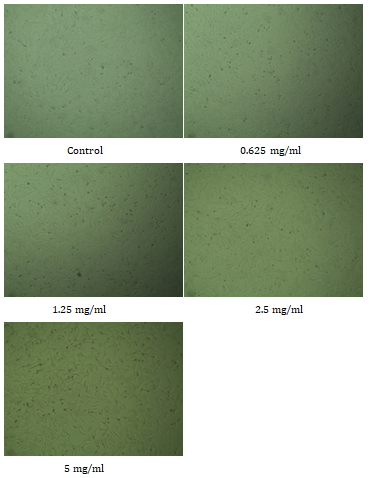
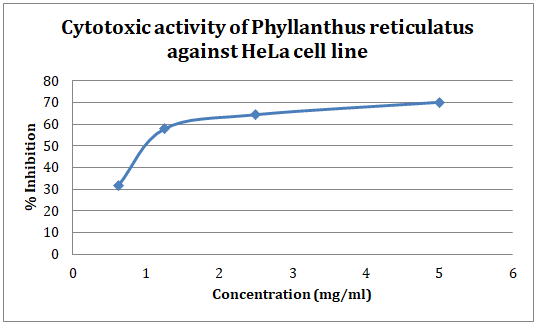
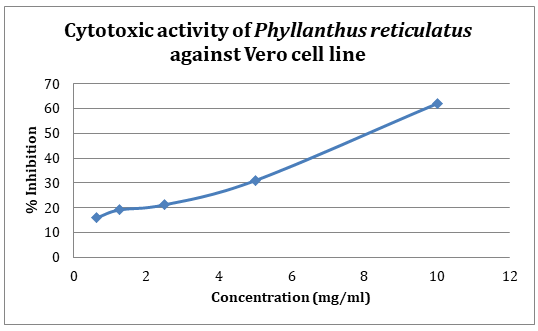
Here, the % inhibition of the 5th concentration is obtained from that of the 4th concentration by doubling it, in order to get the IC50 value graphically (Table 3).
| Sample | IC50 value (mg/ml) | Selectivity Index | |
|---|---|---|---|
| HeLa Cell Line | Vero Cell Line | ||
| Phyllanthus reticulatus | 1 | 8.09 | 8.09 |
Table 3: IC50 value and selectivity index of Phyllanthus reticulatus Poir.
Discussion
The programmed cell death is known as apoptosis which controls the tissue development and homeostasis. Faulty cell death may be responsible for initiating cancer. Apoptosis and reactive oxygen species mediate anticancer effect on HeLa cells. A number of phytochemical compounds may be involved to induce apoptosis in cancer cells [5]. Due to low toxicity and high effectiveness phytochemicals can be a good source of anticancer agents. Phtochemicals can be less resistant compared to other chemotherapeutic agents. For instance some alkaloids may reduce angiogenesis and cancer cell migration, some may trigger apoptosis and autophagy in cancer cells, some may suppress tumor cell invasion [22]. Anthraquinones, and flavonoids may also demonstrate cytotoxic activity [23].
In the present study besides various chemical constituents alkaloids and flavonoids were found to be present in ethanolic leaves extract of Phyllanthus reticulatus Poir. This might be the probable cause of anticancer activity against HeLa cell line. Phyllanthus reticulatus Poir. showed qualitative cytotoxicity against HeLa cell line. Here prominent cell rupture was observed in Phyllanthus reticulatus Poir. compared to the control. It has been observed that the death of HeLa cells in quantitative assay was increased with the increasing concentration of the extract whereas no death was observed in case of control. But the exact mechanism should be revealed in further study.
The selectivity index was calculated to predict the therapeutic potential of the extract studied. Here, the value of selectivity index was 8.09. This value indicates that the cancer cell (HeLa cells) will be killed at higher rate than normal ones i.e. the extract is more toxic for cancer cells.
Conclusion
Phyllanthus reticulatus Poir. showed concentration dependent anticancer activity on HeLa cell line. It was revealed from the study that Phyllanthus reticulatus Poir. showed selective toxicity to cancer cell line compared to noncancer cell line. But further research is required to isolate the chemical constituents responsible for the anticancer activity and to reveal the exact mechanism.
Conflict of Interest
None to declare
Acknowledgements
The authors are grateful to Centre for Advanced Research in Science and Primeasia University for their support.
Funding
None to declare
Author Contribution
- Sumsunnahar Shifa: Designed the research, performed data analysis and wrote the manuscript
- Afsana Hossain Puspo: Conducted experiment and participated in data analysis
- Afsana Arefin: Conducted experiment
- Maria Benta Mazed: Conducted experiment
References
-
Goh BH, Kadir HA (2011) In vitro cytotoxic potential of _Swietenia macrophylla_ King seeds against human carcinoma cell lines. J Med Plant Res 5(8): 1395-1404.
-
González LB, Simirgiotis MJ, Parra C, Alfaro-Lira S, Soto E, et al. (2021) In vitro screening for growth inhibition activity on cancer cell lines of northern Chile highlands shrubs. Cienc Rural 51(1): 1-6.
-
Aarthi C, Babu PBR (2017) Anti-cancer activity of Phyllanthus reticulatus on colon cancer cell line. Int J Civ Eng 8(1): 943-947.
-
Berrington D, Lall N (2012) Anticancer Activity of Certain Herbs and Spices on the Cervical Epithelial Carcinoma (HeLa) Cell Line. ECAM 2012(564927): 1-11.
-
Song X, Liu C, Hong Y, Zhu XC (2015) Anticancer activity of novel oleanolic acid methyl ester derivative in HeLa cervical cancer cells is mediated through apoptosis induction and reactive oxygen species production. Bangladesh J Pharmacol 10: 896-902.
-
Solowey E, Lichtenstein M, Sallon S, Paavilainen H, Solowey E, et al. (2014) Evaluating Medicinal Plants for Anticancer Activity. Sci World J 2014(721402): 1-12.
-
Shadid KA, Shakya AK, Naik RR, Jaradat N, Farah HS, et al. (2021) Phenolic Content and Antioxidant and Antimicrobial Activities of Malva sylvestris L., Malva oxyloba Boiss., Malva parviflora L., and Malva aegyptia L. Leaves Extract. J Chem 2021: 1-10.
-
Ingole RD, Thalkari AB, Karwa PN, Shinde PS (2020) A God Gifted Plant. RJPP 12(4): 227-230.
-
Akhter S, Hasan S, Hasan MM, Begum Y (2018) Investigation of in vivo analgesic and antiinflammatory activities of methanol extracts of Phyllanthus reticulatus and Mimosa pigra. J Pharmacogn Phytochem 7(1): 2378- 2385.
-
Maruthappan V, Shree KS (2010) Effects of Phyllanthus reticulatus **o**n lipid profile and oxidative stress in hypercholesterolemic albino rats. Indian J Pharmacol 42(6): 388-391.
-
Ghani A (2003) Medicinal Plants of Bangladesh: Chemical Constituents and Uses. 2nd (Edn.), Asiatic Society of Bangladesh, Dhaka, Bangladesh, pp: 603.
-
Haque T, Muhsin MDA, Akhter T, Haq ME, Begum R, et al. (2016) Antimicrobial and analgesic activity of leaf extracts of _Phyllanthus reticulatus_ Poir (Family- Euphorbiaceae). J Biol Sci 5(1): 81-85.
-
Manjula V, Norman TSJ (2017) Pharmacognostical study of Phyllanthus reticulatus: A tribal drug. Pharma Innovation 6(9): 107-109.
-
Saleh-E-In MM, Kar P, Roy A, Kowalski R (2022) Phytochemical account: Phyllanthus reticulatus Poir. JPP 1(1): 19-29.
-
Noor NAM, Nafiah MA, Johari SATT, Hasnan MHH, Tan SP, et al. (2019) Anticancer Effect of Hypophyllanthin, Niranthin and Lintetralin From Phyllanthus amarus on HeLa Cells And NIH/3T3 Cells. IJRTE 8(2S7): 106-110.
-
Kumnerdkhonkaen P, Saenglee S, Asgar MA, Senawong G, Khongsukwiwat K, et al. (2018) Antiproliferative activities and phenolic acid content of water and ethanolic extracts of the powdered formula of Houttuynia cordata Thunb. fermented broth and Phyllanthus emblica Linn. Fruit. BMC Complement Altern Med 18(1): 130.
-
Patel S, Gheewala N, Suthar A, Shah A (2009) In-vitro cytotoxicity activity of Solanum nigrum extract against HeLa cell line and vero cell line. Int J Pharm Pharm Sci 1(1): 38-46.
-
Lucey BP, Walter ANR, Hutchins GM (2009) Henrietta Lacks, HeLa Cells, and Cell Culture Contamination. Arch Pathol Lab Med 133(9): 1463-1467.
-
Vijayarathna S, Sasidharan S (2012) Cytotoxicity of methanol extracts of Elaeis guineensis on MCF-7 and Vero cell lines. Asian Pac J Trop Biomed 2(10): 826-829.
-
Godghate AG, Sawant RS (2014) Phytochemical analysis of leaves of Tectona grandis linn. IJPBS 5(1): 355-359.
-
Ghani A (2011) Medicinal plants chemical constituents and uses of the medicinal plants of Bangladesh. Methods of phytochemical screening. 3rd (Edn.), Lap Lambert Academic Publishing, Bangladesh.
-
Thawabteh A, Juma S, Bader M, Karaman D, Scrano L, et al. (2019) The biological activity of natural alkaloids against herbivores, cancerous cells and pathogens. Toxins (Basel) 11(11): 656.
-
Murshid GM, Sohrab MH, Ahmed KS, Masud MM, Mazid MA, et al. (2022) Antiproliferative and Antibacterial Potentials of Endophytic Fungi Associated with Bangladeshi Medicinal Plant Tinospora Cordifolia. Dhaka Univ J Pharm Sci 21(2): 183-194.
- Effects of 5-HTP and Melatonin on the Sleep Cycle of Medical Students
- Adsorption of Bisphenol A on NH4OH- Modified Rice Husk and Sugar Cane Bagasse Biochar
- Comparative Assessment of the Reinforcement Efficiency of Palm Fruit Fibre and Coconut Fibre in High Density Polyethylene (HDPE) Matrix Composite
- Importance of Bio Compounds Naturally Present in Food with Functionality in Animal Metabolism
- Sub-Acute Study on the Cardiotoxic Effects of Monosodium Glutamate Ingestion in Albino Rat
- Weight Management and Its Natural Solutions: A Review