
Bilosomes: An Overview of Advancements in Preparation, Characterization, and Applications
Bilosomes, also known as bile vesicles, are bilayer vesicles that are formed by the hydration of bile salts. They have gained significant attention in recent years due to their potential use in various applications, including drug delivery and nutraceuticals. In this review, we discuss the various techniques used for the preparation of Bilosomes, including the film hydration, reverse phase evaporation, and ether injection methods. We also discuss the characterization techniques used to study the properties of Bilosomes, such as transmission electron microscopy (TEM), dynamic light scattering (DLS), and small angle X-ray scattering (SAXS). Additionally, we discuss the potential applications of Bilosomes, including their use as drug delivery systems for hydrophobic drugs, as well as their use in the food and nutraceutical industries. Finally, we discuss the current state of the Bilosomes market, including the currently available commercial products. Overall, this review provides a comprehensive overview of the recent advancements in Bilosomes research and highlights the potential of Bilosomes in various fields.
Introduction
Bilosomes are artificial phospholipid vesicles that mimic the structure and composition of natural bilayers. They are composed of phospholipids and bile salts, and can encapsulate drugs or genetic material to enhance their bioavailability and target specific cells or tissues [1]. Bilosomes have been proposed as a delivery system for a wide range of therapeutic applications, including cancer therapy, antiviral therapy, gene therapy, and dermatology.
One of the main advantages of Bilosomes is their ability to protect drugs or genetic material from degradation and enhance their transport across cell membranes. This can improve the bioavailability and efficacy of the encapsulated material. They can also be designed to target specific cells or tissues, which can increase the specificity of therapy [2]. Bilosomes are particularly attractive for drug and gene delivery because of their ability to protect the encapsulated materials from degradation and enhance their transport across cell membranes.
However, there are also some limitations to Bilosome technology. They can be sensitive to the conditions of preparation and can be difficult to scale up. Additionally, the choice of phospholipids and bile salts used can affect the properties of the Bilosomes, such as size and stability [3]. While Bilosomes offer many potential advantages for drug and gene delivery, there are also limitations to this technology. One of the biggest challenges is the variability and sensitivity of Bilosomes to preparation conditions.
In conclusion, Bilosomes are a promising drug delivery system that can enhance the bioavailability and target specificity of drugs or genetic material. However, further research and development is needed to optimize the preparation and properties of Bilosomes and to fully assess their safety and efficacy in various therapeutic applications [4, 5].
Advantages
Enhanced bioavailability: Bilosomes can enhance the bioavailability of lipophilic drugs by protecting them from degradation and facilitating their transport across cell membranes. Targeted delivery: Bilosomes can be designed to target specific cells or tissues, increasing the effectiveness of the drug or genetic material. Protection of drugs: Bilosomes can protect drugs from degradation by enzymes and other factors in the body. Reduced toxicity: Bilosomes can reduce the toxicity of drugs by delivering them directly to the target cells or tissues. Gene therapy: Bilosomes can be used to deliver genetic material to cells, which has the potential to be used in gene therapy. Biocompatibility: Bilosomes, being made of natural phospholipids and bile salts, are considered biocompatible, which reduces the risk of adverse reactions [6, 7, 8].
Disadvantages
Complex preparation: Preparing Bilosomes can be complex and time-consuming, requiring specialized equipment and expertise. Stability issues: Bilosomes can be sensitive to temperature and storage conditions, which can affect their stability and integrity. Immune response: Bilosomes can trigger an immune response, which can be problematic for certain applications. Cost: Bilosome production can be expensive and may not be cost-effective for some applications. Limited applications: Bilosomes are currently only used for a limited range of drugs and genetic material. Limited shelf life: Bilosomes have a limited shelf life and may lose their integrity over time, which can affect their effectiveness [9, 10].
Methods of Preparation of Bilosomes
There are several methods for preparing Bilosomes, including the film hydration method, the reverse phase evaporation method, and the ether injection method.
Film Hydration Method
The film hydration method is a common method used to prepare Bilosomes. The basic principle of the method is to hydrate a thin film of phospholipids and bile salts, resulting in the formation of Bilosomes as depicted in Figure
The film hydration method is a common method used to prepare Bilosomes. The basic principle of the method is to hydrate a thin film of phospholipids and bile salts, resulting in the formation of Bilosomes as depicted in Figure 1. The process typically involves the following steps: • A thin film of phospholipids and bile salts is prepared by evaporating a solution of these components. This can be done by spreading the solution on a glass plate and allowing it to evaporate under a laminar flow hood or in a desiccator. • The dried film is then hydrated by adding a solution of the encapsulated material (such as drugs or genetic material) and a buffer solution. This can be done by gently swirling the plate or by sonication to ensure homogenous hydration of the film. • The Bilosomes are then formed by the process of hydration, which causes the phospholipids and bile salts to self-assemble into Bilosomes. This process can be further optimized by varying the conditions of hydration, such as temperature and mixing rate. • The Bilosomes are then harvested by centrifugation or ultracentrifugation. • The final product is then characterized for size, encapsulation efficiency, and stability. • It is important to note that the film hydration method is a simple and versatile method for preparing Bilosomes, but it may not be suitable for all types of encapsulated materials. For example, some drugs or genetic materials may be sensitive to the conditions of hydration or may not be compatible with the phospholipids and bile salts used. Additionally, the choice of phospholipids and bile salts can also affect the properties of the Bilosomes, such as size and stability, and the preparation method should be optimized accordingly [11].
![Figure 1: The process typically involves the following steps: • A thin film of phospholipids and bile salts is prepared by evaporating a solution of these components. This can be done by spreading the solution on a glass plate and allowing it to evaporate under a laminar flow hood or in a desiccator. • The dried film is then hydrated by adding a solution of the encapsulated material (such as drugs or genetic material) and a buffer solution. This can be done by gently swirling the plate or by sonication to ensure homogenous hydration of the film. • The Bilosomes are then formed by the process of hydration, which causes the phospholipids and bile salts to self-assemble into Bilosomes. This process can be further optimized by varying the conditions of hydration, such as temperature and mixing rate. • The Bilosomes are then harvested by centrifugation or ultracentrifugation. • The final product is then characterized for size, encapsulation efficiency, and stability. • It is important to note that the film hydration method is a simple and versatile method for preparing Bilosomes, but it may not be suitable for all types of encapsulated materials. For example, some drugs or genetic materials may be sensitive to the conditions of hydration or may not be compatible with the phospholipids and bile salts used. Additionally, the choice of phospholipids and bile salts can also affect the properties of the Bilosomes, such as size and stability, and the preparation method should be optimized accordingly [11].](/fulltextimages/12480/fig_1.png)
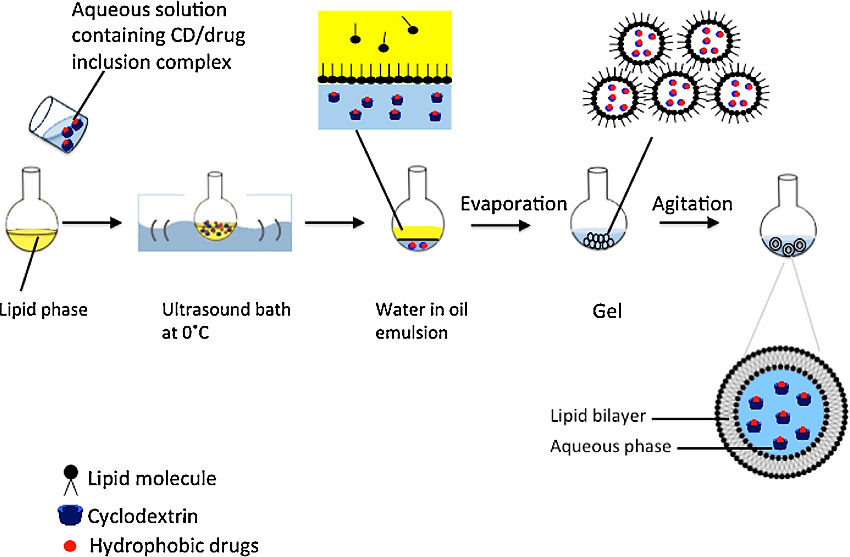
Reverse Phase Evaporation Method
The film reverse phase evaporation method, also known as the reverse phase evaporation method, is another common method used to prepare Bilosomes. This method is similar to the film hydration method but utilizes a different approach to form the Bilosomes as shown in Figure 2. The process typically involves the following steps:
- A solution of phospholipids and bile salts is prepared in an organic solvent such as chloroform or methanol.
- The solution is then added to a container of water, and the organic solvent is evaporated under reduced pressure to form a thin film of phospholipids and bile salts at the interface between the organic and aqueous phases.
- The encapsulated material (such as drugs or genetic material) is then added to the aqueous phase and the mixture is gently agitated to form the Bilosomes.
- The Bilosomes are then harvested by centrifugation or ultracentrifugation.
- The final product is then characterized for size, encapsulation efficiency, and stability.
This method is considered to be a more efficient method for preparing Bilosomes, since it allows for the formation of multilamellar vesicles (MLVs) which are more similar to the natural bilayers. Additionally, the use of organic solvents can help to protect the encapsulated material from degradation and increase its solubility.
However, like the film hydration method, the reverse phase evaporation method also has its limitations. The use of organic solvents can be toxic and may affect the properties of the Bilosomes. Additionally, the method may not be suitable for all types of encapsulated materials. As such, the method should be optimized accordingly, considering the properties of the encapsulated material and the desired properties of the Bilosomes.
It is important to note that the film reverse phase evaporation method is one of the common methods used to prepare Bilosomes, but it is not the only method. There are other methods like Liposome extrusion, Lipid film hydration, Microfluidic methods and many more [12, 13].
Ether Injection Method
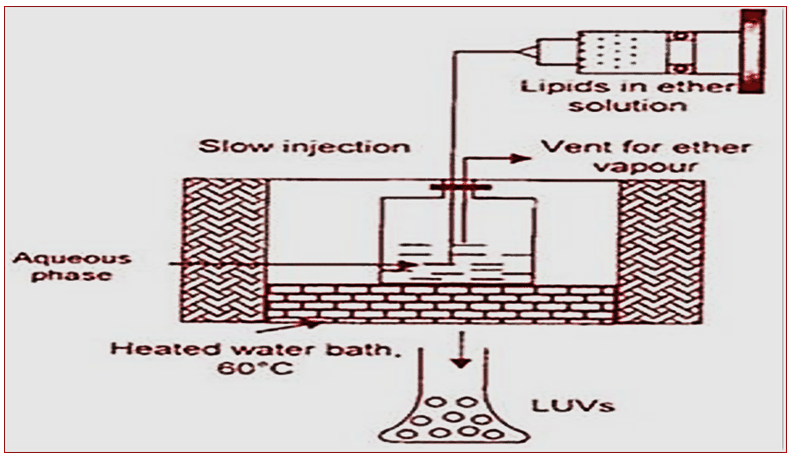
The ether injection method is a method used to prepare Bilosomes, which is based on the injection of an organic solvent, such as ether, into an aqueous solution of phospholipids and bile salts as shown in Figure 3. The process typically involves the following steps:
- An aqueous solution of phospholipids and bile salts is prepared at a desired pH and temperature.
- An organic solvent, such as ether, is then injected into the aqueous solution using a syringe or a similar device.
- The mixture is then agitated, either by stirring or sonication, to form Bilosomes. The agitation causes the phospholipids and bile salts to self-assemble into Bilosomes.
- The Bilosomes are then harvested by centrifugation or ultracentrifugation.
- The final product is then characterized for size, encapsulation efficiency, and stability.
The ether injection method is considered to be a simple and efficient method for preparing Bilosomes. The use of organic solvents can help to protect the encapsulated material from degradation and increase its solubility. Additionally, the method allows for the formation of multilamellar vesicles (MLVs) which are more similar to the natural bilayers.
However, like other methods, the ether injection method also has its limitations. The use of organic solvents can be toxic and may affect the properties of the Bilosomes.
Additionally, the method may not be suitable for all types of encapsulated materials. As such, the method should be optimized accordingly, considering the properties of the encapsulated material and the desired properties of the Bilosomes.
It is important to note that the ether injection method is one of the common methods used to prepare Bilosomes, but it is not the only method. There are other methods like Liposome extrusion, Lipid film hydration, Microfluidic methods and many more [14, 15].
Characterization of Bilosomes
There are several techniques that can be used to characterize Bilosomes, including: Dynamic Light Scattering (DLS): DLS is a technique that uses laser light to measure the size and size distribution of Bilosomes. The scattered light from the Bilosomes is collected and analyzed to determine the size of the particles. DLS is a non-destructive technique that can be used to determine the size of Bilosomes in suspensions and can provide information on the stability of the particles. Transmission Electron Microscopy (TEM): TEM is a technique that uses a beam of electrons to visualize the Bilosomes. The electrons are transmitted through the Bilosomes, and the resulting image is used to determine the size and shape of the particles. TEM can provide information on the ultrastructure of Bilosomes, such as the presence of multiple layers or defects in the bilayer structure. Zeta Potential: Zeta potential is a technique that measures the surface charge of Bilosomes. The zeta potential of a particle is the potential difference between the particle and the solvent, and can provide information on the stability of the particles. Positively charged Bilosomes will repel each other, while negatively charged Bilosomes will attract each other, which can affect the stability of the particles. Differential scanning calorimetry (DSC): DSC is a thermal analysis technique that is used to study the thermotropic behavior of Bilosomes. DSC can provide information on the phase transition temperatures, the enthalpy changes and the degree of crystallinity. The phase transition temperatures can be used to determine the type of lipids present in the Bilosomes and the degree of crystallinity can be used to determine the packing arrangement of the lipids. Fourier-transform infrared spectroscopy (FTIR): FTIR is a technique that uses infrared radiation to study the chemical composition of Bilosomes. FTIR can provide information on the type of lipids present in the Bilosomes, the chemical interactions between the Bilosomes and their environment, and the structural changes that may occur during storage or exposure to other conditions. Nuclear magnetic resonance (NMR) spectroscopy: NMR is a technique that uses magnetic fields to study the molecular interactions and structural properties of Bilosomes. NMR can provide information on the type of lipids present in the Bilosomes, the packing arrangements of the lipids, and the interactions between the lipids and other molecules. X-ray diffraction (XRD): XRD is a technique that uses X-rays to study the structural properties of Bilosomes. XRD can provide information on the degree of crystallinity, the type of crystals, and the packing arrangements of the lipids. Size exclusion chromatography (SEC): SEC is a technique that separates particles based on their size. SEC can be used to measure the size of Bilosomes and can provide information on the size distribution and the polydispersity index (PDI) of the particles. Fluorescence spectroscopy: Fluorescence spectroscopy is a technique that uses fluorescent dyes to study the interactions between Bilosomes and other molecules, such as drugs or proteins. Fluorescence spectroscopy can provide information on the binding of drugs to Bilosomes, the localization of drugs within the Bilosomes, and the stability of the Bilosomes-drug complexes.
These characterization techniques provide valuable information on the properties and behavior of Bilosomes, which can be used to optimize the preparation and design of Bilosomes for specific applications [16, 17, 18, 19].
Applications of Bilosomes
Bilosomes have been proposed for use in a variety of therapeutic applications, including: Cancer therapy: Bilosomes have been proposed as a delivery system for anticancer drugs, as they can target specific cancer cells and enhance the bioavailability of drugs. Antiviral therapy: Bilosomes have been proposed as a delivery system for antiviral drugs, as they can protect the drugs from degradation and enhance their bioavailability. Gene therapy: Bilosomes have been proposed as a delivery system for genetic material, as they can protect the material from degradation and enhance its transport across cell membranes. Dermatology: Bilosomes have been proposed as a delivery system for topical skincare products and cosmetics, as they can help enhance the penetration of the active ingredients through the skin. Ophthalmology: Bilosomes have been proposed as a delivery system for ocular drugs, as they can protect the drugs from degradation and enhance their transport across the cornea. Cardiology: Bilosomes have been proposed as a delivery system for cardiovascular drugs, as they can protect the drugs from degradation and enhance their transport across cell membranes. Neurology: Bilosomes have been proposed as a delivery system for drugs for neurological disorders, as they can protect the drugs from degradation and enhance their transport across the blood-brain barrier.
Bilosomes have a wide range of applications, including in the fields of medicine, cosmetics, and food science. Some of the most common applications of Bilosomes include: Drug delivery: Bilosomes can be used as carriers for drugs, such as anticancer drugs, antibiotics, and anti-inflammatory agents. The Bilosomes protect the drugs from degradation and enhance their solubility, thereby increasing their bioavailability and targeting them to specific cells or tissues. Gene therapy: Bilosomes can be used as carriers for genetic material, such as plasmids, siRNA, and miRNA, for the delivery of genetic therapies. They can protect the genetic material from degradation and enhance its transfection efficiency. Cosmetics: Bilosomes can be used as delivery systems for active ingredients in cosmetics, such as vitamins, antioxidants, and other skin-care agents. They can help to enhance the penetration of these ingredients into the skin and improve their effectiveness. Food science: Bilosomes can be used as delivery systems for food ingredients, such as flavors, colorants, and vitamins, to enhance their stability, solubility and bioavailability. Biomedical imaging: Bilosomes can be used as contrast agents in imaging techniques such as magnetic resonance imaging (MRI) and computed tomography (CT) scans. Agriculture: Bilosomes can be used to protect plants from pests, pathogens and to improve plant growth [20, 21, 22, 23, 24, 25].
It’s important to note that the applications of Bilosomes are not limited to the above examples, and research is ongoing to discover new applications of these vesicles. It is important to note that the application of Bilosomes in the field of medicine and drug delivery has been extensively researched and are in clinical trials, and some of them are already in the market. But still many other fields of application have a lot of potential, and the research is ongoing to discover new applications of these vesicles.
Marketed Products of Bilosomes
There are a number of products that are available in the market that make use of Bilosomes as a key component. Some examples include:
- Doxil (doxorubicin hydrochloride liposome injection) is a chemotherapy drug that is used to treat ovarian and breast cancers. It is encapsulated in Bilosomes that help to target the drug to cancer cells and reduce side effects.
- Myocet (doxorubicin hydrochloride liposome injection) is a chemotherapy drug that is used to treat breast cancer.
- Abraxane (paclitaxel protein-bound particles for injectable suspension) is a chemotherapy drug that is used to treat breast, non-small cell lung, and pancreatic cancers. It is encapsulated in Bilosomes that help to target the drug to cancer cells and reduce side effects.
- Amphotec (amphotericin B liposome injection) is an antifungal drug that is used to treat fungal infections such as aspergillosis and candidiasis.
- Onivyde (irinotecan liposome injection) is a chemotherapy drug that is used to treat pancreatic cancer.
- Marqibo (vincristine sulfate LIPOSOME injection) is a chemotherapy drug that is used to treat acute lymphoblastic leukemia (ALL).
- Vemlidy (Tenofovir Alafenamide) is a nucleotide reverse transcriptase inhibitor (NRTI) used to treat chronic hepatitis B virus (HBV) infection in adults with compensated liver disease [26, 27, 28].
Conclusion
Bilosomes are a promising drug delivery system with many advantages, but also some limitations. Further research is needed to fully understand their potential and to address some of the challenges associated with their use. Additionally, more studies are needed to evaluate the safety and efficacy of Bilosomes in various therapeutic applications. Despite the limitations, Bilosomes have the potential to revolutionize the way drugs and genetic materials are delivered to cells and tissues in the body, making them an area of active research and development in the field of drug delivery.
References
-
Khan A, Ahmad I (2019) Bilosomes: A promising drug delivery system. Journal of controlled release: official journal of the Controlled Release Society 299: 80-98.
-
Gregoriadis G (1990) Immunological adjuvants: a role for liposomes. Immunology today 11(3): 89-97.
-
Gregoriadis G, Allison AC, Poste G (1989) Immunological adjuvants and vaccines. 1st(Edn.), Springer Science & Business Media, New York, USA, pp: 244.
-
Ahmad J, Singhal M, Amin S, Rizwanullah M, Akhter S, et al. (2017) Bile salt stabilized vesicles (bilosomes): a novel nano-pharmaceutical design for oral delivery of proteins and peptides. Current pharmaceutical design 23(11): 1575-1588.
-
Shukla A, Mishra V, Kesharwani P (2016) Bilosomes in the context of oral immunization: development, challenges and opportunities. Drug discovery today 21(6): 888-899.
-
Shukla A, Khatri K, Gupta PN, Goyal AK, Mehta A, et al. (2008) Oral immunization against hepatitis B using bile salt stabilized vesicles (bilosomes). Journal of Pharmacy & Pharmaceutical Sciences 11(1): 59-66.
-
Saifi Z, Rizwanullah M, Mir SR, Amin S (2020) Bilosomes nanocarriers for improved oral bioavailability of acyclovir: A complete characterization through in vitro, ex-vivo and in vivo assessment. Journal of Drug Delivery Science and Technology 57: 101634.
-
Al-Mahallawi AM, Abdelbary AA, Aburahma MH (2015) Investigating the potential of employing bilosomes as a novel vesicular carrier for transdermal delivery of tenoxicam. International journal of pharmaceutics 485(1-2): 329-340.
-
Wilkhu JS, McNeil SE, Anderson DE, Perrie Y (2013) Characterization and optimization of bilosomes for oral vaccine delivery. Journal of drug targeting 21(3): 291- 299.
-
Abbas H, Gad HA, Khattab MA, Mansour M (2021) The Tragedy of Alzheimer’s Disease: Towards Better Management via Resveratrol-Loaded Oral Bilosomes. Pharmaceutics 13(10): 1635.
-
Abdelbary AA, Abd-Elsalam WH, Al-Mahallawi AM (2016) Fabrication of novel ultradeformable bilosomes for enhanced ocular delivery of terconazole: in vitro characterization, ex vivo permeation and in vivo safety assessment. International journal of pharmaceutics 513(1-2): 688-696.
-
Jain S, Harde H, Indulkar A, Agrawal AK (2014) Improved stability and immunological potential of tetanus toxoid containing surface engineered bilosomes following oral administration. Nanomedicine 10(2): 431-440.
-
Wang L, Huang X, Jing H, Ma C, Wang H, et al. (2021) Bilosomes as effective delivery systems to improve the gastrointestinal stability and bioavailability of epigallocatechin gallate (EGCG). Food Research International 149: 110631.
-
Ahmed S, Kassem MA, Sayed S (2020) Bilosomes as promising nanovesicular carriers for improved transdermal delivery: construction, in vitro optimization, ex vivo permeation and in vivo evaluation. International Journal of Nanomedicine 15: 9783-9798.
-
Nemati M, Fathi‐Azarbayjani A, Al‐Salami H, Roshani AE, Rasmi Y, et al. (2022) Bile acid‐based advanced drug delivery systems, bilosomes and micelles as novel carriers for therapeutics. Cell Biochemistry and Function 40(6): 623-635.
-
Singh P, Prabakaran D, Jain S, Mishra V, Jaganathan KS, et al. (2004) Cholera toxin B subunit conjugated bile salt stabilized vesicles (bilosomes) for oral immunization. International journal of pharmaceutics 278(2): 379-390.
-
El-Nabarawi MA, Shamma RN, Farouk F, Nasralla SM (2020) Bilosomes as a novel carrier for the cutaneous delivery for dapsone as a potential treatment of acne: preparation, characterization and in vivo skin deposition assay. Journal of liposome research 30(1): 1-11.
-
Janga KY, Tatke A, Balguri SP, Lamichanne SP, Ibrahim MM, et al. (2018) Ion-sensitive in situ hydrogels of natamycin bilosomes for enhanced and prolonged ocular pharmacotherapy: in vitro permeability, cytotoxicity and in vivo evaluation. Artificial cells nanomedicine and biotechnology 46(1): 1039-1050.
-
Shukla A, Katare OP, Singh B, Vyas SP (2010) M-cell targeted delivery of recombinant hepatitis B surface antigen using cholera toxin B subunit conjugated bilosomes. International journal of pharmaceutics 385(1-2): 47-52.
-
Mann JF, Scales HE, Shakir E, Alexander J, Carter KC, et al. (2006) Oral delivery of tetanus toxoid using vesicles containing bile salts (bilosomes) induces significant systemic and mucosal immunity. Methods 38(2): 90-95.
-
Abbas H, Refai H, Sayed EN, Rashed LA, Mousa MR, et al. (2021) Superparamagnetic iron oxide loaded chitosan coated bilosomes for magnetic nose to brain targeting of resveratrol. International Journal of Pharmaceutics 610: 121244.
-
Waglewska E, Pucek-Kaczmarek A, Bazylińska U (2020) Novel surface-modified bilosomes as functional and biocompatible nanocarriers of hybrid compounds. Nanomaterials 10(12): 2472.
-
Aziz DE, Abdelbary AA, Elassasy AI (2019) Investigating superiority of novel bilosomes over niosomes in the transdermal delivery of diacerein: in vitro characterization, ex vivo permeation and in vivo skin deposition study. Journal of liposome research 29(1): 73-85.
-
Albash R, El-Nabarawi MA, Refai H, Abdelbary AA (2019) Tailoring of PEGylated bilosomes for promoting the transdermal delivery of olmesartan medoxomil: in- vitro characterization, ex-vivo permeation and in-vivo assessment. International journal of nanomedicine 14: 6555-6574.
-
Elkomy MH, Alruwaili NK, Elmowafy M, Shalaby K, Zafar A, et al. (2022) Surface-modified bilosomes nanogel bearing a natural plant alkaloid for safe management of rheumatoid arthritis inflammation. Pharmaceutics 14(3): 563.
-
El-Menshawe SF, Aboud HM, Elkomy MH, Kharshoum RM, Abdeltwab AM, et al. (2020) A novel nanogel loaded with chitosan decorated bilosomes for transdermal delivery of terbutaline sulfate: Artificial neural network optimization, in vitro characterization and in vivo evaluation. Drug delivery and translational research 10(2): 471-485.
-
Abbas H, El-Feky YA, Al-Sawahli MM, El-Deeb NM, El- Nassan HB, et al. (2022) Development and optimization of curcumin analog nano-bilosomes using 21.31 full factorial design for anti-tumor profiles improvement in human hepatocellular carcinoma: In-vitro evaluation, in- vivo safety assay. Drug Delivery 29(1): 714-727.
-
Ahad A, Raish M, Ahmad A, Al-Jenoobi FI, Al-Mohizea AM, et al. (2018) Eprosartan mesylate loaded bilosomes as potential nano-carriers against diabetic nephropathy in streptozotocin-induced diabetic rats. European Journal of Pharmaceutical Sciences 111: 409-417.
- Effects of 5-HTP and Melatonin on the Sleep Cycle of Medical Students
- Adsorption of Bisphenol A on NH4OH- Modified Rice Husk and Sugar Cane Bagasse Biochar
- Comparative Assessment of the Reinforcement Efficiency of Palm Fruit Fibre and Coconut Fibre in High Density Polyethylene (HDPE) Matrix Composite
- Importance of Bio Compounds Naturally Present in Food with Functionality in Animal Metabolism
- Sub-Acute Study on the Cardiotoxic Effects of Monosodium Glutamate Ingestion in Albino Rat
- Weight Management and Its Natural Solutions: A Review