
Synchronization of COVID-19 Epidemic among Nearby Countries in Europe, America and Africa
For epidemiological analysis of COVID-19, daily number of the patients (P) and daily number of the deaths (D) divided by the daily number of the patients (D/P) were plotted in the vertical axis in logarithmic scale along days in the horizontal axis. The plots were synchronized among nearby countries but not across regions. D/P declined wave by wave to become <0.01 by 3-4 months after the start of the epidemic, nearly one year ahead of the start of vaccination.
Introduction
It has been believed that epidemic of infectious diseases evolves through emergence of a mutant in one place and its spread to another place. In that situation, there will be a time lag between the two epidemics. In Japan, however, the COVID-19 epidemic curve was perfectly synchronized among 47 prefectures [1]. To explain this phenomenon, based on the finding that an epidemic involves near 40 minor variants [2], I postulated that SARS-CoV-2 epidemic evolved as quasi-species in the same place [1]. The hypothesis was consistent with the finding that dominant variants in later epidemic were already present in earlier epidemics [3], and quasi-species provided advantageous mutation pool [4]. For further confirmation of the above hypothesis, I examined to which extent the COVID-19 epidemic was synchronized in the world.
Data Source
Morbidity and mortality data starting from 3 January 2020 were derived from Coronavirus disease (COVID-19) Weekly Epidemiological Update https://www.who.int/ emergencies/diseases/novel-coronavirus-2019/situation- reports (downloaded on 6 June 2022); and vaccination coverage data from Coronavirus (COVID-19) Vaccinations - Our World in Data https://ourworldindata.org/coronavirus (downloaded on 25 June 2022).
Epidemic Curves
For analysing COVID-19 epidemic, the number of the patients (P) and the number of the deaths divided by the number of the patients (D/P) was tracked for countries in Europe, America and Africa. Countries with similar epidemic curves were grouped and their epidemic curves were displayed in the same panel. In Europe (Figure 1), France, Italy, Spain, Belgium, Luxemburg and Monaco in Western part (panel A); Germany, Sweden, Austria, Denmark, Finland and Norway in Northern part (panel B); and Ukraine, Poland, Serbia, Bulgaria, Slovakia, Croatia, Lithuania, North Macedonia, Slovenia, Latvia and Estonia in Eastern part (panel C) shared similar epidemic curves within respective groups. Peaks b1, b2, c1 and c2 were shared by all the countries; peak a was prominent in countries in Western part and Northern part (panel A and B) but not in countries in Eastern part and for Russian Federation and Belarus (panels C and D).
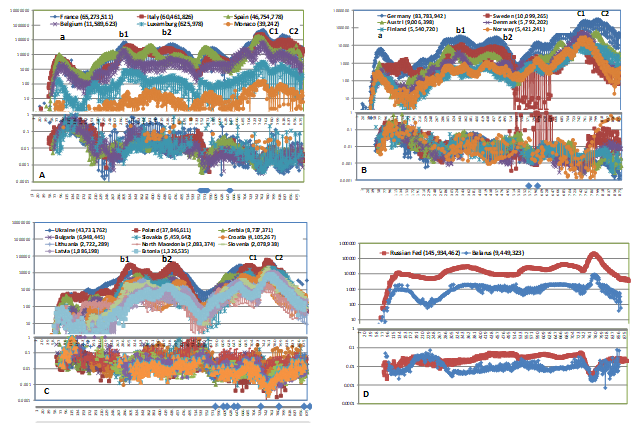
Figure 1: Epidemic curves of European countries. Days starting from the epidemic start (3 January 2021) till date when 50% of the population received two or more vaccine doses are indicated by symbol ◆ in the bottom of panels and shown in parenthesis after country name below: Monaco (560), France (585), Spain (638), Italy (646), Belgium (656), Luxemburg (787) for panel A; Denmark (571), Norway (600), Finland (608) Austria (643), Germany (647) and Sweden (673) for panel B; Ukraine (787), Poland (681), Serbia (886), Bulgaria, Slovakia (742), Croatia (642), Lithuania, North Macedonia, Slovenia (606), Latvia (653) and Estonia (582) for panel C. Neither Russian Federation nor Belarus (panel D) attained vaccination coverage >50% by May 2022. N.B. the date of attainment of vaccination >50% is continuously updated.
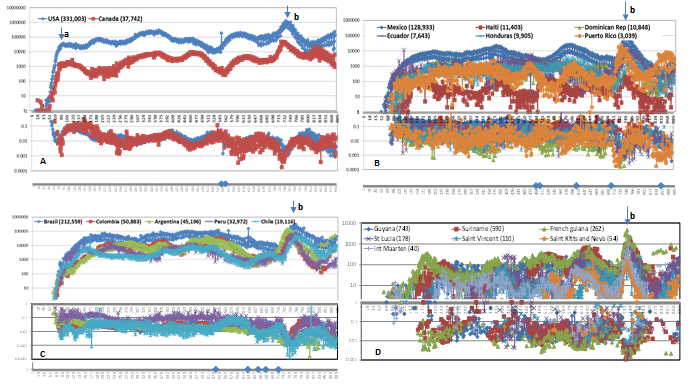
Figure 2: Epidemic curves of European countries. Days starting from the epidemic start (3 January 2021) till date when 50% of the population received two or more vaccine doses is indicated by symbol ◆ in the bottom of panels and shown in parenthesis after country name below: USA (563) and Canada (628) for panel A; Dominican Rep (492), Haiti(503), Ecuador (607), Mexico (706), Honduras (848), Haiti (2.1% as of 6 June 2022), Puerto Rico for panel B: and Chile (534), Argentina (619), Brazil (657), Peru (673), and Columbia (716) for panel C; Guyana, Suriname, French Guinea, St. Lucia, St. Vincent, St. Kitts and Nevis for panel D. N.B. the date of attainment of vaccination >50% is continuously updated.
In America (Figure 2), United States of America (USA) and Canada in North America (panel A), Mexico, Haiti, Dominican Republic, Ecuador, Honduras and Puerto Rico in Central America (panel B), and Brazil, Colombia, Argentina, Peru and Chile in South America (panel C) respectively constituted a group. Peak b was shared by all the countries but peak a was shared only by USA and Canada. Panel D shows plots for small-sized Latin American countries; the overall shape of their plots resembled that of Central American countries in panel B.
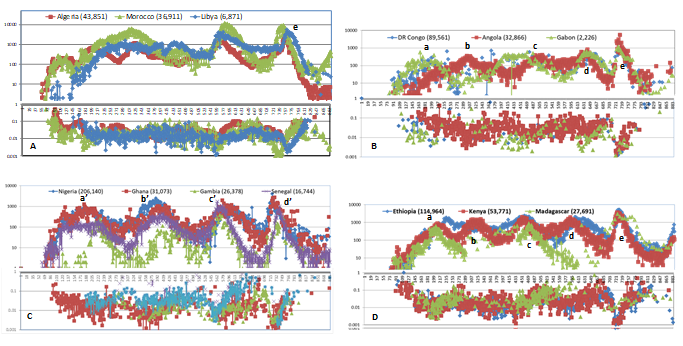
In Africa (Fig. 3), Democratic Republic of Congo, Angola and Gabon in Middle Africa (panel B) and those of Ethiopia and Kenya in Eastern Africa and Madagascar (Southern Africa) (panel D) had five peaks a, b, c, d and e, while Nigeria, Ghana, Gambia and Senegal in Western Africa (panel C) had four peaks, a’, b’, c’ and d’. Middle Africa and Southern Africa (panels A and D) are geographically close.
All the above data indicated that epidemic curves of COVID-19 epidemic were synchronized among nearby countries. The synchronization was probably brought about by frequent comings and goings. In Europe and America, epidemic curves of more populated countries run above those of less populated countries (cf. population size shown in parenthesis after country name) indicating that the number of the patients was proportional to the population size throughout the course of the epidemic.
Vaccination and Epidemic Curves
COVID-19 vaccine was introduced towards the end of
2020, i.e., around day 360 after the start of the epidemic. Date when 50% of the population received two vaccine doses is shown by symbol ◆ in the bottom of the figures and also in parenthesis after country name in figure legends. If the vaccine prevented transmission of SARS-CoV2 or prevented deaths due to the infection, the plots of the patients (P) or the number of the deaths divided by the number of the patients (D/P) should shift downward after completion of the vaccination. In Europe and America, the number of the patients did not decrease after the vaccination and D/P had decreased to ~0.01 by day 250, far ahead of the vaccination. In Africa, where vaccine coverage (two doses) was less than 50% throughout the epidemic (Coronavirus (COVID-19) Vaccinations - Our World in Data; https://africacdc.org/ covid-19-vaccination/), D/P had decreased to <0.01 by day 250 (Figure 3). Thus, impact of vaccination on COVID-19 epidemic has been limited [5]. It is probably because COVID-19 epidemic involves quasi-species and vaccine developed against to one major variant may not be able to neutralize some minor variants.
Synchronization
According to Pikovsky A, et al. [6], to call a phenomenon synchronization, we must be sure: (a) we analyze the behavior of self-sustained oscillators; (b) the systems adjust their rhythms due to weak interaction, and (c) the adjustment of rhythms occurs in a certain range of systems’ mismatch; if the frequency of one oscillator is slowly varied, the second system follows this variation. As for COVID-19 epidemic, (a) the epidemic is self-sustained through evolution as quasi- species (1), (b) there is weak interaction among nearby countries through movement of variant viruses accompanied by people’s movement, and (c) when people’s movement from country A to country B slows down, the movement from country B to A usually slows down.
References
-
Yoshikura H (2022) Synchronization of COVID-19 Epidemic among Different Prefectures and Different Age Groups in Japan. Epidemol Int J 6(S1): 000S1-019.
-
Jary A, Leducq V, Malet I, Marot S, Frutos EK, et al. (2020) Evolution of viral quasispecies during SARS-CoV-2 infection. Clin Microbiol Infect 26(11): 1560.e1-1560.e4.
-
Wassenaar TM, Wanchai V, Buzard G, Ussery DW (2022) The first three waves of the Covid-19 pandemic hint at a limited genetic repertoire for SARS-CoV-2. FEMS Microbiology Reviews 46(3): fuac003.
-
Sun F, Wang X, Tan S, Dan Y, Lu Y, et al. (2021) SARS-CoV-2 Quasispecies Provides an Advantage Mutation Pool for the Epidemic Variants. Microbiol Spectr 9(1): e0026121.
-
Yoshikura H (2021) Epidemic Curves of COVID-19 Unaffected by Vaccination. Epidemol Int J 5(4): 000209.
-
Pikovsky A, Rosenblum M, Kurths J (2003) Synchronization: a universal concept in nonlinear sciences. Cambridge University Press, New York, USA.
- Epidemiological Surveillance and Rumors on Social Media
- Awareness and Treatment of Uncontrolled Hypertension in US Overweight/Obese Youths Aged 16–24 Years, NHANES 2021–2023
- Strengthening EPI Through Parental Engagement: Lessons from Dhaka Slums for IA-2030
- Mothers Knowledge of the Prevalence, Causes, Effects, Prevention and Control of Diarrhoea among Children in Ife East Local Government Area, Ile Ife, Osun State, Nigeria
- Covid-19 Reinfections Case Series from October 2023 to October 2024 in A General Medicine Office in Toledo (Spain)
- Water Contact! One Risk Too Many: Risk Factors Associated with Schistosoma haematobium infection in Osun State, Nigeria