
An Exploratory Study of the Perception of Forensic Science in Mumbai, Maharashtra
Forensic science is an applied science that consists of multiple scientific disciplines and is expanding exponentially. Throughout history, crime has unfortunately been a persistent issue in human society. However, as humans progressed, they developed new tools and techniques to combat criminality and impart justice, including forensic science. A survey was conducted to thoroughly assess the public's awareness and perception of forensic science, specifically their understanding of its various disciplines, sources of awareness, and their outlook on its potential as a career option. Data from 402 individuals (201 females and 201 males) was collected from the age group between 15-65 years and with educational qualifications ranging from 10th grade to Doctorate level. The questionnaire consisted of ten questions relating to the subject of forensic science. Most individuals from the population have an awareness of forensic science, its credibility in the legal system, and sources of such awareness, are mostly crime series. Responses regarding forensic science as a promising career were mostly positive, as determined by Chisquare statistical analysis of the hypothesis considered indicating a recognized potential. In the coming years, positive growth and outlook of society towards forensic science as a mainstream discipline can be observed.
Abbreviations
CA: Chartered Accountancy; FSLs: Forensic Science Laboratories; CAPFs: Central Armed Paramilitary Forces; CBI: Central Bureau of Investigation; NABL: National Accreditation Board for Testing and Calibration Laboratories.
Introduction
Forensic science is the application of various scientific principles, practices, and techniques from multiple scientific disciplines to aid in both civil litigation and criminal investigations. The term ‘forensic science’ originates from the Latin word ‘forensis’, meaning ‘in the forum’ signifying the presentation of cases in public. The field encompasses diverse forensic practitioners who possess expertise in disciplines such as fingerprinting, document examination, DNA profiling, entomology, toxicology, forensic accounting, and many more [1, 2]. The type of crime and the specific requirements of each case determine the kind of forensic practitioner needed [3, 4, 5]. It’s fascinating that in forensics, while the scientific methods used to solve crimes may vary, the underlying principles and virtues remain consistent. Every forensic scientist must adhere to the fundamental principle governing modern investigation, that is Locard’s principle of exchange: “Every contact leaves traces”. This principle emphasizes the concept of association and transfer, highlighting that whenever there is contact between two items or individuals, there will be an exchange of materials [4].
India is a country with a rapidly growing population. and so is the crime rate and innovative approaches to commit crimes. However, the number of forensic science practitioners in India is disappointing compared to the population size. This is one of the challenges faced by the country’s legal system. Another major issue is the number of pending cases, which hampers the process of justice. It’s crucial to recognize forensic science as a valuable and rewarding career option. The current study is an exploratory study that aims to assess the level of public awareness of forensic science, its various disciplines, and the different ways in which awareness is brought to people’s attention. Through this questionnaire, we tried to understand how people perceive forensic science and whether they would be interested in pursuing it as a potential career option, alongside conventional courses [6].
The present paper is a step towards forensic science as a discipline and makes a clear demarcation between what is depicted on TV (Stories of Sherlock Holmes, CID, Crime Patrol etc.) and in reality, an applied subject, a novel profession [7].
Materials and Methods
The primary objective of the study was to evaluate the level of familiarity of forensic science among residents of Mumbai, a bustling financial capital of India. A comprehensive survey was prepared to gather valuable insights into the realm of forensic science, particularly regarding its potential as a career choice. The survey was designed to be self- administered and included a well-balanced mix of open- ended and multiple-choice questions in English. Its purpose was to provoke informed opinions and understanding of various facets of forensic science. Initially comprising 30 detailed questions, the survey underwent a pilot study on a sample of 66 individuals to ensure its efficacy. Subsequently, ten pertinent questions were distilled from it, focusing on specific areas such as sources of awareness, diverse fields within forensic science, and perceptions regarding pursuing a career in this field. The survey aims to furnish valuable data and insights for individuals contemplating a career in forensic science. The survey commences with detailed instructions meticulously outlining the completion process. These instructions are provided to ensure respondents can navigate the questionnaire with ease. Once the instructions had been reviewed and understood, respondents were asked to furnish their socio-demographic information, including age, full name and academic qualifications [8].
Data collection employed a random sampling method, resulting in a sample size of 402 individuals. This sample exhibited equal representation of men and women, with 201 participants each. Furthermore, the data was categorized into five distinct age groups: 15 to 25 years, 26 to 35 years, 36 to 45 years, 46 to 55 years, and 56 to 65 years.
Results and Discussion
In the current study, 402 individuals 201, females and 201 males each from various regions of Mumbai participated. The survey collected vital social demographic information such as age and education qualification, which can help to determine any correlations with the level of awareness. The valuable data obtained has been represented through various bar graphs.
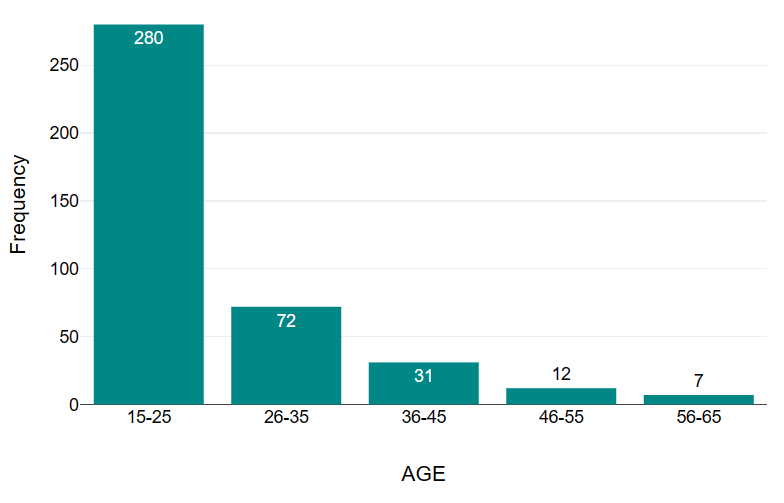
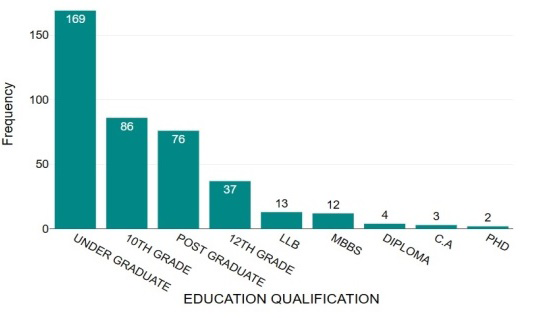
In the present study, 280 respondents belonged to the age group of 15-25, 72 from age group 26 - 35, 31 participants were from the 36-45 age group,12 were from age group 46-55 and 7 were from age group 56 to 65 as shown in Figure 1.. Out of the 402 participants surveyed, educational backgrounds varied widely: 86 had completed education up to class 10, while 37 had completed up to class 12. A significant portion, 169 individuals, had attained undergraduate qualifications, and 76 had pursued education up to the post-graduation level. Furthermore, the survey revealed diverse professional qualifications among respondents: 13 were LLB graduates, 12 had MBBS degrees, 4 had completed diploma courses, and 3 had qualifications in chartered accountancy (CA).
Impressively, two participants had achieved the highest level of academic attainment with Doctorate degrees as depicted in Figure 2 and Table 1.
| Number of Participants | ||||
|---|---|---|---|---|
| Age Groups | ||||
| 15-25 | 280 | |||
| 26-35 | 72 | |||
| 36-45 | 31 | |||
| 56-65 | 7 | |||
| Educational Backgrounds | ||||
| Up to Class 10 | 86 | |||
| Up to Class 12 | 37 | |||
| Undergraduate | 169 | |||
| Post-Graduation | 76 | |||
| Professional Qualifications | ||||
| MBBS | 13 | |||
| LLB | 12 | |||
| Diploma | 4 | |||
| Chartered Accountancy (CA) | ||||
| 3 | ||||
| Doctorate | 2 | |||
Table 1: Summarizing the Demographic and Educational Information from the Survey.
Survey Findings
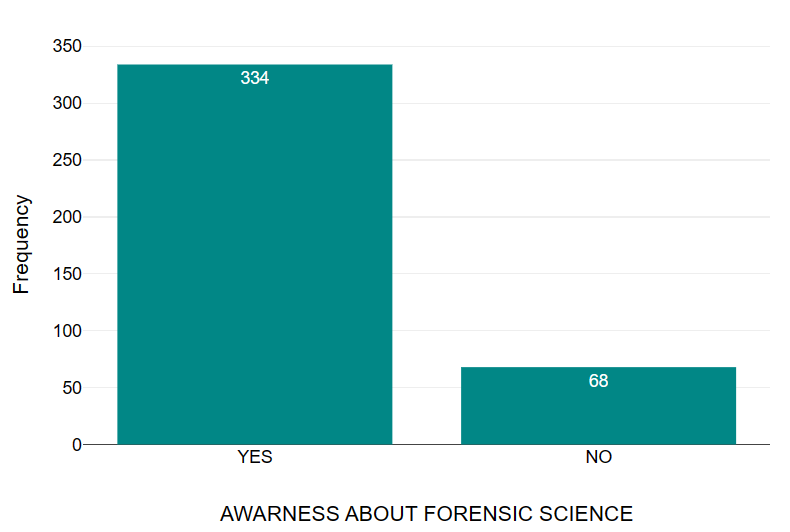
When asked to respond to statement 1 i.e. the participants’ clear understanding of forensic science by its legal definition, 334 participants responded ‘Yes’ and the rest 68 responded ‘No’, depicting non-clarity, misunderstanding, incomplete information and misconceptions about the definition of forensic science as shown in Figure 3. The calculated chi-square value was 176.0, which is significantly higher than the critical value of 3.841 at a 0.05 significance level with 1 degree of freedom as shown in Table 2. Therefore, we reject the null hypothesis of H-1, concluding that there is a significant difference between the observed and expected frequencies. The results suggest that most participants have a clearer understanding of forensic science than the expected distribution depicted in Table 3.
| Category | Observed Frequency (O1) | Expected Frequency (E1) | (O1 - E1)2 / E1 | |
|---|---|---|---|---|
| Up to Class 10 | 334 | 201 | (334 - 201)2 = 17689 | 88 |
| Up to Class 12 | 68 | 201 | (68 - 201)2 = 17689 | 88 |
| Undergraduate | ||||
| Post-Graduation | ||||
| Professional Qualifications | ||||
| MBBS | 334 | 201 | (334 - 201)2 = 17689 | 88 |
| LLB | 68 | 201 | (68 - 201)2 = 17689 | 88 |
| Diploma | ||||
| Chartered Accountancy (CA) | 3 | |||
| Doctorate | 402 | 402 | 176 |
Table 2: Observed and Expected Frequency Determination for Understanding of Forensic Science by its Legal Definition.
| Statistic | Value |
|---|---|
| Chi-Square ($\chi^2$) | 176 |
| Degrees of Freedom (df) | 1 |
| Critical Value ($\alpha = 0.05$) | 3.841 |
| Conclusion | Reject $H_0$ (Null Hypothesis) |
Table 3: Chi-Square test performed for understanding of forensic science by its legal definition.
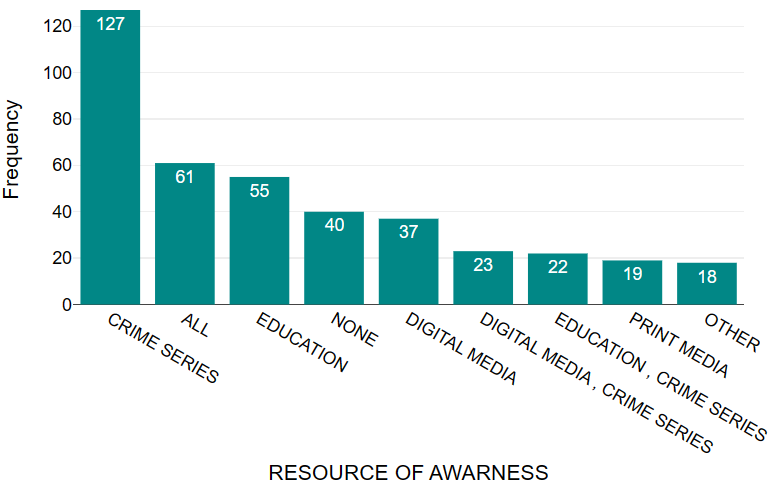
In the survey, respondents provided insights into various sources of awareness regarding forensic science. Out of the 402 participants, 127 individuals reported acquiring familiarity with forensic science through crime and thriller movies or web series. Additionally, 37 participants mentioned digital media, such as crime series, as a source of awareness, while 23 respondents cited educational media, particularly crime series. Print media was referenced by 19 participants. Formal education in forensic science was acknowledged by 55 respondents. Eighteen participants mentioned other unspecified sources of awareness. Notably,
61 respondents indicated gaining awareness from all the mentioned mediums, as depicted in Figure 4. The Chi-square test conducted assuming equal distribution, was 57.43. The calculated chi-square value was 165.93, with 6 degrees of freedom. At a 0.05 significance level, the critical value is 12.592 as shown in Table 4. Since the calculated chi-square value greatly exceeds the critical value, we reject the null hypothesis. This indicates that movies and crime series are significantly more likely to be the main sources of forensic science awareness, supporting the alternative hypothesis as shown in Table 5.
| Observed Frequency (O1) | Expected Frequency (E1) | (O1 - E1)2 | (O1 - E1)2 / E1 | |
|---|---|---|---|---|
| Movies or web series | 127 | 57.43 | 4860.84 | 84.65 |
| Digital media (crime series) | 37 | 57.43 | 422.88 | 7.36 |
| Educational media (crime series) | 23 | 57.43 | 1174.32 | 20.45 |
| Print media | 19 | 57.43 | 1494.06 | 26.01 |
| Formal education | 55 | 57.43 | 5.9 | 0.1 |
| Other sources | 18 | 57.43 | 1559.06 | 27.14 |
| All mediums | 61 | 57.43 | 12.75 | 0.22 |
| Total | 402 | 402 | 165.93 |
Table 4: Observed and Expected Frequency Determination, If Movies and Crime Series are or are not the Main Sources of Table 4: Ob
| Statistic | Value |
| Chi-Square ($\chi^2$) | 165.93 |
| Degrees of Freedom (df) | 6 |
| Critical Value ($\alpha = 0.05$) | 12.592 |
| Conclusion | Reject $H_0$ (Null Hypothesis) |
Table 5: Chi-Square Test Performed to, If Movies and Crime Series are or are not the Main Sources of Awareness of Forensic Scienc
In another question, respondents were asked about their knowledge of various disciplines within forensic science. A majority of 278 participants expressed awareness of the fingerprint domain as one of the sub-disciplines in forensic sciences. This was followed by forensic psychology, forensic biology, toxicology, questioned documents, and ballistics, with 212, 200, 116, 96, and 91 responses respectively, indicating familiarity with these sub-disciplines, as illustrated in Figure 5. The calculated chi-square value was 1299.29 as shown in Table 6, with 5 degrees of freedom. At a 0.05 significance level, the critical value is 11.070 as depicted in Table 7. Since the calculated chi-square value far exceeds the critical value, we reject the null hypothesis, indicating that fingerprinting is significantly more popular and that participants have more knowledge about it compared to other forensic science sub- disciplines. This supports the alternative hypothesis [9, 10, 11, 12, 13, 14, 15].
| Observed Frequency (O1) | Expected Frequency (E1) | (O1 - E1)2 | (O1 - E1)2 / E1 | |
| Fingerprinting | 278 | 67 | 44521 | 664.49 |
| Forensic Psychology | 212 | 67 | 21025 | 313.81 |
| Forensic Biology | 200 | 67 | 17689 | 264 |
| Toxicology | 116 | 67 | 2401 | 35.84 |
| Questioned Documents | 96 | 67 | 841 | 12.55 |
| Ballistics | 91 | 67 | 576 | 8.6 |
| Total | 993 | 402 | 1299.29 |
Table 6: Observed and Expected Frequency Determination if Fingerprinting is/ is not Significantly More Popular than Other Table 6
| Statistic | Value |
|---|---|
| Chi-Square ($\chi^2$) | 1299.29 |
| Degrees of Freedom (df) | 5 |
| Critical Value ($\alpha = 0.05$) | 11.07 |
| Conclusion | Reject $H_0$ (Null Hypothesis) |
Table 7: Chi-Square test performed for, if Fingerprinting is/ is not significantly more popular than other forensic science sub-
![Figure 5: The calculated chi-square value was 1299.29 as shown in Table 6, with 5 degrees of freedom. At a 0.05 significance level, the critical value is 11.070 as depicted in Table 7. Since the calculated chi-square value far exceeds the critical value, we reject the null hypothesis, indicating that fingerprinting is significantly more popular and that participants have more knowledge about it compared to other forensic science sub- disciplines. This supports the alternative hypothesis [9-15].](/fulltextimages/13500/fig_5.png)
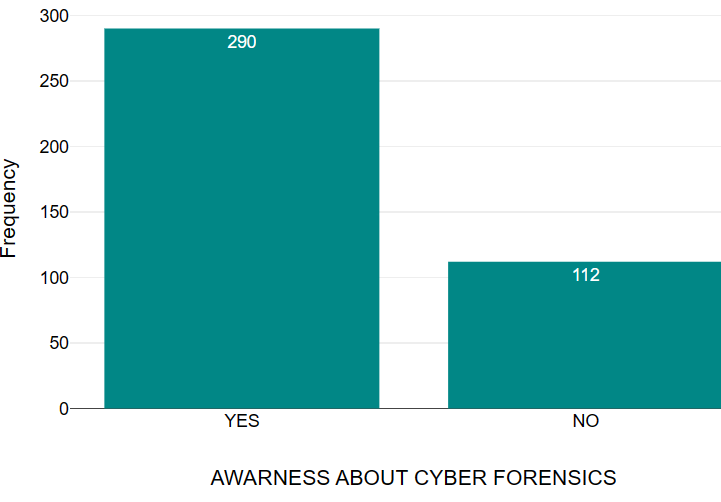
When respondents were queried about their awareness of threats in the virtual world and the role of cyber forensics in addressing virtual crimes, the aim was to gauge their understanding of cyber security issues and the potential of cyber forensics in combating virtual crimes. Results indicated that out of the 402 participants, 290 respondents demonstrated awareness of cyber forensics and cyber security issues in general. However, 112 participants either indicated no response or they lacked sufficient information or had incomplete knowledge about the domain as depicted in Figure 6. The Chi-square value was obtained as 78.8 as shown in Table 8, with 1 degree of freedom, and compared against the critical value of 3.841 at a 0.05 significance level as outlined in Table 9. Since the chi-square value was much greater than the critical value, the null hypothesis was rejected, indicating a significant difference in the awareness levels of cyber forensics and security issues. The data suggests that most of the participants are more aware of these issues than initially expected, as depicted in Table 9.
| Observed Frequency (O1) | Expected Frequency (E1) | (O1 - E1)2 | (O1 - E1)2 / E1 | |
| Respondents aware of cyber forensics & security | 290 | 201 | (290 - 201)2 = 7921 | 39.4 |
| Respondents with incomplete/no knowledge | 112 | 201 | (112 - 201)2 = 7921 | 39.4 |
| Total | 402 | 402 | 78.8 |
Table 8: Observed and Expected Frequency Determination for Respondents’ Awareness of Cyber Forensics and Cyber Security Table 8:
| Value | |
|---|---|
| Chi-Square ($\chi^2$) | 78.8 |
| Degrees of Freedom (df) | 1 |
| Critical Value ($\alpha = 0.05$) | 3.841 |
| Conclusion | Reject $H_0$ (Null Hypothesis) |
Table 9: Chi-Square Test Performed for Respondents’ Awareness of Cyber Forensics and Cyber Security Issues.
The survey uncovered a prevailing stereotype among respondents, with 297 out of 420 individuals acknowledging the perception that forensic science predominantly revolves around DNA analysis and fingerprinting, potentially overshadowing other noteworthy disciplines within the field. Conversely, 105 respondents disagreed with this notion. This finding underscores the importance of addressing and rectifying misconceptions regarding the breadth and diversity of forensic science disciplines beyond the commonly highlighted aspects of DNA analysis and fingerprinting as shown in Fig.7. The expected frequencies for both groups, assuming no difference in perception, were 210 each. The Chi-Square statistic was calculated to be 88.5 (as can be seen in Table 10) with 1 degree of freedom. Comparing this value to the critical Chi-Square value of 3.841 at a 0.05 significance level, we reject the null hypothesis. This suggests a statistically significant difference between the observed and expected responses, indicating that the stereotype of forensic science being primarily focused on DNA and fingerprinting does indeed overshadow other disciplines within the field [16].
| Observed Frequency (O) | Expected Frequency (E) | (O-E) | (O-E)² / E | |
|---|---|---|---|---|
| Agree (Forensic science revolves around DNA & fingerprints) | 297 | 210 | 87 | 36 |
| Disagree (Forensic science includes other disciplines) | 105 | 210 | -105 | 52.5 |
| Total | 420 | 420 | 88.5 |
Table 10: Observed and Expected Frequencies for Understanding the Domination of DNA Analysis and Fingerprinting.
![Figure 7: The expected frequencies for both groups, assuming no difference in perception, were 210 each. The Chi-Square statistic was calculated to be 88.5 (as can be seen in Table 10) with 1 degree of freedom. Comparing this value to the critical Chi-Square value of 3.841 at a 0.05 significance level, we reject the null hypothesis. This suggests a statistically significant difference between the observed and expected responses, indicating that the stereotype of forensic science being primarily focused on DNA and fingerprinting does indeed overshadow other disciplines within the field [16].](/fulltextimages/13500/fig_7.png)
The survey also inquired about individual's opinions regarding whether they would choose or recommend forensic science as a potential career option. Out of 392 respondents, 266 expressed a positive inclination towards choosing or recommending forensic science as a career option, while 66 individuals indicated a negative stance. Additionally, 60 respondents remained neutral on the matter as shown in Figure 8. As per Table 11, the expected frequency for each group, assuming no significant difference in opinion, was 130.67. The calculated Chi-Square value of 210.26, which exceeded the critical value of 5.991 at 2 degrees of freedom, led to the rejection of the null hypothesis. This result indicates a significant difference in responses, with a notable majority positively inclined toward forensic science as a career [17, 18, 19, 20, 21, 22, 23, 24, 25, 26, 27].
| Observed Frequency (O) | Expected Frequency (E) | (O-E) | (O-E)² / E | |
|---|---|---|---|---|
| Positive Inclination | 266 | 130.67 | 135.33 | 140.02 |
| Negative Inclination | 66 | 130.67 | -64.67 | 32.02 |
| Neutral | 60 | 130.67 | -70.67 | 38.22 |
| Total | 392 | 392 | 210.26 |
Table 11: Observed and Expected Frequencies for.
![Figure 8: As per Table 11, the expected frequency for each group, assuming no significant difference in opinion, was 130.67. The calculated Chi-Square value of 210.26, which exceeded the critical value of 5.991 at 2 degrees of freedom, led to the rejection of the null hypothesis. This result indicates a significant difference in responses, with a notable majority positively inclined toward forensic science as a career [17-27].](/fulltextimages/13500/fig_8.png)
Conclusion
As illustrated in Figure 3, the study offers a comprehensive understanding of the awareness levels among the selected population regarding the significance of forensic science in the judicial system. Conducted on a sample population, the study encompassed participants from various backgrounds, notably including students in the 10th and 12th grades, as well as undergraduates, falling within the age bracket of 15 to 25 years. This diverse representation ensures a holistic assessment of perceptions and understanding regarding the utility of forensic science within the judicial system. The data indicates that a significant majority of respondents, particularly teenagers and young adults, possess a clear understanding of the importance of forensic science in the legal system. These findings carry considerable implications for forensic science, signalling a burgeoning interest and acknowledgement of its potential among the youth. This trend is promising for educators and practitioners alike, suggesting a steady influx of young talent who may be inclined to tackle the challenge of solving intricate criminal cases using modern scientific methodologies. Such enthusiasm and recognition among the younger generation bode well for the future advancements and applications of forensic science in addressing complex legal challenges.
According to the study’s findings, a significant number of individuals rely on crime series as their primary source of information, including matters related to forensic science, due to the increasing digitalization of media. While this phenomenon is intriguing, it also raises concerns regarding the accuracy of the information individuals are exposed to. The portrayal of forensic science in such media is often incomplete, superficial, and misleading, contributing to misconceptions about the subject. Consequently, there is a pressing need for reliable information on forensic science to help individuals cultivate a more nuanced and accurate understanding of the field. Educators, media professionals, and forensic experts play pivotal roles in providing accurate information and debunking misconceptions surrounding forensic science, thereby fostering a more informed public discourse on the subject.
The field of forensic science often faces the misconception that it primarily revolves around DNA analysis and fingerprinting, relegating other disciplines to a lesser status. However, in reality, all fields within forensic science carry nearly equal weight based on their scientific validity and reliability. It’s noteworthy that a majority of individuals from the selected sample do not hold such misconceptions. Hence, it’s crucial to recognize the multifaceted nature of forensic science and the contributions that each of its constituent fields makes towards achieving a comprehensive and accurate understanding of legal and criminal cases. When asked about forensic science as a career option, people expressed varied opinions, with many respondents showing positivity, followed by some negative and neutral responses. Interestingly, there was only a slight difference between the neutral and negative responses. Those who gave neutral responses often cited a lack of complete knowledge about the field as the reason for their stance. Overall, there was an acknowledgement of forensic science as a potential career option, indicating a growing interest and recognition of the field’s potential among respondents.
When asked about the potential of forensic science as a career path, respondents offered a range of opinions, spanning from positive to negative, with a smaller portion expressing a neutral stance. Despite this variation, the majority of feedback leaned towards the positive side, closely followed by negative feedback, with minimal disparity between the neutral and negative responses. In India, a career in forensic criminology requires a combination of specialized education, practical training, and qualifications across multiple disciplines. There are around 80 colleges and universities offering forensic science courses across the country, including 54 private and 22 government institutions. These institutions provide degree, diploma, and certificate programs; however, there is a growing need for universities to introduce specialized master’s courses that focus on distinct fields within forensic science, such as fingerprints, toxicology, DNA analysis, forensic anthropology, forensic biology, serology, and questioned documents. Currently, a few universities offer training in some of these areas at the master’s level. However, limited specialized faculty, infrastructure, and laboratories often make it challenging to provide comprehensive training across all major forensic subfields. Including these degrees and diplomas in the recruitment and promotion rules for Forensic Science Laboratories (FSLs) and Fingerprint Bureaux could significantly enhance job prospects for graduates and boost expertise within forensic roles in India’s justice system. Such specialized graduates should also receive consideration in recruitment for the Police and Central Armed Paramilitary Forces (CAPFs) [28].
Basic qualifications for forensic positions vary depending on the sector. In medical colleges and post-graduate institutes specializing in medical education and research, personnel are typically required to hold MBBS and MD degrees. For roles in FSLs, MSc and PhD degrees in forensic science or related disciplines are standard, often alongside relevant experience as outlined in recruitment guidelines. Medicolegal responsibilities in medical colleges and hospitals fall under the Ministry of Health and Family Welfare, whereas forensic laboratories operate under the Ministry of Home Affairs, with oversight varying by state between home departments and police departments. Fingerprint analysis, in particular, is typically handled by Fingerprint Bureaux under police jurisdiction, although some FSLs, including those operated by the Central Bureau of Investigation (CBI) and certain state laboratories, handle fingerprint work within crime investigations. These institutions also contribute to the training and development of personnel across the criminal justice system, including police officers, prosecutors, judiciary members, and medical officers [29].
To become a forensic criminologist in India, professionals must engage in a carefully structured education pathway and seek out hands-on training opportunities, which are often provided through internships in central and state forensic laboratories or specialized forensic programs. Accreditations, such as those provided by the National Accreditation Board for Testing and Calibration Laboratories (NABL), and field-specific certifications can further boost credibility. Additionally, forensic scientists need a combination of technical expertise, communication skills for court presentations, and ethical integrity to ensure accurate and impartial contributions to the justice system. This multi- layered approach equips forensic criminologists to meet the rigorous demands of their field and advance their careers within India’s legal and investigative frameworks [28]. Overall, there was widespread recognition of forensic science as a promising career opportunity among the surveyed individuals.
References
-
Grover N, Tyagi I (2014) Development of Forensic Science and Criminal Prosecution-India. International Journal of Scientific and Research Publications 4(12): 1-7.
-
Elizabeth DS (2008) Ancient science and Forensic. In Embarseddon A and Pass AD (Eds.), Forensic Science, Salem Press.
-
Lawless C (2022) Forensic Science: A Sociological Introduction, In: 2nd (Edn.), Routledge, London, UK, pp: 1-166.
-
Houck MM, Siegel JA (2009) Fundamentals of forensic science, In: 2nd (Edn.), Academic Press, USA, pp: 1-680.
-
Bell S (2008) Crime and circumstance: investigating the history of forensic science, In: 1st (Edn.), Bloomsbury Publishing, USA.
-
Cole SA (2004) History of fingerprint pattern recognition, In Automatic fingerprint recognition systems, Springer, New York, pp: 1-25.
-
Berry J (1991) The history and development of fingerprinting, in Advances in Fingerprint Technology. In: Lee HC and Gaensslen RE (Eds.), New York: Elsevier, pp: 1-38.
-
Laufer B (1912) History of the Finger-Print System. Washington: Government Printing Office.
-
Xiang-Xin Z, Chun-Ge L (1988) The historical application of hand prints in Chinese litigation. Journal of Forensic Identification 38(6): 277-284.
-
Song C (1981) The Washing Away of Wrongs: Forensic Medicine in Thirteenth-Century China. University of Michigan Press.
-
Benecke MARK (2008) A brief survey of the history of forensic entomology. Acta Biologica Benrodis 14: 15-38.
-
Wennig R (2000) Threshold values in toxicology-useful or not?. Forensic Science International 113(1-3): 323-
-
Somanathan A, Mathur K (2017) Evolution of Forensic Toxicology. Toxicology International (Formerly Indian Journal of Toxicology) 24(2): 133-139.
-
Michaleas SN, Veskoukis AS, Simonis G, Pantos C, Androutsos G, et al. (2022) Mathieu Joseph Bonaventure Orfila (1787-1853): The Founder of Modern Toxicology. MæDica 17(2): 532-537.
-
Schüller Pérez A (2003) Life and work of Mateo Orfila [Mateo Orfila: a biography]. Annals of the Royal National Academy of Medicine (Madrid).
-
Ramón Bertomeu-Sánchez J, Nieto-Galan A (2006) Chemistry, medicine, and crime: Mateu J.B. Orfila (1787- 1853) and his time. Sagamore Beach: Science History Publications.
-
Bertomeu-Sánchez JR (2009) Popularizing controversial science: a popular treatise on poisons by Mateu Orfila (1818). Medical History 53(3): 351-378.
-
Miller G (1943) An Autograph Letter of Orfila. Bulletin of the History of Medicine 13(3): 320-327.
-
Myers RO (1961) 2-Mathieu Joseph Bonaventure Orfila (1787-1853). Medicine Science and the Law 1(2): 179- 185.
-
Beeson BB (1930) Orfila: Pioneer Toxicologist. Annals of Medical History 2(1): 68-70.
-
Bertomeu Sánchez JR (2004) Mateu Orfila i Rotger (1787- 1853): Science, medicine, and crime in the nineteenth century. Contributions to Science 2(4): 565-578.
-
Pandey S (2022) Aspect of Forensic Science in Criminal Investigation: Admissibility in the Indian legal System.
-
Shukla RK (2021) A new systematic approach of teaching and learning of forensic science for interdisciplinary students: A step towards renovating the forensic education system. Forensic Science International: Synergy 3: 100146.
-
Romanos P (2022) Public awareness of forensic science: A cross sectional study in Lebanon. International Research Journal of Science Technology Education Management 2(1).
-
Mateen RM, Tariq A, Ahmed GN, Afnan A, Rukhsana P (2021) Public Awareness of Forensic Science and Willingness to Contribute to the DNA Database: A Study in Pakistan. Forensic Genomics 1(4): 113-117.
-
(2023) CID (Indian TV series)
-
Chandra G, Sharma R (2023) Admissibility of Forensic Evidence in Investigations: A Comparative Study Between India, UK & USA. Journal of Legal Studies & Research 9(5): 154-168.
-
Kathane P, Singh A, Gaur JR, Krishan K (2021) The development, status and future of forensics in India. Forensic Science International: Reports 3: 100215.
-
(2017) Report of the Comptroller and Auditor General of India, performance audit of modernisation and strengthening of Police Forces. Comptroller and Auditor General of India, Government of Uttar Pradesh, pp: 1-177.
- Forensic Implications of Adverse Drug Reactions in Schizophrenia A Case Series
- Narcotics and Digital Forensics: Bridging Crimes in the Digital Age
- Ethics in Forensic Psychiatry: Principles, Dilemmas, and Human Rights
- Impact of Acute Stress on Attentional Orienting to Social Cues
- Head Injury and Intracranial Hemorrhage in Western Region of Libya
- A Forensic Study on Handedness: Examination of Handwriting Features in Right and Left Handed Writers