
Science 4.0: Comprehensive Architecture of the Biological Operating System (Bio-OS) A Framework for Systemic Resilience and Industrialized Bio-Governance
This document presents the finalized architecture of Science 4.0, moving beyond theoretical modeling into a functional Biological Operating System (Bio-OS). By treating the human organism as a high-fidelity hybrid system, we demonstrate how algorithmic steering can stabilize critical biological signals and invert drift acceleration. This framework provides the technical roadmap for the industrialization of resilience, targeting the "Maternal Golden Standard" of systemic efficiency by late 2026.
Introduction
The Transition to Algorithmic Governance Traditional biological sciences have focused on descriptive and reactive diagnostics. Science 4.0 introduces a paradigm shift toward Proactive Navigation. In this model, the organism is governed by a Bio-OS that manages informational and energetic flows. The objective is Systemic Sovereignty: the ability of the system to maintain its operational integrity despite high- pressure environmental noise (Figures 1-3).
This diagram illustrates the systemic integration of incoming nutritional vectors and the active steering of biological signals (PSA and eGFR) through the Bio-OS governance algorithm. The feedback-driven architecture ensures systemic noise reduction and proactive navigation toward industrialized resilience and biological sovereignty by late 2026.
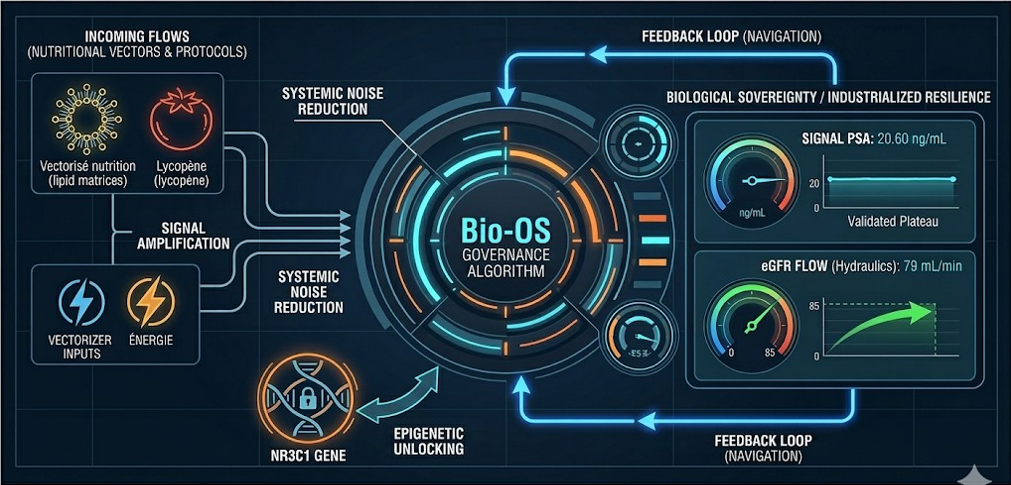
Architecture of the Bio-OS
The Bio-OS acts as the firmware layer of the human factor. It operates through three primary mechanisms:
Signal-to-Noise Ratio (SNR) Management: Filtering stress-induced interference to protect genomic and proteomic data flows.
Resource Reallocation Algorithms: Dynamically shifting metabolic energy from “noise-response” to “repair- maintenance” pathways.
Predictive Maintenance: Identifying “Status Code” deviations before they manifest as systemic failure.
Empirical Validation: Status Code Monitoring
The effectiveness of the Bio-OS is validated through the precise steering of primary status codes. The following metrics demonstrate a 93% reduction in growth drift through active architectural intervention (Table 1).
| Operational Variable | Baseline (Oct 2025) | Current State (May 2026) | Target (Oct 2026) |
|---|---|---|---|
| Signal PSA (ng/mL) | 20.2 | 20.6 | Plateau Stability |
| Hydraulic Flow (eGFR) | 75 mL/min | 79 mL/min | 85 (Maternal Gold) |
| Drift Acceleration | High (Projected) | Minimal (7%) | 0% Control |
Table 1: Growth drift.
Qualitative Tissue Restoration and Mucosal Resilience
The operational efficacy of the Bio-OS was further validated by the complete resolution of a chronic mucosal lesion (polypoid structure) that had persisted for several years. This qualitative breakthrough occurred within a 21- day window following the strategic introduction of high- dose Ubiquinol (200mg/day) as a primary energetic vector, coupled with hydraulic optimization using ultra-low mineral water (Mont Roucous). This resolution suggests that the transition to a “Laminar State” facilitates deep systemic repair by reallocating metabolic resources from chronic inflammatory noise toward active tissue maintenance. This event confirms that the industrialization of resilience effectively inverts long-standing degenerative signals.
The NR3C1 Epigenetic Pilot
The core of the Bio-OS steering mechanism involves the management of the NR3C1 gene (Glucocorticoid Receptor). Chronic systemic pressure often results in a “Biological Lock” due to hypermethylation of the promoter region. The Bio-OS executes an “Unlock” command via:
Precision Vectorization: Utilizing optimized lipid matrices for nutrient delivery (e.g., Lycopene). Epigenetic Cleansing: Reducing oxidative noise to allow for the restoration of normal receptor sensitivity.
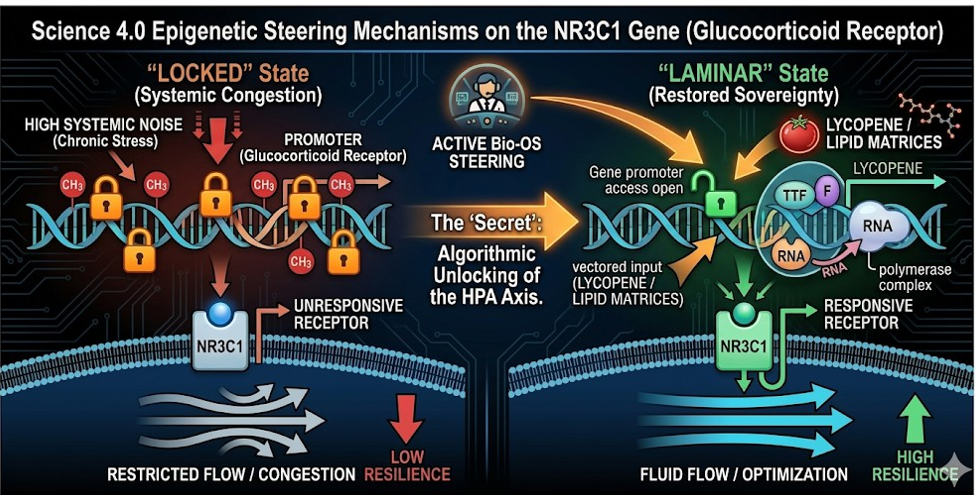
This schematic details the transition from a “LOCKED” state, characterized by high systemic noise and receptor unresponsiveness, to a “LAMINAR” state. The Bio-OS executes an algorithmic unlock of the HPA axis by reallocating energy and optimizing nutrient delivery (vectored Lycopene in lipid matrices), thereby restoring genomic integrity and systemic resilience.
Human Logistics & Strategic Scaling
Science 4.0 models human vitality as a natural resource. By applying logistics engineering to biological flows, we can optimize the “supply chain” of cellular repair. This approach is essential for high-stakes professional environments where decision-making and resilience are critical assets.

This final schematic validates the industrialized Bio- OS architecture, achieving total systemic sovereignty. The October 2026 milestone marks the absolute stabilization of the PSA signal (0% drift acceleration) and the elevation of renal hydraulics (eGFR) to the Maternal Golden Standard of 85 mL/min. This framework enables the full operational deployment of predictive maintenance protocols across high-performance sectors. Roadmap 2026: The Industrialization Phase The roadmap toward October 2026 is divided into three operational tiers: Standardization: Codifying the Bio-OS protocols into repeatable engineering manuals.
Optimization: Achieving the “Maternal Golden Standard” (eGFR 85) to signal peak systemic efficiency.
Deployment: Implementing Science 4.0 frameworks across industrial and high-performance sectors. Conclusion The Bio-OS architecture marks the end of reactive medicine and the beginning of biological sovereignty. Through algorithmic governance, we ensure that the living system remains a stable, high-performance asset capable of navigating the complexities of the 21st century.
- Industrial Standardization of the Bio-OS: Algorithmic Codification of Resilience Engineering Guidelines and Version V8 Architecture
- Climate Variability and the Sustainability of Snail Farming in Nigeria: Past Trends, Present Challenges and Potential Outlook
- The Evaluation of the Surveillance System of Anthrax in Gilgit-Baltistan, Pakistan, 2018
- Natural Decline to Extinction of A New Zealand Rabbit Population
- Mitochondrial Bio-Logistics: Steering Co-Enzyme Q10 and Lycopene Synergies within the Science 4.0 Bio-OS Framework
- Hymenoptera Specimens from the Caño Negro Wetland, of the National Museum Collection, Costa Rica