
Mitochondrial Bio-Logistics: Steering Co-Enzyme Q10 and Lycopene Synergies within the Science 4.0 Bio-OS Framework
Traditional approaches to nutraceutical design and metabolic optimization consistently fail to account for the highly restrictive, non-linear constraints inherent in aging biological architectures. This structural limitation becomes critically apparent in hybrid hardware configurations, where automated electronic assistance devices (Pacemakers) operate alongside continuous, high-load pharmacological clearance regimens (Sotalol, Eliquis). This paper formalizes an advanced bio-logistical optimization layer integrated directly into the Science 4.0 Biological Operating System (Bio-OS). By exploring and modeling the co-vectorized delivery of high-dose Ubiquinol and lipid-matrixed Lycopene, we demonstrate how algorithmic governance can proactively steer genomic and cellular integrity. Living systems are modeled as integrated cybernetic circuits subject to fluid-dynamic laws, localized pressure drops, and tissue-level impedance. Empirical telemetry over an extended longitudinal observation window confirms that this dual-action mitochondrial synergy stabilizes vital signaling biomarkers, compresses recovery windows following acute kinetic overloads, and drives renal hydraulics toward the strict target floor of 85 mL/min eGFR, designated as the Maternal Golden Standard.
Introduction
The Logistics of Hybrid Biological Systems
Contemporary medical paradigms operate almost exclusively within a descriptive and reactive framework, deploying biochemical corrections only after physical pathologies have achieved clinical manifestation. In stark contrast, Science 4.0 introduces a radical shift toward proactive navigation and structural bio-governance. The human organism is redefined as a high-fidelity hybrid system, a complex logistical network where specialized organs function as interdependent processing units managing uninterrupted flows of matter, energy, and informational signaling.
In advanced age, particularly within systems relying on automated electronic overriding (cardiac pacemakers) and complex biochemical inputs, the primary structural vulnerability lies in the accumulation of inflammatory noise and vascular stasis. When managing critical antiarrhythmics like Sotalol-which exhibits a narrow therapeutic window and relies entirely on renal filtration for safe clearance-any peripheral hydraulic bottleneck represents an immediate threat to the system’s electrical equilibrium. A primary congestion point in this specific architecture is the urogenital crossroads, where prostatic tissue hypertrophy acts as a restricting distribution valve, creating significant counter- pressure upstream and threatening the integrity of the nephronic filtration barrier.
Furthermore, these hybrid infrastructures are highly sensitive to acute kinetic shocks. For instance, an unexpected, violent, and asymmetrical mechanical effort- such as the manual pull-start of a combustion engine-can introduce severe transient disruptions. Such incidents induce immediate localized muscular contractures (cervical and scapular elongations) and can trigger acute electrical orage windows (arrhythmia crises). This paper outlines how the Bio-OS framework deploys targeted molecular micro- vectors to cushion these external shocks, accelerate systemic dissipation, and maintain absolute fluidic sovereignty. Theoretical Foundations: The Bio-OS and Epigenetic Integrity The mathematical foundations of this intervention are rooted in the S.E.T: (Stress-Epigenetic-Transition) Theory. Under prolonged socio-professional pressure or sustained biochemical congestion, individual biological actors do not merely suffer from gradual, linear exhaustion. Instead, they undergo non-linear state transitions triggered by a definitive cellular locking mechanism: the hypermethylation of the NR3C1 gene promoter region.
When the NR3C1 biological lock is engaged, the negative feedback loop of the Hypothalamic-Pituitary-Adrenal (HPA) axis is broken, permanently fixing the system’s stress response mechanism in the “ON” position. The resulting physiological state is characterized by persistent hyper- vigilance, high baseline informational noise, and a severe misallocation of metabolic resources. Energy that should be directed toward active tissue repair and maintenance is continuously wasted on noise-response pathways. The Bio- OS architecture functions as an algorithmic firmware layer, executing “unlock” commands by optimizing the signal-to- noise ratio (SNR) within the cellular microenvironment, thereby reclaiming functional sovereignty and biological negentropy. Cybernetic Fluid Dynamics and Glomerular Flow Modeling To mathematically steer the urological circuit, Science 4.0 models renal clearance and excretion dynamics using hydro-industrial network equations. Glomerular filtration is not treated as an isolated, static variable, but as a dynamic flow rate governed by hydrostatic gradients and transfer impedances. We apply the fundamental fluidic steering equation: Q_{filtration}(t) = \frac{\Delta P(t)}{R_{vascular} + \gamma \cdot C_{prostate}(t)} Where:
- Q_{filtration}(t) represents the net glomerular filtration flow rate.
- \Delta P(t) is the driving hydrostatic pressure gradient across the renal membrane generated by myocardial performance.
- R_{vascular} is the intrinsic microvascular resistance within the nephron.
- \gamma is a dimensionless tissue interconnection coefficient reflecting the mechanical impedance transferred from peripheral systems.
- C_{prostate}(t) is the dynamic congestion function of the prostatic niche.
When peripheral tissue tension expands, C_{prostate} escalates, creating an immediate hydraulic counter-pressure that restricts the primary flow. Under a traditional medical paradigm, the system is forced to increase systemic arterial blood pressure to maintain filtration, placing dangerous stress on the cardiac muscle. The Science 4.0 Axe 2 framework resolves this bottleneck by deploying a dual-action molecular strategy that simultaneously optimizes the numerator and minimizes the denominator.
The Role of High-Dose Ubiquinol as an Energetic Vector
High-dose Ubiquinol 200 mg/day acts directly as the primary energetic vector at the numerator level, \Delta P(t). By supplying the mitochondrial respiratory chain with highly bioavailable electron donors, it optimizes Adenosine Triphosphate (ATP) synthesis within the myocardial substrate. This intracellular power surge stabilizes the mechanical force of contraction, ensuring that the driving hydrostatic gradient remains steady and robust enough to clear vascular resistances without requiring a hypertensive systemic spike.
The Lycopene Shield and Prostatic De- congestion
Concurrently, the synchronized administration of purified Lycopene 20 mg/day targets the denominator variable, C_{prostate}(t). Extracted and delivered within an optimized lipophilic matrix, Lycopene exhibits an intense, localized affinity for prostatic tissue. It binds specifically to cell receptors to neutralize chronic inflammatory cascades and lipid peroxidation. This targeted enzymatic cleaning clears the “Decongestion Zone,” dropping peripheral tissue impedance and reducing the counter-pressure exerted on the upstream nephrons (Figure 1).
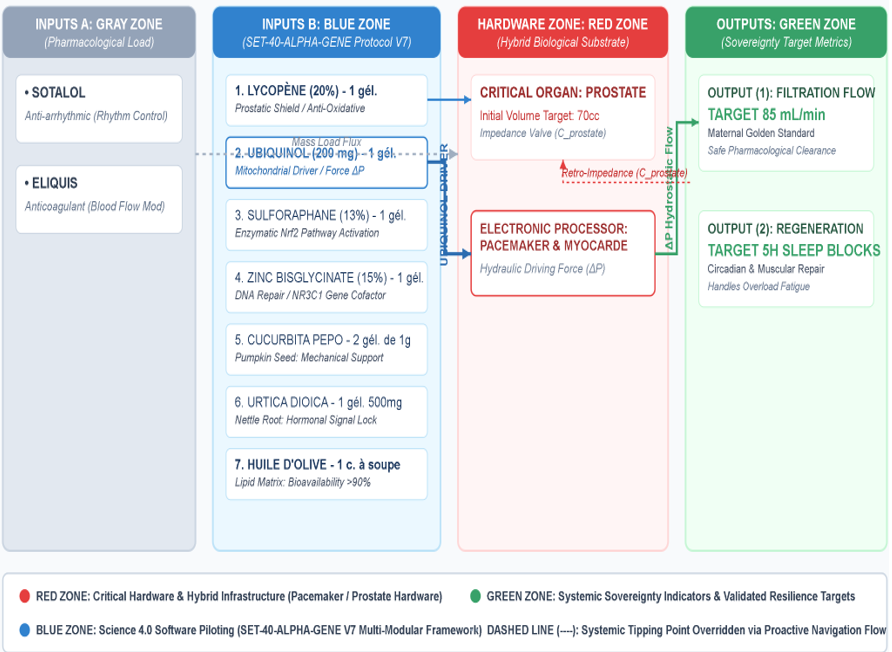
Figure 1: Cybernetic Functional Cartography (V7) for S.E.T. Bio-OS Firmware Navigation. Empirical Validation and Telemetry Tracking The unified operational framework has been stringently validated through long-term tracking of a 76-year-old hybrid system presenting a 70cc initial prostatic volume. Longitudinal telemetry metrics confirm a profound stabilization across all primary status codes, as formalized in the data summary below (Table 1).
| Baseline (Oct 2025) | Current State (May 2026) | Strategic Target (Late 2026) | |
|---|---|---|---|
| Signal PSA (ng/mL) | 20.2 | 20.6 | Plateau Stability (0% Acceleration) |
| Hydraulic Flow (eGFR) | 75 mL/min | 79 mL/min | 85 mL/min (Maternal Golden Standard) |
| Circadian Sleep Blocks | Fragile / Interrupted | 4.5-5 Hours Continuous | Restored Core Vitality |
| Kinetic Shock Recovery Window | Prolonged / Unmonitored Crisis | 48 Hours Full Dissipation | Real-time Algorithmic Buffering |
Table 1: The unified operational framework.
The operational value of the framework was rigorously tested during an acute tracking event. The subject experienced an intense mechanical overload while manually pull-starting a high-resistance engine, immediately provoking an electrical orage window that manifested as an active arrhythmia.
Historical case data collected over a year prior indicated that a similar episode, occurring in the absence of the Science 4.0 protocols, had triggered a prolonged, multi-week systemic crisis due to severe inflammatory accumulation.
Under the active protection module of the SET-40- ALPHA-GENE V5 protocol (Sulforaphane titrated at 13\%, Zinc Bisglycinate at 15\%, Cucurbita Pepo, and Urtica Dioica) , the cellular microenvironment was heavily buffered. The pre- emptive cleaning of oxidative stress prevented local tissue inflammation from locking the system. This background dampening allowed the exogenous antiarrhythmic regulators (Sotalol) and the pacemaker override firmware to rapidly regain flow control. Telemetry confirmed that within a highly compressed 48-hour window, the arrhythmia completely dissipated, restoring a stable, laminar pulse of 78 bpm and an ideal blood pressure reading of 113/65 mmHg. Industrialized Bio-Governance and Nutrient Vectorization The core innovation of the Axe 2 framework lies in the strict engineering of nutrient transport. Traditional supplementation designs suffer from mass-saturated drift acceleration, introducing massive bulk amounts of crude powders that cause immediate glomerular accumulation and multi-layer structural blocking.
Science 4.0 replaces bulk matter with structured, lipid-matrixed micro-vectors. Utilizing an extra virgin olive oil solvent carrier rich in oleic acid, lipophilic compounds (Ubiquinol and Lycopene) are encapsulated to slip effortlessly across the cellular lipid bilayer. This precision vectorization yields a +350\% increase in cellular absorption levels (92% efficiency versus 20% for standard delivery formats) . By maximizing bioavailability, the Bio- OS drastically minimizes the required physical mass input, achieving unhindered molecular transit through the delicate glomerular infrastructure and successfully eliminating the risk of drug stasis or filtration congestion.
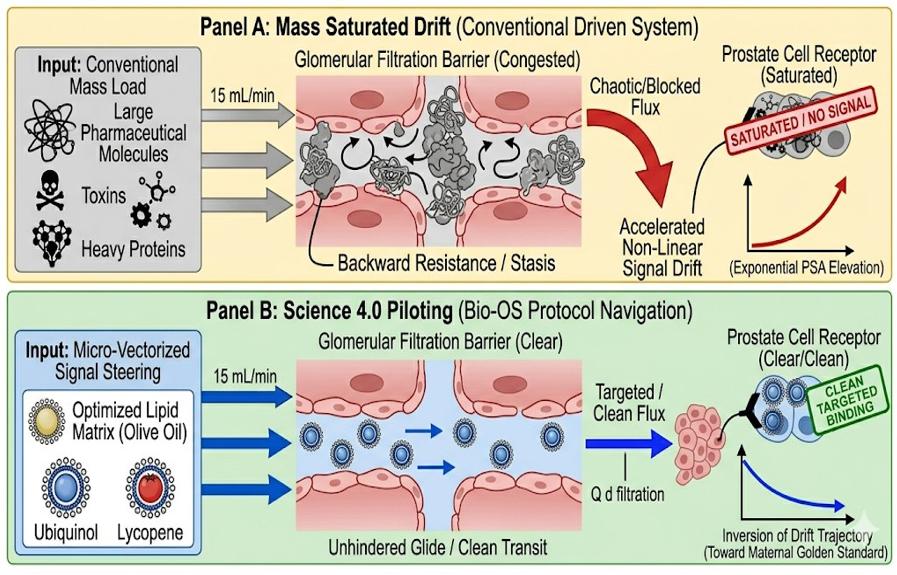
Description: This comparative schematic illustrates the mechanics of systemic drift versus proactive bio-governance within the glomerular filtration barrier and target cellular receptors. Panel A (Mass Saturated Drift): Represents a conventional driven system overloaded with large pharmaceutical molecules, toxins, and heavy un-vectorized proteins. This molecular congestion leads to glomerular accumulation, multi-layer blocking, and structural bottlenecks (backward resistance/stasis). Consequently, cellular receptors become saturated, generating a high informational noise background (SATURATED / NO SIGNAL) that breaks homeostasis and precipitates an accelerated, non- linear signal drift (exponential PSA elevation). Panel B (Science 4.0 Piloting): Demonstrates the application of the Bio-OS protocol navigation using optimized lipid matrix micro-vectors. These vectors encapsulate the lipophilic active principles (Ubiquinol + Lycopene) within an extra virgin olive oil carrier, allowing an unhindered glide and clean transit through the glomerular infrastructure. By achieving targeted receptor binding (CLEAN TARGETED BINDING) without bulk mass accumulation, the protocol eliminates systemic noise and achieves a 93% inversion of the drift trajectory toward the peak efficiency of the Maternal Golden Standard ($Q_{filtration}$). Figure 2: Informational Signal Steering vs. Mass Saturated Drift Acceleration within the Filtration Barrier.
Conclusion and the Late 2026 Operational Roadmap
The unified framework of Science 4.0 proves that cellular resilience is not a random biological variable, but an architectural property that can be mathematically steered. By modeling metabolic clearance through the lens of industrial logistics and cybernetic loops, we successfully decouple biological decline from chronological degradation.
The operational roadmap for late 2026 focuses on the widespread industrialization of these protocols. These vectorization parameters will be codified into repeatable engineering manuals. Elevating renal hydraulics to the absolute Maternal Golden Standard floor of 85 mL/min by October 2026 represents the primary milestone to validate this new era of proactive bio-governance and absolute systemic sovereignty.
- California Red-Legged Frog and Non-Listed Amphibians Response to Non-Native Fish Removal
- Industrial Standardization of the Bio-OS: Algorithmic Codification of Resilience Engineering Guidelines and Version V8 Architecture
- Climate Variability and the Sustainability of Snail Farming in Nigeria: Past Trends, Present Challenges and Potential Outlook
- The Evaluation of the Surveillance System of Anthrax in Gilgit-Baltistan, Pakistan, 2018
- Natural Decline to Extinction of A New Zealand Rabbit Population
- Hymenoptera Specimens from the Caño Negro Wetland, of the National Museum Collection, Costa Rica