
California Red-Legged Frog and Non-Listed Amphibians Response to Non-Native Fish Removal
The California Red-legged Frog (Rana draytonii) is a federally threatened species that is declining in its range. Additionally, other Amphibians are declining in distribution, and researchers attribute these declines to the presence of exotic predators. For nearly 150 years, the introduction of non-native fish into California livestock ponds has been prevalent. The impact of these releases has been damaging to native frogs. Pond restoration efforts aimed at eradicating non-native fish can reverse this trend by improving habitat conditions that support the California Red-legged Frog's recovery goals. Following the removal of Largemouth Bass (Micropterus salmoides) and Bluegill (Lepomis macrochirus) from a permanent livestock pond at Pleasanton Ridge Regional Park in the fall of 2022, the location started supporting native amphibians the following spring. For the first time since 2016, when systematic annual surveys began, adults and larvae of the Pacific Chorus Frog (Pseudacris regilla) and California Newt (Taricha torosa) started inhabiting the pond (2023 to 2026). Adult California Red-legged Frogs colonized the site two years later (2024 to 2026) and have increased by more than 4-fold. This new site-specific information on the California Red-legged Frog and native Amphibian responses to exotic fish removal in a central California rangeland will inform recovery efforts to preserve and manage habitat for this threatened species.
Introduction
In many terrestrial ecosystems, amphibians comprise a large part of the vertebrate biomass and thus are vital elements in ecosystems [1]. However, in the past decades, herpetologists worldwide have reported that frog, toad, and salamander populations are declining [2]. The extent of this decline varies among regions and species [3]. But in North America and the USA, these declines are more frequently documented in the West [4]. For example, in California’s Sierra Nevada mountains, Drost, et al. [5] described the serious decline of five species of frogs and toads near the Yosemite area. Additionally, multiple species decreases have been documented in California’s Central Valley [6].
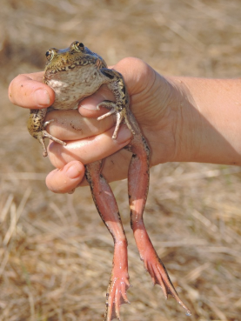
The California Red-legged Frog (Rana draytonii) is a moderately large ranid frog with adults ranging in size from 116 mm to 138 mm SVL [7]. It was once abundant in central California, ranging from the coast to the Sierra Nevada foothills, and is now listed as a federally threatened species [8]. California’s official state amphibian (Figure 1) typically inhabits permanent and seasonal water sources (streams, lakes, marshes, natural and human-made ponds, and ephemeral drainages) in valley bottoms and foothills up to 1,500m in elevation [9, 10]. California’s largest native frog has disappeared from over 70% of its historical range [10, 11]. Major factors contributing to this decline include habitat loss, habitat fragmentation, and introduction of the invasive Bullfrog (Lithobates catesbeiana) [12, 13]. In addition, for nearly 150 years, the introduction of non-native fish into livestock ponds [14, 15] has been damaging to native California frogs [16, 17, 18].
The Pacific Chorus Frog (Pseudacris regilla) is relatively small, with adults ranging in size from 26 mm to 51 mm SVL [7], and is the classic example of an anuran habitat generalist, occupying a wide range of environments, ranging from sea-level brackish marshes to above timberline, mountain meadows [19]. This non-listed species is frequently found in ponds, streams, springs, lakes, and reservoirs in open grasslands, woodlands, forests, and parks in suburban areas [19]. This frog typically breeds from January through July by attaching egg clusters to vegetation in shallow ponds, streams, roadside ditches, and marshes [19]. Following the introduction of predatory non-native fish, local declines have been reported for this non-listed species [7].
The California Newt (Taricha torosa) is a moderately sized salamander (101 mm SVL, 225 mm TL) [7], that is typically associated with woodlands that are intermixed with grasslands and chaparral [19]. This species was once one of the most abundant salamanders throughout the coastal range of California, but is now listed as a California Species of Special Concern [19]. The loss of upland foraging and retreat habitat, coupled with the loss of breeding sites (ponds, creek pools), has greatly reduced its population [19]. Additionally, they are threatened due to the introduction of non-native predators (such as Mosquitofish and Green Sunfish) [7].
Exotic species, also called alien species, are non-native members of a community. Ecological systems around the world are characterized by native assemblages of organisms uniquely adapted to their environments. The introduction of non-native species disrupts this natural balance by altering interactions among species. For example, the Opossum Shrimp (Mysis relicta), introduced into Montana lakes in the 1960’s, added a trophic level, ultimately resulting in less food for the Bald Eagle (Haliaeetus Leucocephalus) [20]. Often, alien species directly compete with or prey upon native species, thereby reducing their abundance or causing localized expiration. The introduction of exotic, non-native species is the second-most important reason for biodiversity loss [20]. Among the known and possible human causes of amphibian declines is the introduction of competitors, and especially predatory fish [1].
The Bluegill (Lepomis macrochirus) is one of the most abundant members of the Sunfish Family (Centrarchidae) in California, and is extremely prolific, capable of producing up to 50,000 eggs per female [21]. Coupled with this high reproductive rate, excellent nest and young protection, broad diet selection, and consuming any available aquatic food, they are capable of rapidly expanding in the warm-water habitats where they are introduced [21]. The Largemouth Bass (Micropterus salmoides) is one of the most popular warm-water game fish in North America. This piscivorous fish (total length of 75 cm and max weight of 9.7kg) occupies the role of top predator, eating whatever fits into its mouth, in many of the aquatic systems it occupies [21]. The longstanding recommendation of planting both non-native Bluegill and Largemouth Bass into agricultural ponds and reservoirs was to produce a recreational fishery composed of large, catchable, tasty fish species [21].
The USFWS recovery plan for the California Red-legged Frog calls for further research to determine the precise impacts on the species [22], including pond restoration efforts to promote the reestablishment of a California Red-legged population in each core area of the species historic range where the species is currently not present, and preserve habitat requirements for connectivity, re- colonization, and adequate dispersal for the species. This work informs recovery plan data gaps and answers the need for further studies proposed by Fisher RN, et al. [12, 13, 22] on the negative impacts of introducing predatory fish on native amphibian species.
Materials and Methods
The study was carried out at the PrPnd 035 (37°38’3.33”N Lat., 121°56’2.76”W Long.), a permanent livestock pond a part of the Pleasanton Ridge Regional Park, a wildlands area located along Sunol Ridge in Alameda County, California, that is owned and operated by the East Bay Regional Park District. This lentic environment (0.17 acre) is situated between the transition of oak woodland and grassland, which drains into the Stonybrook Creek Watershed. This site is within the California Red-legged Frog critical habitat unit ALA-1B [23].
Surveys were conducted for all life stages of the California Red-legged Frog from 2016 to 2026, during the months of January through August, using the U.S. Fish and Wildlife Service California Red-legged Frog habitat assessment and protocol-level survey guidelines [24]. During these assessments, binoculars (10 x 42 mm) were used to search the pond bank, water, floating and emergent vegetation, and woody debris, to locate adult California Red-legged Frogs or egg masses [25]. Due to staffing limitations, the sampling effort varied from the typical California Red-legged Frog protocol-level survey in that the pond was annually surveyed only once for the presence of larval amphibians (from mid-May to mid-June). The pond was sampled using D-shaped (radius 23cm), long-handled dipnets with 1/8th inch (3.2mm) mesh [25]. Dipnet sweeps consisted of moving a net 1.5m through representative portions of aquatic features, thus sampling 28 liters of larval amphibian habitat per sweep [25]. To minimize the disturbance of pond flora and fauna, sampling ceased after 10 dipnet sweeps [25]. Data recorded included all life stages of the California Red-legged Frog, Pacific Chorus Frog, and California Newt observed, the number of individuals observed, and size classes.
The pond restoration effort that occurred in September 2022 included a dewatering operation using screened and filtered pumps. Dewatering bags were connected to the pumps to prevent sediment from entering the waterway. The contents of the dewatering bags were emptied onto a sediment removal site, and the used bags were disposed of at the appropriate facility. A qualified biologist with all necessary permits was on-site during the dewatering activities, and no amphibians were encountered requiring translocation to a nearby pond. More than 350 Largemouth Bass and Bluegill were removed from this permanent livestock pond. With the winter rain of 2023, the pond reformed to its original size. Amphibian population data that were collected preceding and following the restoration action were obtained using the methods described above. To compare the effects of the pond management action on native Amphibians before (2016 to 2022) and after (2023 to 2026) the restoration, trend lines (R2 values) were calculated for each species.
Results
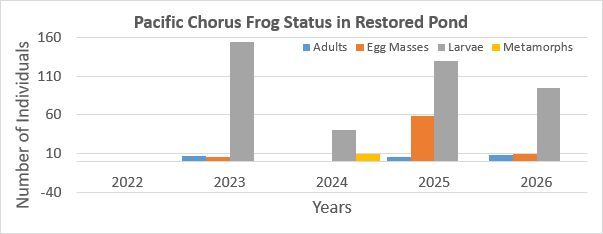
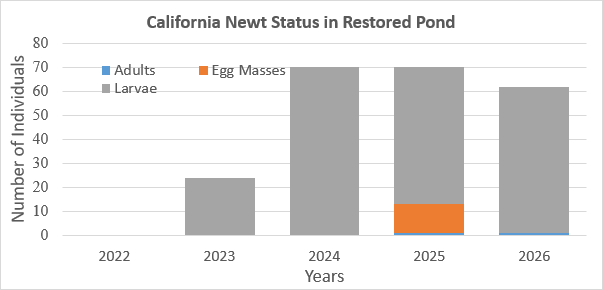
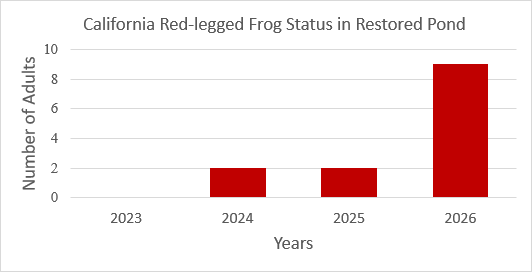
The non-listed Pacific Chorus Frog started inhabiting and breeding successfully in the pond following the removal of non-native fish from the livestock pond, for the first time, during the spring of 2023, and continues to show a significant population increase (Figure 2, R2 = 0.88). Likewise, the species of special concern, California Newt, started inhabiting and breeding in the pond in the spring of 2023, and shows a significant population increase following the restoration action described above (Figure 3, R2 = 0.71). Lastly, the federally threatened California Red-legged Frog colonized the restored pond, now devoid of predatory fish, two years later, in the spring of 2024, presumably started breeding as their population had increased by more than four-fold (Figure 3, R2 = 0.75).
Discussion
Anthropogenic alterations to the environment, like climate change [26], habitat destruction and fragmentation [27], are having significant, negative effects on biodiversity [28]. Species invasion is of particular interest for the conservation of native species and communities when an organism is introduced beyond its natural range. Known variously as exotics, aliens, invaders, non-natives, or nonindigenous. There are many examples of the disastrous invasions by such species, resulting in native species losses, community structure changes, and even alteration of the physical system [29]. Non-native species introduction is hypothesized to be the leading cause of animal extinction worldwide [30].
Introduced fishes have caused the local extinction of various amphibian populations, presumably by eating the tadpoles [3]. For example, in California’s Sierra Nevada Mountain lakes, several introduced salmonid fishes caused the extinction of the Mountain Yellow-legged Frog (Rana muscosa) populations [31]. Likewise, the introduction of the Mosquitofish (Gambusia affinis), which eats newt larvae, is likely responsible for the decline of the California Newt from streams in the Santa Monica Mountains of southern California [32].
As pointed out by Morrison [33], restoration efforts aimed at improving the conditions for native species should be judged by how successful wildlife species respond to such attempts. According to Rowe, et al. [34], the benefits of restoration may increase over time due to system stability and generation succession. The positive trend of increasing numbers of federally listed threatened (California Red-legged Frog), state-listed species of special concern (California Newt), and non-listed (Pacific Chorus Frog), reported here, once non-native predatory fish were removed from a livestock pond, is consistent with those reported by Alvarez, et al. [35]. Restorative efforts such as these may have increased benefits over time because frogs born in a certain pond are likely to remain and have offspring of their own in the same location. Tatarian [36] reported that most tagged frogs in her study did not migrate from their source pool over two seasons. Additionally, Feller, et al. [37] reported that the median distance of movement away from breeding ponds for the California Red-legged Frog was 150m, while some made long-distance movements of up to 1400m. As inferred by Bulger, et al. [9], Amphibian breeding sites should take priority in our restoration planning because they will allow the species to recover in population size.
While numerous documented declines and disappearances in frog, toad, and salamander populations worldwide remain unexplained, and many hypotheses have been proposed, the current thinking by a majority of scientists suggests there are probably many interactions causing these losses [38]. Restoration efforts aimed at improving pond hydroperiod [25] and the removal of predatory, non-native fish [35] are successful strategies at improving habitat conditions for California’s state-listed (California Newt), non-listed (Pacific Chorus Frog), and support the USFWS recovery goals for the federally threatened California Red- legged Frog [22, 39].
Conclusion
Achieving the proper balance between scientific certainty, management actions, and species preservation will continue to be challenging in the future. This research clearly provides a framework for helping to inform pond restoration efforts in Central California Rangelands and promoting the long-term survival of the native amphibian species.
Acknowledgments
Survey efforts and equipment were largely funded by the Regional Parks Foundation, Alameda County Fish & Wildlife Commission, and the California Department of Fish and Wildlife. I would also like to express our sincere gratitude to the following individuals who helped make this work possible: N Beadle, D Bell, J Dorcy, A Dwyer, J Geoghegan, S Gidre, T Groff, N Hector, S Lockett, C Newell, T Noonan, M Orcutt, M Peixoto, S Pinell, B Wainwright, and D Chauncey Walls. This work was conducted in accordance with the terms and conditions of U.S. Fish and Wildlife Service permit #TE-817400-13 and the California Department of Fish and Wildlife permit #SC-2298, and California Department of Fish and Wildlife – Permit to Destroy Harmful Species of Fish in Private Waters for Management Purposes.
References
-
Stebbins RC, Cohen NW (1995) A Natural History of Amphibians. Princeton University Press, Princeton, New Jersey, USA.
-
Phillips K (1994) Tracking the Vanishing Frogs: An Ecological Mystery. St. Martin’s Press, New York, USA.
-
Pough FH, Robins AM, Cadle JE, Crump ML, Savitzky AH, et al. (2001) Herpetology. In: 2nd (Edn.), Prentice Hall, Upper Saddle River, New Jersey, USA
-
Corn PS (1994) “What we know and don’t know about amphibian declines in the West,” Sustainable Ecological Systems: Implementing an Ecological Approach to Land Management. In: Covington WW, DeBano LF (Eds.), USDA Forest Service, Rocky Mountain Forest and Range Experiment Station, Ft. Collins, Colorado. General Technical Report RM-247, pp: 59-67.
-
Drost CA, Feller GM (1996) Collapse of regional frog fauna in the Yosemite area of the California Sierra Nevada, USA. Conservation Biology 10(5): 414-425.
-
Fisher RN, Shaffer HB (1996) The decline of amphibians in California’s Great Central Valley. Conservation Biology 10(5): 1387-1397.
-
Hansen RW, Shedd JD (2025) California Amphibians and Reptiles. Princeton University Press, Princeton, New Jersey, USA.
-
U.S. Fish and Wildlife Service (USFWS) (1996) Endangered and threatened wildlife and plants: determination of threatened status for the California Red-legged Frog. Federal Register 61 (101): 25813- 25833.
-
Bulger JB, Scott NJ, Seymour RB (2003) Terrestrial activity and conservation of adult California Red-legged Frogs (Rana aurora draytonii) in coastal forests and grasslands. Biological Conservation 110: 85-95.
-
Jennings MR, Hayes MP (1994) Amphibian and reptile species of special concern in California. Final Report to the California Department of Fish and Game pp: 255.
-
Hayes MP, Jennings MR (1988) Habitat correlates of distribution of the California Red-legged Frog (_Rana_ _aurora draytonii_) and the Foothill Yellow-legged Frog (_Rana boylii_): implications for management. In Proc Proceedings of the symposium on the management of amphibians, reptiles, and small mammals in North America. United States Department of Agriculture, Forest Service, General Technical Report (GTR0-166), pp: 144-245.
-
Fisher RN, Shaffer HB (1996) The decline of amphibians in California’s Great Central Valley. Conservation Biology 10: 1387-1397.
-
Hayes MP, Jennings MR (1986) Decline of ranid frog species in western North America: are Bullfrogs (_Rana_ _catesbeiana_) responsible?. Journal of Herpetology 20: 490-509.
-
Lawler SP, Dritz D, Strange T, Holyoak M (1999) Effects of introduced Mosquitofish and Bull Frogs on the threatened California Red-legged Frog. Conservation Biology 13: 613-622.
-
Curtis B (1942) The general situation and the biological effects of the introduction of alien fishes into California waters. California Fish and Game 28: 2-8.
-
Moyle PB (1976) Fish introductions in California: history and impact of native fishes. Biological Conservation 9(2): 101-118.
-
Bradford DF (1989) Allotropic distribution of native frogs and introduced fish in the high Sierra Nevada lakes of California: implications of the negative effects of introductions. Copeia pp: 775-778.
-
Knapp RA, Matthews KR (2000) Non-native fish introductions and the decline of the Mountain Yellow- legged Frog from within protected areas. Conservation Biology 14: 428-438.
-
Stebbins RC, McGinnis SM (2012) Field Guide to Amphibian and Reptiles of California. University of California Press, Berkeley, California, USA.
-
Mader SS (2014) Inquiry into Life. McGraw-Hill Companies, Inc., New York, USA.
-
McGinnis SM (1984) Freshwater Fish of California. University of California Press. Berkeley, California, USA.
-
U.S. Fish and Wildlife Service (USFWS) (2002) Recovery Plan for the California Red-legged Frog (_Rana aurora_ _draytonii_). U.S. Fish and Wildlife Service, Portland, Oregon, USA, pp: 17.
-
U.S. Fish and Wildlife Service (USFWS) (2010) Endangered and threatened wildlife and plants; revised designation of critical habitat for the California Red- legged Frog; Final Rule. Federal Register 75(51): 12816- 12959.
-
U.S. Fish and Wildlife Service (USFWS) (2005) Revised guidance on site assessments and field surveys for the California Red-legged Frog. pp: 25.
-
Riensche DL, Tutino CD, Koenig L (2019) California Red- legged Frog Response to Pond Restoration. Western Wildlife 6: 45-49.
-
Thomas CD, Cameron A, Green RE (2004) Extinction risk from climate change. Nature 427: 145.
-
Brooks TM, Mittermeier RA, Mittermeier CG (2002) Habitat loss and extinction in the hotspots of biodiversity. Conservation Biology 16: 909-923.
-
Amore AD, Hemingway V, Wasson K (2009) Do a threatened native amphibian and its invasive congener differ in response to human alteration of the landscape?. Biological Invasions 12: 145-154.
-
Meffe GK, Carroll CR (1997) Principles of Conservation Biology. In: 2nd (Edn.), Sinauer Associates, Inc. Publishers. Sunderland, Massachusetts, USA.
-
Clavero M, Garcia-Berthou E (2002) Invasive species are a leading cause of animal extinction. Trends in Ecology and Evolution Journal 20(3): 110.
-
Bradford DF, Tabatabai F, Graber DM (1993) Isolation of remaining populations of the native frog Rana mucosa, by introduced fishes in Sequoia and Kings Canyon National Parks, California. Conservation and Biology 7(4): 882-888.
-
Gamradt SC, Kats LB (1996) Effects of introduced crayfish and mosquitofish on California newts. Conservation Biology 10(4): 1155-1162.
-
Morrison ML (2002) Wildlife Restoration: Techniques for Habitat Analysis and Animal Monitoring. Island Press, Washington DC, USA.
-
Rowe JC, Garcia TS (2014) Impacts of wetland restoration efforts on an amphibian assemblage in a multi-invader community. Wetlands 34: 141-153.
-
Alvarez JA, Dunn C, Zurr A (2002) Response of the California Red-legged Frogs to predatory fish removal. Transactions of the Western Section of the Wildlife Society 38(39): 9-12.
-
Tatarian PJ (2008) Movement patterns of California Red- legged Frogs (_Rana draytonii_) in an inland California environment. Herpetological Conservation and Biology 3(2): 155-169.
-
Feller GM, Kleeman PM (2007) California Red-legged Frog (_Rana draytonii_) movement and habitat use: implications for conservation. Journal of Herpetology 41: 276-286.
-
Pechmann JHK, Wake DB (1997) Declines and Disappearance of Amphibian Populations in Principles of Conservation Biology. In: 2nd (Edn.), Meffe GK, Carroll CR (Eds.), Sinauer Associates, Inc. Publishers. Sunderland, Massachusetts, USA Pages 135-137.
-
Thomson RC, Wright AN, Shaffer HB (2016) California Amphibian and Reptile Species of Special Concern. California Department of Fish and Wildlife, University of California Press, Oakland, California.
- Industrial Standardization of the Bio-OS: Algorithmic Codification of Resilience Engineering Guidelines and Version V8 Architecture
- Climate Variability and the Sustainability of Snail Farming in Nigeria: Past Trends, Present Challenges and Potential Outlook
- The Evaluation of the Surveillance System of Anthrax in Gilgit-Baltistan, Pakistan, 2018
- Natural Decline to Extinction of A New Zealand Rabbit Population
- Mitochondrial Bio-Logistics: Steering Co-Enzyme Q10 and Lycopene Synergies within the Science 4.0 Bio-OS Framework
- Hymenoptera Specimens from the Caño Negro Wetland, of the National Museum Collection, Costa Rica