
Climate Variability and the Sustainability of Snail Farming in Nigeria: Past Trends, Present Challenges and Potential Outlook
Climate variability poses significant challenges to the sustainability of agricultural enterprises, particularly climate-sensitive micro-livestock systems such as snail farming. This study examines the implications of climate variability for snail production in Nigeria using annual time-series data spanning 2000–2024. The analysis employed the Augmented Dickey-Fuller (ADF) unit root test, Autoregressive Distributed Lag (ARDL) model, Error Correction Model (ECM), Dynamic Ordinary Least Squares (DOLS), and Mann–Kendall trend analysis to evaluate both long-run and short-run relationships among climatic and socio-economic variables. The ARDL bounds test produced an F-statistic of 6.08, confirming a stable long-run equilibrium relationship among snail output, rainfall, temperature, wages, population, and relative humidity. Long-run estimates revealed that rainfall significantly reduced output (β = -3.051, p < 0.05), while wages (β = 0.287, p < 0.01) and relative humidity (β = 0.188, p < 0.01) enhanced production. The ECM coefficient (-1.185, p < 0.01) indicated rapid adjustment toward equilibrium following short-run shocks. Trend analysis further showed that snail production increased from approximately 18,000 tonnes in 2000 to over 46,000 tonnes in 2024. Diagnostic tests confirmed model robustness, while DOLS estimates validated the ARDL findings. The study concludes that moisture-related climatic factors are critical determinants of sustainable snail production and recommends climate-smart management practices, improved drainage systems, and humidity regulation strategies to enhance resilience and productivity in Nigeria's heliciculture sector.
Introduction
Agriculture remains one of the most climate sensitive sectors of the global economy providing food, income, employment and livelihoods for billions of people around the world. Agricultural production in the developing world, particularly in Sub-Saharan Africa, is extremely dependent on climate. As a result, the industry is extremely vulnerable to changes in temperature, humidity, precipitation and extreme weather. Recent studies from Intergovernmental Panel on Climate Change (IPCC) show that climate variability and climate change continue to increase production risks [1, 2, 3, 4, 5, 6, 7, 8, 9, 10], threaten food security and sustainable agricultural growth in sensitive parts of the world. Concerns about the long-term viability of agricultural systems, especially in countries with low capability for adaptation, have been raised by increasing frequency of heat waves, droughts, floods and erratic rainfall patterns.
Nigeria is highly vulnerable to climate variability given its reliance on rain-fed agriculture and a growing population. In recent decades, the country experienced many major climatic disruptions such as rising temperatures, unpredictable rainfall patterns, extended dry seasons, flooding and worsening environmental degradation [11, 12]. These developments have impacted on the country’s food security, rural livelihoods and agricultural output. Empirical studies show that climate variability significantly impacts agricultural productivity through its effects on soil moisture, water availability, insect and disease prevalence, and biological productivity [13, 14, 15, 16, 17, 18]. There is increasing demand to understand the nature and extent of climate impacts on different agricultural businesses so that effective adaptation and resilience measures can be developed.
There has been a lot of attention on the effects of climate variability on major food crops like rice, maize, cassava and sorghum. But non-conventional livestock businesses have received relatively little attention even though they are contributing more and more to agricultural diversification and nutritional security. Helliculture (snail farming) has become a successful and sustainable agricultural venture in many parts of Nigeria. Snail farming has several advantages such as low start-up capital requirement, low land requirement, high reproductive potential and growing market demand. Moreover, snail meat is a very desirable delicacy due to its high protein level, low fat content, iron, calcium, magnesium, essential amino acids and medicinal properties [3, 8]. These characteristics are such that snail farming can serve as a major alternative source of animal protein that can help low-income households to improve their nutrition and food security.
However, snail farming is still highly dependent on environmental factors despite its economic and nutritional importance. Snails are extremely sensitive to climatic conditions owing to the direct influence of temperature, rainfall and atmospheric humidity on their feeding habits, development, reproduction, metabolism and survival. Adverse weather can cause dormancy, reduce feeding efficiency, increase mortality and inhibit productivity, but sufficient humidity stimulates activity, reproduction and weight gain. Too much rain can create poor environmental conditions such as flooding, loss of habitat and increased incidence of disease. The unpredictability of climate, therefore, offers opportunities and risks for sustainable snail production [19, 20, 21, 22, 23, 24, 25, 26].
Methodologically, research on snail farming in Nigeria has centred on profitability analysis, production constraints, management practices, and socioeconomic characteristics of farmers. Most of these studies are based on cross-sectional survey approaches, budgetary analysis or descriptive statistics that cannot capture dynamic adjustment processes and long-run equilibrium linkages related to climate variability. Therefore, there is still a scarcity of scientific information on the interactions of socio-economic and climatic factors over time that affect snail production. This methodological gap hampers the generation of evidence- based policies that can support climate-resilient snail farming systems [27, 28, 29].
In view of this, this study investigates the effect of climate variability on the sustainability of snail farming in Nigeria using the annual time series data of 2000-2024. The study specifically applies the Autoregressive Distributed Lag (ARDL) model, Error Correction Model (ECM), Dynamic Ordinary Least Squares (DOLS) and Mann–Kendall trend analysis to investigate the effects of rainfall, temperature, relative humidity, wages and population on snail output. The study contributes to the growing body of knowledge on climate-resilient agriculture, agricultural diversification and sustainable livestock growth by providing empirical data on the dynamic relationships between climatic conditions and snail production. The results will be useful to the policy makers, researchers, extension agencies and private investors interested in improving the sustainability, productivity and resilience of snail farming in Nigeria.
The broad objective of this study is to examine the influence of climate variability on the sustainability of snail farming in Nigeria. The specific objectives are to: (i) Determine the effects of rainfall, temperature, and relative humidity on snail production in Nigeria. (ii) Examine the long-run equilibrium relationship between snail production and its climatic and socio-economic determinants. (iii) Evaluate the short-run adjustment dynamics of snail production in response to climatic variations. (iv) Provide policy recommendations for promoting climate-resilient and sustainable snail farming practices in Nigeria.
Materials and Methods
Study Area and Population of the Study
The study adopts a national perspective, with Nigeria as the unit of analysis. The population consists of annual time-series data on snail production and its major climatic and socio-economic determinants from 2000 to 2024. Important variables are snails output, rainfall, temperature, relative humidity, wages and population. The study uses a comprehensive data set covering the entire nation, allowing it to observe long-term trends, climatic variations and structural changes affecting snail production and thus providing a holistic framework to analyse the association of climate variability and heliciculture sustainability in Nigeria.
**Data Collection**
This study used only secondary data collected from credible national and international sources. Data on snail production and socio-economic indicators were sourced from the National Bureau of Statistics (NBS), Food and Agriculture Organization (FAO) and other relevant publications while climatic variables such as rainfall, temperature and relative humidity were obtained from the Nigerian Meteorological Agency (NiMet) and recognised climate databases. Data were harmonised into an annual time-series covering the years 2000-2024. When necessary, variables were transformed to natural logarithms to stabilise the data and allow for elasticities interpretation.
**Data Analysis**
The study used a combination of descriptive and econometric techniques to analyse the relationship between climate variability and snail production in Nigeria. The Augmented Dickey-Fuller (ADF) test was used to check the stationarity of variables and the trend was assessed by the Mann-Kendall test. The Autoregressive Distributed Lag (ARDL) approach with Bounds Test was used to analyse the long-run equilibrium relationships and the Error Correction Model (ECM) was utilised to model the short-run adjustment dynamics. Dynamic Ordinary Least Squares (DOLS) estimation was used to check robustness of long-run estimates. Also, the diagnostic tests such as Breusch-Godfrey LM test, Breusch–Pagan test, Jarque–Bera test and Ramsey RESET test were conducted to check the adequacy of the model and to make the estimated results reliable.
Model Specification
In the short-run, the ARDL model is expressed as
$$\Delta ln(Output_t) = \alpha_0 + \sum_{i=1}^{q} \alpha_i \Delta ln(Output_{t-i}) + \sum_{j=0}^{q} \beta_j \Delta X_{t-j} + \lambda ECM_{t-1} + u_t$$
(1)
$$\Delta ln(Output_t) = snail production/output) at time . (tonnes)$$
$$\alpha_0 = \text{Intercept term (constant)}, \text{ capturing the average change in output not explained by other variables}$$
$$\alpha_i = \text{Short-run dynamic coefficients of the lagged dependent variable, measuring the persistence of output changes.}$$
$$p = \text{Optimal lag length for the dependent variable.}$$
$$\Delta ln(Output_{t-1}) = \text{Lagged changes in output, capturing short-run adjustment dynamics.}$$
$$\beta_j = \text{Short-run coefficients of the explanatory variables.}$$
$$X_t = \text{Vector of independent variables (e.g., temperature, rainfall, prices, income, labor).}$$
$$\Delta X_{t-1} = \text{Lagged changes in explanatory variables, reflecting short-run effects on output.}$$
$$q = \text{Optimal lag length for the explanatory variables.}$$
$$\lambda = \text{peed of adjustment parameter, indicating how quickly deviations from long-run equilibrium are corrected. (Expected to be negative and statistically significant.)}$$
$$ECM_{t-1} = \text{Error Correction Term (lagged residual from the long-run relationship), representing the extent of disequilibrium in the previous period.}$$
$$= \text{White noise error term, assumed to be independently and identically distributed with zero mean and constant variance. In the long-run, the ARDL snail output-input relationship is specified as:}$$
$$ln(Output_t) = \beta_0 + \beta_1 ln(Rainfall_t) + \beta_2 ln(Temp_t)$$
$$+ \beta_3 ln(Wages_t) + \beta_4 ln(Pop_t) + \beta_5 RH_t + \beta_6 Shock_t + \varepsilon_t$$
(2)
where: Natural logarithm of total output (e.g., snail production) at time t; represents the dependent variable.
$$\beta_0 = \text{Constant term (intercept), capturing baseline output when all explanatory variables are zero.}$$
$$ln(Rainfall_t) = \text{Natural logarithm of total annual rainfall at time t (e.g., mm); proxies water availability and climatic conditions affecting production.}$$
$$ln(Temp_t) = \text{Natural logarithm of average temperature at time t (e.g., °C); captures thermal conditions influencing biological productivity.}$$
$$ln(Wages_t) = \text{Natural logarithm of average wage rate at time t; represents labor cost or income effects on production.}$$
$$ln(Pop_t) = \text{Natural logarithm of total population at time t; reflects market size or labor supply effects.}$$
$$RH_t = \text{Relative humidity at time (percentage); captures moisture conditions relevant to production (included in level form, not logged).}$$
$$Shock_t = \text{Dummy variable capturing exogenous shocks (e.g., extreme weather events, policy changes, pandemics); typically takes value 1 during shock periods and 0 otherwise.}$$
$$-\beta_6 = \text{Estimated coefficients measuring the elasticity or marginal effect of each explanatory variable on output.}$$
$$\varepsilon_t = \text{Error term capturing unobserved factors affecting output at time t, assumed to be white noise.}$$
Also, to ensure the robustness of the long-run estimates, this study employs the Dynamic Ordinary Least Squares (DOLS) estimator. The DOLS approach, originally developed by Stock, et al. [19], corrects for potential endogeneity and serial correlation by incorporating leads and lags of the differenced regressors. Its usefulness has been widely demonstrated in both theoretical and applied econometric literature. For instance, Kao, et al. [12] extend the application.
of DOLS to panel data settings, highlighting its efficiency and consistency in estimating cointegrated relationships. More recently, Adebayo [2] applied DOLS alongside ARDL to examine macroeconomic dynamics and found that the consistency of results across estimators strengthens the reliability of empirical findings. In line with these studies, the use of DOLS in this study serves as a robustness check to validate the ARDL long-run estimates. The DOLS model is expressed as:
( ) 0 1 2 3 4 5
Output Rainfall Temp Wages Pop RH
β β β β β β $$ = \beta_ {0} + \beta_ {1} \ln \left(R a i n f a l l _ {t}\right) + \beta_ {2} \ln \left(T e m p _ {t}\right) + \beta_ {3} \ln \left(W a g e s _ {t}\right) + \beta_ {4} \ln \left(P o p _ {t}\right) + \beta_ {5} R H _ {t} + $$ ln ln( ) ln( ) ln( ) ln( ) t t t t t t $$ \begin{array}{l} \sum_ {j = - 1} ^ {1} \delta_ {1 j} \Delta \ln \left(R a i n f a l l _ {t - j}\right) + \sum_ {j = - 1} ^ {1} \delta_ {2 j} \Delta \ln \left(T e m p _ {t - j}\right) + \sum_ {j = - 1} ^ {1} \delta_ {3 j} \Delta \ln \left(W a g e s _ {t - j}\right) + \\ \sum_ {j = - 1} ^ {1} \delta_ {4 j} \Delta \ln \left(P o p _ {t - j}\right) + \sum_ {j = - 1} ^ {1} \delta_ {5 j} \Delta R H _ {t - j} + \varepsilon_ {t} \tag {3} \\ \mathrm {W h e r e}, \\ \end{array} $$
1 1 1 Rainfall Temp Wages
δ δ δ ∆ + ∆ + ∆ +
ln( ) ln( ) ln( )
j t j j t j j t j j j j
$$ \sum_ {j = - 1} ^ {1} \delta_ {1 j} \Delta \ln \left(R a i n f a l l _ {t - j}\right) + \sum_ {j = - 1} ^ {1} \delta_ {2 j} \Delta \ln \left(T e m p _ {t - j}\right) + \sum_ {j = - 1} ^ {1} \delta_ {3 j} \Delta \ln \left(W a g e s _ {t - j}\right) $$
1 2 3 1 1 1
1 1 Pop RH δ δ ε ln( )
j t j j t j t j j
$$ \sum_ {j = - 1} ^ {1} \delta_ {4 j} \Delta \ln \left(P o p _ {t - j}\right) + \sum_ {j = - 1} ^ {1} \delta_ {5 j} \Delta R H _ {t - j} $$
4 5 1 1 ( ) ln t Output = Natural logarithm of snail output (tonnes) at time t; the dependent variable representing production level.
0 β = Constant term (intercept), capturing the baseline level of output when all explanatory variables are held constant.
ln( ) t Rainfall = Natural logarithm of total annual rainfall (mm) at time t; proxies water availability and climatic conditions.
ln( ) t Temp = Natural logarithm of average annual temperature (°C) at time t; reflects thermal conditions affecting biological productivity.
ln( ) t Wages = Natural logarithm of average annual wages (₦) at time t; represents labour cost and investment capacity.
ln( ) t Pop = Natural logarithm of total population at time t; captures labour supply and market demand effects. RHt= Relative humidity (%) at time t; measures atmospheric moisture conditions relevant to snail survival and growth.
∆= First difference operator, representing short-run changes in the variables.
kj δ = Coefficients of the leads and lags of differenced explanatory variables; capture short-run dynamics and correct for endogeneity and serial correlation.
Results and Discussion
$$ \sum_ {i = 0} ^ {1} _ {j = 1} ^ {1} $$
= Summation over one lead (j = -1), contemporaneous
(j = 0), and one lag (j = +1) of the differenced variables.
1 tε = Stochastic error term at time t, assumed to be independently and identically distributed with zero mean and constant variance. Similarly, The Mann-Kendall test, which is often used to test for trends in climatological time series (Tosic, et al. [20]; Oguntunde, et al. [15]; Dinpashoh, et al. [5]), was used to test for the presence of trends in this study. This is applicable in cases when the data values, x of a time series can be assumed to obey the model:
$$ X _ {t} = f (t) + t = 1 \sum_ {n c t} \tag {3} $$
Xt = Observed value of the variable at time
f(t)= Deterministic trend component; a function of time
representing the underlying (monotonic) trend in the series tε = Random error term at time , assumed to be independently and identically distributed with zero mean t= Time index (e.g., years from 2000 to 2024) n = Total number of observations in the time series $$ \sum_ {t = 1} ^ {n} \varepsilon_ {t}: \tag {thestud} $$
= Cumulative random variation (disturbance) over
the study period equation (3) is decomposed, simplified and
expressed as:
n
1 $$ x _ {t} = f (t) + \varepsilon_ {t} (4) $$
xt= The observed value of the variable of interest at time
(e.g., output, rainfall, temperature, etc.).
f(t) = A deterministic function of time representing the
underlying trend component
tε = The stochastic error term at time , representing random
fluctuations or unexplained variations
| Variable | ADF Statistic (Level) | ADF Statistic (1st Difference) | Order of Integration |
|---|---|---|---|
| ln(Output) | -2.11 | -5.42*** | I(1) |
| ln(Rainfall) | -2.34 | -6.01*** | I(1) |
| ln(Temperature) | -1.98 | -4.88*** | I(1) |
| ln(Wages) | -1.75 | -7.22*** | I(1) |
| ln(Population) | -2.2 | -5.63*** | I(1) |
| Relative Humidity | -2.45 | -6.10*** | I(1) |
Table 1: Augmented Dickey–Fuller (ADF) Unit Root Test.
Note: *** denotes significance at 1% level. Critical value at 5% ≈ -2.99. Source: aggregated data from FAOSTAT, and NBS (2026). Table 1: Augmented Dickey–Fuller (ADF) Unit Root Test.
The results of the Augmented Dickey-Fuller (ADF) unit root test for all the variables used in the model are presented in Table 1. The results indicate that the ADF test statistics for ln(Output), ln(Rainfall), ln(Temperature), ln(Wages), ln(Population) and Relative Humidity are not greater than the 5% critical value in absolute terms, and therefore none of the variables is stationary at level. However, after taking first difference, all variables become statistically significant at 1% level with ADF statistics much negative than critical values. This leads to rejection of the null hypothesis of a unit root and confirms that all variables are integrated of order one, I(1). The uniform order of integration provides an important econometric basis for the study of long-run relationships among the variables and avoids the risk of making misleading inferences from regressions involving non-stationary series.
The results satisfy a major prerequisite for the application of cointegration techniques including the Autoregressive Distributed Lag (ARDL) bounds testing approach and Dynamic Ordinary Least Squares (DOLS), which are both suitable for estimating long-run equilibrium relationships among integrated variables [6, 16, 19]. The I(1) nature of the climatic variables (rainfall, temperature and relative humidity) and socio-economic variables (wages and population) is consistent with theoretical and empirical expectations, as these variables tend to display persistent trends over time [4]. The same applies to snail production as proxy for agricultural output, where the levels are affected by changing environmental and economic conditions and are non-stationary. The results are consistent with previous studies reporting unit root properties for climatic and agricultural variables [15] and thus reaffirm the suitability of the ARDL and DOLS frameworks adopted in the study.
| Test Type | Statistic | Probability | Conclusion |
|---|---|---|---|
| Breusch-Godfrey LM Test | 1.42 | 0.27 | No serial correlation |
| Breusch-Pagan Test | 5.11 | 0.4 | No heteroskedasticity |
| Jarque-Bera Test | 1.88 | 0.39 | Residuals are normal |
| Ramsey RESET | 1.12 | 0.31 | Confirms no omitted variable |
Table 2: Post-Estimation Diagnostic Tests.
Source: aggregated data from FAOSTAT, and NBS, (2025). Table 2: Post-Estimation Diagnostic Tests.
Table 2 presents the results of an extensive battery of post-estimation diagnostic tests for assessing the statistical adequacy and robustness of the estimated model. These diagnostics are important in time series econometrics since they help to check whether the assumptions of the regression framework hold and the estimated parameters can be interpreted with confidence. The Breusch-Godfrey Lagrange Multiplier (LM) test is used to detect the presence of serial correlation in the residuals. The results of the diagnosis confirm the statistical adequacy of the model. The Breusch-Godfrey test indicates no autocorrelation. The Breusch-Pagan test confirms homoskedastic residuals. The Jarque-Bera statistic indicates that residuals are normally distributed, and the Ramsey RESET test shows no evidence of omitted variable bias or functional form misspecification. These results suggest that the estimated coefficients are reliable and can be used for policy interpretation. In practice, this result implies that the log-linear functional form and the selected explanatory variables give a reasonable representation of the underlying data generating process [17].
| Test stat/Significance | Value | Lower bound1(0) | Upper Bound1(1) |
| F-statistic | 6.08 | - | - |
| 10% | - | 2.46 | 3.52 |
| S5% | - | 2.86 | 4.01 |
| 1% | - | 3.74 | 5.06 |
Table 3: ARDL Bounds Cointegration Test Results.
Source: aggregated data from FAOSTAT, and NBS, (2025). Table 3: ARDL Bounds Cointegration Test Results.
Table 3 reports the results of the ARDL bounds test for cointegration, which is used to examine the existence of a long-run equilibrium relationship among the variables. The computed F-statistic (6.08) exceeds the upper critical bound values at all significance levels. Therefore, the null hypothesis of no cointegration is rejected. This confirms the existence of a stable long-run equilibrium relationship between snail output and its climatic and socio-economic determinants. The result implies that although short-term fluctuations occur, the variables move together over time and maintain long-run equilibrium. Similar findings have been reported in empirical studies examining climate–agriculture linkages, where cointegration between climatic variables and agricultural output is often observed due to persistent environmental and economic trends [14, 15].
| Variable | Coefficient | Standard Error | t-Statistic | Probability |
| ln(Rainfall) | -3.051 | 1.102 | -2.77 | 0.011 |
| ln(Temperature) | 0.847 | 0.623 | 1.36 | 0.185 |
| ln(Wages) | 0.287 | 0.094 | 3.05 | 0.005 |
| ln(Population) | -0.637 | 0.341 | -1.87 | 0.074 |
| Relative Humidity | 0.188 | 0.052 | 3.61 | 0.002 |
| Constant | 26.161 | 8.732 | 2.99 | 0.006 |
Table 4: Estimated Long-Run ARDL Model.
Source: aggregated data from FAOSTAT, and NBS, (2025). Table 4: Estimated Long-Run ARDL Model.
The estimated long-run coefficients from the ARDL model are presented in Table 4, which explain the equilibrium relationship between agricultural output and its climatic and socio-economic determinants. The long-run results show a significant reduction in snail production due to rainfall. Heavy rains can create unfavourable conditions for production, such as flooding, waterlogging and greater incidence of disease. Relative humidity had a positive and significant effect on output suggesting that snail growth and reproduction are moisture dependent.
Wages have a positive effect on output implying that labour is still an important input that enhances productivity in snail production. Population has a weak negative effect which may be an indication of increasing pressure on land and environmental resources. The positive but insignificant coefficient for temperature indicates that the temperature fluctuations during this period of study was within the tolerable biological limits for snail production. The results showed that moisture related climatic factors are the most important environmental factors that influence the sustainability of snail farming in Nigeria. This is in agreement with biological and environmental studies which have pointed out the sensitivity of such systems to moisture conditions [4].
| Variable | Coefficient | Standard Error | t-Statistic | Probability |
| Δln(Rainfall) | -2.679 | 1.021 | -2.62 | 0.015 |
| Δln(Temperature) | 0.556 | 0.421 | 1.32 | 0.198 |
| Δln(Wages) | 0.392 | 0.215 | 1.82 | 0.082 |
| Δln(Population) | -0.198 | 0.132 | -1.5 | 0.147 |
| Δ(Relative Humidity) | 0.165 | 0.061 | 2.7 | 0.013 |
| ECM(-1) | -1.185 | 0.214 | -5.53 | 0 |
Table 5: Error Correction Model (Short-Run Dynamics).
Source: aggregated data from FAOSTAT, and NBS, (2025). Table 5: Error Correction Model (Short-Run Dynamics).
Table 5 presents the short-run dynamics arising from the Error Correction. The Error Correction Model offers information about the short run responses of the snail production to changes in climatic and socio-economic variables. The coefficient of error correction term [ECM(- 1)] is negative and statistically significant confirming the existence of long run stable relationship among variables. The magnitude of the coefficient (-1.185) implies a rapid adjustment process, implying that the deviations from the long-run equilibrium are corrected within a relatively short period. This means snail production is sensitive to shocks originating from climate variability.
Rainfall has a significant adverse impact on snail output in the short run. Too much rain can cause waterlogging, destruction of snail habitats and increased incidence of disease which can lead to decreased production. The positive and statistically significant effect of relative humidity indicates the importance of sufficient moisture conditions for snail survival, feeding and reproduction. The positive coefficient of wages indicates better utilisation of labour raising output but the effect is only marginally significant.
Temperature and population are statistically insignificant in the short run indicating that their effects are more gradual and long term. This corresponds to long-run results and may reflect adaptive responses or the relatively short range of temperature variability over the study period [17].
| Variable | DOLS Coefficient | Std. Error | t-Statistic | Probability | ARDL Long-Run | Consistency |
| ln(Rainfall) | -2.884*** | 0.982 | -2.94 | 0.008 | -3.051 | Consistent |
| ln(Temperature) | 0.801 | 0.577 | 1.39 | 0.176 | 0.847 | Consistent |
| ln(Wages) | 0.301*** | 0.081 | 3.71 | 0.001 | 0.287 | Consistent |
| ln(Population) | -0.592* | 0.298 | -1.99 | 0.059 | -0.637 | Consistent |
| Relative Humidity | 0.172*** | 0.046 | 3.74 | 0.001 | 0.188 | Consistent |
| Constant | 24.887*** | 7.912 | 3.15 | 0.004 | — | — |
Table 6: Dynamic OLS (DOLS) Estimates and Robustness Test (ARDL/ DOLS).
Source: Source: aggregated data from FAOSTAT, and NBS, (2025). Table 6: Dynamic OLS (DOLS) Estimates and Robustness Test (ARDL/ DOLS).
Table 6 shows the estimates of the Dynamic Ordinary Least Squares (DOLS) The DOLS estimation was done to check the robustness of the ARDL long-run results. The results show a remarkable consistency between the signs and the magnitudes of the estimated coefficients. Rainfall has a significant negative impact on snail output, which proves that heavy rainfall has an adverse effect on production performance. The relative humidity is positive and significant, emphasising its importance to maintain the favourable ecological conditions for the snail’s growth.
Similarly, wages still have a positive and significant impact on production, highlighting the importance of labour in snail farm management and productivity. Population continues to have a negative coefficient and temperature a positive but statistically insignificant coefficient. The similarity of the estimates obtained using the ARDL and DOLS techniques suggests that the results are robust and not sensitive to the estimation technique used. This increases confidence in the empirical evidence and provides a reliable basis for policy recommendations for the promotion of sustainable snail farming under changing climatic conditions. The robustness of this result emphasises the importance of labour dynamics in agricultural production, especially in farming systems [29].
| Test/Criteria | Statistic | Interpretation |
|---|---|---|
| Akaike Information Criterion (AIC) | -3.87 | Minimum value selected |
| Schwarz Information Criterion (SIC) | -3.12 | Supports optimal lag structure |
| Hannan-Quinn Information Criterion (HQIC) | -3.54 | Confirms model selection |
| CUSUM Stability Test | Stable | Plot remained within 5% critical bounds |
| CUSUMSQ Stability Test | Stable | No structural instability detected |
| Overall Conclusion | Stable | ARDL estimates are reliable and robust |
Table 7: Lag Selection Criteria and Stability Diagnostics.
Source: Authors’ Computation (2026). Table 7: Lag Selection Criteria and Stability Diagnostics.
Table 7 reports the lag selection criteria and stability diagnostic results for the estimated ARDL model. The optimal lag structure was identified based on Akaike Information Criterion (AIC), Schwarz Information Criterion (SIC) and Hannan-Quinn Information Criterion (HQIC) to ensure a suitable trade-off between model fit and parsimony. The stability of the chosen lag specification was then checked via CUSUM and CUSUMSQ procedures. The results showed that both stability plots were within the critical limits of 5% during the study period. Thus, there was no structural break and no parameter instability. The results indicate that the estimated ARDL model is stable and reliable. This increases the confidence in the validity of the long-run and short-run coefficients and policy implications obtained from the analysis. This result is consistent with econometric arguments put forward by Ramsey JB [17]. They pointed out that model stability and correctly specified models are necessary conditions to obtain reliable and policy relevant regression estimates.
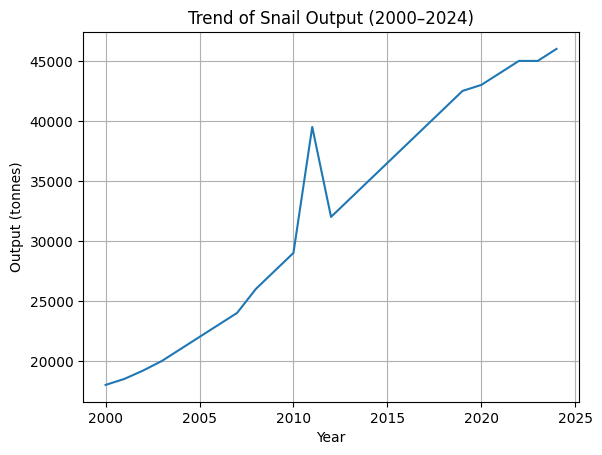
Source: aggregated data from FAOSTAT, and NBS, (2025) Figure 1: trend of snail output in Nigeria (2000-2024).
Figure 1 depicts a strong upward trend in snail production and a significant increase in snail production over the study period. Production rose from around 18,000 tonnes in 2000 to over 46,000 tonnes in 2024. The consistent growth is attributed to the increasing awareness of the economic and nutritional benefits of snail farming, the growing domestic demand, and the gradual improvements in production practices.
But there was a big dip between 2011 and 2012 with a sharp increase in production followed by a temporary decline. This pattern could be linked to climatic disturbances, disease outbreaks, market adjustments, or policy-related factors affecting agricultural production.
Notwithstanding these temporary fluctuations, the overall trend indicates that snail farming is still a growing agricultural enterprise with great potential for income generation, employment creation and enhancement of food security in Nigeria.
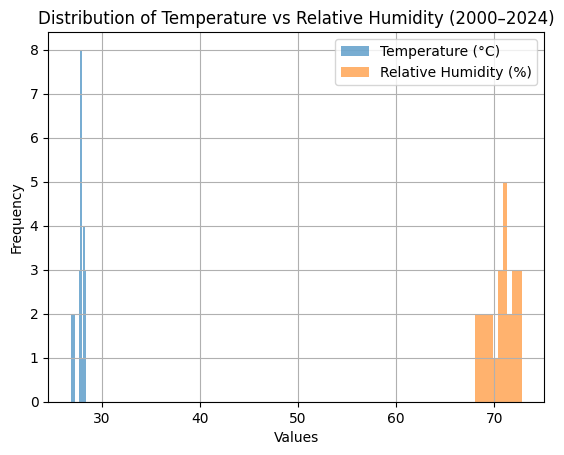
Source: aggregated data from FAOSTAT, and NBS, (2025). Figure 2: distribution of temperature and Relative Humidity.
As shown in Figure 2, temperature over the period 2000–2024. temperature exhibited a gradual upward trend throughout the study period, increasing from approximately 26.8°C to 28.4°C. This increase is consistent with a warming climate, but the variation was small and did not substantially affect snail production. Relative humidity, however, had a more significant upward trend, increasing from about 68% to over 72%. This increase is especially important because snail growth and reproduction are highly dependent on adequate moisture conditions.
The more prominent role of humidity over temperature justifies the fact that humidity is a major determinant of snail production in the ARDL and DOLS estimations. These results imply that future adaptation strategies should be focused on moisture management rather than temperature control.
Conclusion
This study examined the effects of climate variability on the sustainability of snail farming in Nigeria using annual time-series data for the period 2000-2024. The findings revealed the existence of a long-run equilibrium relationship between snail production and its climatic and socio-economic determinants.
The results show that rainfall has significant negative impact on output and relative humidity has positive impact on production in short run and long run. Wages also had a positive effect on output, highlighting the role of labour in raising productivity. Temperature had a statistically not significant positive effect, showing that the temperature variations observed during the study period were within tolerable limits for the growth and development of the snail.
The Error Correction Model showed a speedy adjustment to long-run equilibrium for short run shocks. The DOLS estimation confirmed the robustness of ARDL results.
The study concludes that climate variability is a challenge and an opportunity to sustainable snail farming in Nigeria. Too much rain can hinder productivity but good humidity conditions can boost output greatly. Thus, the sustainability of future heliciculture will depend heavily on the application of effective climate adaptation and moisture management strategies.
Recommendations
The following recommendations are suggested based on the results of this study:
- Farmers should employ climate-smart snail production systems that optimise moisture regulation and minimise vulnerability to excessive rainfall.
- Making drainage facilities better in snail housing structures to help reduce the negative effects of flooding and waterlogging.
- Agricultural extension agencies should improve education of farmers on climate adaptation practices and sustainable snail management techniques.
- Enhancement of climate information services by government to provide timely weather forecasts to farmers for improved production planning.
- Investment in research should focus on development of climate resilient snail production technologies and improved breeding systems.
- Enhanced access to credit and production inputs for farmers to adopt modern climate adaptation technologies.
- Policies that promote agricultural diversification should recognise snail farming as an important aspect of sustainable development of livestock in Nigeria.
Conflict of Interest
The authors declare that there is no conflict of interest regarding the publication of this study.
Ethical Approval
This study utilized secondary data obtained from publicly available sources. No human participants or experimental animals were involved in the research; therefore, ethical approval was not required.
Funding
The authors received no specific funding for this study from any public, commercial, or non-profit organization.
Data Availability Statement
The datasets used and analyzed during this study are available from the corresponding author upon reasonable request.
Author Contributions
Michael IE Edaba: Conceptualization, methodology, data analysis, manuscript drafting, and correspondence. AR Aroyehun: Literature review, data validation, manuscript review, and editing. H Amaegberi: Statistical review, interpretation of results, and manuscript revision. Add a limitation statement:
Limitations
The study is constrained by the availability of national- level snail production data, resulting in a relatively small sample size of 25 annual observations. Nevertheless, the ARDL framework is considered appropriate because of its suitability for small-sample estimation.
In addition, the national snail production statistics are derived from secondary sources and may not fully capture production activities occurring within informal and smallholder farming systems. Consequently, some degree of measurement error or underreporting may exist. However, the data were obtained from reputable national and international agencies and provide the most consistent time-series information currently available for examining long-run trends and climate-related dynamics in Nigeria’s snail farming sector. Future studies may improve upon this by combining national statistics with farm-level panel data collected across major snail-producing regions.
References
-
Abdulai A, Huffman W (2014) The adoption and impact of soil and water conservation technology: An endogenous switching regression application. Land Economics 90(1): 26-43.
-
Adebayo TS (2021) Testing the relationship between globalization, energy consumption and environmental degradation in Nigeria: Evidence from ARDL and DOLS approaches. Environmental Science and Pollution Research 28(45): 64581-64595.
-
Adeyeye SAO, Bolaji OT, Abegunde TA, Adesina TO (2020) Processing and utilization of snail meat in alleviating protein malnutrition in Africa. Nutrition & Food Science 50(6): 1185-1197.
-
Asteriou D, Hall SG (2015) Applied Econometrics. In: 3rd (Edn.), London, Palgrave Macmillan, UK.
-
Dinpashoh Y, Fakheri-Fard A, Moghaddam M, Jahanbakhsh S, Mirnia M (2011) Selection of variables for the purpose of regionalization of Iran’s precipitation climate using multivariate methods. Journal of Hydrology 297: 109-123.
-
Engle RF, Granger CWJ (1987) Co-integration and error correction: Representation, estimation and testing. Econometrica 55(2): 251-276.
-
Etukudo OM, Inyang AB, Nkantion UN, Okon B (2024) Economic prospects and sustainability of snail farming in Nigeria. Journal of Agricultural Extension and Rural Development 16(2): 45-58.
-
Ghosh-Jerath S, Kapoor R, Singh A, Downs S, FanzoJ (2020) Leveraging traditional and indigenous foods to improve nutrition security. Frontiers in Nutrition 7.
-
Gujarati DN, Porter DC (2009) Basic Econometrics. 5th (Edn.), New York, McGraw-Hill, USA.
-
Intergovernmental Panel on Climate Change (IPCC) Climate Change (2021) The Physical Science Basis. Cambridge, Cambridge University Press, UK.
-
Jayne TS, Chamberlin J, Headey D (2014) Land pressures, the evolution of farming systems and development strategies in Africa: A synthesis. Food Policy 48: 1-17.
-
Kao C, Chiang MH (2001) On the estimation and inference of a cointegrated regression in panel data. Advances in Econometrics 15: 179-222.
-
Letta M, Montalbano P, Paolantonio A (2024) Climate shocks and agricultural productivity: Evidence from Sub-Saharan Africa. Journal of Development Studies 60(2): 245-262.
-
Lobell DB, Schlenker W, Costa-Roberts J (2011) Climate trends and global crop production since 1980. Science333(6042): 616-620.
-
Oguntunde PG, Abiodun BJ, Lischeid G (2011) Rainfall trends in Nigeria and their implications for agriculture. Journal of Hydrology 411(3-4): 207-218.
-
Pesaran MH, Shin Y, Smith RJ (2001) Bounds testing approaches to the analysis of level relationships. Journal of Applied Econometrics 16(3): 289-326.
-
Ramsey JB (1969) Tests for specification errors in classical linear least-squares regression analysis. Journal of the Royal Statistical Society Series B 31(2): 350-371.
-
Salahudeen MM, Mukhtar MA, Abubakar SS (2024) Climate variability and agricultural productivity in Nigeria: New empirical evidence. Heliyon 10(3): e24015.
-
Stock JH, Watson MW (1993) A simple estimator of cointegrating vectors in higher-order integrated systems. Econometrica 61(4): 783-820.
-
Tosic I, Unkasevic M (2005) Analysis of precipitation series for Belgrade. Theor Appl Climatol 80(1-2): 67-77.
-
Wooldridge JM (2013) Introductory Econometrics: A Modern Approach. In: 5th (Edn.), Cengage Learning, USA.
-
Letta M, Tolossa T (2023) Climate variability and agricultural productivity in Sub-Saharan Africa: A systematic review. Environ Chall 11: 100735.
-
Thornton PK, Ericksen PJ, Herrero M (2024) Climate change and livestock systems in developing countries: Challenges and adaptation opportunities. Agric Syst 217: 103821.
-
Mottet A, de Haan T, Falcucci H (2023) Livestock systems and sustainable development goals: Pathways for resilience and productivity. Glob Food Secur 39: 100722.
-
Lipper L, Thornton P, Campbell B (2024) Climate-smart agriculture for food security and resilience under climate change. Nat Rev Earth Environ 5(2): 87-102.
-
Benin S, Diao X (2024) Agricultural diversification and rural transformation in Africa. Food Policy 122: 102563.
-
Rojas-Downing MM, Nejadhashemi AP, Harrigan T (2023) Climate change impacts on livestock production and management: A review. Clim Risk Manag 16: 145- 163.
-
Fanzo J, Pandya-Lorch R, Yosef S (2024) Alternative animal protein sources and global food security. Annu Rev Food Sci Technol 15: 211-233.
-
Edaba MIE, Aroyehun AR, Ologidi PO (2025) Determinants of Adoption of Climate-Smart Agricultural (CSA) Practices among Arable Crop Farmers in Bayelsa State, Nigeria. Climate Change 11(9): 1-15.
- The Evaluation of the Surveillance System of Anthrax in Gilgit-Baltistan, Pakistan, 2018
- Natural Decline to Extinction of A New Zealand Rabbit Population
- Mitochondrial Bio-Logistics: Steering Co-Enzyme Q10 and Lycopene Synergies within the Science 4.0 Bio-OS Framework
- Hymenoptera Specimens from the Caño Negro Wetland, of the National Museum Collection, Costa Rica
- Science 4.0: Comprehensive Architecture of the Biological Operating System (Bio-OS) A Framework for Systemic Resilience and Industrialized Bio-Governance
- Rabbit on, or Hare Back? Understanding Climate Change