
Rabbit on, or Hare Back? Understanding Climate Change
"Many scientists believe that climate change is a serious threat to human civilisation. We need to find sustainable forms of agriculture, manufacturing, and energy. How will we respond? How can we respond?"
Essay Theme
Keywords: Ecology; Climate Change; Rabbits; Hares
Introduction
Although climate change is a serious threat to civilisation, it is merely a symptom of a far more intractable problem: over - population. As Malthus warned us in 1798 [1].
Let us Start with the Simple Questions
How will we respond? Too little, and too late, if at all. That is obvious from our past record, and the almost universal belief in the benefits of growth, and oxymorons like “sustainable development”. The greenhouse effect of increasing levels of carbon dioxide in the atmosphere has been in school textbooks since 1964. Nothing has been done in New Zealand to reduce our ever-increasing emissions.
Business-as-usual merchants have successfully deflected the argument by demanding proof that the increase is caused by us, and is not a natural event. The problem has to be resolved regardless of what caused it, and we should have started reducing our contribution 50 years ago: “Ecology will be ignored more and more as things get tough.”- Paul Ehrlich [2]. Economists with their popular mantra of everlasting economic growth are believed; greenies, doom-sayers, and scientists like the Club of Rome who point out that continual growth on a finite planet is impossible, are derided. This will Essay not change, because most people still believe in fairies of one sort or another [3].
Hence my confidence that we will not respond until it is too late. How could we respond? One sustainable agriculture story: an Australian poultry expert arrives in Indonesia to help increase egg production. He asks how many eggs a local hen produced, and is told 70 a year. “Well in Australia we get 270; food and housing cost the equivalent of 230 eggs, giving us a profit of 40 eggs a year so we could improve your productivity easily. What do you feed them?” “Nothing - they forage for themselves.” “And how do you house them?” “They live under a house or up a tree.” “Oh,” says the poultry expert, “You should be coming to tell us how to farm poultry.” Similar stories abound in other countries. UN experts trying to improve rice yields in the Philippines removed the weed Azolla, only to find that it was the main source of nitrogen for the rice, and yields declined. Attempts to increase protein supply by using rice paddies as fish ponds were resisted by locals; “Fish turn into rats.” “Nonsense” said the experts, and stocked the paddies with fish. All went well until harvest, when rats appeared; they had spent summer feeding on fish, breeding to high numbers, and then wiped out the rice crop.
We could respond more effectively by learning from history; looking at successful examples of agriculture, like those rice terraces that have fed generations in Asia for over 2000 years, and resisting our obsession to “improve”. Agriculture in Europe was sustainable a hundred years ago, before the days of cheap energy, chemical fertilisers, and pesticides. A few farmers are leading the way with organics and permaculture, battling international giants like Monsanto, but for most New Zealanders that is “going back to the dark ages,” so it won’t happen.
The real problem is simply too many people for a finite world to support, demanding intensive agriculture based on energy that causes climate change. To reduce our ecological footprint we need to reduce the number of feet, not tinker with shoe sizes. If climate change is “patched up” our numbers expand to the next crisis. Ensuing crises become worse until we get to one that technology cannot fix. Population control has to come eventually and the longer we wait the more degraded our environment becomes. Also, in a finite world, the higher the population the smaller each person’s share; living standards decline: a fact forgotten by western societies that have cornered most of the wealth.
Why is controlling human populations so difficult? After 50 years studying hares and rabbits, I found this biological answer. Rabbits released on suitable islands increase rapidly to reach 300/hectare, over-eat their food supply, and starve. Hares put on similar islands increase to 4/ha, remain at that density, and never over-eat the food supply. Their populations stay relatively stable with minor changes caused by predators, climate extremes, or diseases.
When I compared all the available peak populations of other kinds of rabbits and hares (there are about 30 of each) none exceeded 40/ha. Clearly the common European rabbit is exceptional, and the reason is that they were domesticated by monks for 600 years. They were then spread over Europe and kept in warrens as a food supply, but soon escaped and lived in the wild. Domestication had removed the mechanism for self-regulation, and rabbits introduced into Australia, New Zealand, and South America swarmed, causing great damage to the environment, and agriculture [4].
Vero Wynne-Edwards [5] had already pointed out in 1962 that wild animal populations self-regulated, usually at about a tenth of their available food limit. But his claim that this was achieved by group-selection faced strong opposition by geneticists for 30 years, until the power of group-selection was recognised. Meanwhile his discovery of self-regulation adaptations was ignored.
Other domesticated animals like sheep, goats, cattle, pigs, or horses also increase to the food limit, unlike the wild forms from which they evolved. Domesticated birds (doves, ducks, and feral pigeons) and even fish (Chinese carp, and goldfish) follow this pattern. Some animals domesticated themselves; our three common rats and the house mouse probably lived in grain stores of Neolithic man 11,000 years ago. More than a thousand other kinds of rats and mice exist, but apart from the aptly named rice-rat, never become pests [6].
Humans became domesticated (“civilised”) when they started planting grain crops, and populations increased rapidly. Jared Diamond, a famous ecologist and author, writes in “The worst mistake in the history of the human race” that this change to agriculture was “our greatest blunder” [7] (This is remarkable, readable, and extremely well researched article, is available on the internet, dated 1999). Curiously, he came to this conclusion studying the archaeology of prehistoric tombs, 14 years before I published the rabbit/ hare paper on the same topic [8].
Former mechanisms of population self-limitation (tribal warfare, infanticide, cannibalism, territorial defence) were suppressed in favour of co-operation. Religions arose, reinforcing behaviour to maintain social cohesion and tolerance of high-density living. They banned all forms of population control, and sanctified human life: behaviour now accepted as “good”.
In contrast, hunter-gatherer tribes in the Arctic, Amazon, Africa, and New Guinea retain stable populations, and pose no threat to our climate. But their adaptations that keep populations within the food limit we regard with horror as totally “evil”.
“Love thy neighbour” leads to unlimited population increase. “Hate thy neighbour” is the basis of natural self- limitation below the food limit in wild animals and early humans. One solution to environmental crises such as climate change, is to reverse this. Which may be happening already in over-crowded cities, as street gangs and terrorists revert to primitive values. An ecological, civilised, remedy is “Love thy environment as thyself.” Elevate the rights of all life to the same value. Biologically this is sound; plants and animals have been around a lot longer than humans, and it’s their world we are destroying by altering the climate. But only altruists are prepared to forego their own welfare, to leave a sustainable heritage for the benefit of future generations. Altruists form 8% of our population. What chance have we got? Rabbit on.
Epilogue
Since I wrote this essay in 2008, we now have a bright comet on the horizon: Greta Thunberg and her world-wide followers in “Fridays for Future” and “School Strike 4 Climate Change”. I walked with them. And a New Zealand organiser, Sophie Handford, is continuing the journey in 2026, with Mary Moeono-Kolio, in a chapter “Seeds of solidarity: The role of the youth Climate Movement in the fight for climate justice” [9].
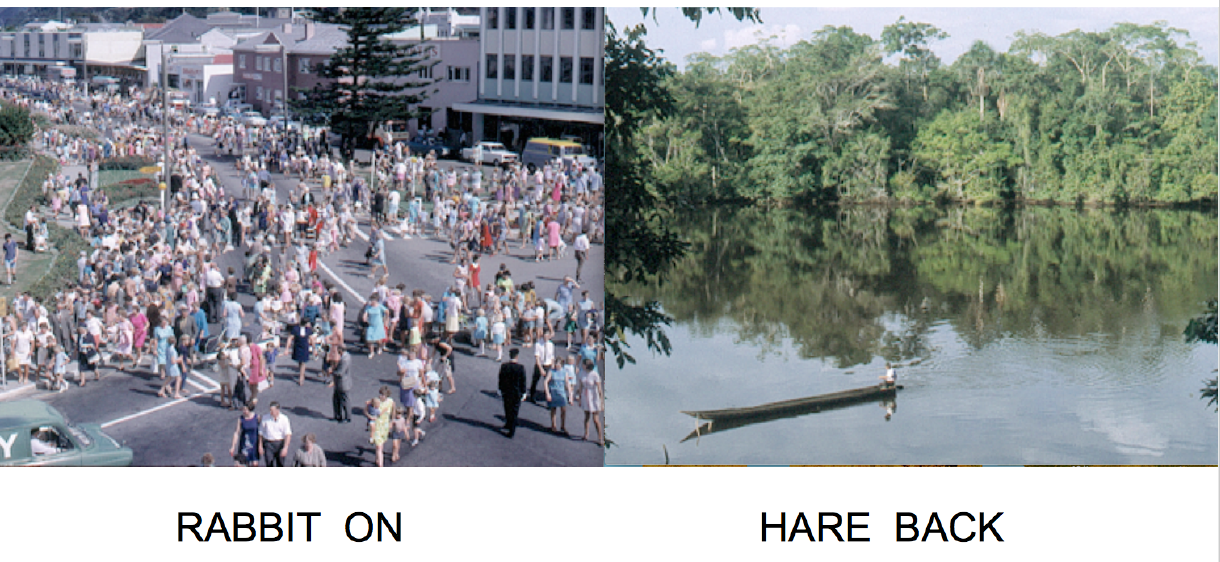
Also, there is a new attitude to the value we attach to Hare back?
indigenous ecological knowledge: “After almost 250 years of shared history, a combination of Maori and Pacific ways of thinking, backed by a robust scientific tradition, makes it easier for New Zealanders to see themselves as part of living systems, including the ocean, forests and waterways, and to recognise that these have their own rights to prosper, since our fates are tied together.” (Anne Salmond in “The Big Questions”) [10].
References
-
Malthus TR (1798) An Essay on the Principle of Population. J Johnson, London, UK, pp: 160.
-
Ehrlich PR (1969) The Population Bomb. Sierra Club, Binghamton, New York, USA, pp: 191.
-
Huxley A (1942) The Art of Seeing. Harper & Brothers, USA, pp: 142.
-
Cooke BD, Flux JEC, Bonino N (2018) Introduced Lagomorphs. In: Smith AT, Johnson CH, et al. (Eds.) Lagomorphs: Pikas, Rabbits, and Hares of the World. Johns Hopkins University Press, Baltimore, USA, pp: 13- 17.
-
Wynne-Edwards VC (1962) Animal Dispersion in Relation to Social Behaviour. Oliver & Boyd, Edinburgh, pp: 653.
-
Macdonald D (2020) The Encyclopaedia of Mammals: 2. Allen & Unwin, London, pp: 636-683.
-
Diamond J (1987) The Worst Mistake in the History of the Human Race. Discover 8(5): 64-66.
-
Flux JEC (2001) Evidence of self-limitation in wild vertebrate populations. Oikos 92: 555-557.
-
Handford S, Moeono-Kolio M (2026) Seeds of solidarity: The role of the youth movement in the fight for climate justice. In: Vincent T (Ed) Kiwis in Climate: Voices for Climate Solutions in Aotearoa New Zealand. Bateman Books, Auckland, pp: 65-73.
-
Salmond A (2018) Can we learn to live with our world?. In: The Big Questions: What is New Zealand’s Future? Penguin Random House New Zealand, pp: 277-292.
- Industrial Standardization of the Bio-OS: Algorithmic Codification of Resilience Engineering Guidelines and Version V8 Architecture
- Climate Variability and the Sustainability of Snail Farming in Nigeria: Past Trends, Present Challenges and Potential Outlook
- The Evaluation of the Surveillance System of Anthrax in Gilgit-Baltistan, Pakistan, 2018
- Natural Decline to Extinction of A New Zealand Rabbit Population
- Mitochondrial Bio-Logistics: Steering Co-Enzyme Q10 and Lycopene Synergies within the Science 4.0 Bio-OS Framework
- Hymenoptera Specimens from the Caño Negro Wetland, of the National Museum Collection, Costa Rica