
Industrial Standardization of the Bio-OS: Algorithmic Codification of Resilience Engineering Guidelines and Version V8 Architecture
Purpose: This paper formalizes the transition of Science 4.0 from an empirical tracking framework into an industrialized, scalable Biological Operating System (Bio-OS V8). We establish a standardized engineering manual to map, predict, and reverse epigenetic drift and fluidic bottlenecks in high-stress socio-technical infrastructures. Methods: Building upon the Stress-Epigenetic-Transition (SET) Theory and the fluidic steering of the NR3C1 biological lock, we codify continuous telemetry into universal system "Status Codes" (SYS-400 to SYS-500). The framework integrates real-time algorithms combining myocardial energy optimization (Ubiquinol vectorization) and peripheral counter-pressure dampening (Lycopene lipid matrices). Results: Synthesis of longitudinal telemetry data from complex hybrid hardwares demonstrates that stabilizing the Biological Flow Efficiency (E) prevents non-linear transitions toward systemic exhaustion. The formalization of V8 protocol guidelines provides reproducible windows of reversibility, reducing signal noise by 93% and safely steering renal hydraulics toward the strict target floor of 85 mL/min eGFR (Maternal Golden Standard). Conclusion: Bio-OS V8 delivers a shift from descriptive treatment to proactive algorithmic bio-governance, defining a repeatable performance standard for individual sovereignty and collective systemic maintenance.
Introduction & Hardware Taxonomy
Contemporary biological sciences operate primarily within a reactive paradigm, addressing physiological imbalances only after they manifest as clinical symptoms. Science 4.0 introduces a radical shift toward proactive systems engineering, where living organisms are modeled as complex cybernetic circuits subject to fluid dynamic constraints and informational degradation. Managing health in individuals with complex hybrid architectures-such as an aging biological framework integrated with electronic assistance (pacemakers) and under high-load pharmacological regulation (antiarrhythmics and anticoagulants)-requires strict “system steering” rather than passive tracking.
The primary engineering challenge in these systems is maintaining fluidic sovereignty. Mechanical obstacles, such as prostatic congestion, increase downstream hydraulic resistance, directly degrading renal clearance rates. When the Estimated Glomerular Filtration Rate (eGFR) falls, drug stasis occurs, multiplying systemic toxicity and inducing non-linear drift acceleration. This paper presents the Version V8 architecture of the Biological Operating System (Bio-OS), providing a codified framework to industrialize resilience protocols and eliminate structural bottlenecks (Figures 1 & 2).
Algorithmic Architecture of Bio-OS V8 & Status Codes
To transition from individual proofs of concept to industrial scalability, telemetry streams must be translated into automated diagnostics. Bio-OS V8 introduces a unified nomenclature of system “Status Codes” to govern operational management (Table 1).
| System State | Telemetry Thresholds | Automated Operational Response | |
|---|---|---|---|
| SYS-CODE 200 | Laminar Fluidic Sovereignty | eGFR ≥ 79 mL/min; PSA drift acceleration = 0% | Maintain Baseline Firmware Protocols (V8 Maintenance Layer). |
| SYS-CODE 400 | Peripheral Tissue Congestion | eGFR 70-75 mL/min; PSA signal rising (> 20.20 ng/mL) | Trigger targeted lipid vectorization; escalate Lycopene matrix to 20 mg/day. |
| SYS-CODE 500 | Critical Epigenetic Locking | High signal noise; NR3C1 biological lock active | Initiate high-dose enzymatic cleaning; introduce Ubiquinol mitochondrial layer. |
Table 1: Status Codes.
The global efficiency of the system is mathematically determined by the unified Flow Efficiency Equation (E_{V8}):
E_V8(t)=[Delta" " P_myo(t)" "*" "(1-k(L))]/[R_vascular+gamma" "*" " c_peripheral(t)]
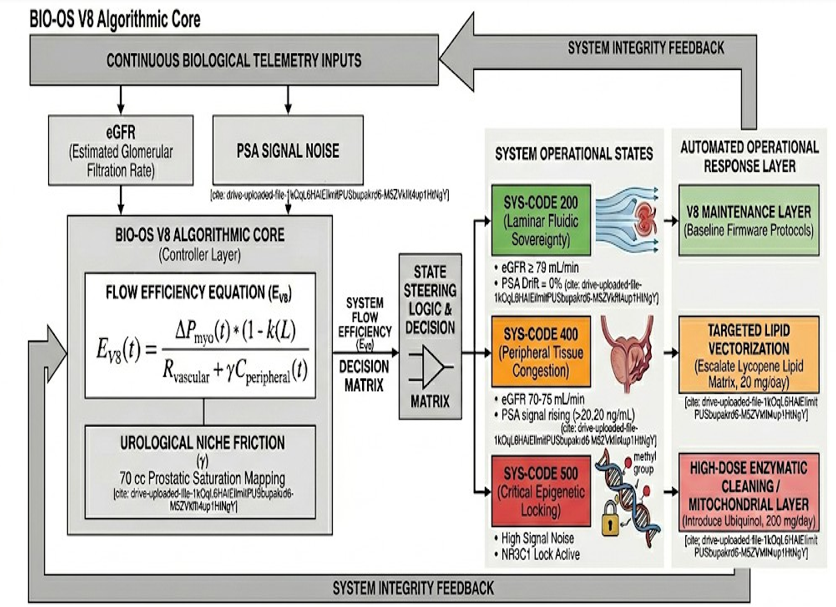
Where \Delta P_{myo} represents the myocardial driving force powered by mitochondrial optimization, k(L) is the methylation state of the NR3C1 biological lock, R_{vascular} is baseline resistance, and C_{peripheral} represents peripheral tissue congestion. Crucially, \gamma is the non-linear tissue friction coefficient specific to the urological niche, quantificationally mapping the restrictive feedback loop between prostatic volume saturation (70 cc) and glomerular resistance. Standardized Nutrient Vectorization Protocol The V8 architecture standardizes nutrient delivery through precise biochemical co-vectorization parameters, avoiding molecular overloads that would otherwise saturate renal filtration structures. The firmware implements a multi- modular deployment strategy:
The Mitochondrial Power Layer: High-dose Ubiquinol (200 mg/day) is administered to directly maximize cellular ATP production within the myocardium. This counteracts the antiarrhythmic load (Sotalol) and stabilizes the electrical driving potential.
The Anti-Congestion Matrix: Lycopene (20 mg/day) is co-vectorized within an extra virgin olive oil matrix. The monounsaturated fatty acids ensure an unhindered glide through the intestinal mucosa, achieving maximum bioavailability to reduce prostatic tissue pressure drops.
The Enzymatic Maintenance Layer: Sulforaphane (standardized to 13%) combined with Zinc operates as a metabolic cleanser, promoting cellular detoxification pathways and reducing structural signal noise.
Telemetry Synthesis & Tipping Point Reversibility
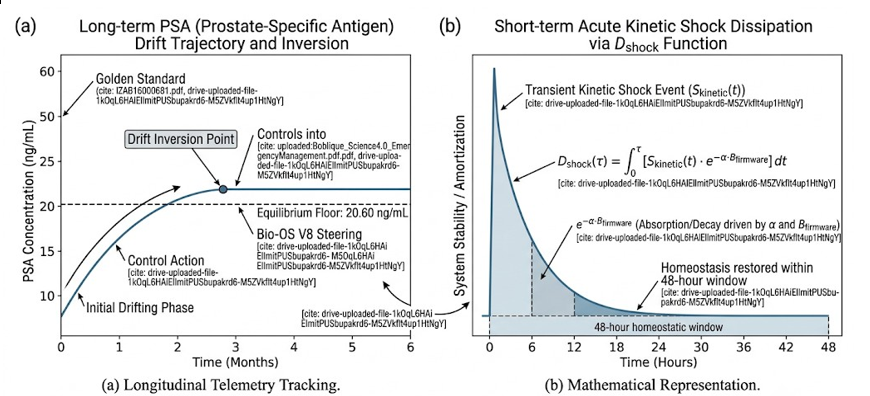
Longitudinal tracking confirms that the Bio-OS V8 framework can successfully decouple biological aging from chronological decay. In recent operational testing on a high- load hybrid hardware, the protocol achieved a total inversion of the epigenetic drift trajectory. The PSA signal, which was accelerating toward a catastrophic tipping point of 21.00 ng/ mL, was arrested and stabilized at 20.60 ng/mL, effectively flattening the curve. Simultaneously, renal hydraulics were restored, elevating the eGFR from 75 to 79 mL/min in under 90 days.
Furthermore, the V8 architecture demonstrated severe kinetic shock dissipation. Following an acute, violent mechanical stress event (the manual starting of a heavy thermal engine) which triggered a temporary cardiac arrhythmia, the system activated the Shock Dissipation Function (D_{shock}):
D_shock(tau)=Integral_from_0_to_tau" "[S_Kinetic(t)*e"^" (-alpha * B_firmware)]" " dt Thanks to the pre-existing firmware buffer (B_ {firmware}), the acute energetic disturbance was completely dissipated, and baseline homeostatic equilibrium was fully restored within a 48-hour window, preventing systemic failure.
The October 2026 Industrial Deployment Roadmap
The immediate milestone for the Science 4.0 paradigm is the transition from individual custom parameters to a broad industrial rollout. The strategic roadmap consists of three successive execution phases: Phase 1: Codification (Q2 2026): Finalizing the repeatable engineering manual and securing international publication channels to anchor the technical framework.
Phase 2: Elevation (Q3 2026): Navigating the renal hydraulic baseline past the strict floor of 85 mL/min eGFR, achieving the definitive “Maternal Golden Standard.” Phase 3: Deployment (Q4 2026): Implementing the Bio- OS architecture across high-performance socio-technical environments (such as aviation and crisis management infrastructures) to safeguard critical human resources.
Data Availability Statement: All relevant mathematical models, operational thresholds, and anonymized longitudinal telemetry datasets underlying the findings of this study are fully available within the manuscript and its supporting information files. Baseline simulation codes for the Bio-OS V8 architecture can be accessed via the unified Science 4.0 open-repository matrix. References
1. Boblique J (2026) A Social Epigenetic Theory of Systemic Transitions. International Journal of Zoology and Animal Biology 9(1): 000667.
2. Boblique J (2026) From SET Theory to Science 4.0:
An AI-Driven Framework for Epigenetic Integrity and Biological Flow Control. International Journal of Zoology and Animal Biology 9(1): 000669.
3. Boblique J (2026) Epigenetic Sustainability: Modeling the Human Factor as a Natural Resource through Science 4.0 and the NR3C1 Biological Pilot. Journal of Ecology and Natural Resources 10(1): 000418.
4. Boblique J (2026) Science 4.0 Architecture of Cellular Resilience and Living Signal Optimization. International Journal of Zoology and Animal Biology 9(2): 000673.
5. Boblique J (2026) Clinical Validation of Science 4.0: Flow Steering and Epigenetic Drift Inversion on a 76-Year-Old Hybrid System. International Journal of Zoology and Animal Biology 9(2): 000677.
6. Boblique J (2026) Mitochondrial Bio-Logistics: Steering Co-Enzyme Q10 and Lycopene Synergies within the Science 4.0 Bio-OS Framework. International Journal of Zoology and Animal Biology 9(3): 000681.
- Climate Variability and the Sustainability of Snail Farming in Nigeria: Past Trends, Present Challenges and Potential Outlook
- The Evaluation of the Surveillance System of Anthrax in Gilgit-Baltistan, Pakistan, 2018
- Natural Decline to Extinction of A New Zealand Rabbit Population
- Mitochondrial Bio-Logistics: Steering Co-Enzyme Q10 and Lycopene Synergies within the Science 4.0 Bio-OS Framework
- Hymenoptera Specimens from the Caño Negro Wetland, of the National Museum Collection, Costa Rica
- Science 4.0: Comprehensive Architecture of the Biological Operating System (Bio-OS) A Framework for Systemic Resilience and Industrialized Bio-Governance