
The Evaluation of the Surveillance System of Anthrax in Gilgit-Baltistan, Pakistan, 2018
Background: Anthrax is primarily a disease of herbivores. It is a highly fatal zoonotic bacterial disease found in endemic pockets. It is less common in human beings than in animals. In humans, Bacillus anthracis is recognized as a highly potential biological weapon agent. It can be transmitted in human beings through close proximity to infected livestock and their products, like skin, meat, hides, and bones. Methods: Anthrax is prevalent in some parts of Gilgit-Baltistan. Most of the outbreaks have been reported in the post-monsoon season, i.e., from July to September and November to January. The surveillance system of the Department of Livestock, Gilgit-Baltistan, was evaluated during February 2018, using the CDC updated guidelines 2001. For that purpose, one-to-one interviews and group discussions with concerned stakeholders were carried out. The passive data from different veterinary health units were also collected and evaluated accordingly. Results: The results revealed that the surveillance system was very simple, useful, flexible, and accommodating, but the timeliness was poor, and the sensitivity to pick the real cases was poor. Hospital/ dispensary cases were not a true representation of the whole livestock population, as most of the livestock in Gilgit-Baltistan remained in pastures, and no data were available for them. Conclusion: The system should explicitly include a case definition along with the provision of diagnostic kits to all veterinary laboratories in Gilgit-Baltistan to make the system more representative and sensitive.
Introduction
Anthrax is a common disease primarily of herbivores; however, it has been reported in other vertebrates as well [1]. A Gram-positive spore-forming bacillus (Bacillus anthracis), which is the etiologic agent of the highly contagious and zoonotic disease [2]. The disease occurs in countries where widespread vaccination of animals is not practiced [3]. Anthrax in humans is less common than in animals and usually spreads to human populations through close proximity to infected livestock or by handling infected livestock and its byproducts [4, 5]. Anthrax is found all over the world, including Europe, where spores were widely distributed in soil, but human cases were rare [6]. A one- health approach is needed to control the occurrence of diseases, both in animals and humans [7].
Anthrax has been a one-health concern in Pakistan, affecting animals and humans, as well, attributed to low socioeconomic conditions and lack of awareness [8].
In Pakistan, the concept of Participatory disease surveillance (PDS) was introduced during 2002-2005 under a FAO Trust Fund Project, “Support for Emergency Prevention and Control of Main Transboundary Animal Diseases in Pakistan (Rinderpest, FMD, PPR)”.While there is no proper and separate surveillance system for Anthrax and other zoonotic diseases, the Livestock Department all over Pakistan reports and takes preventive measures to combat outbreaks on a regular basis [9].
Livestock and dairy development in Gilgit-Baltistan has been working since 1948. The livestock department is working in all 10 districts of Gilgit-Baltistan. Major responsibilities of this department are to diagnose, treat, and control all types of livestock and poultry diseases, including zoonotic diseases. It has been observed that most infectious diseases in humans are of animal origin, and as the One Health concept is gaining popularity, it’s important to control zoonotic diseases. The purpose of this surveillance system is early diagnosis, treatment, and control of all infectious diseases, including Anthrax, in Gilgit-Baltistan. This Surveillance system monitors all livestock diseases, including both contagious and non-contagious diseases. The main contagious diseases include Anthrax, Brucellosis, Rabies, Avian Influenza, Scabies, Foot and Mouth Disease, PPR, and CCPP, and Sheep/Goat pox [10].
According to the Livestock Department, Gilgit-Baltistan, the estimated livestock population is 3.3 million. Among them, sheep and goats are 58%, while cattle account for 20% and poultry 18%, while the remaining population is of poultry and equines. The district has the highest number of livestock, while District Ghizar has the lowest. Also, small ruminants are greater in number in all districts compared to other animals. Livestock numbers increased considerably in the past but have shown a decline of about 3% per year during the last decade due to a depletion of natural feed reserves. In most areas, livestock are free-grazed or stall-fed in winter, whilst at the village, but from April/May to late September, animals are taken to high summer pastures, often quite distant from villages (Figures 1-3).
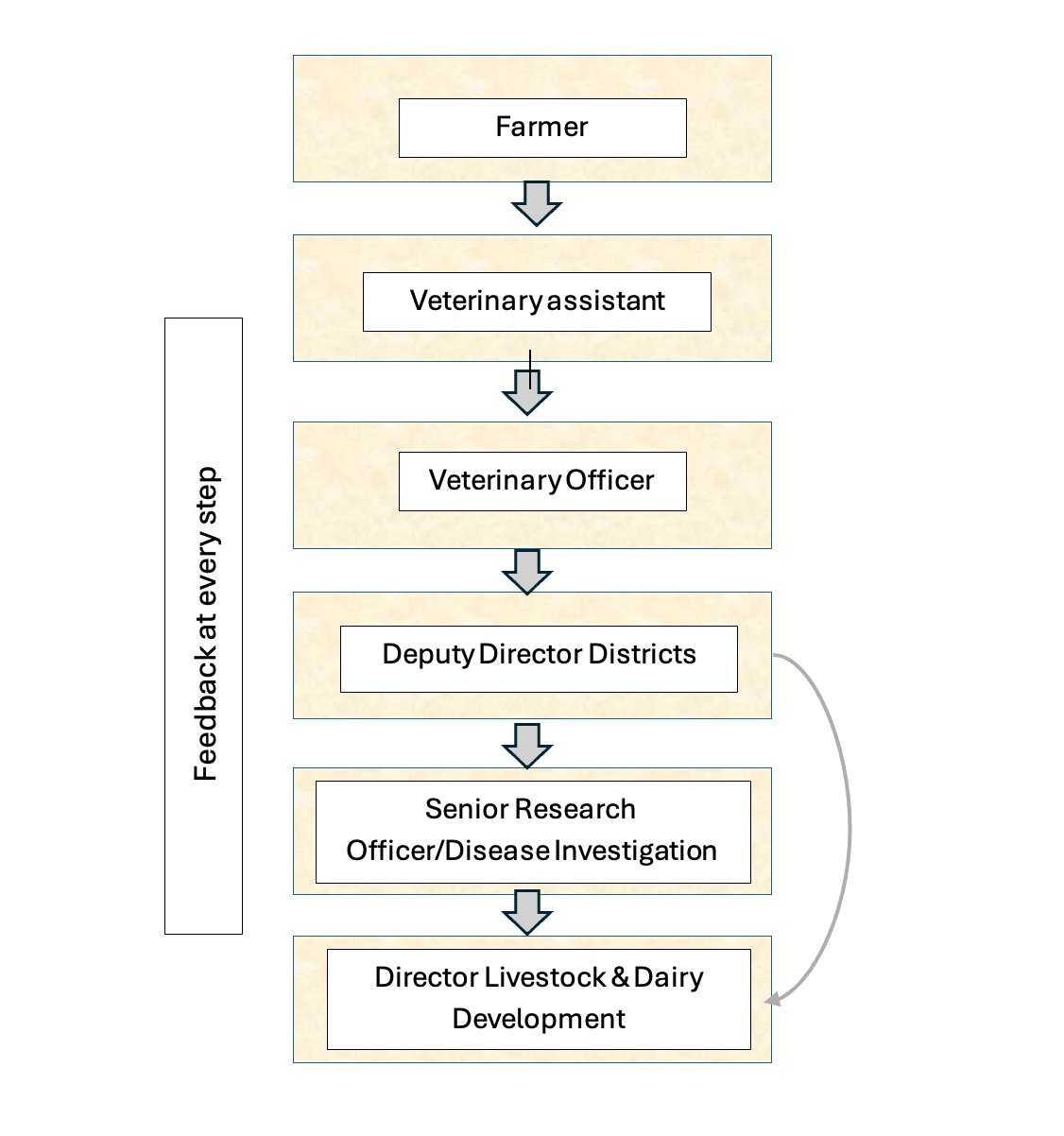
Disease Reporting System Flowchart
Two types of surveillance systems, both active and passive, were operating in the Livestock Department of Gilgit-Baltistan. As mentioned above, the passive surveillance system functioned routinely, where a farmer reports a case at the local dispensary to a veterinary assistant, then to a veterinary officer, followed by the deputy director, who generally reports directly to the director of livestock and dairy development. If further laboratory diagnosis is needed, the report is sent to either the diseases investigation officer or the senior research officer, and after laboratory confirmation, it is forwarded to the director and the deputy director for necessary action. In the case of an outbreak, field staff and laboratory personnel gather information and collect samples directly from the field, reporting straight to the director of livestock and dairy development in Gilgit- Baltistan. The usual reporting cycle is one month, with each district submitting a monthly progress report.
Anthrax Cases in Gilgit-Baltistan
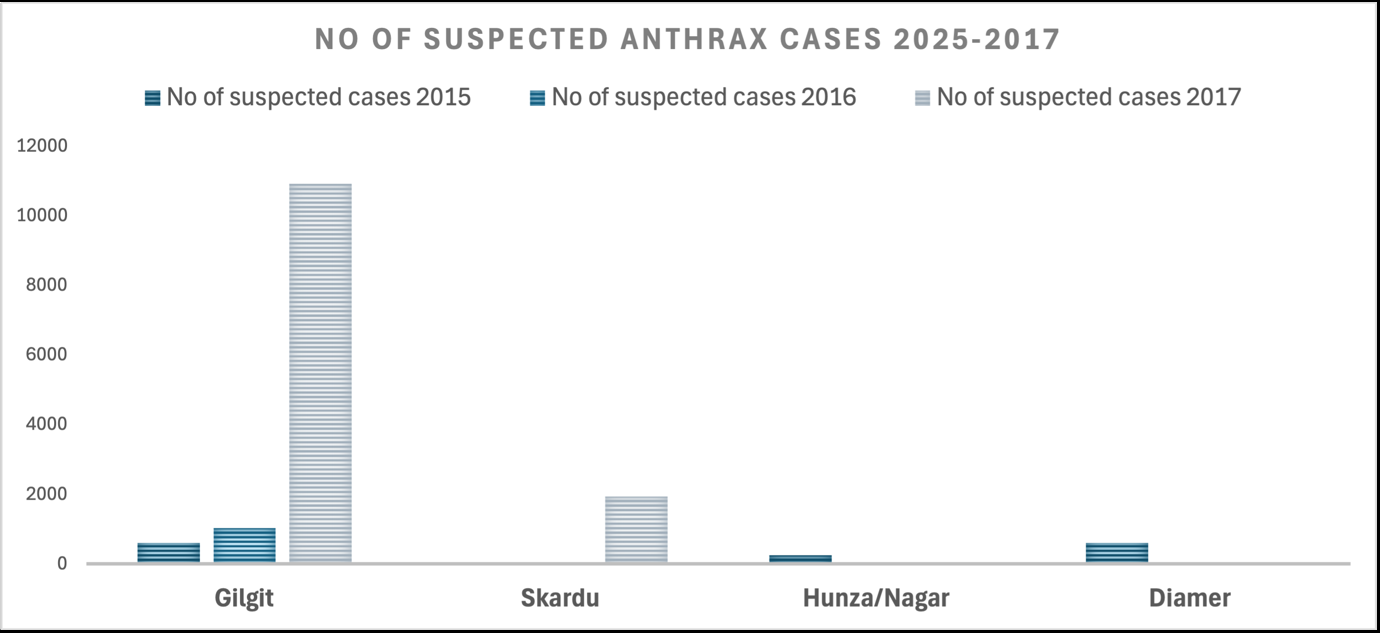
Anthrax is endemic in most parts of Gilgit-Baltistan. From 2015 to 2017, a huge number of anthrax cases were reported. A major outbreak of anthrax occurred in 2016 when a total of 408 animals were affected and reported from the Gilgit district. In 2017, we can see the persistence of anthrax cases. The reason why there are more cases in Gilgit than others is the availability of a functional laboratory. The main laboratory is the Gilgit-Baltistan Veterinary Laboratory, which has functional bacteriology and virology laboratories, and they do ELISA and Staining (Gram stain, Giemsa stain, Field Stain, etc) on a regular basis , whereas in other districts there are labs available but there is no test for anthrax, so they send those samples to the main laboratory. However, there is mostly underreporting and reluctance to send samples to the main laboratory; that is also one of the reasons we can see very few cases in those districts.
Although several regions are endemic for anthrax, seasonal fluctuation in the number of anthrax outbreaks has been observed. Most of the anthrax outbreaks are reported in the post-monsoon season, i.e., from July to September and November to January in different parts of Gilgit-Baltistan.
Financial Loss due to Anthrax
Livestock are the backbone of the rural economy as they provide draught power, milk and milk products, meat, manure, skins, hides, eggs, and poultry meat. Almost every household in Gilgit-Baltistan is directly or indirectly dependent on Livestock for its livelihood. Every household has at least two to five milking animals in city areas and more than ten animals in remote areas. The village people are solely dependent on livestock for their survival. Due to a lack of awareness about disease status, contagious diseases of livestock affect the rural economy. Like anthrax, which has a high mortality rate and is difficult to diagnose, it may be the cause of financial loss. In Gilgit-Baltistan, approximately one cattle costs Pakistani Rs. 100,000, while a goat and a sheep cost Rs. 25000 and Rs. 20000, respectively. This leads to both financial and livelihood concerns for the farmer and the local community.
Vaccination status Anthrax
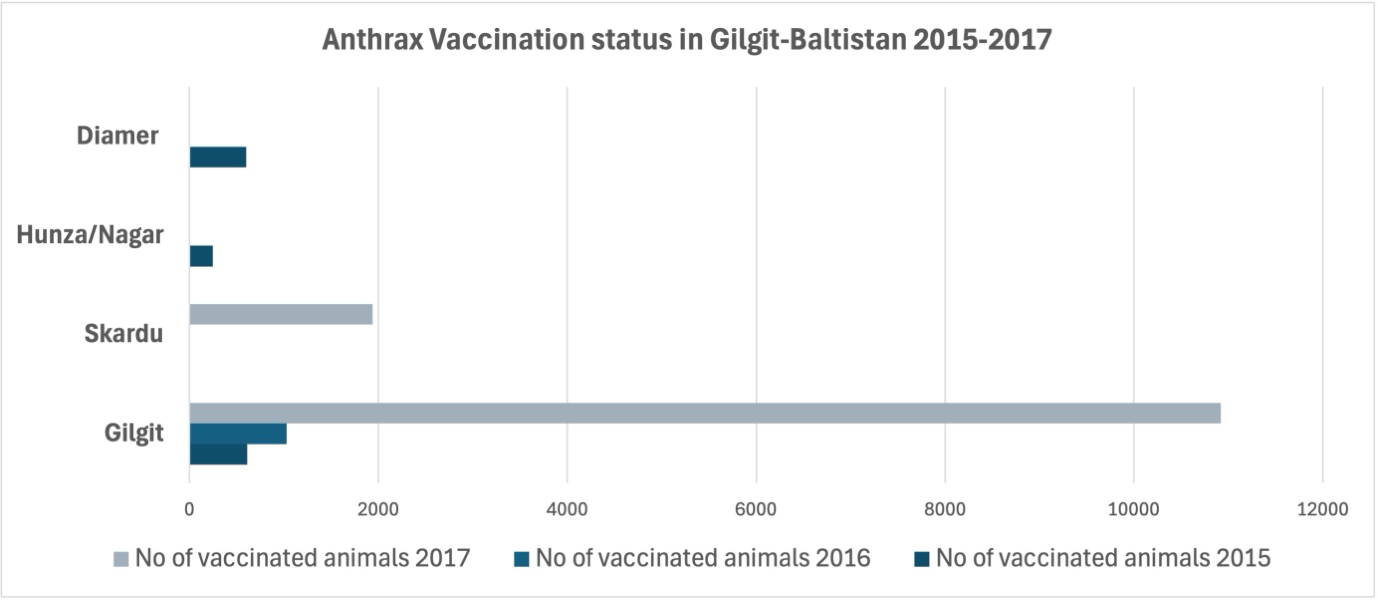
During the year 2025 to 2017, a total of 15340 animals were vaccinated across Gilgit-Baltistan. In Gilgit district, the highest no of animals were vaccinated, followed by Skardu district, with 12550 and 1940, respectively.
Rationale/Objective
Every year, a dozen livestock animals in Gilgit-Baltistan, especially cattle, die due to anthrax, particularly in anthrax- endemic areas, and most of the time these cases are observed to be undetected by the surveillance system, which makes it even worse to control such a deadly and highly zoonotic disease. Every year, the Livestock Department claims a higher rate of vaccination coverage in most parts of Gilgit- Baltistan, but the outbreaks are still persistent. The lack of a surveillance system for this particular disease in public health settings may also contribute to the spread of this disease to the human population, causing outbreaks. In order to contain, interrupt, and eradicate this disease, a surveillance system is crucial; for that purpose, the gaps in the surveillance system need to be explored and addressed.
Materials and Methods
Study Area: Gilgit-Baltistan Study Duration: February 2018 (Two weeks) Study Design: Descriptive Tool: CDC’s updated guidelines for Public Health Surveillance System 2001 were used for evaluation of the system, and findings were graded as Poor/low, Average, and Good. Methodology: System-specific stakeholders were identified. The main stakeholders were veterinarians, field staff including para vet staff, and laboratory staff including senior research officer and disease investigation officer. Verbal consent was followed by one-to-one interviews and group discussions. A detailed open-ended questionnaire assessed the system performance attributes of usefulness, acceptability, and stability. In-depth interviews with stakeholders also collected information about their opinions for improving the system and whether the expansion to collect data on additional conditions would be acceptable. Veterinary hospitals and dispensaries were also visited to collect data from hospital registers. Field staff were also interacted with to assess their knowledge and skills necessary to conduct effective surveillance and to make a timely response.
Objectives of the Evaluation Study
To provide a comprehensive summary of how the surveillance system operates through information provided by system representatives To identify key strengths and weaknesses. To make recommendations based on findings.
Results
The results for these system attributes were transcribed by following the CDC guidelines, and the measures considered for evaluation were graded as poor, average, good, and excellent. The attributes that fulfilled more than 80% of the criteria were graded as excellent, 61-80% as good, 50-60% as average, while those falling below 50% were graded as poor.
Simplicity (Average)
The surveillance system was simple. The farmer reports anthrax cases to the respective dispensary or hospital. The Veterinary officer or Veterinary assistant reports the reported case to the district deputy director. The Deputy Director then referred the case to the main laboratory in Gilgit, and subsequently to the research officer and the disease investigation officer. After the laboratory confirmation, this report has been sent to the director, and the director will plan the preventive measures in the high-risk areas.
Flexibility (Good)
This system was extended in 2017, and the mini diagnostic laboratories were established in all other districts in Gilgit-Baltistan, and every district had a mini laboratory along with all basic laboratory equipment. Although the basic tests are available for some of the diseases, there is no test available for anthrax, so they have to send those samples to the main laboratory in Gilgit. We graded it good because there is close coordination between the main laboratory and mini laboratories; also, the main laboratory is in close coordination with the national laboratories, such as the National Veterinary Laboratory, Islamabad, and samples could also be sent in case of an outbreak or if the testing capacity is not available at the main laboratory in Gilgit.
Data Quality (Poor)
The data quality was not good, as there was no separate system for reporting of anthrax. Most of the data was taken from the veterinary dispensaries and hospitals, while passive data from the monthly progress reports was also collected from the Directorate of Livestock Gilgit-Baltistan . Cases were diagnosed on the basis of signs and symptoms, and a very minimal number of cases were laboratory confirmed in the main laboratory.
Acceptability (Good)
All stakeholders participate in the system, but no standard case definition was available. All the stakeholders, including the laboratory staff, were well aware of the importance of the disease and its consequences if transferred to humans.
Sensitivity (Poor)
The system has no standard case definition. All cases, including anthrax, were diagnosed on the basis of signs and symptoms. Also, in those areas where anthrax was endemic, there was no diagnostic laboratory for the timely confirmation of cases. Every year, hundreds of animals are vaccinated against anthrax in anthrax-endemic areas such as Danyore, Jutal, Sultanabad, Rahimabad, and Gilgit.
Predictive Value Positive (Poor)
This surveillance system reported 320 cases of suspected Anthrax during the year 2017, but only a few were lab-tested in the Gilgit-Baltistan Veterinary Laboratory, Gilgit; most of the cases were diagnosed on the basis of signs and symptoms. Of these 320 cases, 20 were lab-tested, and 8 tested positive by Gram staining. So, PPV is 40%. Given that only 6.2% of samples were lab-tested, we cannot comprehend the true PVP value.
Representativeness (Poor)
The cases were not representative of the whole population, as most of the livestock in Gilgit-Baltistan remains in high mountain pastures most of the time, and there is no data available for those animals.
Timeliness (Average)
Due to the smooth flow of the surveillance operating system and all district heads of the department were in close coordination/Collaboration with the main veterinary laboratory and the Disease Investigation Office, Gilgit, the outbreaks are timely reported. Also, every month, a monthly progress report of all the contagious and non-contagious diseases from all the dispensaries throughout Gilgit- Baltistan has to be submitted to the main office in Gilgit, but in most cases, the vaccination or the preventive measures have been taken after the outbreak, and the outbreaks are still persistent.
Stability (Good)
The system is stable as the main veterinary laboratory is in close coordination with the mini laboratories in different districts. Lab support is available. Each mini laboratory is well equipped with advanced laboratory equipment. All the staff are permanent but not well-trained yet.
This system is useful, as it has the ability to report in a timely manner and to determine the magnitude of any outbreak due to the close coordination among the district staff. Also, due to the availability of diagnostic laboratories, timely confirmation of cases can be done. Every year, due to the identification of anthrax endemic areas by this surveillance system, it’s now easy to take preventive measures.
Conclusion
This surveillance system is useful in theory; however, it lacks the physical infrastructure, laboratory supplies, and human resources, which could ultimately prevent reductions in outbreaks.
Recommendations
The primary objectives of the anthrax surveillance system should be to prevent or reduce livestock losses and to prevent zoonotic transmission. To achieve these objectives, the surveillance system should explicitly include a case definition for anthrax, which is fundamental to any surveillance system.
Mini laboratories should be equipped with diagnostic kits for anthrax diagnosis. Also, the main laboratory in Gilgit should introduce a PCR test for confirmation after Gram staining. Moreover, capacity building of laboratory personnel is essential. The department should allocate a special fund to diagnose high-priority zoonotic diseases in Gilgit-Baltistan.
Emphasize education for farmers and front-line veterinarians on detecting, confirming, and reporting cases. This detection, confirmation, and reporting should be followed by a strong response from the veterinary health system to control the disease. Prevention of cases among livestock depends on knowledge of enzootic regions and timely vaccination of livestock in those affected areas.
To prevent future outbreaks, the Livestock Department should ensure anthrax vaccinations every year throughout the area, and particularly in highly endemic areas.
Reference
1. (2026) Anthrax in animals.
2. (2011) Biology and History of Bacillus anthracis.
3. Islam SS, Sarker MS, Akhter AHMT, Shanta IS, Rahman
AKMA, et al. (2023) Animal, human, and environmental perspectives on anthrax in Bangladesh. Heliyon 10(1): e23481.
4. Di Bari C, Venkateshwaran N, Fastl C, Sarah G, Grace D, et al. (2023) The global burden of neglected zoonotic diseases: Current state of evidence. One Health 17: 100595.
5. Hattendorf J, Bardosh KL, Zinsstag J (2017) One Health and its practical implications for surveillance of endemic zoonotic diseases in resource limited settings. Acta Trop 165: 268-273.
6. Schmid G, Kaufmann A (2002) Anthrax in Europe: Its epidemiology, clinical characteristics, and role in bioterrorism. Clinical Microbiology and Infection 8(8): 479-488.
7. Subedi D, Pantha S, Jyothi S, Gautham B, Kaphle K, et al. (2024) Anthrax in Humans, Animals, and the Environment and the One Health Strategies for Anthrax Control. Pathogens 13(9): 773.
8. Sardar N, Aziz MW, Mukhtar N, Yaqub T, Anjum AA, et al. (2023) One Health Assessment of Bacillus anthracis Incidence and Detection in Anthrax-Endemic Areas of Pakistan. Microorganisms 11(10): 2462.
9. Manzoor U (2026) Epidemiological Analyses of Foot and Mouth Disease in Pakistan.
10. Abbas W, Kalhoro DH, Baloch H, Abubakar M, Kalhoro MS, et al. (2026) Seroprevalence of Brucella abortus in Yak, Zo and Cows in Gilgit and Nagar Districts of Gilgit- Baltistan, Pakistan. Pakistan J Zoo 56(2): 503-1000.
References
-
(2026) Anthrax in animals.
-
(2011) Biology and History of Bacillus anthracis.
-
Islam SS, Sarker MS, Akhter AHMT, Shanta IS, Rahman AKMA, et al. (2023) Animal, human, and environmental perspectives on anthrax in Bangladesh. Heliyon 10(1): e23481.
-
Di Bari C, Venkateshwaran N, Fastl C, Sarah G, Grace D, et al. (2023) The global burden of neglected zoonotic diseases: Current state of evidence. One Health 17: 100595.
-
Hattendorf J, Bardosh KL, Zinsstag J (2017) One Health and its practical implications for surveillance of endemic zoonotic diseases in resource limited settings. Acta Trop 165: 268-273.
-
Schmid G, Kaufmann A (2002) Anthrax in Europe: Its epidemiology, clinical characteristics, and role in bioterrorism. Clinical Microbiology and Infection 8(8): 479-488.
-
Subedi D, Pantha S, Jyothi S, Gautham B, Kaphle K, et al. (2024) Anthrax in Humans, Animals, and the Environment and the One Health Strategies for Anthrax Control. Pathogens 13(9): 773.
-
Sardar N, Aziz MW, Mukhtar N, Yaqub T, Anjum AA, et al. (2023) One Health Assessment of Bacillus anthracis Incidence and Detection in Anthrax-Endemic Areas of Pakistan. Microorganisms 11(10): 2462.
-
Manzoor U (2026) Epidemiological Analyses of Foot and Mouth Disease in Pakistan.
-
Abbas W, Kalhoro DH, Baloch H, Abubakar M, Kalhoro MS, et al. (2026) Seroprevalence of Brucella abortus in Yak, Zo and Cows in Gilgit and Nagar Districts of Gilgit- Baltistan, Pakistan. Pakistan J Zoo 56(2): 503-1000.
- Natural Decline to Extinction of A New Zealand Rabbit Population
- Mitochondrial Bio-Logistics: Steering Co-Enzyme Q10 and Lycopene Synergies within the Science 4.0 Bio-OS Framework
- Hymenoptera Specimens from the Caño Negro Wetland, of the National Museum Collection, Costa Rica
- Science 4.0: Comprehensive Architecture of the Biological Operating System (Bio-OS) A Framework for Systemic Resilience and Industrialized Bio-Governance
- Rabbit on, or Hare Back? Understanding Climate Change
- Clinical Validation of Science 4.0: Flow Steering and Epigenetic Drift Inversion on a 76-Year-Old Hybrid System