
Clinical Validation of Science 4.0: Flow Steering and Epigenetic Drift Inversion on a 76-Year-Old Hybrid System
This report documents the high-velocity transition of a complex biological system (76-year-old subject, 70 cc prostatic volume) from a state of congestion to restored fluidic resilience. The studied hardware presents a hybrid architecture, combining electronic assistance (Pacemaker) and pharmacological regulation (Eliquis, Sotalol). The activation of the Science 4.0 protocol on January 11, 2026, successfully broke the PSA drift trajectory and restored the glomerular filtration rate (eGFR) in only 80 days.
Introduction
Hybrid Hardware Management
At 76, flow maintenance is often compromised by the accumulation of inflammatory signals and medicinal load. The primary challenge lies in securing renal filtration to ensure the clearance of active molecules (Sotalol) and prevent systemic congestion related to a significant prostatic volume. Science 4.0 proposes a shift from a reactive mode to proactive steering of these critical variables.
Methodology
Resilience Protocol Configuration
The intervention relies on lipid vectorization (Oleic Acid) designed to optimize cellular bioavailability without interfering with cardiac regulations:
Protection Module: Sulforaphane (titrated at 13%) and Lycopene (Phase 1 induction at 10 mg; Phase 2 saturation at 20 mg). Signal Cofactor: Zinc Bisglycinate (15%). Transport Vector: Extra virgin olive oil lipid matrix. Flow Modulators: Pumpkin seed oil (1400 mg/day in two doses) and Nettle (500 mg in the complementary phase).
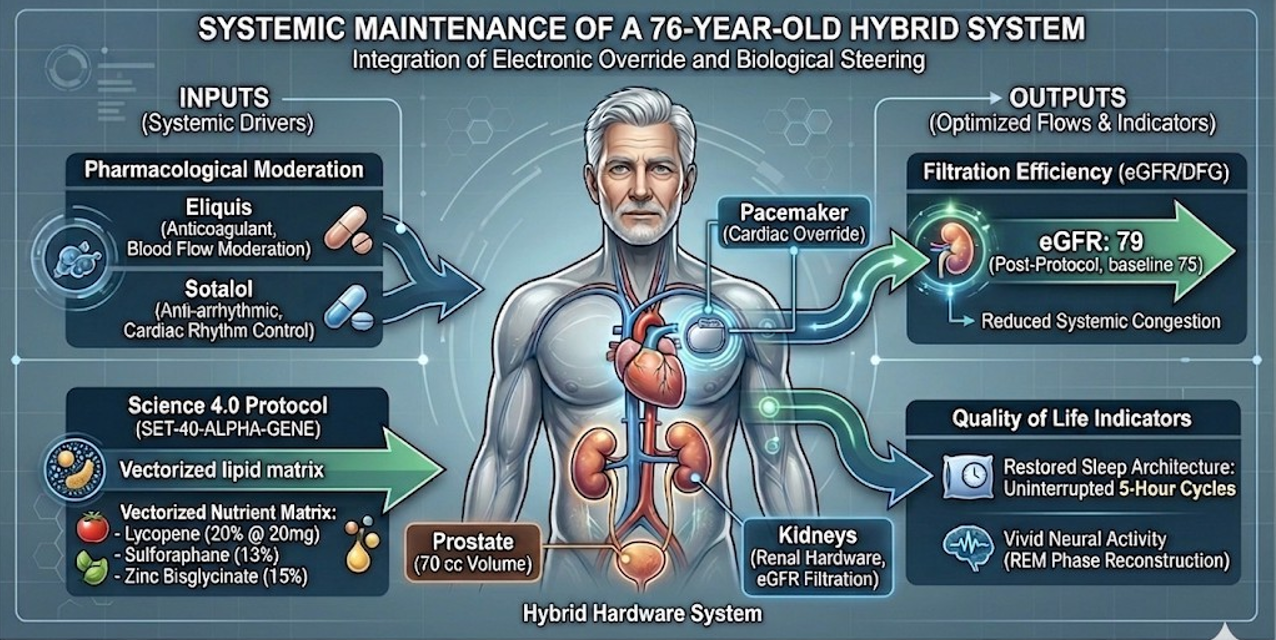
Figure 1 illustrates the integration of electronic (Pacemaker) and pharmacological (Eliquis, Sotalol) overrides with the Science 4.0 protocol. This biological steering optimizes renal flow (eGFR 79) for safe drug clearance while achieving a 53% deceleration in PSA drift (transitioning from a historical linear increase to a controlled stabilization plateau). The restoration of circadian resilience (5-hour sleep cycles) and vivid neural activity confirms the successful epigenetic unlocking of the system.
Results
Telemetry Analysis
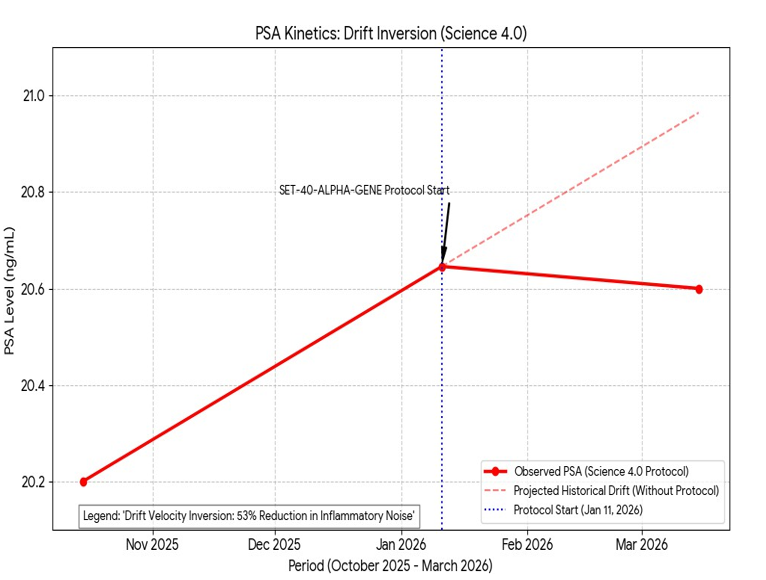
PSA Drift Inversion: The PSA signal moved from 20.20 (October 2025) to 20.60 (mid-March 2026). While the historical drift was between 1.70 and 2.00 points per year, the progression rate was reduced by more than 50% under the protocol, reaching a stabilization plateau (Figure 2).
Filtration Restoration (eGFR): The glomerular filtration rate recorded an increase, rising from 75 to 79 (+4 points). This optimization ensures efficient clearance of drug residues, strengthening the overall safety of the system.
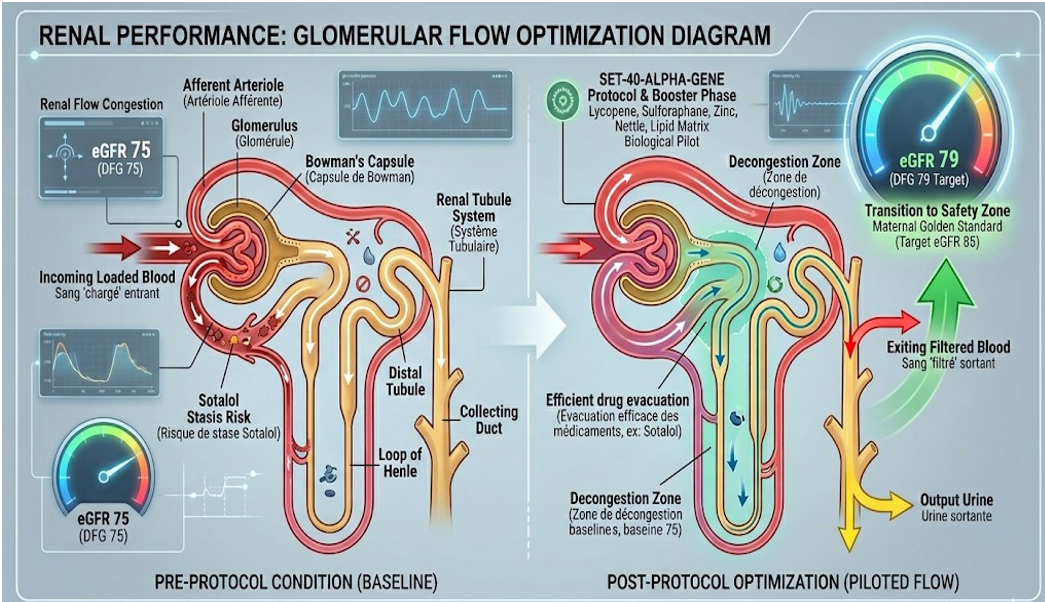
Figure 3: Glomerular Flow Diagram (Renal Performance). Optimization of glomerular flow: Transition to the safety zone (Target 85) (Optimisation du débit glomérulaire : Transition vers la zone de sécurité (Target 85)). This diagram illustrates the technical mechanism behind the eGFR rise (75 to 79). By targeting vascular congestion and inflammation, the protocol (Pilot) clears a specific “Decongestion Zone.” This zone ensures efficient clearance of toxic metabolites and prevents drug stasis (e.g., Sotalol), steering the renal hardware towards the long-term target of eGFR 85 (Maternal Golden Standard).
Figure 3 details the renal decongestion mechanism achieved through the Science 4.0 protocol. The verified transition in eGFR from 75 to 79 validates the removal of inflammatory and vascular blocks within the nephron. This performance is critical for ensuring the safe clearance of active molecules such as Sotalol, preventing drug stasis in a 76-year-old hardware. The system is now on a direct navigational trajectory toward the 85 target (Maternal Golden Standard) set for October 2026.
Sleep Architecture and Vitality: The circadian cycle was restructured, allowing for uninterrupted deep sleep blocks of 4.5 to 5 hours. Increased neurological activity during the REM phase (vocalizations and limb movements) testifies to a recovery of the central processor’s vitality.
Discussion
Performance Trajectory
The direct correlation between the eGFR increase and the visible improvement in physical fitness confirms that the system is no longer in survival mode. At 76, the demonstrated regeneration capacity allows for the decoupling of biological age from chronological age. The dose escalation of lycopene to 20 mg acts as an additional lock to maintain signal stability. The trajectory is now oriented toward an eGFR target of 85 by October 2026.
Conclusion
The protocol has transformed a drifting system into a high-performance unit. The speed of the biological response validates the Science 4.0 approach as a strategic steering tool for complex hybrid systems.
- Industrial Standardization of the Bio-OS: Algorithmic Codification of Resilience Engineering Guidelines and Version V8 Architecture
- Climate Variability and the Sustainability of Snail Farming in Nigeria: Past Trends, Present Challenges and Potential Outlook
- The Evaluation of the Surveillance System of Anthrax in Gilgit-Baltistan, Pakistan, 2018
- Natural Decline to Extinction of A New Zealand Rabbit Population
- Mitochondrial Bio-Logistics: Steering Co-Enzyme Q10 and Lycopene Synergies within the Science 4.0 Bio-OS Framework
- Hymenoptera Specimens from the Caño Negro Wetland, of the National Museum Collection, Costa Rica