
Seeds Planted by another Mind
As a full-time ecologist for 45 years I had plenty to study without bothering about the occult; until I read my daily newspaper on 13th June 2017.
Introduction
As a full-time ecologist for 45 years I had plenty to study without bothering about the occult; until I read my daily newspaper on 13th June 2017.
The New Zealand Antarctic Heritage Trust had found a painting, by Edward A Wilson, among old papers in a hut at Cape Adair.
Wilson died with Falcon Scott on their return from the South Pole in 1912, and why he had taken this painting of a dead treecreeper (an inconspicuous brown bird, one third the size of a sparrow) was a puzzle. But I had carried a photo of the same bird in a wallet for seven years after arriving in New Zealand, to remind me of the woods I roamed as a child at home in Scotland. I imagined Wilson had done the same. Just a coincidence; seed number one, no need to get excited about it.
However, I knew nothing about Wilson and was curious, so I bought two books of his paintings. As I scanned the pages that seed exploded in all directions. I recognized things, in dozens of my sketches, paintings, and photographs, that the books showed Wilson had already drawn 40 years before me. After copying 150 pairs, I thought that was enough for a book on coincidences. Especially the final pair of us at university - everyone who sees it says “Wow! You must be identical twins!” (Photo here. Caption: I have no idea why I am matching Wilson by wearing a white shirt and funeral black tie, on Essay what seems to have been a bird-watching trip at some beach with a university friend who sent me this photograph.
All artistic work can overlap - favorite views, scenery, subjects, techniques, would be expected; these are not coincidences. What amazed me was the parallel in insignificant details: we drew the grooves on toenails after grouse (a Scottish game-bird) shed their claws; and the shield of stiff feathers that protect the eyes of swifts, those incredible birds which fledge from nests in Europe, and migrate to Africa and back twice before landing again, anywhere.
Scientists calculate the odds of such events happening. We both pictured a Silver Y moth head-on. On the internet I found 1824 photographs taken side-on (which shows their distinctive crests), two front views, but only one from our angle. Our swallows were both shown from below, mine on Indian red and yellow power lines, Wilson’s on a red and yellow stick. Only 13 of 3985 internet swallows, all perched on normal telephone lines, were taken from below.
Even a mathematician like Albert Einstein gave up on coincidences: “Coincidence is God’s way of remaining anonymous”. I turned back to where the trail of seeds led. Why were we doing the same thing? What sort of character was Wilson? Where was it all taking me?
Fortunately, George Seaver had written three very useful books: 1936. “Edward Wilson of the Antarctic: Naturalist and friend”. 1937. “Edward Wilson Nature-Lover”, and 1948. “The Faith of Edward Wilson”. These fed the seeds, fast growing into a climbing vine. Or was I following the roots, into the burrow where the White Rabbit led Alice?
Our early lives were similar. We were both taught to draw by our artistic parents; argued with our fathers on subjects to study at university (resulting in my having to do two years in medicine - Wilson’s main subject); won prizes in spring- board diving; graduated with first class honors in Natural History. In our twenties we taught children in Episcopalian Sunday schools, and worked with teams investigating grouse declines on Scottish moorland estates.
On his return Wilson planned to become a government scientist or warden in New Zealand to record the vanishing flora and fauna, but no vacancies were available. Earlier he had wished to join the Universities Mission in East Africa, but illness prevented that. The UK, New Zealand, and East Africa, by chance, are the only countries where I have worked.
In character we were both loners, avoiding team games (neither of us had any interest in competition) and parties. I made a pact with my mother that my sixth birthday party was to be my last; Wilson “could not stand social occasions and had to have sedatives” (W E Swinton, “Physicians as Explorers” 1977). As a child “the least thing” made Wilson cry; and, aged 15, I amazed my art class, and teacher, by crying when a design failed.
Wilson remained a Christian, but disliked formal church services. I changed from Episcopalian to Presbyterian to Atheism to Pantheism - where we met again: “The pantheistic element in his faith was correlative to the theistic. He saw no opposition between them” (Seaver 1948). As an extension to Pantheism, I find the following views of Einstein highly relevant.
“Einstein’s legacy must include not only his physical theories but his cosmic religion - little known and little shared, until perhaps another age” (Eugene Mallove, Washington Post, 1985). Mallove continues, quoting Einstein: “I maintain that the cosmic religious feeling is the strongest and noblest motive for scientific research”.
And “In my view, it is the most important function of art and science to awaken this feeling and keep it alive in those who are receptive to it.” Central to him, he said, was a “rapturous amazement at the harmony of natural law, which reveals an intelligence of such superiority that , compared with it, all the systematic thinking and acting of human beings is an utterly insignificant reflection.” The writings of St Francis of Assisi (1182-1226) had a major influence on Wilson. In a letter to his future wife he wrote, “Above all things, I admire in St Francis his broad- minded happiness in everything...of beauty, whether it was birds, flowers, poverty, or sickness, or any other odd thing that came his way, and turned his mind to love and praise and sympathy...” (Seaver 1948).
Rene Dubos, in “So Human an Animal” (1970), recounts that Lynn White, an American historian saw, in 1966, as “the only hope for the world’s salvation the profoundly religious sense that the thirteenth-century Franciscans had for the spiritual and physical interdependence of all parts of nature. Scientists, and especially ecologists, he urged, should take as their patron Saint Francis of Assisi.” I agree, as Wilson would, and now avoid killing any animal; yes, even rats, roaches, or mosquitoes.
The problem of why Wilson planted seeds in my mind was solved when I read Apsley Cherry-Garrard’s postscript, added to the 1965 edition of his book, “The Worst Journey in the World” (Scott’s journey to the South Pole):
“In such a world, violent, angry and tired, Wilson sets a standard of faith and work. In a world which destroys itself and beauty, desperately and impotently desiring peace, he helps...We have missed him ever since he died. But you must find him: his voice, it is a quiet voice, is for those who listen...by the time he started on our Winter Journey he had reached another plateau...where he was beyond ambition and beyond fear. He had the quiet mind. That feeling he could communicate to others. Such men do occur in history, but they are very rare, and when they do happen they are among the great ones of our race.”
So I (we?) Wrote A Book
“Is a Coincidence of Coincidences just a Coincidence? Following Edward A Wilson into the Unknown”, published in 2025 by Reardon Publishing, Cheltenham, UK. - the town where Wilson’s two nephews, who have been very supportive of the book, built a museum for him.
Having published many scientific papers I know the summary is the hardest part to write, and can take days. Nicholas Reardon asked for a 200 word blurb to print on the back cover. With Wilson at my shoulder it took ten minutes to reach 200 words, and none were changed (Figure 1).
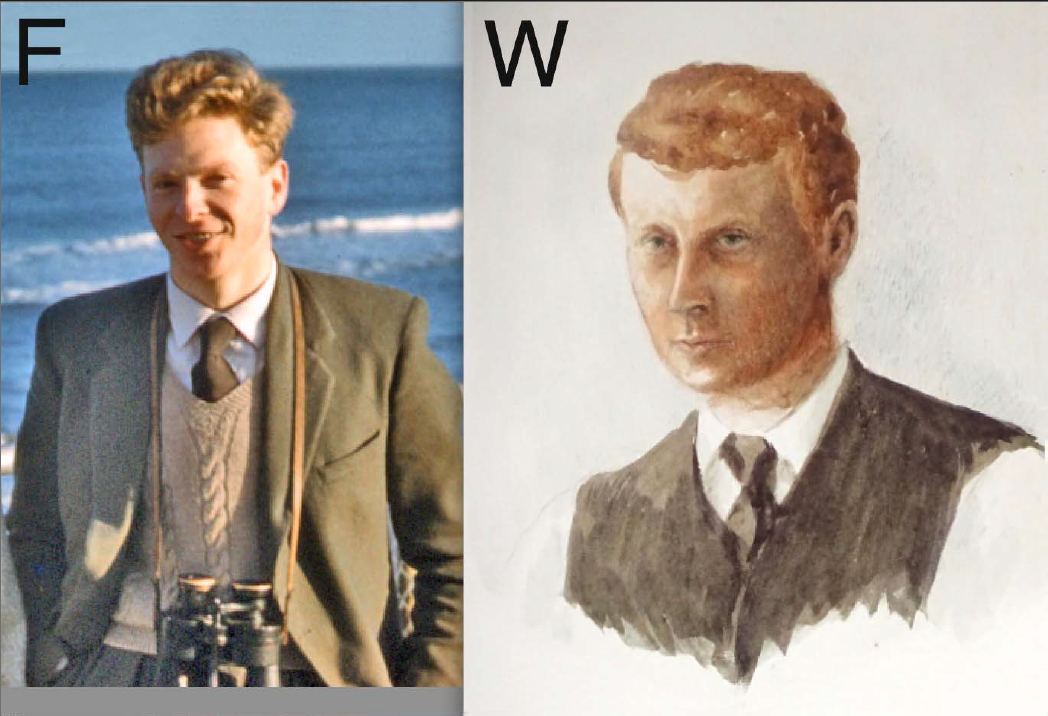
Figure1: 20 Collar Dark Tie copy.
We end: “Following in Wilson’s footsteps leads to a new appreciation of the necessity to understand things; to find reasons for beauty, music, art, and poetry; philosophy, religion, and the occult. Can we solve the problem of finding any acceptable future for humanity?”
- Industrial Standardization of the Bio-OS: Algorithmic Codification of Resilience Engineering Guidelines and Version V8 Architecture
- Climate Variability and the Sustainability of Snail Farming in Nigeria: Past Trends, Present Challenges and Potential Outlook
- The Evaluation of the Surveillance System of Anthrax in Gilgit-Baltistan, Pakistan, 2018
- Natural Decline to Extinction of A New Zealand Rabbit Population
- Mitochondrial Bio-Logistics: Steering Co-Enzyme Q10 and Lycopene Synergies within the Science 4.0 Bio-OS Framework
- Hymenoptera Specimens from the Caño Negro Wetland, of the National Museum Collection, Costa Rica