
Natural Decline to Extinction of A New Zealand Rabbit Population
Early introductions of rabbits (Oryctolagus cuniculus) to New Zealand in 1834 failed, but liberations of Silver-grey and wild type from 1862 to 1868 spread. Most of South Island was occupied by1880 and North Island by 1900. During the initial expansion, rabbits became established in marginal habitats such as alpine grasslands and montane valleys. Those in Nelson Lakes National Park originated partly from Silver-grey stock in Nelson about 1865. In the early 1900s they were present above the tree-line at 1500 m, and on the Travers Valley floor at 600 m. The alpine population apparently did not survive long, but three pockets of rabbits in the Travers Valley remained in 1960. One became extinct about 1964; one was watched carefully for a week each month, declining gradually from 26 rabbits in November 1963 to nil in January 1966; and the third became extinct in the early 1970s. A combination of poor habitat, predation, isolation, and competition from hares (Lepus europaeus) seems responsible.
Introduction
Rabbits, Oryctolagus cuniculus (L.), of domestic breeds, were brought to New Zealand before 1838, but until about 1860 there was little spread despite many liberations. Silver-greys (black domestic rabbits with scattered white hairs) were a favoured breed, introduced into Kaikoura and the Nelson area in 1865, from where they spread inland. The domestic forms “were finally overwhelmed by the grey rabbit from the south” [1] which was the wild-type introduced at Mataura about 1864. In this expansion phase, rabbits occupied even alpine areas: Thomson [1] saw them “in abundance on top of Mt Tyndall-nearly 8000 feet-among the snow-beds.” Henry [2] found “rabbits on all the mountain tops between Manapouri and Te Anau, and through the bush.” A few isolated pockets remained until at least 1960 in alpine areas on Mt Taranaki, the Tararua Range, and two mountains in Fiordland [3].
After occupying most of the eastern South Island by 1880, rabbits began to decline: ...”there has been a steady diminution [from 1895] in the colder and wetter parts of the country...Even in [suitable] spots their numbers declined, and from many of them disappeared altogether” (Begg, quoted by Thomson [1]). The decline was variously attributed to poisoning, shooting, trapping, introduced mustelids, and cats Felis catus L: but in many remote places only changes in natural conditions could have been the cause.
From 1963 to 1966, during a study of hare and rabbit interactions in Nelson Lakes National Park, the rabbits under observation declined to extinction. This paper describes the event, and general changes in adjacent rabbit populations.
Methods
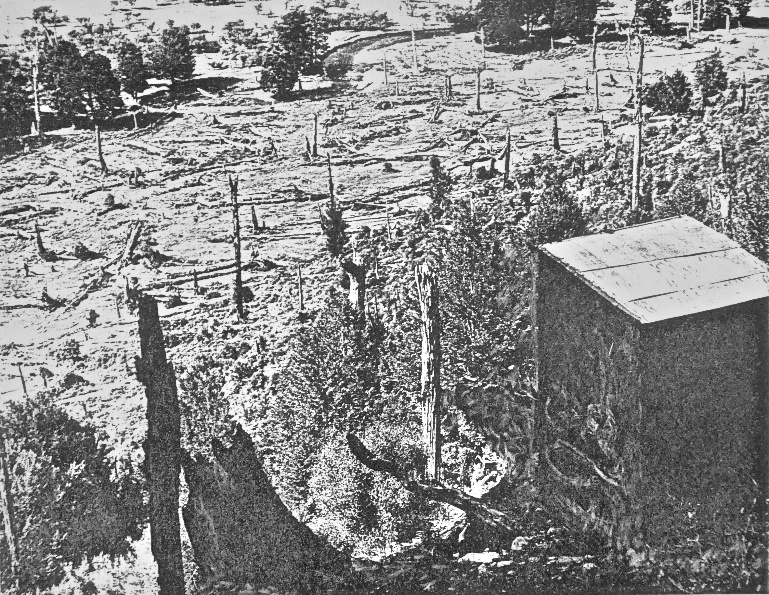
The central study area, “Coldwater”, was 1.5 hectares of grassy river flats in the Travers Valley (41 53 S, 172 49 E). There, up to 12 hares and 30 rabbits fed together and were watched from a permanent hide (Figure 1) at dawn and dusk, for approximately one week each month. Rabbits, hares, and sheep, Ovis aries L., were counted every 15 minutes, giving a total of 1666 counts in 124 days during the 35 months of observation. In addition, five mammalogists working up the Travers Valley recorded rabbit numbers, from 1962 to 1966, at the Lakehead area on the opposite side of the valley from Coldwater, and at Arnst junction, 6 km upstream. No rabbits were seen between these areas.
While living at St Arnaud (1963-64) I noted rabbit distributions, and talked to local people about the history of rabbits in the region.
Results
Because of mixing with domestic breeds, rabbits at Nelson Lakes were multi-coloured: “In the 1890s it was difficult to get enough rabbits to make a rabbit pie” but by 1904 they “were so thick....we nominated one colour to shoot”. The same pattern held in the adjacent Upper Wairau valley: no rabbits in 1899, but by 1906 shepherds “wondered if they were driving sheep or rabbits” [4]. Farmers cleared vegetation to graze sheep above the tree-line (1500 m) on Mt Robert, and the St Arnaud Range, in the 1850s; tussock and scrub were burned annually, and rabbits became abundant. They died out about 1920 when sheep were removed (J. Wrenn pers. comm. 1963). The distribution of rabbit populations in 1960 is shown in Figure 1.
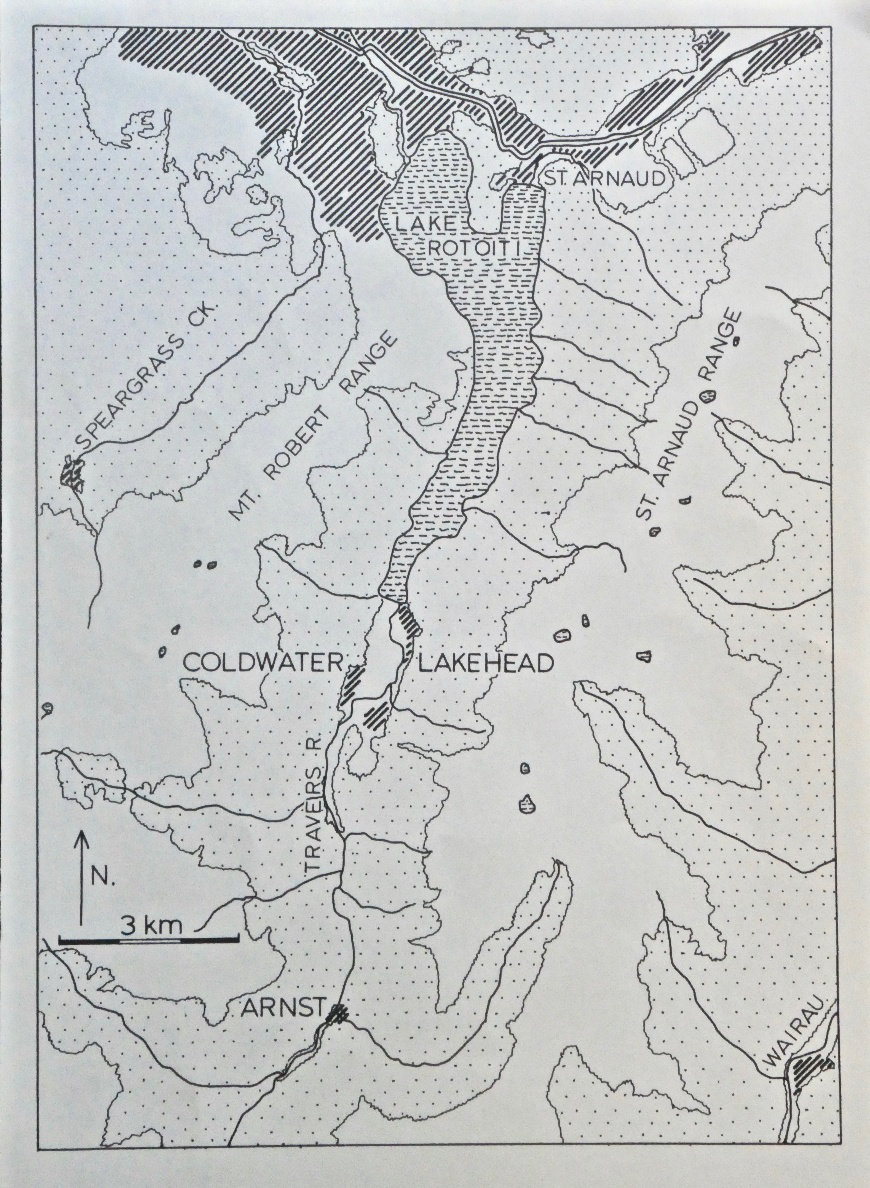
Rabbits in the valleys survived longer-until the 1950s at the top of Speargrass Creek (1400 m), and at three places in the Travers Valley in 1960. The mammalogist’s recorded that the Arnst population (of about 50 rabbits, half silver-greys and half wild-type), died out by 1964; and perhaps 100 at Lakehead declined by 1966 and were extinct by 1970.
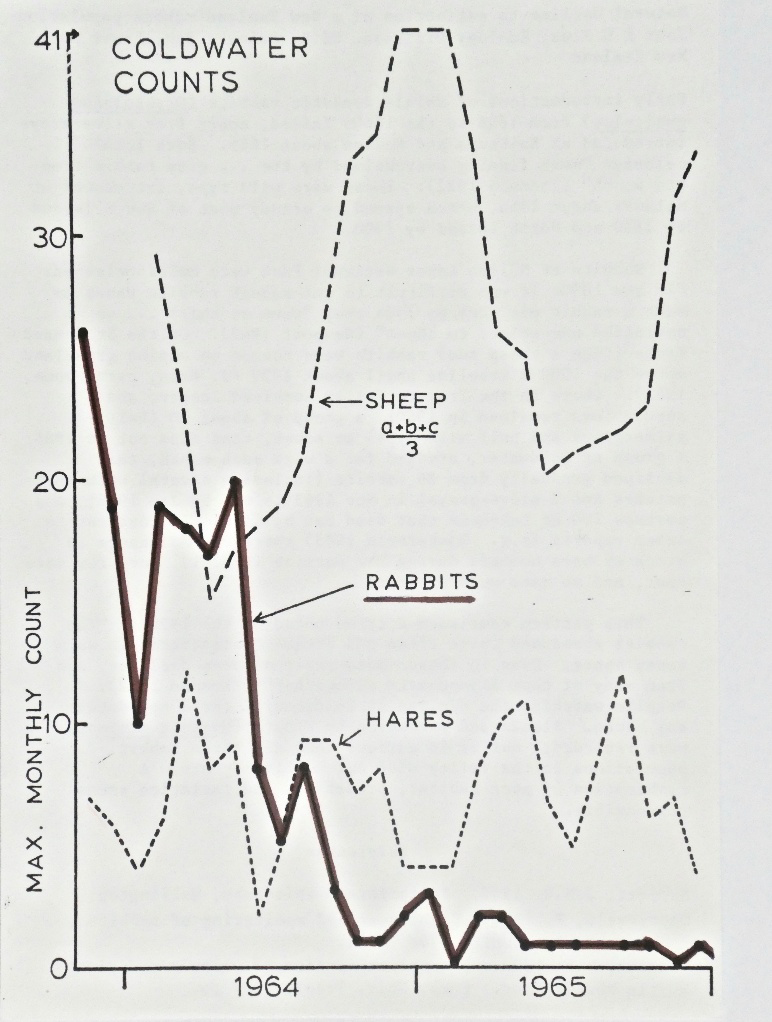
Monthly maximum counts of rabbits, hares, and sheep at Coldwater (Figure 3) show the pattern of decline from 26 rabbits (including two silver-greys and several with white patches) in November 1963 to nil by January 1966. The number of young in the monthly totals show that breeding was reasonably successful in 1963; but only three young were produced by seven adults in 1964 (appearing in August), and these had all disappeared by the beginning of September. The single survivor produced no young in 1965, although a few possible mates were then still available on the other side of the river.
Discussion
The introduction of rabbits into New Zealand resulted in a classical “ecological explosion” [5] with the typical fast spread and subsequent decline. The usual explanation, that the decline follows over-exploitation of the food supply, seems reasonable for rabbits, which have been shown to starve at densities reached in the wild [6]. That the decline was still continuing after 50 years is curious.
Control by poisoning and night shooting probably explains the marked decrease in rabbit numbers in New Zealand since 1945 [7], but isolated populations such as those in the Travers Valley are unlikely to have been affected. From their colours, there was no evidence of recruitment from the large population at Rotoiti (5000 poisoned one night in 1944-Potton [8]) which remained common, while the valley populations disappeared from 1960 to 1970.
Environmental factors may be responsible. A cold winter is marginal for rabbits. The main predators, stoats Mustela erminea L. and harriers Circus approximans Peale, declined from 8 to 2, and 29 to 19, respectively, per 100 hours observation before and after September 1964. Both predators were present before rabbits arrived, and there is no reason for their impact to have increased after 1960. No wild cats were seen in the valley, although they “were everywhere” in 1904 at the rabbit peak [9]. Rabbits often need ungulates to provide short grasslands [10], but there was no decline in sheep, or hare, grazing (Figure 3). Possums Trichosurus vulpecula (Kerr) spread up the Travers Valley from 1960, and often grazed alongside the rabbits, but any competition should have affected hare numbers also. No diseased or dead rabbits were seen.
A combination of poor habitat, predation, isolation, and competition from hares [11] may be the ultimate factor responsible, but a proximate factor to explain the synchrony of the declines remains unknown.
Epilogue
This paper, written in 1985 for the proceedings of a conference, was never published; but the data remain relevant for pest control, and conservation, today. More recent reviews of rabbit and hare populations in New Zealand are available: Flux [12, 13]; King and Forsyth [14]. A detailed history of Rotoiti, Walker [15], includes dates for the arrival and spread of introduced species in the Travers Valley.
Acknowledgements
I am very grateful to Dick Porter for help with the hide counts. Les Batcheler, Peter Bull, Chris Christy, Colin Clarke, Bill Magnusson, and Rowley Tailor kindly filled in Mammal Record cards; John Gibb, Morgan Williams, and three reviewers made helpful comments on the text.
References
-
Thomson GM (1922) The Naturalisation of Animals & Plants in New Zealand. Cambridge University Press, London, UK, pp: 607.
-
Henry R (1884) Notes from Lake Te Anau. New Zealand Journal of Science 2: 82-84.
-
Gibb JA, Flux JEC (1973) Mammals. In: Williams GR (Ed.), The Natural History of New Zealand. Reed, Wellington, pp: 334-371.
-
Newport JNW (1962) Footprints. Whitcombe & Tombs, Wellington pp: 428.
-
Elton C (1958) The Ecology of Invasions by Animals and Plants. Methuen, London, UK, pp: 181.
-
Gibb JA, Ward CP, Ward GD (1978) Natural control of a population of rabbits, Oryctolagus cuniculus (L.) for ten years in the Kourarau enclosure. New Zealand DSIR Bulletin No. 223: 89.
-
Williams JM (1983) The impact of biological research on rabbit control policies in New Zealand. Acta Zoologica Fennica 174: 79-83.
-
Potton C (1984) The story of Nelson Lakes National Park. Nelson Lakes National Park handbook series.
-
Bull PC (1965) Birdlife. In: Host E (Ed.), Nelson Lakes National Park. Nelson Lakes National Park Board, Nelson, pp: 90-96.
-
Oosterveld P (1983) Eight years of monitoring of rabbits and vegetation development on abandoned arable fields grazed by ponies. Acta Zoologica Fennica 174: 71-74.
-
Flux JEC (1993) Relative effect of cats, myxomatosis, traditional control, or competition in removing rabbits from islands. New Zealand Journal of Zoology 20: 13-18.
-
Flux JEC (1997) Status of rabbits (Oryctolagus cuniculus) and hares (Lepus europaeus) in New Zealand. Gibier Faune Sauvage, Game and Wildlife 14: 267-280.
-
Flux JEC (1999) Status, ecology, and control by predators of rabbits and hares in New Zealand. Proceedings of the Rabbit Control, RCD: Dilemmas and Implications Conference. Royal Society of New Zealand Miscellaneous Series 55: 4-9.
-
King CM, Forsyth DM (2001) The Handbook of New Zealand Mammals. In: 3rd (Edn.), CSIRO Publishing, Melbourne, Australia, pp: 538.
-
Walker AK (2025) Up the Lake. The story of Rotoiti. No Catchem Press, Potton & Burton, pp: 176.
- Mitochondrial Bio-Logistics: Steering Co-Enzyme Q10 and Lycopene Synergies within the Science 4.0 Bio-OS Framework
- Hymenoptera Specimens from the Caño Negro Wetland, of the National Museum Collection, Costa Rica
- Science 4.0: Comprehensive Architecture of the Biological Operating System (Bio-OS) A Framework for Systemic Resilience and Industrialized Bio-Governance
- Rabbit on, or Hare Back? Understanding Climate Change
- Clinical Validation of Science 4.0: Flow Steering and Epigenetic Drift Inversion on a 76-Year-Old Hybrid System
- Seeds Planted by another Mind