
Indigenous Knowledge on Parent Adult Tree Locust, Anacridium melanorhodon melanorhodon (Orthoptera: Acrididae) at Ennohoud Locality, West Kordofan State, Sudan
This study was conducted during the season 2013/2014 at Ennohoud Locality, West Kordofan State and dealt with the parent adult tree locust, Anacridium melanorhodon melanorhodon (Orthoptera: Acrididae) the most destructive insect pest of Acacia senegal, Hashab trees, the main source of Gum Arabic production. The study was designed, generally, to scrutinize aspects pertinent documentation of some relevant indigenous knowledge in the area. For documentation of the indigenous knowledge a key informant questionnaire was designed and duly filled by interviewing 100 respondents from Ennohoud Crop Market and 4 villages in the area. The respondents were interviewed for their experience and knowledge in aspects relevant to the adult tree locust. Data were statistically analysed using IBM-SPSS (version 20) software package. Descriptive and inferential statistics were followed for data manipulation. Results indicated that respondents can distinguish between adult tree locust and other locusts. Parent adult tree locust arrived to the area at May and June. Adult tree locust arrived at evening at the same time Hashab trees were newly sprouted. 82% of the respondents believed that copulating was the main activity of parent adult tree locust. Copulating occurred at June. Most of respondents confirm that eggs were laid at June and the peak of eggs hatching occurred at August.
Yahia², Elrashid Imam Elkhidir³ and Omer Rahama Mohamed
Rahama*4
Kordofan, Sudan
respondents confirm that eggs were laid at June and the peak of eggs hatching occurred at August.
Keywords: West Kordufan; Acacia Senegal; Tree locust; Anacridium; Indigenous Knowledge
Introduction
Acacia senegal (L.) Willd. (Hashab) is an important woody tree species that gained, as a major source of Gum Arabic, a great socio-economic and environmental importance in the Sudan [1, 2]. Natural stands of the A. senegal is dominating, what is commonly known as, the Gum Arabic belt which is occupying the area between latitudes 10°–14°N, [3]. This belt is considered as an important biome that accommodates around one fifth of the Sudan’s population and two thirds of its livestock population in addition to other living components that enrich the biodiversity [4]. Gum Arabic is the most important product of this low input production system, which significantly contributes to domestic income and hard currency earnings for the Sudan. The country is accounted for production of more than 70% from the globally marketable Gum Arabic [5, 6, 7, 8, 9]. In Sudan, Kordofan region is historically very famous for the production of Gum Arabic, where Hashab tree is grown and 70% of the Sudanese Gum Arabic was produced [7].
Gum Arabic production is drastically decreased as Hashab tree faced multitude of environmental and biological constraints that lead together with other social factors to a rigorous deterioration in the natural stands of tree. As far as the biological constraints are concerned, insect attacks were implicated as the main causal agents in the decline of the Gum production [10]. Bashier EM [11] reported serious damage by the locust during season 1991/ 1992, where losses in Gum Arabic production were estimated at 86.5%. The effect of the tree locust was neglected or uncared for; however, this locust received a great attention as a pest of many crops in traditional rain- fed areas of western Sudan [12]. Adults were found throughout the year except in February, March and April and their number decreased with increase in rainfall and relative humidity [13]. Adults of the tree locust appeared in the field in May and high populations were recorded during the period from June to September reaching the peak in November [14].
The eggs laid in moist soil during rainy season around mid-July and the estimated average incubation period was 40 days [15, 16]. Eggs hatched giving nymphal stages that develop during August and early September. During the day adults normally roost in trees, and if disturbed, they will fly from branch to branch or to a nearby tree [17]. Symmons PM [16] reported that: during summer, eggs hatched during June-July whereas fledglings were observed in August-October. Most feeding and flight activities occur at night, both adults and nymphs roost on acacia trees [18].
Materials and Methods
A questionnaire was designed to interview rural communities involved in Gum Arabic production (Hashab garden owners and Tappers) for their experience with the tree locust infestation at West Kordofan State, Ennohoud locality in season 2013/2014. Pre-test was conducted to the questionnaire. 100 respondents were randomly selected from 5 clusters. Four (4) village councils surround Ennohoud town were randomly selected and Ennohoud Crop Market. 20 respondents were randomly selected from each village council. Interviews were conducted and data was collected and summarised for analysis.
Data analysis
To fulfil the objectives of this study, descriptive and inferential statistics methods were applied specifically, tabular and graphical presentation measures of central tendency and dispersion analysis of variance and correlation. The study used IBM-SPSS version 20 software for data analysis.
Results
Distinguish between Tree Locust and Other Types of Locusts
Table (1) shows 100% of the respondents were generally distingue ished between tree locust and other types of locusts.
| Categories | Frequency | Percent |
|---|---|---|
| Yes | 100 | 100.0 |
| no | 0.00 | 0.00 |
Table 1: Distinguish between tree locust and other types of locusts
Arrival time of parent adults of the tree locust
Table (2) showed that 41% of the parent adult tree locusts arrived to the area in May and 59% in June.
| Categories | Frequency | Percent |
|---|---|---|
| May | 41 | 41.0% |
| June | 59 | 59.0% |
| Total | 100 | 100.0% |
Table 2: The arrival time of parent adults of the tree locust to the area
The Main Activity of the Arrived Parent Adults Tree Locust
Figure (1) showed the main activity of the arrived adult tree locust was copulation (82%), followed by eating and copulation (16%) and eating 2%.
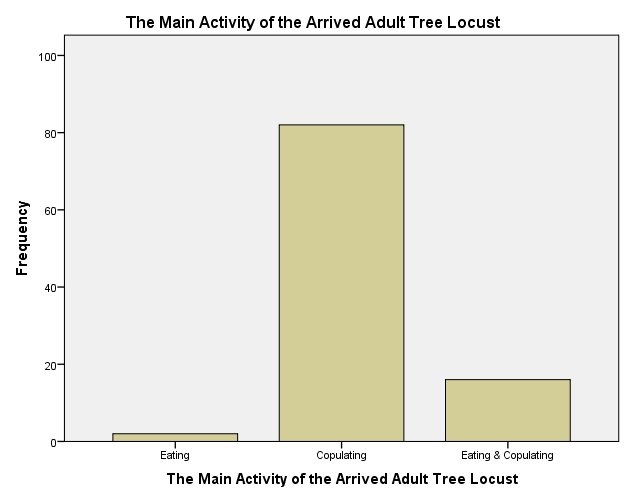
Figure1: The main activity of the arrived parent adult tree locusts
Arrival day time of parent adult tree locust
The day time of adult tree locust arrived, in which all respondents said that it arrived at evening 100%, in (Table 3).
| Categories | Frequency | Percent |
|---|---|---|
| Evening | 100 | 100.0% |
| Mid-day | 0 | 0 |
| Morning | 0.00 | 0.00 |
Table 3: Arrival day time of adult tree locust
The stages of Hashab tree when parent adults tree locust arrived
Table (4) viewed that, 65% of respondents said that tree locust arrived when Hashab is newly sprouting.
| Categories | Frequency | Percent |
|---|---|---|
| Resting Stage | 35 | 35.0% |
| Newly sprout | 65 | 65.0% |
| Total | 100 | 100.0% |
Table 5: The Stage of Hashab tree when adult tree locust arrived
Arrival time of the Parent Adult Tree Locust Arrived and Humidity
Table (5) shows the relationship between arrival of adult tree locust and humidity. All the respondents (100%) agreed that the tree locust arrived in moderate humidity.
| Categories | Frequency | Percent |
|---|---|---|
| Moderate | 100 | 100.00% |
| High | 0.00 | 0.00 |
| Low | 0.00 | 0.00 |
Table 4: Arrival time of the adult tree locust arrived and humidity
The month of parent adults tree locust copulation
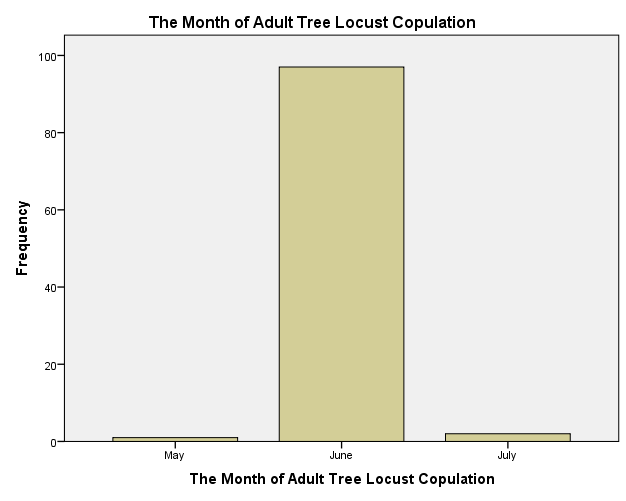
Figure (2) showed the month of adult tree locust copulation 97% of the respondents said the copulation occurred in June.
The month of female adult tree locust laying eggs
Table (6) showed that 82% of the respondents agreed that female adult laying eggs was during June.
| Categories | Frequency | Percent |
|---|---|---|
| June | 82 | 82.0% |
| July | 18 | 18.0% |
| Total | 100 | 100.0% |
Table 6: The month of female adult tree locust laying eggs
The day time of female adult tree locust laying eggs
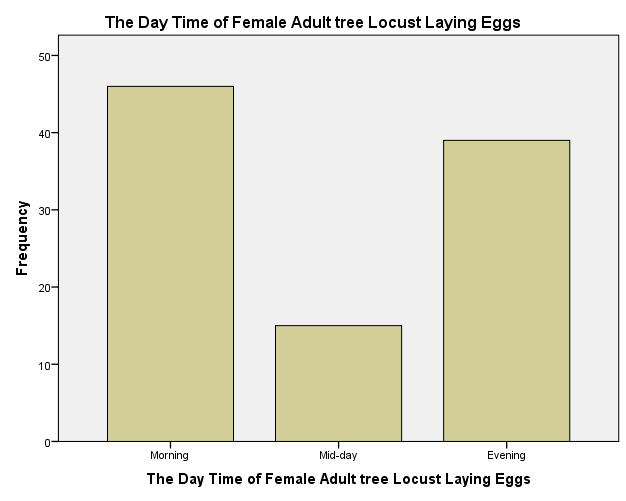
Figure (3) showed that the day time of the adult female tree locust laying eggs gives for (46%, 15% and 39% of the respondents for morning, mid-day and evening, respectively).
The month of tree locust hatching eggs
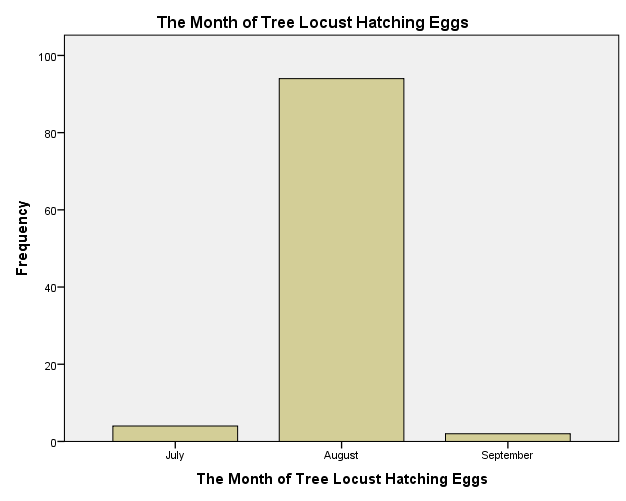
The month of tree locust hatching eggs in (Figure 4) showed that eggs hatched in August (94%).
Discussion
Rahama [14] Stated that adults of the tree locust appeared in the field in May and high populations were recorded during the period from June to September reaching the peak in November Safi [13] found that adults were found throughout the year except in February, March and April. The results of this study showed that the adult mature tree locusts arrived to the area during June and July; the tree locust then leaves the area in October. The results reported herein, obtained from interviewees, are more or less in line with what was earlier indicated by the above mentioned authors. The slight differences, however, may be attributed to the fact that such type of studies maybe influenced by fluctuation of environmental factors from place to place and from season to season.
The main activity of mature adult tree locust observed by was copulation. In June and July when the adults mature tree locust were observed, the main activity was copulation this was confirmed by Safi [13] and Rahama [14].
Conclusion
- Parent adults of the tree locust arrived from elsewhere to invade Acacia senegal trees in June - July, copulation, laying eggs these activities coincide with the effective rainfall.
- Infestation of Hashab trees with locust pose great impacts on taping date and losses inflicted by locust in Gum Arabic production estimated to be around 50%.
Recommendations
- To get a blemish free Gum Arabic produce and to reduce pesticides residues in Gum Arabic, phenology of both Hashab tree and the tree locust should be considered for better targeting of the pest during the locust management operations.
- An area wide monitoring program to pinpoint the origin of the locust invasion and to identify factors that trigger for local and trans-border migration is crucial if efficient control measure is to be applied.
References
-
NAS (1979) Tropical LeGumes: Resource for the Future National Academy of Sciences (NAS), Washington.
-
Mahmoud TE (2004) The adequacy of price Incentives on production, processing and marketing of Gum Arabic in Sudan: A case Study North and West Kordofan. PhD Thesis Submitted to Institute for International Forest and Forest Economics. Technical University, Dresden, Tharandt.
-
Vogt K (1995) A field Workers Guide to the Identification, Propagation and Uses of Common Trees and Shrubs of Dry land Sudan. SOS Sahel International, London, Khartoum, Sudan.
-
Ballal EM, El Siddig EA, Elfadl MA, Luukkanen O (2005) Relationship between Environmental Factors, Tapping Dates, Tapping intensity and Gum Arabic Yield of An Acacia senegal Plantation in Western Sudan. J Arid Environ 63(2): 379-389.
-
Mohammed Abdullah (1961) Behavioral Effects of Temperature Insects. Ohio J Sci 61(4).
-
Sara SA, Rabah A, Ali HI, Mahmoud TE (2016) Acacia seyal Gums in the Sudan: A review. The seventh graduate studies and scientific research conference, University of Khartoum 20-23.
-
Jamal A, Huntsinger L (1993) Deterioration of a sustainable agro-silvo-pastoral system in the Sudan/ the Gum gardens of Kordofan. Agro-forestry Systems l23(1): 23-38.
-
Berry La Verle (2015) Area handbook Series: Sudan-a country study. Fedral Research Division. Library of Congress. Fifth edation, First printing 2015. ISBN 978-0-8444-0750-0.
-
Yasseen AM, ADIL Yousif Eljack, Mohammed, Elawad Dafa Ella Ahmed (2015) Sudan Gum Arabic Export Performance during (2000-2014). Int J Chem Environ Biol Sci 3(5): 260-263.
-
Jamal A (1994) Major insect pests of Gum Arabic Acacia senegal Willd and Acacia seyal L in Western Sudan. J Appl Entomol 117(1-5): 10-20.
-
El Bashier EM (1994) The impact of defoliation by the tree locust {Anacridium melanorhodon melanorhodon (walker)} on the Gum Arabic production by Hashab trees [Acacia Senegal (L.)Willd] MSc. Thesis; University of Khartoum, Faculty of Forestry, 1994.
-
USAID (1990) Supplemental Environmental Assessment (SEA) for USAID Funding of Locust or Grasshopper Pesticide Usages in Sudan.
-
Safi, Ahmed Ismail Ahmed Safi (2011) Assessment of Damage by the Tree Locust (Anacridium melanorhodon melanorhodon ) on Hashab Tree (Acacia senegal) using Ground Surveys and Remote Sensing Data. A thesis submitted to the Graduate College, University Khartoum in fulfilment of the requirements for the degree of Doctor of Philosophy in Agriculture**.**
-
Rahama, Omer Rahama Mohamed, Magzoub Omer Bashir Ahmed, Mutassim Mohamed Yassin (2017) Sesonal Occerance of the Tree locust, Anacridium melanorhodon melanorhodon on Acacia senegal in North Kordofan State, Sudan.
-
Ibrahim M, Abdalla MA (2015) Bio-ecology of Anacridium Melanorhodon Melanorhodon, (Orthoptera: Acrididae) on Acacia Senegal in North Kordofan State, Sudan. Tropentag, September 16-18, 2015, Berlin, Germany.
-
Symmons PM, Cressman K (2001) Desert locust guidelines, Biology and Behaviour. Food and Agriculture Organization of the United Nations (FAO). Second edition 2001.
-
Steedman A (1990) Locust Handbook. Natural Resources Institute, VI + 204pp. 3rd (Edn.), ISBN 0- 85954-281-5.
-
Song Hojun (2010) Density-Dependent Phase Polyphenism in Nonmodel Locusts: A Minireview. Hindawi publisher corporation, Psyche-volume 2011, article ID 741769-16 pages.
- Lessons to Learn: Trees are More than the Lungs of the World
- Community Forestry Enterprises as a Model for Sustainable Forest Development: The Case Of The "Baja Tarahumara" in Chihuahua, Mexico
- Ecological and Socio-Economic Impacts of Chromolaena odorata and Mesosphaerum suaveolens, Two Invasive Alien Species in Central and Southern Benin, West Africa
- Epigenetic Sustainability: Modeling the Human Factor as a Natural Resource through Science 4.0 and the NR3C1 Biological Pilot
- Growth-at-Risk: A Framework for Assessing Economic Vulnerability
- The Rural Territory as a Socioecological System for the Management of Public Policy for Sustainable Rural Development