
Avifaunal Composition of Municipal Areas of Ajmer District, Rajasthan, India
The urbanization is the key phenomenon of the Information Age. The tremendous growth of the urban areas has developed a new interest of the conservationists to work in the direction of synchronizing the conservation of the habitats and associated species with the pace of development. These man-made ecosystems have the spaces with high biological diversity. In the series of the work of the authors in the central chain of the Aravalli Hills (Rajasthan, India), the present investigation has been carried out in the urban areas of the central district of Rajasthan, i.e., Ajmer. The investigation aimed to review and prepare comprehensive database through assessment of the avifaunal species of the municipal area of Ajmer. The seasonal surveys and periodic sampling observations were taken for twenty-four months from February 2017 to January 2019. In the present study the urban area was classified into three regions namely, the Urban Green Patches (UGP), Urban Aquatic Area (UAA) and Human Settlement Area (HSA). The terrestrial habitats of UGA & HSA harbored 104 species and 41 species respectively whereas the aquatic habitats categorized as UAA harbored 95 species. The Relative Diversity Index of the various species was calculated to observe the species dominance in a particular area. Thus, the present investigation recorded 167 species from 58 families. The earlier studies recorded around 235 species of 62 families from the Ajmer District which included the urban, rurban and rural environs. There was addition of 13 new species in the checklist along with two families. Thus, the cumulative list presents an account of 243 bird species from 64 families from different habitats of Ajmer District.
Introduction
The urbanization process has given rise to the human dominated landscapes with complex ecological systems as the urban ecosystems which need to be explored and converted to the opportunity [1, 2, 3, 4, 5, 6, 7]. Such man-made ecosystems have certain areas of high biological diversity. These sites are the point of interest for the conservationists for the study of the urban biodiversity especially avifauna. The patterns of biodiversity determine the features of the urban ecosystems.
Rajasthan (India) owes diversity of the habitats which area also evident in the human settlements. The western low rainfall desert region, central hilly terrains, eastern high rainfall terrains of plains and plateau provide habitats for diverse avifauna. Over 500 avifaunal species are being recorded from the state of Rajasthan. The Aravalli Hills harbor over 300 avifaunal species, near about eighty percent of which are recorded from the central parts [3, 5, 6, 8]. The study of the birds gives the better understanding of the past and present status of the biodiversity of the area. The environmental challenges could be better understood by the birds [9, 10, 11]. Further, monitoring the species abundance, habitat preference, and correlation between species abundance and habitat provides basic information for determining factors causing population fluctuation of bird species. Richness, abundance and community composition are often used by ecologists to understand the diversity of species in their natural occurrence [12]. The change in vegetation composition could impact the quality and quantity of habitat for birds in terms of food, water and cover which can further affect the diversity, abundance and distribution of birds [13]. In order to prioritize the future conservation of species, understanding the effect of habitat on bird community structure is important [14]. In the long run, the relative value of different habitats and conservation importance of sites can be assessed by investigating the diversity of birds present at those sites [15].
Material and Methods
Profile of Study Area
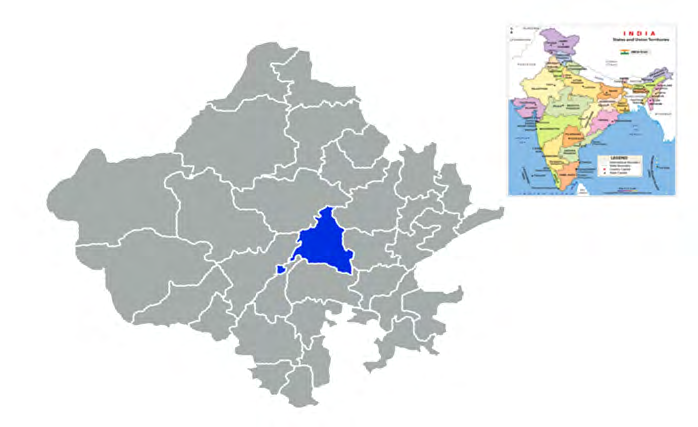
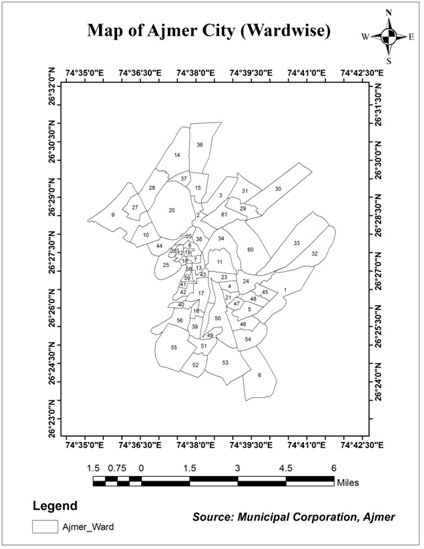
Rajasthan is situated in north – western part of India between the latitude 230 03’ to 300 12’ N and longitude 690 30’ to 780 17’E. It is the largest state of the Republic of India by area. Geographical features include the Thar Desert, Aravalli Mountain Ranges, Southern Malwa Plateau and Eastern plains. The Ajmer District is located nearly in the center of the Rajasthan and bordered with one of the world oldest mountain ranges i.e. Aravalli Hills (Figure 1). The Ajmer Municipal area lies in the foothills of the Central Aravalli Hills with the highest peak Taragarh (870 feet) (Figure 2). It experiences a mean annual rainfall of 573mm but scanty and often uncertain. Temperature ranges from 20C to 460C. The summers are extremely hot in this part. However, there are many climate changes the Aravalli has witnessed in the recent past, particularly the rainfall, temperature fluctuation and shift of weathers.
For the ease of study, the habitats of the municipal area of Ajmer city in the present study was categorized under two broad groups.
A. Urban Aquatic Areas (UAA): All perennial and seasonal water bodies within the municipal limits of Ajmer city were categorized under Urban Aquatic Areas (Anasagar Lake, Foy Sagar Lake, Chaurasiywas Talab, Paal Bichla Talab and Khanpura Talab). B. Urban Terrestrial Areas: The terrestrial area within the municipal limits of Ajmer city which was further classified as: Human Settlement Areas (HSA): Areas with direct human involvement and high anthropogenic pressure were included in this category (Constructed areas, buildings, roads etc.). Urban Green Patches (UGP): This includes areas with less human intervention and lesser anthropogenic pressure (Institutional and Urban gardens, Agricultural fields, green patches of hillock of Aravalli).
Field Studies and Surveys
The field surveys and observations were taken for the period of two years February 2017 to January 2019. Recording of the bird species were also made from the calls. Regular surveys carried out by systematically walking on the fixed routes through the study area. Systematic observations of the species in different habitats of the municipal limits (Figure 2) were recorded from 6:00 to 9:00 hrs and from 16:00 to 18:00 hrs. General observations were also made during other timings too. The nomenclature is after Manakadan & Pittie [16], and taxonomic arrangement is following Gill & Donsker [17]. The status of the species like resident, winter migrant, summer migrant and passage migrant were assigned were assigned as per the observations in each survey based on the presence/absence method along with analysis of the other parameters.
Data Collection and Analysis
Relative Diversity (RDi): The relative diversity (RDi) of families was calculated using the following formula [18]
Number of birdspeciesin a family RDi 100 Totalnumber of Species = ×
Similarity Indices: Similarity indices between the intensive study sites were calculated using Jaccard Index and Sorenson Index [12].
Jaccard Index:
$$ c _ {j} = \frac {j}{(a + b - j)} $$
Where j = the number of species common to both sites
Observation and Results
a = the number of species in site A and b = the number of species in site b Sorenson Index:
$$ c _ {8} = \frac {2 j}{(a + b - j)} $$
j = the number of species common to both sites
a = the number of species in site A and
b = the number of species in site b
| S. No. | Common Name | Scientific Name | UAA | HSA | UGP |
|---|---|---|---|---|---|
| Grebes | Podicipedidae | ||||
| 1 | Little Grebe | Tachybaptus ruficollis | + | - | - |
| Pelicans | Pelecanidae | ||||
| 2 | Great White Pelican | Pelecanus onocrotalus | + | - | - |
| 3 | Dalmatian Pelican | Pelecanus crispus | + | - | - |
| Cormorants/Shags | Phalacrocoracidae | ||||
| 4 | Little Cormorant | Phalacrocorax niger | + | - | - |
| 5 | Indian Shag | Phalacrocorax fuscicollis | + | - | - |
| 6 | Great Cormorant | Phalacrocorax carbo | + | - | - |
| Darters | Anhingidae | ||||
| 7 | Darter | Anhinga melanogaster | + | - | - |
| Herons, Egrets & Bitterns | Ardeidae | ||||
| 8 | Little Egret | Egretta garzetta | + | - | - |
| 9 | Grey Heron | Ardea cinerea | + | - | - |
| 10 | Purple Heron | Ardea purpurea | + | - | - |
| 11 | Large Egret | Casmerodius albus | + | - | - |
| 12 | Median Egret | Mesophoyx intermedia | + | + | - |
| 13 | Cattle Egret | Bubulcus ibis | + | + | + |
| 14 | Indian Pond-Heron | Ardeola grayii | + | + | + |
| 15 | Little Green Heron | Butorides striatus | + | - | - |
| 16 | Black-crowned Night-Heron | Nycticorax nycticorax | + | - | - |
| Storks | Ciconiidae | ||||
| 17 | Painted Stork | Mycteria leucocephala | + | - | + |
| 18 | Asian Openbill-Stork | Anastomus oscitans | + | - | - |
| Ibises & Spoonbills | Threskiornithidae | ||||
| 19 | Glossy Ibis | Plegadis falcinellus | + | - | - |
| 20 | Oriental White Ibis | Threskiornis melanocephalus | + | - | - |
| 21 | Black Ibis | Pseudibis papillosa | + | - | + |
| 22 | Eurasian Spoonbill | Platalea leucorodia | + | - | - |
| Flamingos | Phoenicopteridae | ||||
| 23 | Greater Flamingo | Phoenicopterus ruber | + | - | - |
| Swans, Geese & Ducks | Anatidae | ||||
| 24 | Greylag Goose | Anser anser | + | - | - |
| 25 | Bar-headed Goose | Anser indicus | + | - | - |
| 26 | Brahminy Shelduck | Tadorna ferruginea | + | - | - |
| 27 | Comb Duck | Sarkidiornis melanotos | + | - | - |
| 28 | Gadwall | Anas strepera | + | - | - |
| 29 | Eurasian Wigeon | Anas penelope | + | - | - |
| 30 | Mallard | Anas platyrhynchos | + | - | - |
| 31 | Spot-billed Duck | Anas poecilorhyncha | + | - | - |
| 32 | Northern Shoveller | Anas clypeata | + | - | - |
| 33 | Northern Pintail | Anas acuta | + | - | - |
| 34 | Garganey | Anas querquedula | + | - | - |
| 35 | Common Teal | Anas crecca | + | - | - |
| 36 | Red-crested Pochard | Rhodonessa rufina | + | - | - |
| 37 | Common Pochard | Aythya ferina | + | - | - |
| 38 | Ferruginous Pochard | Aythya nyroca | + | - | - |
| Hawks, Eagles, Buzzards, Old World Vultures, Kites, Harriers | Accipitridae | ||||
| 39 | Oriental Honey-Buzzard | Pernis ptilorhynchus | - | - | + |
| 40 | Black-shouldered Kite | Elanus caeruleus | - | - | + |
| 41 | Black Kite | Milvus migrans | + | + | + |
| 42 | Egyptian Vulture | Neophron percnopterus | - | - | + |
| 43 | Short-toed Snake-Eagle | Circaetus gallicus | - | - | + |
| 44 | Western Marsh-Harrier | Circus aeruginosus | + | - | + |
| 45 | Shikra | Accipiter badius | - | + | + |
| 46 | Tawny Eagle | Aquila rapax | - | - | + |
| 47 | Steppe Eagle | Aquila nipalensis | - | - | + |
| Osprey | Pandionidae | ||||
| 48 | Osprey | Pandion haliaetus | + | - | - |
| Falcons | Falconidae | ||||
| 49 | Common Kestrel | Falco tinnunculus | - | - | + |
| Pheasants, Partridges, Quails | Phasianidae | ||||
| 50 | Grey Francolin | Francolinus pondicerianus | - | + | + |
| 51 | Rain Quail | Coturnix coromandelica | - | - | + |
| 52 | Jungle Bush-Quail | Perdicula asiatica | - | - | + |
| 53 | Indian Peafowl | Pavo cristatus | - | + | + |
| Rails, Crakes, Moorhens, Coots | Rallidae | ||||
| 54 | White-breasted Waterhen | Amaurornis phoenicurus | + | - | + |
| 55 | Purple Moorhen | Porphyrio porphyrio | + | - | - |
| 56 | Common Moorhen | Gallinula chloropus | + | - | - |
| 57 | Common Coot | Fulica atra | + | - | - |
| Jacanas | Jacanidae | ||||
| 58 | Pheasant-tailed Jacana | Hydrophasianus chirurgus | + | - | - |
| 59 | Bronze-winged Jacana | Metopidius indicus | + | - | - |
| Painted-Snipes | Rostratulidae | ||||
| 60 | Greater Painted-Snipe | Rostratula benghalensis | + | - | - |
| Plovers, Dotterels, Lapwings | Charadriidae | ||||
| 61 | Little Ringed Plover | Charadrius dubius | + | - | - |
| 62 | Kentish Plover | Charadrius alexandrinus | + | - | - |
| 63 | Yellow-wattled Lapwing | Vanellus malabaricus | + | - | + |
| 64 | Red-wattled Lapwing | Vanellus indicus | + | + | + |
| Sandpipers, Stints, Snipes, Godwits & Curlews | Scolopacidae | ||||
| 65 | Common Snipe | Gallinago gallinago | + | - | - |
| 66 | Black-tailed Godwit | Limosa limosa | + | - | - |
| 67 | Spotted Redshank | Tringa erythropus | + | - | - |
| 68 | Common Redshank | Tringa totanus | + | - | - |
| 69 | Wood Sandpiper | Tringa glareola | + | - | - |
| 70 | Common Sandpiper | Actitis hypoleucos | + | - | + |
| 71 | Little Stint | Calidris minuta | + | - | + |
| 72 | Temminck’s Stint | Calidris temminckii | + | - | - |
| 73 | Ruff | Philomachus pugnax | + | - | + |
| Ibisbill, Avocets & Stilts | Recurvirostridae | ||||
| 74 | Black-winged Stilt | Himantopus himantopus | + | + | + |
| 75 | Pied Avocet | Recurvirostra avosetta | + | - | - |
| Gulls, Terns & Noddies | Laridae | ||||
| 76 | Pallas’s Gull | Larus ichthyaetus | + | - | - |
| 77 | Brown-headed Gull | Larus brunnicephalus | + | - | - |
| 78 | Black-headed Gull | Larus ridibundus | + | - | - |
| 79 | Gull-billed Tern | Gelochelidon nilotica | + | - | - |
| 80 | River Tern | Sterna aurantia | + | - | - |
| 81 | Whiskered Tern | Chlidonias hybridus | + | - | - |
| Sandgrouse | Pteroclididae | ||||
| 82 | Chestnut-bellied Sandgrouse | Pterocles exustus | - | - | + |
| 83 | Painted Sandgrouse | Pterocles indicus | - | - | + |
| Pigeons & Doves | Columbidae | ||||
| 84 | Blue Rock Pigeon | Columba livia | + | + | + |
| 85 | Little Brown Dove | Streptopelia senegalensis | + | + | + |
| 86 | Red Collared-Dove | Streptopelia tranquebarica | - | - | + |
| 87 | Eurasian Collared-Dove | Streptopelia decaocto | + | + | + |
| 88 | Yellow-legged Green-Pigeon | Treron phoenicoptera | - | - | + |
| Parakeets & Hanging-Parrots | Psittacidae | ||||
| 89 | Alexandrine Parakeet | Psittacula eupatria | - | - | + |
| 90 | Rose-ringed Parakeet | Psittacula krameri | + | + | + |
| 91 | Plum-headed Parakeet | Psittacula cyanocephala | - | - | + |
| Cuckoos, Malkohas & Coucals | Cuculidae | ||||
| 92 | Asian Koel | Eudynamys scolopacea | - | + | + |
| 93 | Greater Coucal | Centropus sinensis | - | - | + |
| Owls | Strigidae | ||||
| 94 | Spotted Owlet | Athene brama | - | + | + |
| Nightjars | Caprimulgidae | ||||
| 95 | Common Indian Nightjar | Caprimulgus asiaticus | - | - | + |
| Swifts | Apodidae | ||||
| 96 | House Swift | Apus affinis | - | - | + |
| Kingfishers | Alcedinidae | ||||
| 97 | Small Blue Kingfisher | Alcedo atthis | + | - | - |
| 98 | White-breasted Kingfisher | Halcyon smyrnensis | + | + | + |
| 99 | Lesser Pied Kingfisher | Ceryle rudis | + | - | - |
| Bee-eaters | Meropidae | ||||
| 100 | Small Bee-eater | Merops orientalis | + | + | + |
| 101 | Blue-cheeked Bee-eater | Merops persicus | - | - | + |
| 102 | Blue-tailed Bee-eater | Merops philippinus | - | - | + |
| Rollers | Coraciidae | ||||
| 103 | European Roller | Coracias garrulus | - | - | + |
| 104 | Indian Roller | Coracias benghalensis | + | - | + |
| Hoopoes | Upupidae | ||||
| 105 | Common Hoopoe | Upupa epops | - | + | + |
| Hornbills | Bucerotidae | ||||
| 106 | Indian Grey Hornbill | Ocyceros birostris | - | + | + |
| Barbets | Capitonidae | ||||
| 107 | Coppersmith Barbet | Megalaima haemacephala | - | + | + |
| Woodpeckers | Picidae | ||||
| 108 | Eurasian Wryneck | Jynx torquilla | - | - | + |
| 109 | Lesser Golden-backed Woodpecker | Dinopium benghalense | - | + | + |
| Larks | Alaudidae | ||||
| 110 | Singing Bush-Lark | Mirafra cantillans | - | - | + |
| 111 | Common Crested Lark | Galerida cristata | - | - | + |
| Swallows & Martins | Hirundinidae | ||||
| 112 | Dusky Crag-Martin | Hirundo concolor | - | + | + |
| 113 | Wire-tailed Swallow | Hirundo smithii | + | + | + |
| 114 | Red-rumped Swallow | Hirundo daurica | - | - | + |
| 115 | Streak-throated Swallow | Hirundo fluvicola | - | - | + |
| Wagtails & Pipits | Motacillidae | ||||
| 116 | Large Pied Wagtail | Motacilla maderaspatensis | + | - | - |
| 117 | Citrine Wagtail | Motacilla citreola | + | - | - |
| 118 | Yellow Wagtail | Motacilla flava | + | - | - |
| 119 | Paddyfield Pipit | Anthus rufulus | + | - | + |
| Cuckoo-Shrikes, Flycatcher-Shrikes, Trillers, Minivets, Woodshrikes | Campephagidae | ||||
| 120 | Small Minivet | Pericrocotus cinnamomeus | - | - | + |
| 121 | Common Woodshrike | Tephrodornis pondicerianus | - | + | + |
| Bulbuls & Finchbills | Pycnonotidae | ||||
| 122 | White-eared Bulbul | Pycnonotus leucotis | - | - | + |
| 123 | Red-vented Bulbul | Pycnonotus cafer | + | + | + |
| Shrikes | Laniidae | ||||
| 124 | Bay-backed Shrike | Lanius vittatus | - | - | + |
| 125 | Rufous-backed Shrike | Lanius schach | - | - | + |
| 126 | Southern Grey Shrike | Lanius meridionalis | - | + | + |
| Thrushes, Shortwings, Robins, Forktails, Wheaters | Turdinae | ||||
| 127 | Bluethroat | Luscinia svecica | + | - | - |
| 128 | Oriental Magpie-Robin | Copsychus saularis | - | - | + |
| 129 | Indian Robin | Saxicoloides fulicata | - | + | + |
| 130 | Black Redstart | Phoenicurus ochruros | - | - | + |
| 131 | Common Stonechat | Saxicola torquata | - | - | + |
| 132 | Pied Bushchat | Saxicola caprata | - | - | + |
| 133 | Desert Wheatear | Oenanthe deserti | - | - | + |
| 134 | Isabelline Wheatear | Oenanthe isabellina | - | - | + |
| 135 | Indian Chat | Cercomela fusca | - | + | + |
| Babblers, Laughingthrushes, Babaxes, Barwings, Yuhinas | Timaliinae | ||||
| 136 | Yellow-eyed Babbler | Chrysomma sinense | + | - | - |
| 137 | Common Babbler | Turdoides caudatus | - | - | + |
| 138 | Large Grey Babbler | Turdoides malcolmi | - | + | + |
| 139 | Jungle Babbler | Turdoides striatus | - | - | + |
| Goldcrest, Prinias, Tesias, Warblers | Sylviinae | ||||
| 140 | Ashy Prinia | Prinia socialis | - | + | + |
| 141 | Rufous-fronted Prinia | Prinia buchanani | - | - | + |
| 142 | Plain Prinia | Prinia inornata | - | - | + |
| 143 | Common Chiffchaff | Phylloscopus collybita | - | + | + |
| 144 | Common Lesser Whitethroat | Sylvia curruca | - | + | + |
| Flycatchers | Muscicapinae | ||||
| 145 | Red-throated Flycatcher | Ficedula parva | - | - | + |
| 146 | Grey-headed Flycatcher | Culicicapa ceylonensis | - | - | + |
| Monarch-Flycatchers & Paradise- Flycatchers | Monarchinae | ||||
| 147 | Asian Paradise-Flycatcher | Terpsiphone paradisi | - | - | + |
| Fantail-Flycatchers | Rhipidurinae | ||||
| 148 | White-browed Fantail-Flycatcher | Rhipidura aureola | - | - | + |
| Tits | Paridae | ||||
| 149 | Great Tit | Parus major | - | - | + |
| Sunbirds & Spiderhunters | Nectariniidae | ||||
| 150 | Purple Sunbird | Nectarinia asiatica | - | + | + |
| White-eyes | Zosteropidae | ||||
| 151 | Oriental White-eye | Zosterops palpebrosus | - | - | + |
| Buntings | Emberizinae | ||||
| 152 | Crested Bunting | Melophus lathami | - | - | + |
| Finches | Fringillidae | ||||
| 153 | Common Rosefinch | Carpodacus erythrinus | + | - | + |
| Munias (Estrildid Finches) | Estrildidae | ||||
| 154 | White-throated Munia | Lonchura malabarica | - | - | + |
| 155 | Spotted Munia | Lonchura punctulata | - | - | + |
| Sparrows & Snowfinches | Passerinae | ||||
| 156 | House Sparrow | Passer domesticus | + | + | + |
| 157 | Yellow-throated Sparrow | Petronia xanthocollis | - | - | + |
| Weavers | Ploceinae | ||||
| 158 | Baya Weaver | Ploceus philippinus | + | - | + |
| Starlings & Mynas | Sturnidae | ||||
| 159 | Brahminy Starling | Sturnus pagodarum | - | + | + |
| 160 | Rosy Starling | Sturnus roseus | + | - | + |
| 161 | Asian Pied Starling | Sturnus contra | + | + | + |
| 162 | Common Myna | Acridotheres tristis | + | + | + |
| 163 | Bank Myna | Acridotheres ginginianus | + | + | + |
| Orioles | Oriolidae | ||||
| 164 | Eurasian Golden Oriole | Oriolus oriolus | - | - | + |
| Drongos | Dicruridae | ||||
| 165 | Black Drongo | Dicrurus macrocercus | + | + | + |
| Crows, Jays, Treepies, Magpies | Corvidae | ||||
| 166 | Indian Treepie | Dendrocitta | - | + | + |
| 167 | House Crow | Corvus splendens | + | + | + |
Table 1: The Avi-Faunal Composition of Municipal Area of Ajmer District, Rajasthan (Family wise species occurrence at classified
| S. No. | Family Commonly Known as | Family Name | Overall Rdi | No of Species in UAA | No of Species in HSA | No of Species in UGP |
|---|---|---|---|---|---|---|
| 1 | Grebes | Podicipedidae | 0.6 | 1 | 0 | 0 |
| 2 | Pelicans | Pelecanidae | 1.19 | 2 | 0 | 0 |
| 3 | Cormorants/Shags | Phalacrocoracidae | 1.79 | 3 | 0 | 0 |
| 4 | Darters | Anhingidae | 0.6 | 1 | 0 | 0 |
| 5 | Herons, Egrets & Bitterns | Ardeidae | 5.36 | 9 | 3 | 2 |
| 6 | Storks | Ciconiidae | 1.19 | 2 | 0 | 1 |
| 7 | Ibises & Spoonbills | Threskiornithidae | 2.38 | 4 | 0 | 0 |
| 8 | Flamingos | Phoenicopteridae | 0.6 | 1 | 0 | 0 |
| 9 | Swans, Geese & Ducks | Anatidae | 8.93 | 15 | 0 | 0 |
| 10 | Hawks, Eagles, Buzzards, Old World Vultures, Kites, Harriers | Accipitridae | 5.36 | 2 | 2 | 9 |
| 11 | Osprey | Pandionidae | 0.6 | 1 | 0 | 0 |
| 12 | Falcons | Falconidae | 0.6 | 0 | 0 | 1 |
| 13 | Pheasants, Partridges, Quails | Phasianidae | 2.38 | 0 | 2 | 4 |
| 14 | Rails, Crakes, Moorhens, Coots | Rallidae | 2.38 | 4 | 0 | 1 |
| 15 | Jacanas | Jacanidae | 1.19 | 2 | 0 | 0 |
| 16 | Painted-Snipes | Rostratulidae | 0.6 | 1 | 0 | 0 |
| 17 | Sandpipers, Stints, Snipes, Godwits & Curlews | Scolopacidae | 5.36 | 4 | 1 | 2 |
| 18 | Plovers, Dotterels, Lapwings | Charadriidae | 2.38 | 9 | 0 | 3 |
| 19 | Ibisbill, Avocets & Stilts | Recurvirostridae | 1.19 | 2 | 1 | 1 |
| 20 | Gulls, Terns & Noddies | Laridae | 3.57 | 6 | 0 | 0 |
| 21 | Sandgrouse | Pteroclididae | 1.19 | 0 | 0 | 2 |
| 22 | Pigeons & Doves | Columbidae | 2.98 | 3 | 3 | 5 |
| 23 | Parakeets & Hanging- Parrots | Psittacidae | 1.79 | 1 | 1 | 3 |
| 24 | Cuckoos, Malkohas & Coucals | Cuculidae | 1.19 | 0 | 1 | 2 |
| 25 | Owls | Strigidae | 0.6 | 0 | 1 | 1 |
| 26 | Nightjars | Caprimulgidae | 0.6 | 0 | 0 | 1 |
| 27 | Swifts | Apodidae | 0.6 | 0 | 0 | 1 |
| 28 | Kingfishers | Alcedinidae | 1.79 | 3 | 1 | 1 |
| 29 | Bee-eaters | Meropidae | 1.79 | 1 | 1 | 3 |
| 30 | Rollers | Coraciidae | 1.19 | 1 | 0 | 2 |
| 31 | Hoopoes | Upupidae | 0.6 | 0 | 1 | 1 |
| 32 | Hornbills | Bucerotidae | 0.6 | 0 | 1 | 1 |
| 33 | Barbets | Capitonidae | 0.6 | 0 | 1 | 1 |
| 34 | Woodpeckers | Picidae | 1.19 | 0 | 1 | 2 |
| 35 | Larks | Alaudidae | 1.19 | 0 | 0 | 2 |
| 36 | Swallows & Martins | Hirundinidae | 2.38 | 1 | 2 | 4 |
| 37 | Wagtails & Pipits | Motacillidae | 2.38 | 4 | 0 | 1 |
| 38 | Cuckoo-Shrikes, Flycatcher-Shrikes, Trillers, Minivets, Woodshrikes | Campephagidae | 1.19 | 0 | 1 | 2 |
| 39 | Bulbuls & Finchbills | Pycnonotidae | 1.19 | 1 | 1 | 2 |
| 40 | Shrikes | Laniidae | 1.79 | 0 | 1 | 3 |
| 41 | Thrushes, Shortwings, Robins, Forktails, Wheaters | Turdinae | 5.36 | 1 | 2 | 8 |
| 42 | Babblers, Laughingthrushes, Babaxes, Barwings, Yuhinas | Timaliinae | 2.38 | 1 | 1 | 3 |
| 43 | Goldcrest, Prinias, Tesias, Warblers | Sylviinae | 2.98 | 0 | 3 | 5 |
| 44 | Flycatchers | Muscicapinae | 1.19 | 0 | 0 | 2 |
| 45 | Monarch-Flycatchers & Paradise-Flycatchers | Monarchinae | 0.6 | 0 | 0 | 1 |
| 46 | Fantail-Flycatchers | Rhipidurinae | 0.6 | 0 | 0 | 1 |
| 47 | Tits | Paridae | 0.6 | 0 | 0 | 1 |
| 48 | Sunbirds & Spiderhunters | Nectariniidae | 0.6 | 0 | 1 | 1 |
| 49 | White-eyes | Zosteropidae | 0.6 | 0 | 0 | 1 |
| 50 | Buntings | Emberizinae | 0.6 | 0 | 0 | 1 |
| 51 | Finches | Fringillidae | 0.6 | 1 | 0 | 1 |
| 52 | Munias (Estrildid Finches) | Estrildidae | 1.19 | 0 | 0 | 2 |
| 53 | Sparrows & Snowfinches | Passerinae | 1.19 | 1 | 1 | 2 |
| 54 | Weavers | Ploceinae | 0.6 | 1 | 0 | 1 |
| 55 | Starlings & Mynas | Sturnidae | 3.57 | 4 | 4 | 5 |
| 56 | Orioles | Oriolidae | 0.6 | 0 | 0 | 1 |
| 57 | Drongos | Dicruridae | 0.6 | 1 | 1 | 1 |
| 58 | Crows, Jays, Treepies, Magpies | Corvidae | 1.19 | 1 | 2 | 2 |
| 100 | 95 | 41 | 104 |
Table 2: Relative diversity (RDi) of avian families at Municipal area of Ajmer District, Rajasthan and number of species at vario
| Jaccard Index | ||||
|---|---|---|---|---|
| S o r e n s o n Index | UAA | HAS | UGP | |
| UAA | 0.1709 | 0.1976 | ||
| HSA | 0.2919 | 0.3809 | ||
| UGP | 0.33 | 0.5517 |
Table 3: Similarity indices (Jaccard Index and Sorenson Index) between the various study sites.
Observation and Results
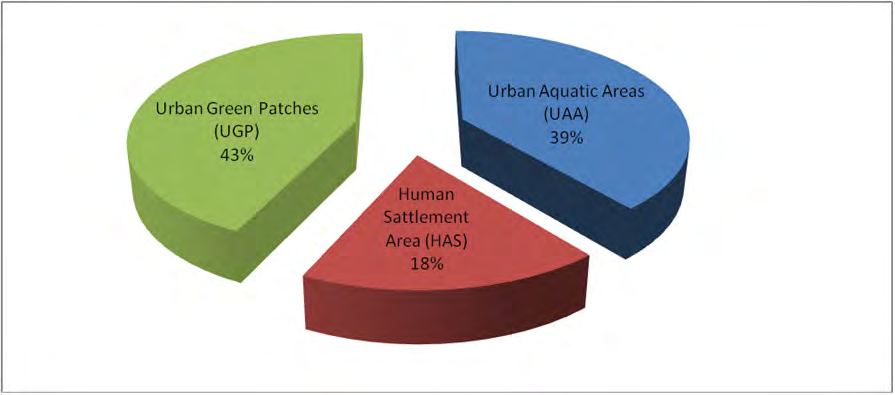
In the investigation period of twenty-four months, a total of 167 species of birds belonging to 58 families were recorded in the study area (Table 1). The three different study sites i.e. Urban Aquatic Area (UAA) had 39% of the total species observed; Human Settlement Area (HSA) had 18% and Urban Green Patches (UGP) had 43% of the total species observed (Figure 3). The Relative Diversity of different families was calculated to determine the dominance of species occurrence at a particular study site (Table 2). The highest relative diversity was recorded as of Anatidae family with 15 species and 8.93 RDi followed by Ardeidae, Accipitridae, Scolopacidae and Turdinae families with 9 species each and 5.36 RDi respectively representing the dominance of species occurrence belonging to these families at study area (Table 2). The calculation for the similarity indices among different study sites reveled that Urban Green Patches and Human Settlement Areas had more similar habitat structure as the Jaccard index and Sorenson Index values are higher i.e. 0.3809 and 0.5517 respectively. While on the other hand Urban Aquatic Areas and Human Settlement Areas had very less similarity in habitat characteristics hence the values of Jaccard index and Sorenson Index are lower as 0.1709 and 0.2919 respectively (Table 3).
Overall 95 species belonging to 34 families were present in the Urban Aquatic Area (UAA). The Anatidae family with 15 species dominated the Urban Aquatic Area followed by the Scolopacidae with 9 species. The urban terrestrial area which was further classified for simplification into Human Settlement Area (HAS) and Urban Green Patches (UGP).The Human Settlement Area was represented by 41 species belonging to 27 families. This Area had a lesser number of species and was dominated by Sturnidae family (4 species) followed by Ardeidae, Columbidae, and Sylviinae (3 species each). The Urban Green Patches had 47 families (104 species) and Accipitrae family dominated the area (9 species) followed by Turdinae family (8 species).
Conclusion and Discussion
The present study concluded that the Municipal area of Ajmer district represents near about 68% of the avifaunal diversity observed in different habitats of the Ajmer District as a whole [2, 3, 5, 6, 7, 8]. The study area includes the foothills of the oldest mountain range the Aravalli that provides an excellent habitat for various floral and faunal components hence the diversity is rich at the study area. The Urban Aquatic Areas (Anasagar Lake, Foy Sagar Lake, Chaurasiywas Talab, Paal Bichla Talab and Khanpura Talab) represented by the 96 species belonging to the 34 families. The Anasagar Lake, which is located in the central part of Ajmer Municipal area supports the 40 species [19], whereas another study conducted after two years by same authors documented 42 species from the same locality [20]. In the continuation another worker documented 48 species of birds from the Anasagar Lake and 42 species from the Foy Sagar Lake [21, 22, 23].
References
-
Mehra SP, Mehra S, Uddin M, Verma V, Sharma H, et al. (2017) Waste as a resource for avifauna: Review and survey of the avifaunal composition in and around waste dumping sites and sewage water collection sites (India). Int J Waste Resour 7(3): 289.
-
Mehra SP, Mehra S, Sharma KK (2014) Importance of urban biodiversity-A case study of Udaipur, India, pp: 403-418.
-
Maheshwari BL, Purohit RC, Malano HM, Singh VP (2019) Securing Water, Food, Energy and the Liveability of Cities. Challenges and Opportunities for Peri-urban Futures, Science+Business Media B.V. Dordrecht, Springer, The Netherlands.
-
Mehra SP, Mehra S, Sen P (2013) Urban avifauna of Udaipur and its importance to the local population (Udaipur, Rajasthan, India). International Journal of Biodiversity Watch No. 2: 120-146.
-
Mehra SP, Mehra S (2013) Short Study to Assess the Potential of Wetlands of Dholpur, Rajasthan, India. Pp 306-313. In: Sheikh, M. M. (ed.) Environmental Consciousness and Human Perceptions, LAP LAMBERT Academic Publishing, Germany.
-
Mehra S (2012) The avifauna of southern Rajasthan with special emphasis on threatened species and bioacoustic applications in their identifications and monitoring. Department of Zoology, M. D. S. University, Ajmer. Ph. D. Thesis.
-
Mehra S, Mehra SP, Sharma KK (2012) Importance of aquatic avifauna in southern Rajasthan, India. Pg. 159- 183. In: Rawat., M. & Dookia, S. (eds.) Biodiversity of Aquatic Resources, Daya Publishing House, Delhi, 2012.
-
Mehra S, Mehra SP, Sharma KK (2011) Aquatic Avifauna: Its Importance for Wetland conservation in Rajasthan, India. Pg. 179-190.
-
Mathur SM, Shrivastava VK, Purohit RC (2011) (eds.) Conservation of Lakes and Water Resources Management strategies, Himanshu Publications, Udaipur.
-
Mehra S, Mehra SP, Sharma KK (2011) Aquatic avifauna of Aravalli Hills Rajasthan, India. Pp. 145-167 (In Gupta, V. K. & Verma, A. K. (eds.) Animal Diversity, Natural History and Conservation Vol. I, Daya Publishing House, Delhi, 2011.
-
Mehra SP, Mehra S (2014) Perspective on water and Biodiversity Issues: A Case Study of Keoladeo National Park, Bharatpur, India. The Security of Water, Food, Energy and Liveability of Cities: 419-434.
-
Taper ML, Bohning-Gaese K, Brown JH (1995) Individualistic responses of bird species to environmental change. Oecologia 101(4): 478-486.
-
Olechnowski BF (2009) An examination of songbird avian diversity, abundance trends, and community composition in two endangered temperate ecosystems: riparian willow habitat of the Greater Yellowstone Ecosystem and a restored tall grass prairie ecosystem, Neal Smith National Wildlife Refuge Iowa State University.
-
Magurran AE (1988) Ecological Diversity and its Measurement. Princeton University Press, Princeton, NJ. 192pp
-
Western D, Grimsdell JJR (1979) Measuring the distribution of animals in relation to the environment. Handbook No. 2, African Wildlife Leadership Foundation, Nairobi.
-
Zakaria M, Rajpar MN, Sajap SA (2009) Species diversity and feeding guilds of birds in Paya Indah Wetland Reserve, Peninsular Malaysia. Intl J Zoological Res 5(3): 86-100.
-
Bensizerara D, Chenchouni H, Bachir AS, Houhamdi M (2013) Ecological status interactions for assessing bird diversity in relation to a heterogeneous landscape structure. Avian Biology Research 6(1): 67-77.
-
Manakadan R, Pittie A (2001) Standardized common and scientific names of the birds of the Indian subcontinent. Buceros 6(1): 1-37.
-
Gill F, Donsker D (2017) IOC world bird list
-
Torre-Cuadros MD, Herrando-Perez S, Young KR (2007) Diversity and Structure patterns for tropical montane and premontane forests of central Peru, with an assessment of the use of higher-taxon surrogacy. Biodiversity and Conservation 16: 2965-2988.
-
Yadav I, Swarop R (2017) Diversity, Abundance and Inter-specific Correlation in Water-birds at Anasagar Lake, Ajmer. Int Jon Sci Res 6(7): 1306-1317.
-
Swarop R, Yadav I (2017) Frequency and Status of occurrence of water-birds at Anasagar Lake, Ajmer. Int J Res Appl Sc Engg Tech 5(10): 1079-1090.
-
Dutt U, Prakesh B (2018) Distribution and Assessment of Water-bird and Water-Associated Birds Diversity from Two Wetlands of Ajmer, Rajasthan. Shrinkhla Ek Shodhparak Vaicharik Patrika 5(12): 82-89.
- Lessons to Learn: Trees are More than the Lungs of the World
- Community Forestry Enterprises as a Model for Sustainable Forest Development: The Case Of The "Baja Tarahumara" in Chihuahua, Mexico
- Ecological and Socio-Economic Impacts of Chromolaena odorata and Mesosphaerum suaveolens, Two Invasive Alien Species in Central and Southern Benin, West Africa
- Epigenetic Sustainability: Modeling the Human Factor as a Natural Resource through Science 4.0 and the NR3C1 Biological Pilot
- Growth-at-Risk: A Framework for Assessing Economic Vulnerability
- The Rural Territory as a Socioecological System for the Management of Public Policy for Sustainable Rural Development