
Effect of Bridge Construction Works on the Structure of Macroinvertebrates of Two Forest Streams in the Coastal Zone of Cameroon
Whilst several studies have dealt with the effects of domestic, municipal and industrial pollution on river biodiversity in Cameroon, very little data is available on the impact of bridge construction works on this biodiversity. To fill these gaps in our knowledge, we collected macroinvertebrates of two forest streams between January to June 2020, and then compared their biological indices at the crossings of the bridges under construction with the same indices at sampling stations located upstream and downstream of the bridges under construction. Simultaneously, Measurements of the physicochemical variables were done. The results showed that macroinvertebrate communities were negatively affected by the construction of the bridges because the taxonomic richness, abundance, taxonomic richness of Ephemeroptera-Plecoptera-Trichoptera and abundance of Ephemeroptera-Plecoptera-Trichoptera were significantly different between the sites under the bridges and the reference sites upstream of the bridges. Habitat modifications related to activities of bridge construction (excavation of the edges of the watercourse, cleaning of the bed, installation of the footings of the foundations of the bridges, embankment, stabilization of the bed of the watercourse by the blocks of stones), would be the principal erosion predictors of macroinvertebrates biodiversity. However, this work does not lead to significant long-term changes in the physicochemical quality of waters. The significant impacts of bridges construction on macroinvertebrate diversity indicates henceforth the importance of habitat restoration after the completion of construction works.
Introduction
To enable the movement of people and goods from rural African areas with high economic potential, it is necessary to build roads between these areas and major urban centers.
During road construction and associated works, aquatic ecosystems and especially watercourses are drastically affected. In developed countries, several studies have demonstrated that the construction of roads, highways, road crossings and bridges can have impacts on watercourses, such as the reduction of water quality, sedimentation and its ecological effects, habitat degradation, the input of toxins from construction materials and the loss of biodiversity [1, 2, 3, 4, 5, 6, 7]. In Cameroon, on the other hand, apart from the environmental impact studies carried out prior to the implementation of the various major projects, very few studies have been conducted to assess the real impact of these projects on the ecosystems at the time of their implementation. As far as rivers are concerned, most of the work carried out so far has been limited to assessing the effects of domestic, municipal and industrial pollution on rivers [8, 9, 10, 11]. To date, no study to our knowledge has been devoted to the ecological assessment of the impact of road construction works and notably bridges on the ecological integrity of watercourses.
In order to develop management and restoration plans for watercourses subject to road construction, it is necessary to detect and evaluate, through rigorous environmental monitoring, the degree of disturbance to their ecological integrity. In order to achieve an efficient and relevant assessment of human impacts on ecosystems, the use of biological communities is recommended because changes in their organizational and functional structures reflect the consequences of physico-chemical and biological modifications to ecosystem functioning [12]. Among the organisms inhabiting freshwater ecosystems, benthic macroinvertebrates are good tools for assessing anthropogenic disturbance in lotic freshwaters, due to their ubiquity, high diversity and wide range of sensitivity to different disturbances [13, 14].
The main objective of this study is to identify the effects of road construction works and especially bridge construction on benthic macroinvertebrates in the Bihissi and Nko forest streams in the coastal zone of Cameroon. Specifically, we compared for each river, the values of abiotic parameters and biological indices of benthic macroinvertebrates of the study station located at the point of construction of the bridge and the station located downstream of the bridge with the values of abiotic parameters and biological indices of benthic macroinvertebrates of the reference station located upstream, 500 m from the point of construction of the bridge.
Materials and Methods
Study area and sampling stations
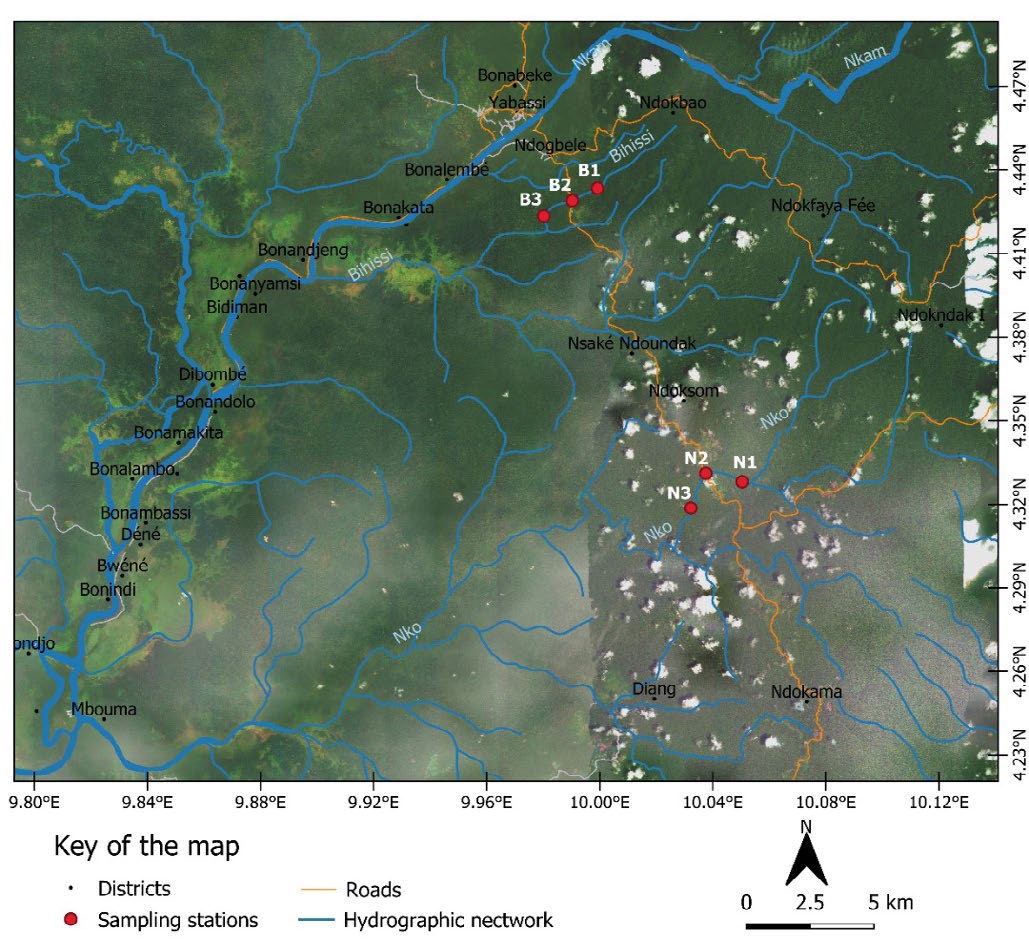
Investigations were carried out in two streams (Bihissi and Nko) located in the district of Yabassi, Littoral Region of Cameroon (Figure 1). Yabassi has an equatorial climate of Guinean type and Cameroonian coastal sub-type, with average annual precipitation of about 4 000 mm [15]. This climate has two mains seasons, a long rainy season from March to November and short dry season from December to February. Temperatures vary between 23°C and 33.5°C with a monthly average of around 28°C [15].
A total of 6 study stations were selected, of which 3 on the Bihissi and 3 on the Nko (Figure 1). These stations are located in the middle stream section of each of the streams studied, which allowed the comparison of benthic macroinvertebrate population belonging to the same section of the stream. The stations located on the Bihissi are designated B1, B2 and B3 and those located on the Nko are designated N1, N2 and N3 (Figure 1). Stations B1 and N1 are located respectively on Bihissi and Nko, 500 m upstream of the bridge construction site of both streams. These two stations, free of any anthropic activity, have been considered as reference stations. Stations B2 and N2 were positioned respectively on the Bihissi and Nko rivers at the place where the bridge is built on each of the rivers; they will be referred to throughout the study as “stations under the bridges”. Stations B3 and N3 are located respectively on the Bihissi and Nko rivers, downstream, about 500 meters respectively from stations B2 and N2. Table 1 presents the characteristics of sampling stations.
Assessment of water quality
The analysis of the physicochemical parameters were conducted according to the protocols described by Rodier, et al. [16], between January to June 2020. At each sampling station, several physicochemical variables were measured in situ. In site, water temperature (T), pH, electrical conductivity (EC) and dissolved oxygen concentration (DO) were measured using a portable multi-parameter HANNA HI
9829. In addition, water samples were collected in the field in a pre-clean double-capped polyethylene bottle of 250 ml and parameters such as turbidity (Turb), suspended solids (SS), orthophosphate (PO4), ammonium (NH4) and nitrite (NO2) were measured in the laboratory, using a HACH DR/3900 spectrophotometer.
Sampling of Benthic Macro-Invertebrates
The protocol described by starck, et al. [17] was used to collect macroinvertebrates once a month at each station between January to June 2020, using a long-handled kick net (30 cm x 30 cm side, 400-µm mesh size and 45 cm of depth). Twenty drags of the kick net were carried out at each sampling station in the targeted habitats (leaf packs, branches, macrophyte beds, sand, mud and rafts), for a sampled surface area of 6 m2. Collected benthic macroinvertebrates were fixed in situ using 70% ethanol contained in labeled plastic bottles. In the laboratory, each sample was sorted, the animals grouped according to their general characteristics, counted and identified to the family taxonomic level, using appropriate taxonomic identification keys proposed by De Moor [18, 19] and Tachet, et al. [20, 21].
Data Analysis
To assess the water quality, Organic Pollution Index (OPI) was calculated from the concentrations of NH4, NO2 and PO4 [22]. For benthic macroinvertebrates, we used the taxonomic approach including biological indices to describe changes in the structure of benthic macroinvertebrate stands between upstream stations (B1, N1), under-bridge stations (B2, N2) and downstream stations (B3, N3). The biological indices calculated in this study are taxonomic richness (S), total abundance (TA), taxonomic richness of Ephemeropteran- Plecopteran-Trichopteran (S-EPT), relative abundance of EPT taxa (%-EPT), Shannon and Weaver’s diversity index, and Pielou’s index.
To determine whether the effects of bridges construction on water quality and benthic macroinvertebrate assemblages are significant, we compared, for each stream, the values of the physico-chemical parameters and the biological indices of macroinvertebrates of the site upstream of the bridge with the values of the site under the bridge on the one hand, and the values of the physico-chemical parameters and the biological indices of macroinvertebrates of the site upstream of the bridge with the values of the site downstream of the bridge using the two samples comparison of Mann Whitney. To complete this comparison, a Hierarchical Ascending Classification (HAC) made with the benthic macroinvertebrate abundances of each stream, allowed to test the separation or rapprochement of macroinvertebrate communities between the station upstream of the bridge, the station under the bridge and the station located downstream of the bridge.
| Land use | Latitude N | Longitude E | Width (m) | Depth (cm) | Dominant Substrate | |
|---|---|---|---|---|---|---|
| Bihissi | ||||||
| B1 | Forest | 4°26′0.15″ | 9°59′57.36″ | 4.90-7.13 | 11.55-12.95 | Sand, gravel |
| B2 | Forest | 4°25′44.20″ | 9°59′25.13″ | 3.60-7.22 | 8.45-14.13 | Stone, gravel |
| B3 | Forest | 4°25′24.04″ | 9°58′48.91″ | 8.90-12.64 | 7.60-17.82 | Mud |
| Nko | ||||||
| N1 | Forest | 4°19′41.01″ | 10°3′1.66″ | 14.87-19.10 | 12.33-32.82 | Sand, gravel |
| N2 | Forest | 4°19′51.85″ | 10° 2′15.24″ | 13.3-16.82 | 27.70-33.10 | Stone, sand |
| N3 | Forest | 4°19′7.16″ | 10° 1′56.22″ | 21.30-28.40 | 15.65-21 | Mud, sand |
Table 1: Characteristics of the sampling stations.
Results
Water Quality
Table 2 presents the mean values and standard deviations of the physicochemical variables at the different study stations. These physicochemical variables revealed through the OPI that the waters of the Bihissi and Nko rivers at the studied stations show moderate organic pollution. The Mann Whitney test was performed 40 times to look for statistically significant differences between the physicochemical parameters of the stations upstream of the bridges (B1, N1) and the stations below the bridges (B2, N2), between the physicochemical parameters of the stations upstream of the bridges (B1, N1) and the stations downstream of the bridges (B3, N3) and only in 5 cases were significant differences obtained (Table 3). Thus, the values of OPI and PO4 respectively obtained in the stations below the bridges (B2) and downstream of the bridge (B3) are significantly higher than the values obtained at the upstream station B1. Conversely, the OPI of station B3, the values of SS and NO2 of B2 were significantly lower than that of the upstream station B1.
| Streams | Bihissi | Nko | ||||
|---|---|---|---|---|---|---|
| Sampling stations | B1 | B2 | B3 | N1 | N2 | N3 |
| T | 26.76±1.96 | 26.42±1.33 | 27.03±1.96 | 26.55±1.83 | 26.90±2.27 | 27.29±2.22 |
| pH | 7.00±0.54 | 7.18±0.52 | 7.06±0.67 | 6.75±0.41 | 6.54±0.58 | 6.77±0.58 |
| DO | 55.00±10.47 | 53.23±11.13 | 48.33±11.63 | 49.70±2.81 | 53.30±9.47 | 49.76±5.94 |
| EC | 29.00±7.77 | 28.50±3.67 | 28.00±6.23 | 25.50±1.87 | 24.33±4.80 | 23.67±4.23 |
| SS | 5.00±1.09 | 2.17±1.60 | 10.33±6.41 | 2.33±1.97 | 3.33±4.93 | 3.00±1.41 |
| Turb | 14.83±7.44 | 9.17±8.31 | 27.83±14.95 | 10.83±10.44 | 15.33±9.18 | 10.83±8.09 |
| NO2 | 0.05±0.02 | 0.03±0.01 | 0.07±0.05 | 0.05±0.02 | 0.04±0.02 | 0.05±0.02 |
| PO4 | 0.11±0.09 | 0.06±0.04 | 0.23±0.11 | 0.09±0.14 | 0.04±0.02 | 0.05±0.04 |
| NH4 | 0.09±0.14 | 0.11±0.16 | 0.19±0.10 | 0.07±0.06 | 0.11±0.16 | 0.09±0.06 |
| IPO | 3.5±0.28 | 3.89±0.27 | 3.06±0.25 | 3.78±0.41 | 3.89±0.34 | 3.78±0.40 |
Table 2: Mean and standard deviation value of the physicochemical variables measured at the sampling stations of Bihissi and Nko
| T | pH | DO | EC | SS | Tur | NO 2 | PO 4 | NH 4 | OPI | |
|---|---|---|---|---|---|---|---|---|---|---|
| B1 and B2 | 0,689 | 0,471 | 0,936 | 0,627 | 0,018* | 0,148 | 0,021* | 0,373 | 0,688 | 0,040* |
| B1 and B3 | 0,748 | 0,810 | 0,230 | 1,000 | 0,101 | 0,078 | 0,373 | 0,030* | 0,127 | 0,030* |
| N1 and N2 | 0,470 | 0,471 | 0,471 | 0,373 | 0,934 | 0,172 | 0,468 | 0,871 | 1,000 | 0,675 |
| N1 and N3 | 0,471 | 1,000 | 0,748 | 0,374 | 0,568 | 0,374 | 0,745 | 0,810 | 0,520 | 1,000 |
Table 3: ** Results of Mann Whitney test of water quality variables between the upstream station and the station under the bridge
* indicates a significant difference between the two stations tested (P < 0.05). Table 3: Results of Mann Whitney test of water quality variables between the upstream station and the station under the bridge on the one hand, and between the upstream station and the downstream station on the other hand, for each of the Bihissi and Nko streams.
Benthic macroinvertebrate abundance, taxonomic richness, EPT taxa richness, % EPT and diversity
A total of 23 different families were identified in each of the water courses studied. In Bihissi, the Arthropod and Mollusc phyla were represented by 21 and 2 families respectively, while in Nko, 22 families belonged to the Arthropod phylum and 1 to the Mollusc phylum. Concerning the abundance 1,303 and 1,004 individuals were respectively counted in the Bihissi and Nko rivers. In the Bihissi stream, Arthropods constitute 46.20% of the total number of individuals while Molluscs account for 53.80%. In the Nko stream, Arthropods and Molluscs constitute respectively 85.76% and 14.24% of the collected macroinvertebrates.
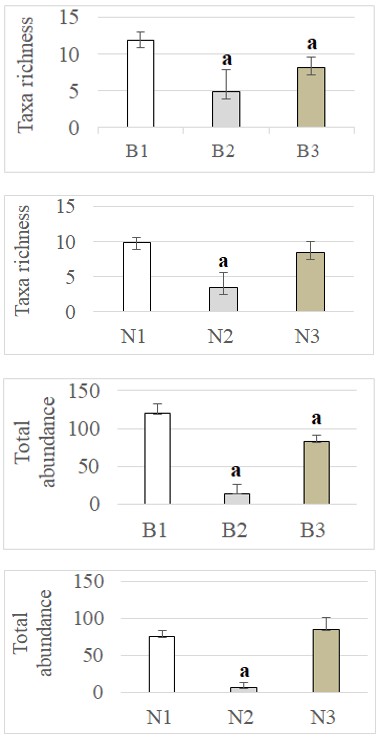
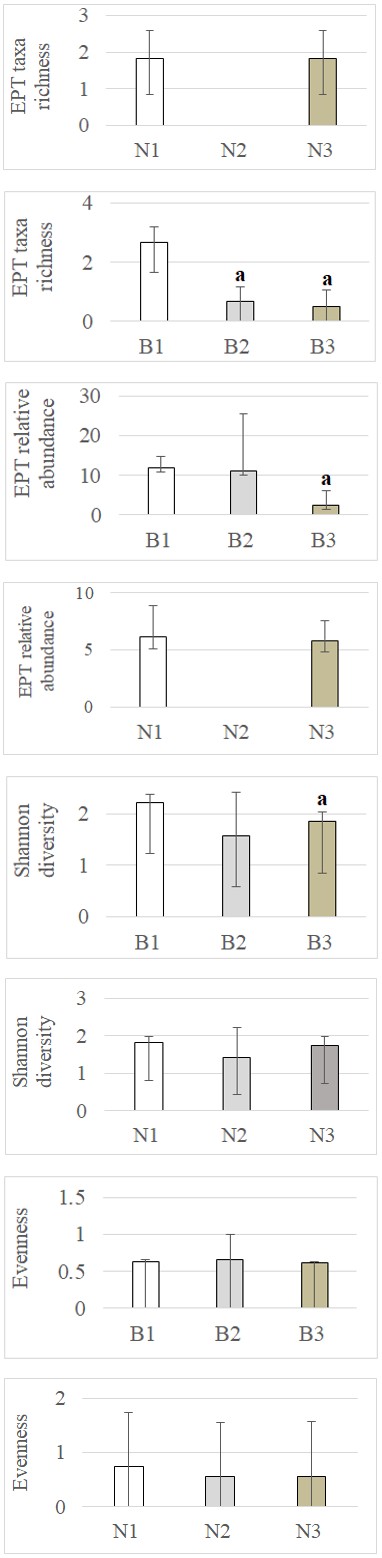
The taxonomic richness of macroinvertebrates was significantly higher in reference stations B1 (11.83±1.17) and N1 (19.83±0.75) located upstream of the bridges than in stations B2 (4.83±3.06) and N2 (3.50±2.17) located under the bridges (Figure 2). As regards the downstream stations, only station B3 had significantly lower taxonomic richness than its upstream station B1 (Figure 2). In the Bihissi stream, the mean number of EPT taxa was 2.67±0.52, 0.67±0.52 and 0.50±0.55 respectively obtained in stations B1, B2 and B3. Mann Whitney’s test showed that the construction of the bridge over the Bihissi stream had a negative effect on the number of EPT taxa (Figure 2). In the Nko stream, the upstream (N1) and downstream (N3) stations showed a similar mean number of EPT taxa, i.e. 1.83±0.75. The absence of EPT taxa at station N2 under the bridge highlights the negative impact of the construction of this structure on the Nko stream.
On average, 120.17±12.51, 14.33±11.71 and 82.67±8.36 individuals were respectively counted upstream (B1), under the bridge (B2) and downstream of the bridge (B3) on the Bihissi stream. Mann Whitney’s test revealed a significantly negative impact of road works on benthic macroinvertebrate abundances at the point of construction of the bridge (B2) and downstream of this point (B3) (Figure 2). In the Nko stream, only macroinvertebrate abundances at the station under the bridge N2 (TA = 7.00±5.87) were negatively and significantly impacted by the bridge construction. Macroinvertebrate abundances at the downstream station N3 (TA = 85.00±16.52) did not vary significantly from the abundances at the upstream station N1 (75.33±7.97) (Figure 2). Concerning the relative abundances of EPT taxa in the Bihissi stream, the downstream station B3 (2.49±3.48) showed significantly lower relative abundances than the upper station B1 (11.80±3.00) (Figure 2). In the Nko stream, no individuals belonging to EPT taxa were counted in station N2 under the bridge, whereas at stations N1 and N3, 6.11±2.79 and 5.81±1.73 were counted respectively.
Spatial distribution of benthic macro-invertebrates fauna of Bihissi showed the preeminence of the family Thiaridae (42.16%) and Atyidae (32.87%) in station B1. In station B2, macrofauna is dominated by the families Thiaridae (48.84%), Capaniidae (12.79%) and Atyidae (9.30%). The benthic fauna at station B3 is dominated by the family Thiaridae (62.90%). In the Nko stream, the Atyidae family is preponderant at all stations with 63.94%, 45.24% and 65.69% relative abundance respectively obtained at stations N1, N2 and N3. The Atyidae are followed by individuals of the Thiaridae family which account for 17.26% and 12.55% of the total abundance at the upstream (N1) and downstream (N3) stations respectively. In station N2 under the bridge, Chironomidae with 16.67% relative abundance are the second most abundant taxon.
In the Bihissi and Nko streams, the highest Shannon and Weaver index values were recorded in the upstream stations B1 (2.22±0.15) and N1 (1.82±0.15), while the lowest were observed in the under-bridge stations B2 (1.57±0.85) and N2 (1.43±0.79) (Figure 2). The downstream stations B3 and N3 have values of 1.85±0.18 and 1.73±0.26 respectively. Mann Whitney’s test showed that only the Shannon index of the downstream station B3 differs significantly from its reference station B1 (Figure 2). Contrary to the Shannon and Weaver index, whose values are the lowest at the stations located under the bridges, the Pielou J index presented the highest values at these stations, i.e. 0.66±0.35 for B2 and 0.74±0.38 for N2 (Figure 2).
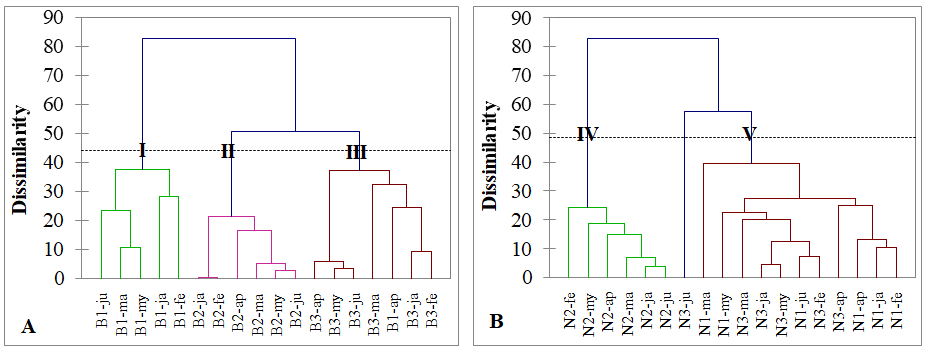
The HAC based on macroinvertebrate abundances in Bihissi showed that the 18 samples collected during the 6 months of the study are separated into three clusters that differ in their community composition. Cluster I, Cluster II and Cluster III are mainly composed of samples from stations B1, B2 and B3 respectively (Figure 3). In the Nko stream, the HCA revealed that macroinvertebrates are distributed in two main clusters with different structures. Cluster IV is composed of samples from station N2 located under the bridge, and cluster V is composed of samples from the upstream station N1 and downstream station N3 (Figure 3).
Bihissi Nko
Discussion
No significant impact on the water quality
Unlike forest streams in temperate regions which are generally characterized by low concentrations of organic matter and nutrients [23], the current study found that the Bihissi and Nko streams located in the tropical forest zone in Cameroon have waters with moderate organic pollution. In fact, tropical treams receive 3 to 4 times more litter from dense forests, characteristic of tropical systems, which is the cause of a greater load of organic matter in the waters [24, 25]. Nyamsi Tchatcho, et al. [26] and Onana, et al. [11] working in forest streams in Cameroon have obtained similar results. Furthermore, Mann Whitney’s pair-wise comparison test, based on physicochemical parameters, between sites upstream of the bridges and sites under the bridges on one hand, and between sites upstream of the bridges and sites downstream of the bridge on the other hand, showed no significant difference in almost all cases. Based on these results, we tend to conclude that the construction of the bridges over the Bihissi and Nko rivers may not have affected water quality. Indeed, the sampling campaigns were not carried out at the time of the works, but generally on Sundays, which is a day of rest for the workers.
A negative and significant impact on the structure of benthic macroinvertebrate communities
The biological indices highlighted the negative impact of road construction works and in particular the construction of bridges over the watercourses studied. Our results corroborate those of other authors who had shown that the construction of structures such as bridges, railway crossings and other works modifying the morphology of stream beds reduce aquatic biodiversity, particularly that of macroinvertebrates [1, 4, 5, 7]. Indeed, the various activities carried out during the construction of the bridges over the Bihissi and Nko streams, i.e., excavation of the stream banks, cleaning of the stream bed, laying of bridge footings, backfilling and stabilization of the stream bed by stone blocks, resulted in changes in the stream bed geomorphology, thus modifying the natural micro-habitats of the streams. All these activities, coupled with the destruction of riparian vegetation, caused the release of large quantities of solid, fine and coarse materials into the watercourse [2].
The resulting increase in suspended particles and sedimentation rate [2] induce changes to stream morphology, reduced habitat and other ecological stressors [27]. Thus, during the present study, the taxonomic richness, abundance, and taxonomic richness of EPT were significantly reduced at stations located under the bridges compared to upstream reference stations. In addition, EPT taxa completely disappeared from the benthic macrofauna of the Nko stream in the station under the bridge (N2). Several authors [27, 28, 29, 30, 31], have shown that macroinvertebrates and especially EPT taxa are seriously affected by an influx of sediment into the streams. In addition, Larsen, et al. [32] and Jones, et al. [14] have shown experimentally that deposition of large amounts of sediments in streams can reduce invertebrate abundance by up to 90%.
Contrary to taxonomic richness and abundance, the diversity indices (H’ and J) seemed not to have been affected by the construction of the bridges over the Bihissi and Nko streams. Indeed, these indices did not vary statistically between the upstream stations (B1 and N1) and the stations under the bridges (B2 and N2). We believe that the stations under the bridges B2 (S = 4.83±3.06; TA = 14.33±11.71) and N2 (S = 3.50±2.17; TA = 7.00±5.87) present a pseudo- diversity because very few different taxa, each composed of a very small number of individuals, were collected at these stations, with consequences of raising the indices at these stations.
The HAC showed a clear separation of the 3 stations of the Bihissi stream, proof that the construction of the bridge on this river also has an impact on the downstream station B3, whose indices (S, TA, S-EPT, %-EPT, H’ ) with the exception of J were significantly lower than those of the upstream station B1. Gal, et al. [7], to explain the impact of road construction works, incriminate water runoff which, by entrainment, transports pollutants from the point of impact to the downstream areas of the watercourse. In the Nko stream, on the other hand, the HAC pooled the samples from the upstream (N1) and downstream (N3) stations within the same cluster, showing that the macroinvertebrate communities at these two stations are similar. Similarly, no statistical significant difference was found between the indices of the upstream and downstream stations of the Nko stream. It can therefore be assumed that the bridge construction on the Nko stream has no impact downstream, 500 m from the bridge construction point.
Conclusion
The results of the present study did not highlight the negative effects of bridge construction on water quality, as the sampling campaigns were carried out on off days, where no work was effectuated (Sunday). We can therefore think that the construction of the bridges would have a momentary effect, on short term, on the physicochemical parameters of the water. On the other hand, the modification of habitats linked to the bridge construction works led to the disruption of the functional continuity of the watercourses, which significantly decreased the biodiversity of macroinvertebrates at the place where the bridges were built. The negative effect of the bridge construction work on benthic macroinvertebrates was also felt at 500 m downstream of the bridge construction point on one stream, while on the other stream, at 500 m downstream, the work appeared to have had no significant impact. It is therefore necessary to carry out additional studies that would make it possible to accurately identify the point downstream of the bridge construction work, where the river regains the heterogeneity of its microhabitats and its functional continuity.
Acknowledgment
This study was financially supported by the Cameroonian government through the special funds for the modernization of University research for the year 2020.
References
-
Wellman JC, Combs DL, Cook SB (2000) Long-term impacts of bridge and culvert construction or replacement on fish communities and sediment characteristics of streams. Journal of Freshwater Ecology 15(3): 317-328.
-
Bouska WW, Keane T, Paukert CP (2010) The effects of road crossings on prairie stream habitat and function. Journal of Freshwater Ecology 25(4): 499-506.
-
Purcell P, Bruen M, O’Sullivan J, Cocchiglia L, Kelly- Quinn M (2012) Water quality monitoring during the construction of the M3 motorway in Ireland. Water and Environment Journal 26(2): 175-183.
-
Zhengda Yu, Wang H, Wang R, He T, Cao Q, et al. (2016) The Effects of Bridge Abutments on the Benthic Macroinvertebrate Community. Polish Journal of Environmental Studies 25(3): 1331-1337.
-
Bin Zhu, Smith DS, Benaquista AP, Rossi DM, Kadapuram BM, et al. (2018) Water quality impacts of small-scale hydromodification in an urban stream in Connecticut, USA. Ecological Processes 7: 11.
-
Roy S, Sahu AS (2018) Road-stream crossing an in- stream intervention to alter channel morphology of headwater streams: case study. International Journal of River Basin Management 16(1): 1-19.
-
Gál B, Weiperth A, Farkas J, Schmera D (2020) The effects of road crossings on stream macro‑invertebrate diversity. Biodiversity and Conservation 29: 729-745.
-
Foto MS, Tchakonte S, Ajeagah GA, Zebaze SH, Bilong CF, et al. (2013) Water Quality Assessment Using Benthic Macroinvertebrates in a Periurban Stream (Cameroon). International Journal of Biotechnology 2(5): 91-104.
-
Tchakonté S, Ajeagah GA, Diomande D, Camara IA, Ngassam P (2014) Diversity, dynamic and ecology of freshwater snails related to environmental factors in urban and suburban streams in Douala-Cameroon (Central Africa). Aquatic Ecology 48: 379-395.
-
Tchakonté S, Ajeagah GA, Camara AI, Diomandé D, Nyamsi Tchatcho NL, et al. (2015) Impact of urbanization on aquatic insect assemblages in the coastal zone of Cameroon: the use of biotraits and indicator taxa to assess environmental pollution. Hydrobiologia 755: 123-144.
-
Onana FM, Zebaze Togouet SH, Tamsa AA, Nyamsi Tchatcho NL, Tchakonte S, et al. (2019) Comparing freshwater benthic macroinvertebrate communities in forest and urban streams of the coastal ecological region of Cameroon. Open Journal of Ecology 9: 521-537.
-
Levêque C, Mounolou JC (2008) Biodiversité : Dynamique biologique et conservation. Dunod, Paris, France, pp: 260.
-
Gresens SE, Belt KT, Tang JA, Gwinn DC, Banks PA (2007) Temporal and spatial responses of Chironomidae (Diptera) and other benthic invertebrates to urban storm water runoff. Hydrobiologia 575: 173-190.
-
Jones JI, Murphy JF, Collins AL, Sear DA, Naden PS, et al. (2011) The impact of fine sediment on macro- invertebrates. River Research and Applications 28(8): 1055-1071.
-
Suchel J (1972) Les climats du Cameroun. Doctorat Thesis, University of Bordeaux III, France, pp: 1186.
-
Rodier J, Legube B, Merlet N (2009) The Water Analysis. 9th Edition, Dunod, Paris, France, pp: 1579.
-
Stark JD, Boothroyd KG, Harding JS, Maxted JR, Scarsbrook MR (2001) Protocols for Sampling Macroinvertebrates in Wadeable Streams. Macroinvertebrates working group, report N°. 1, Ministry for the Environment, New Zealand.
-
De Moor IJ, Day JA, De Moor FC (2003a) Guides to the Freshwater Invertebrates of Southern Africa, Volume 7: Insecta I. Ephemeroptera, Odonata, Plecoptera. WRC Report N°. TT 207/03, South Africa.
-
De Moor IJ, Day JA, De Moor FC (2003b) Guides to the Freshwater Invertebrates of Southern Africa, Volume 8: Insecta II. Hemiptera, Megaloptera, Neuroptera, Trichoptera and Lepidoptera. WRC Report N° TT 214/03, South Africa.
-
Tachet H, Richoux P, Bournaud M, Usseglio-Polatera P (2006) Freshwater Invertebrates: Systematic, Biology and Ecology. CNRS Edition, Paris, France, pp: 588.
-
Tachet H, Richoux P, Bournaud M, Usseglio-Polatera P (2010) Freshwater Invertebrates: Systematic, Biology and Ecology. CNRS Edition, Paris, France, pp: 607.
-
Leclercq L, Maquet, B (1987) Two New Chemical and Diatomic Indices of Running Water Quality. Application to Samson and Its Tributaries (Belgian Meuse Basin). Comparison with Other Chemical, Biocenotic and Diatomic Indices. Working document, Royal Institute of Natural Sciences of Belgium, Belgium.
-
Allan JD, Castillo MM (2007) Stream Ecology: Structure and function of running waters, 2nd (Edn.), Springer, Dordrecht, The Netherlands, pp: 436.
-
Dommergues Y (1963) Les cycles biogéochimiques des éléments minéraux dans les formations tropicales. Revue Bois et Forêts des Tropiques 87: 9-25.
-
Jung G (1969) Cycle biogéochimique dans un écosystème de région tropicale sèche Acasia albida (Del.) Sol férrugineux tropical, peu lessivé (Dior). Gauthier Villards, pp: 195-210.
-
Nyamsi Tchatcho NL, Zébazé Togouet SH, Foto Menbohan S, Onana FM, Tchakonté S, et al. (2017) Characterization of a Physicochemical Water Quality Reference Status for the Centre-South Forest Region of Cameroon. International Journal of Science and Research 6(11): 397-405.
-
Townsend CR, Uhlmann SS, Matthaei CD (2008) Individual and combined responses of stream ecosystems to multiple stressors. Journal of Applied Ecology 45(6): 1810-1819.
-
Zweig LD, Rabeni CF (2001) Biomonitoring for deposited sediment using benthic invertebrates: a test on 4 Missouri streams. Journal of the North American Benthological Society 20(4): 643-657.
-
Kaller MD, Hartman KJ (2004) Evidence of a threshold level of fine sediment accumulation for altering benthic macroinvertebrate communities. Hydrobiologia 518: 95-104.
-
Larsen S, Vaughan IP, Ormerod SJ (2009) Scale-dependent effect of fine sediments on temperate headwater invertebrates. Freshwater Biology 54(1): 203-219.
-
Pollard AI, Yuan LL (2009) Assessing the consistency of response metrics of the invertebrate benthos: a comparison of trait- and identity-based measures. Freshwater Biology 55(7): 1420-1429.
-
Larsen S, Pace G, Ormerod SJ (2011) Experimental effects of sediment deposition on the structure and function of macroinvertebrate assemblages in temperate streams. River Research and Applications 27(2): 257-267.
- Lessons to Learn: Trees are More than the Lungs of the World
- Community Forestry Enterprises as a Model for Sustainable Forest Development: The Case Of The "Baja Tarahumara" in Chihuahua, Mexico
- Ecological and Socio-Economic Impacts of Chromolaena odorata and Mesosphaerum suaveolens, Two Invasive Alien Species in Central and Southern Benin, West Africa
- Epigenetic Sustainability: Modeling the Human Factor as a Natural Resource through Science 4.0 and the NR3C1 Biological Pilot
- Growth-at-Risk: A Framework for Assessing Economic Vulnerability
- The Rural Territory as a Socioecological System for the Management of Public Policy for Sustainable Rural Development