
Aspects Complementary to the Teaching of Environmental Education in Changing Attitudes about High Andean Solid Waste
The objective of the study was to determine the effectiveness of a didactic unit as an environmental education strategy, in initial education students of the National University of San Cristóbal de Huamanga, of the Natural Sciences subject, applying the competence of attitude towards waste solid. The population consisted of the entire population of all students enrolled in the Natural Sciences course 2017-I. The type of research was descriptive and the design was cross-sectional. As instruments for data collection, the pretest and posttest were used, where knowledge about attitudes about solid waste is reported. 21% of students failed the pretest and 100% passed the posttest. Student learning improved significantly with the application of the didactic unit, as an environmental education strategy in the Natural Sciences course, and the students' attitude about solid waste was positive.
Introduction
The pedagogical systems are generally formed to meet the educational needs of society following the principles of efficiency, equity and justice, as well as the satisfaction of students, taking as a basis the General Law of Education in force.
The Faculty of Educational Sciences of the National University of San Cristóbal de Huamanga (UNSCH) has 4 Professional Schools of Initial Education, Primary Education, Secondary Education and Physical Education. It has study plans from 2004 and none of them takes the Environmental Education course, for this reason a didactic unit was implemented in the Natural Sciences course, to be evaluated according to the competencies.
The Natural Sciences subject CN-141 belongs to the Academic Department of Biological Sciences, Faculty of Biological Sciences, the syllable of the course had 3 didactic units: general laws of physics, general laws of chemistry and general laws of biology, to which a fourth didactic unit called Environmental Education was added. The foundation is based on the fact that at present this topic of Environmental Education is of global relevance, because in its content several topics are developed such as solid waste management, environmental pollution, climate change, among others. From this fourth didactic unit, environmental education was applied as a strategy to change the attitudes of the current university student of the Professional School of Initial Education and future teacher.
The scientific justification of the research work is based on the application of pedagogical constructivism as an active methodological process, to understand the effectiveness of a didactic unit, as a strategy of environmental education in changing attitudes about solid waste, in the university environment the student elaborates, builds his own knowledge, based on acquired experiences and the interactions that he establishes with the teacher and his environment.
The university student is also strengthened by the psychopedagogical theory that sustains it, such as Piaget’s theory of cognitive development, Ausbel’s theory of meaningful learning, Vigostky’s sociocultural theory, Brunner’s theory of learning by discovery, the theory of intelligences. Gardner’s multiples and Novak’s concept map theory.
The importance of this research was the evaluation of the incorporation of an additional didactic unit as a strategy and learning of environmental education, to suggest the change of attitudes of university students in the treatment of solid waste. It is an issue that has become vitally important in the world in which we live, today we educators are also in the continuous search for healthy and sustainable environments that allow equitable, viable and bearable socioeconomic development that involves the environment and society.
The objective of the research is to determine the effectiveness of a didactic unit, as an environmental education strategy for the change of attitudes in university students of the 2017-I semester of the Professional School of Environmental Education.
Theoretical Framework
Study Background
The review of scientific articles on this subject allows us to have an overview, to locate ourselves in the context in which we live. Investigation on the environmental awareness in favor of the environment of Brazilian university students, reaching the conclusion that there is no firm awareness of the defense of the environment, particularly at the university level, when they should be the defenders of The conservation of the environment. Quiñones and Barraza [1] designed a solid waste separation program at the Autonomous University of Mexico, which allowed the generation of various collaborative activities with the participation of teachers, students, and administrative staff. Torres [2] points out that the feasibility study for solid waste management at the Ricardo Palma Private University is a technical and economic alternative that can improve solid waste management, as well as promote the active participation of the university community. Pacheco [3] states that despite the fact that the UNMSM is a higher education center in which topics related to the preservation of the environment and protection of people’s health are developed, the environmental awareness of the university population is generally very poor. Vásquez [4] concludes that the management of solid waste at the Faustino Sánchez Carrión National University is not adequate, however, there is a favorable predisposition for change. Scientific article published by the Pontifical Catholic University of Peru, performs the analysis of solid waste management in the city of Lima, where there are 1020 tons per day in various Lima districts, which are collected by 10 thousand recyclers who work in very precarious conditions that affect their health and that of their family.
It has been noted that there are many limitations in terms of environmental education, of the common citizen and it really affects our daily life, the news shows us that in the country there is no adequate management of solid waste, both by the municipalities in various cities of the country, in state institutions, nor in schools and university cities. The future teacher must be prepared in the university classrooms in the competencies of knowledge, skills and attitudes, because when he graduates he will teach the children of the future not to pollute the environment. These solid wastes are found in many places, such as in the country’s districts, giving a denigrating spectacle, occupying spaces, obstructing free movement, emanating energy and are the focus of various diseases that may affect living beings in the future.
In this context, environmental education is considered to be key to understanding the existing relationships between natural and social systems, generating new knowledge, clarifying concepts, recognizing skills, strengthening values, promoting attitudes of respect towards the protection and improvement of the environment. Sometimes we notice that some citizens, groups and youth organizations are worrying about establishing voluntary collection of solid waste. Hence the duty of the future teacher is to prepare in university classrooms in all fields, to teach in kindergartens and kindergartens, children who are the future of the country, perhaps some will be authorities, leaders, professionals, among others.
Theoretical bases
Didactic unit It is the teaching programming and performance unit made up of a set of activities that take place in a given time, in order to achieve didactic objectives. A didactic unit answers all the curricular questions about what to teach (objectives and contents), when to teach (ordered sequence of activities and contents), how to teach (activities, organization of space and time, didactic materials and resources), and evaluation (criteria and instruments to evaluate), all of them in a clearly defined time. The proposed activities are framed within the goals of knowledge, methods, praxis and communication and it is intended that the students achieve the performances of exploration, guided research and final synthesis project. Important to foresee evaluation activities that students develop according to the didactic unit that is the basis of programming.
Pedagogical methodology The term methodology derives from the Greek meta: beyond, from ears: path and logos: reason, study. The methodology is the set of rational procedures used to achieve a range of objectives that govern a scientific investigation, a presentation of tasks that require specific skills, knowledge or care. Pedagogical models fulfill a specific function and it is the one that guides the educational process, where the transformation of the socio-cultural is the basis of the formation of the individual, which must be coherent and contributes to development of their own context, being consistent with the pedagogical practice, the program and the profiles that the institution develops.
Strategy It is the set of procedures aimed at a specific objective. It is a human action to a conscious and intentional goal. It requires planning and control of execution as well as the selection of resources and techniques. Strategy shows how it is intended to reach the proposed objectives. Its adaptation to planning schemes is due to the need to direct the appropriate behavior of agents, in different and even opposite situations. In other words, it is the roadmap to be followed by the great lines of action to achieve purposes, objectives and goals set in the short, medium and long term, which allows it to attend to the different styles and rates of student learning.
Change of actitud The change in attitude is a valuable contribution to examine, learn, compare and analyze human behavior. It is the tendency to accept or reject events or situations, since we will carry out an assessment of behaviors that are circumscribed in the search or rescue of the training function in the field of moral development from both the individual and social point of view. Melero [5] states that all the inhabitants of our paneta must create awareness of ecological problems in children and young people, promoting the disposition for a responsible treatment of the environment and educating to induce conscious behavior that is effective.
Environmental education Environmental education is a holistic, permanent process in the formation of environmental awareness with a vision of accessible development. Novo [6] accepts the importance of environmental education to analyze the relationship between society and nature and what it means to think about these links, due to the complexity of the environmental framework to be able to teach accordingly. Cardona [7] proposes that environmental education is a dynamic axis to modify people’s attitudes so that they are able to evaluate the problems of sustainable and sustainable development.
Methodology
The research corresponds to a descriptive type study because it allows us to determine the relationship between the strategy of the didactic unit and the change in attitude about solid waste. The population consisted of students from the first semester of Initial Education, enrolled in the Natural Sciences course in the 2017-I semester, Faculty of Education Sciences of the National University of San Cristóbal de Huamanga, district of Ayacucho, province of Huamanga and department of Ayacucho. A pretest and posttest was used as a data collection instrument to determine the change in attitude towards solid waste, before and after applying the instruments.
The construction of the instrument has required to identify useful and simple indicators that reflect the learning of the students, these indicators of achievement are observable signs of knowledge and the change of attitude towards solid waste. Additionally, practical class sessions were developed in their respective learning groups.
The practical class sessions were designed on the basis of the competency curriculum, including the attitudes and abilities of the students. A. Stage of diagnosis and design. It began with the diagnosis of the didactic unit as an environmental education strategy, the presence of solid waste throughout the university city. B. Planning and implementation stage. Corresponding strategies and instruments were prepared to record the data to be obtained, documents to request permits from teachers, administrators and to talk with students in classrooms and environments with solid waste, develop leaflets and posters, also buy containers or synthetic garbage cans and label them. C. Action and follow-up stage. The pre-test was taken to groups of students and later 5 theoretical and practical sessions were developed on the environmental attitude for the students before the post-test, which are the following:
- Ecosystems
- Climate change
- Greenhouse effect
- Environmental pollution
- Solid waste d) Evaluation and analysis stage. The pre-test and post-test instruments were evaluated according to the established competencies, using the corresponding bibliography.
Results
| AGE (YEARs) | FREQUENCY | PERCENTA Ges |
|---|---|---|
| 17 - 19 | 29 | 48,3 |
| 20 - 22 | 21 | 35,0 |
| 23 - 25 | 10 | 16,7 |
| Total | 60 | 100 |
Table 1: We observe the age groups of the students who participated in the effectiveness of a didactic unit.
Discussion
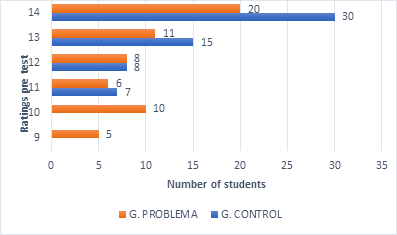
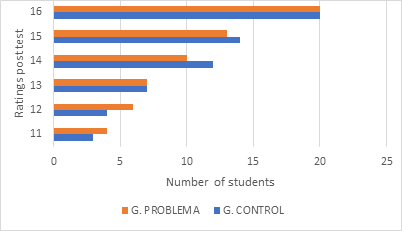
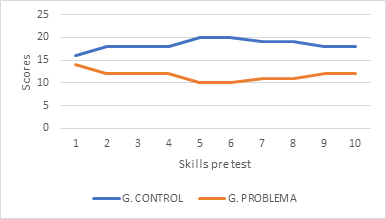
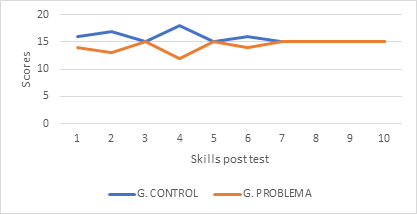
Table 1 shows the results of the age classification as frequencies and percentages. Being the age group between 17 to 19 years old with 48.3% and in a lower percentage between the ages of 23 to 25 years old with 16.7%, all of them are young people entering the Professional School of Initial education, mostly 98% made up of the female sex and only 2% of the male sex. The results of the knowledge test on the effectiveness of a didactic unit in the pre-test are observed in Figure 1, where the students of the control group passed the evaluation, but the young people of the problem group failed 25% in the pre-test. If we compare the evaluation in the post- test of figure 2, where 100% of students from both groups with a heterogeneity of passing grades.
What shows that young people are entering another stage of their lives, being in university, is not a simple way of seeing things, but is being in contact with another academic reality, they are nourished by information and observe university problems, As is the case of alteration of the environment, university solid waste and society in general, both nationally and internationally, through the media and social networks, all this serves to face new challenges of modern society or the globalized world.
In this regard, Hurtado [8] mentions that: as a result of the pre-test there is a very similar trend of responses in both groups of not relating the concepts addressed with the phenomenon that occurred in cotineanity, being in general the percentage of responses of 40.70% for group 1 and 40.3% for group 2 in comparison with the incorrect answers whose percentage for group 1 was 59.29% for group 2 academics of the first period of the students of group 1.
Diaz Barriga [9] points out the importance of recognizing that cognitive learning seeks to develop skills that lead to the solution of problems in the community of belonging. Andraca [10] points out that subsequent research, it is important to consider various variables that deepen the knowledge and relationship of external factors and attitude to different environmental problems. García [11] proposes the analysis and conceptual reinforcement from four dimensions; the aims of environmental education (awareness, sensitization and responsibility) the contents of environmental education and the teaching and learning processes, the epistemological status of environmental education. When comparing our results with other authors, we note that Mamani [12] obtained grades from 8 to 16 for both tests. Chávez [13] obtains grades from 12 to 20 for both tests. Students must learn to see problems in known and unknown conditions, be able to determine the new functions of their objects of study, in short, they require a critical activity, with comprehensive approaches that generates new ideas.
Hernández [14] narrates that Gosset wrote under the pseudonym of “Student” and described the distribution of the variable T, when the sampling is done in a normally distributed population, it helps us to make inference about population means when the standard deviation of a single population. Mamani [12] applied the Z test for the difference of means for 1500 students, where he showed that it was not significant for the pre-test but for the post-test. When comparing our data, we note that they coincide with those carried out by Chávez [13] using the Student’s T test and there is an approximation of established results where there are significant differences between the entry and exit tests.
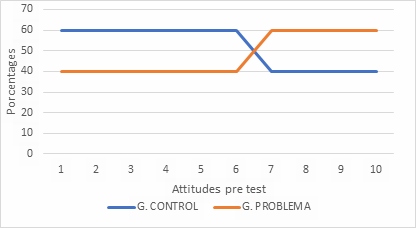
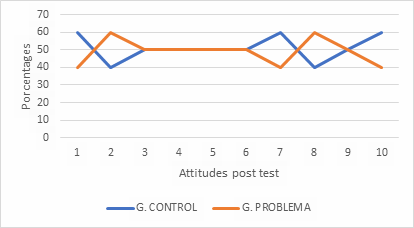
On the evaluation of attitudes that are reflected in figure 3 of the pre-test on 10 environmental education activities programmed in the didactic unit to be evaluated. The control group begins with a lot of energy doing the environmental education activities until the sixth week, decreasing to the seventh week, it is there when the members of the problem group outperform in activities until the tenth week in the pre-test. In figure 4 it is observed that the students of both groups compete week by week, the control group starts at 60% and decreased after two weeks, leveling with the problem group from the third to the sixth week, then the attitudinal competition continues until the tenth week.
The evaluation criteria in reference to the didactic objectives, contents, procedures and evaluation instruments for both groups, which allow evaluating the performance achieved by the students with the greatest objectivity possible. Castro [15] studied the change of attitudes about urban solid waste in a state educational institution in the city of Ayacucho, for the post test the experimental group obtained 76% and for the control group 14% Melendro [16] points out that it is also necessary to take into account the great variability in the responses and the existence of important differences, such as the times used for each type of activity. Molano [17] found that 12% of students can be included in the attitudinal orientation by the teacher and 34% of the students consider that this is the orientation of the subject according to the attitudinal content. The stimuli carried out for both groups for the evaluation of the didactic unit by means of the post test, various workshops on environmental education were held, they generated that the members of both groups change their attitudes to collaborate and improve their interventions. Rojas [18] in a multiple linear regression analysis of the activities as a whole, evidenced the dependence that the improvement in academic performance and the type of activity carried out showed. Diaz-Barriga [9] observes a better attitude in those who participated in the program in relation to those who did not. There are parameters that can serve as the basis for the development of projects on solid waste management through meaningful learning experiences. Non-parametric tests are in common use, there are many cases in which data measured on a nominal or ordinal scale are collected, many applications in the educational field involve opinions or feelings, and these data are used to make decisions [19, 20, 21, 22].
The Chi square distribution is one of the most used distributions in statistics to facilitate its use, there are tables that allow finding areas that are probabilities associated with intervals limited by determined values of the chi square according to the degrees of freedom, and they do not differ significantly each [23, 24].
Conclusions
- The proposed objectives were achieved and the hypothesis was verified, using the Student’s T test and the Chi-square, allowing to find significant differences between the problem group.
- The students of the problem group received the corresponding stimulus through class sessions, therefore their main concern is environmental education and university solid waste management.
- The application of a didactic unit as a strategy of environmental education, allowed to demonstrate the effectiveness of scientific principles regarding academic learning at the conceptual, procedural and attitudinal level, the students showed their interest and critical reflection on the moment in which we live especially for environmental education.
References
-
Quiñonez L, Barraza J (2013) Solid waste separation program of the academic unit of Dentistry of the Autonomous University of Nayarit. Mexicali.
-
Torres A (2008) Feasibility study for solid waste management at Ricardo Palma University. URP Industrial Engineer Thesis. Lime.
-
Pacheco A (2011) Characterization of the problem of solid waste management in the UNSMSM. RIGEO Magazine. Vol. 14 - 27. Lima.
-
Vásquez E (2013) Perception and management of solid waste in university students. Faustino Sánchez Carrión National University. Lime.
-
Melero J (2013) Environmental attitudes and behaviors in solid waste management in Higher Education Institutions in the city of Mexicali.
-
Novo M (1998) Environmental education: ethical, conceptual and methodological bases. UNESCO. Editorial Universitas. Madrid.
-
Cardona J (2010) Conceptions on environmental education and professional development of teachers of experimental Sciences in training. Doctor of Science and Philosophy degree. University of Huelva. Spain.
-
Hurtado A (2013) The use of solid waste as a didactic strategy in the teaching-learning of Natural Sciences. Faculty of Engineering and Administration. National university of Colombia. Bogota.
-
Diaz-Barriga F, Hernández G (2003) Teaching strategies for meaningful learning. Edit. Mc Graw Hill. Mexico.
-
Andraca C (2009) Environmental education program to influence the attitude of urban solid waste management. Regional Development Sciences Unit. Autonomous University of Guerrero. Mexico.
-
García E (2003) Environmental education in universities. Edit. Research Unit in Educational Sciences. University of Valencia.
-
Mamani V (2012) Environmental awareness through a program of organic gardens in high school students from educational institutions in the urbanization special projects of the district of San Juan de Lurigancho. Magister thesis of the UNEE. Lime.
-
Chávez J (2009) Efficacy of the learning technique through the medium in the level of achievement of academic competencies in students of the third semester of the specialty of Obstetrics of the Universidad Néstor Cáceres Velázquez. Doctoral thesis. UNEE. Lime.
-
Hernández D (2005) Model for the development of teaching programs and units by competencies. Edit. The waterfall. Bilbao. Spain.
-
Castro T (2007) Effectiveness of environmental education in changing attitudes at Colegio Mariscal Cáceres. Investigation report. UNSCH. Ayacucho.
-
Melendro M (2008) Innovative training strategies in environmental education and for sustainable development. National University of Distance Education. UNED. Spain.
-
Molano A (1998) Conceptions and practices on environmental education of teachers in the universities of Bogotá. Doctoral thesis Faculty of Education and Social Work. University of Valladolid. Spain.
-
Rojas W (2010) Pedagogical strategies as an educational tool. Edit. OIE. Bogota
-
Echarri F (2007) Meaningful learning and environmental education: didactic applications of the Museum of Natural Sciences of the University of Navarra. MAPFRE Foundation.
-
Núñez L (2010) Pedagogical guide. Editions B. Honorio. MINEDU. Lime.
-
RESU (2011) Program for the integral management of university solid waste. Edit. Veracruz University. Mexico.
-
Suárez M (2010) Contemporary pedagogical currents and implications in the teaching profession. University of the Andes. Táchira. Venezuela.
-
Tacca R (2012) The new pedagogical approach: the skills. Edit. Educational investigation. Vol. 15 No. 28. Lima.
-
Velázquez A (2006) Environmental management and urban waste treatment: proposal for the metropolitan area of Guadalajara. Geography and History Thesis. Complutense University of Madrid. Spain.
- Lessons to Learn: Trees are More than the Lungs of the World
- Community Forestry Enterprises as a Model for Sustainable Forest Development: The Case Of The "Baja Tarahumara" in Chihuahua, Mexico
- Ecological and Socio-Economic Impacts of Chromolaena odorata and Mesosphaerum suaveolens, Two Invasive Alien Species in Central and Southern Benin, West Africa
- Epigenetic Sustainability: Modeling the Human Factor as a Natural Resource through Science 4.0 and the NR3C1 Biological Pilot
- Growth-at-Risk: A Framework for Assessing Economic Vulnerability
- The Rural Territory as a Socioecological System for the Management of Public Policy for Sustainable Rural Development