
Conjoint Analysis: A Preference Based Approach for the Accounting of Conservation and Tourism Benefits in Choquequirao Management
The intervention of the State in conservation policies as in public tourist infrastructure as in natural protected areas-NPA must be, in one way or another, assumed in financial terms by the users who perceive benefits of said interventions. These NPAs provide a wide variety of environmental goods and services that do not have a market price to determine their real economic value. The preference methods can be used to determine this economic value through the willingness to pay-WTP for the improvements associated with conservation change policies and tourism in a natural area such as Choquequirao-CHOQ. This economic instrument will raise funds to implement natural and cultural conservation policies and tourist policies in the NPA. The WTP proposed by the Cojoint Analysis (CJA) method shows results, by the implementation of joint improvements in conservation projects and tourist infrastructure an additional WTP to the entrance fee of 11.50 dollars per tourist, which would contribute to the fulfillment of the strategic objectives of conservation of the area. The economic benefits that would be reported, by the joint preference of the conservation and tourist policies of tourists, annually, would be an amount of 80,718.50 dollars.
Introduction
The ecosystems that have the Natural Protected Areas- NPA grant flows of goods and services direct and indirect to economic agents and society in general, however, these flows of environmental benefits lack a market for their exchange, these market failures make that these goods and services do not have a price in the market that allows determining their true economic value. Regarding the valuation of ecosystem goods and services in NPA, there are many studies, estimating the value of their recreational use through the traditional contingent valuation method, the direct method of preferences and the most widely used [1]. This method uses the simulation of a hypothetical market, from the opinions collected through a survey and to be able to identify the manifestation of preferences of the respondents.
The contingent valuation method applies a question in particular to the person interviewed, “what is the global monetary value of the good or object of study?”, In the conditions of use and conservation of the moment [2]. The valuation context is presented in terms of willingness to pay- WTP to avoid the deterioration of its environmental quality, which would undoubtedly occur in the absence of public intervention.
Another method that is also more frequently used is the travel cost method, which is an indirect or revealed preference way of estimating values based on visitor behavior and spending. In the case of its application to a natural area, both methods (contingent valuation and travel cost) allow a monetary valuation of the environmental asset as a whole.
In recent years and together with these classical methods, another valuation method has emerged based on joint analysis also called contingent ordering, it is a direct method of analysis of expressed preferences, a multiple attribute analysis technique, which allows obtaining the contribution of various attributes to the willingness to pay- WTP [3, 4, 5, 6, 7, 8, 9], its main characteristics are:
- It allows decomposing the global value assigned by an individual to a resource in the sum of the values of the most relevant attributes that compose it.
- By decomposing the global value into the sum of its parts, it is possible to modify the relative importance of each attribute, giving it different levels and presenting the interviewees with different alternatives, options, in the composition of the asset to be valued.
- The valuation can be non-monetary and simply consist of classifying the options presented according to preferences or, also incorporating the price to pay for the use among the attributes used, so that it is possible to carry out not only a preference ordering, but also an economic valuation, from the same.
The article contributes to the application of these other methods of declared preferences, direct method, preferences shown by visitors to the Choquequirao natural area, specifically referring to certain characteristics or attributes in conservation and tourism improvements. This method of declared preference known as Conjoint Analysis-CJA, allows decomposing the global utility declared by an individual in its different attributes and is capable of obtaining preferences on environmental goods that have been comparatively little used in environmental valuation. Instead of offering the interviewees a single good, this other method offers multiple attributes with different levels and asks them to express their preferences on the set of attributes of said goods and / or ecosystem services.
The objective of the research is to estimate the social benefits reported by the individual preferences of tourists with respect to improvements, ex ante, in investment policies in conservation and tourism to be developed in the natural area using the CJA method. The interest of the application of the CJA model is that its results can be used, at least potentially, in the appropriate decision-making by the officials who administer the area, regarding the implementation of investment policies to project and program level. The next sections that are presented are methodology, results and discussion and conclusions.
Methodology, CJA a multiatribute decisión- making process
The Conjoint Analysis-CJA is based on the economic theory of the consumer, as it has a direct relationship with the Lancaster demand theory [10]. Lancaster postulates that consumers derive their utility not from the goods themselves but from the characteristics or attributes of those goods, attributes that cannot be easily dissociated so that, when a certain good is chosen, in reality the entire set of characteristics is being chosen associated with it. The CJA postulates that by breaking down an individual’s general judgment into its basic elements, inferences can be made about the importance of each attribute and the psychological trade-offs made during the consumer’s decision.
There are some studies developed on the preference of individuals in relation to attributes of environmental goods that used CJA both in terrestrial parks, forests and in Wetlands. Mackenzei used CJA in one of his investigations, who characterized deer hunting trips as an outdoor recreational asset in Alabama forests, with multiple attributes. He estimated the WTP by attributes associated with the deer hunting trip, among them determined that the implicit marginal utility for an increase of 1% in the probability of hunting a deer was $ 6.84 and the marginal utility of a reduction of one hour in the travel time to the hunting site was $ 24.72, [3].
One perspective for the decision to hunt waterfowl in Louisiana wetlands is that hunters face multiple hunting alternatives and that they must select the alternative that will maximize their hunting utility [5]. The attributes that they look for in the hunting alternatives are those less congested sites and that they are willing to pay $ 990.06 and for hunting with friends a WTP of $ 1,189.94, both per hunting season; results that the author obtains using the conjoint analysis method.
Through the use of the CJA method, Rueda [11] presents an evaluation alternative for the ex ante estimation of the social benefits reported by implementing public conservation and security policies in the Chingaza Natural Park located in the eastern mountain range between the Departments
from Cundinamarca and Meta. The compensatory variations found in the article indicate that a representative household in the city of Bogotá would be WTP $. 0.55 monthly for the improvement in conservation and $. 0.98 for the improvement in security.
The work developed by Bengochea [1], analyzed the preference of individuals regarding the degree of biodiversity and extension of a natural area in the desert of Las Palmeras in the area of Castellón-Spain. Two levels were set for the degree of biodiversity (high and low), two levels for the surface area (large and small) and three levels for the annual maintenance cost (0 dollars, $ 1.37 and $ 2.74 per year). The estimation of the preferences of each one of the individuals through the application of CJA reported a WTP for increasing the degree of biodiversity to 0.01 dollars/year and 0.14 dollars/year for increasing the surface.
The type of CJA selected for this study was the contingent ranking, which consists of asking the respondent to order a set of options according to their preferences and the underlying premise of the CJA is that by providing respondents with a set of stimuli to choose, it is possible to make inferences about their order of preferences [2, 12, 13, 14]. The options are made up of different combinations of their characteristics and/or their attributes and the cost associated with each one of them. The CJA method in its version of contingent ordering has the advantage of obtaining the trade off that respondents make among a conjoint set of attributes. The application of the method consists of the following phases:
- Identification of attributes and levels and choice of alternative scenarios.
- Specification of the preference model.
- Choice of data collection method and measurement scale.
- Estimation of the utility function.
Identification of attributes and levels
Before presenting the attributes and levels, let’s see the characterization of the study area in terms of its conservation and the development of tourist activity. The Choquequirao- ANCHOQ natural area has 103,814.39 hectares, it is located on the right bank of the Apurímac River, in the geography of the Santa Teresa and Vilcabamba districts, La Convencion Province and in the Limatambo and Mollepata districts. Anta Province of the department of Cusco. It is surrounded by mountain foothills on the western slope of the Salkantay mountain range and by the Qoriwayrachina, Sacsarayoc, Choquetarpo, Huamantay and Padreyoc mountains. The area is home to the Choquequirao Archaeological Park, located at 3,100 meters above sea level, in the middle of the mountainside that bears the same name. You can observe natural spaces with a variety of life zones related to dry, montane and sub-tropical forests, where there are extraordinary successions of bioclimatic zones and in which an important biodiversity develops. The NA-CHOQ is one of the 21 Regional Conservation Areas-RCA, established as such by D.S. N° 022-2010-MINAM [15]. Below you can see at a macro and micro location of the Choquequirao natural area (Figures 1 & 2).
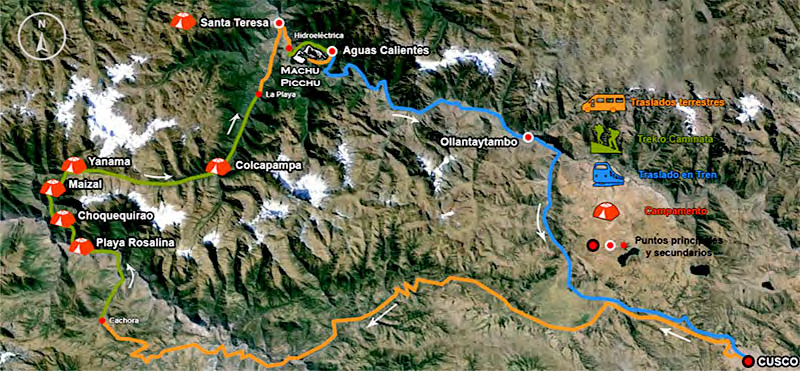
Fuente: tomado de https://www.google.com/search?q=mapa+de+choquequirao+cusco&tbm=isch&tbs=rimg:CUA2J- w7zhdxIji414xHNsbec
![Figure 2: Micro-location of RCA Choquequirao. Source: SNIP Investment Bank: public investment project with code 307376 Regarding the natural heritage of the RCA CHOQ, the Master Plan 2014-2018 GRRNGMA [16], indicates that it must conserve biological corridors and genetic refreshing areas for fauna species, mainly for the “spectacled bear”, _Tremarctos_ _ornatus_, as well as many birds and mammals. In this way, the continuity of ecological processes in other nearby protected natural areas such as: Machu Picchu and Ampay would be ensured. On the other hand, high threats were identified, such as forest and grassland fires, contamination by solid waste generated by tourism and external geodynamics and as medium threats the expansion of the agricultural frontier, extraction of timber species for firewood among the most important and, finally, as low threats extraction of orchids and other ornamental plants.](/fulltextimages/7735/fig_2.png)
Figure 2: Micro-location of RCA Choquequirao. Source: SNIP Investment Bank: public investment project with code 307376 Regarding the natural heritage of the RCA CHOQ, the Master Plan 2014-2018 GRRNGMA [16], indicates that it must conserve biological corridors and genetic refreshing areas for fauna species, mainly for the “spectacled bear”, Tremarctos ornatus, as well as many birds and mammals. In this way, the continuity of ecological processes in other nearby protected natural areas such as: Machu Picchu and Ampay would be ensured. On the other hand, high threats were identified, such as forest and grassland fires, contamination by solid waste generated by tourism and external geodynamics and as medium threats the expansion of the agricultural frontier, extraction of timber species for firewood among the most important and, finally, as low threats extraction of orchids and other ornamental plants.
The situation of the species in 2014, according to the classification and categorization of threatened species of wild fauna, determined by the Ministry of Agriculture, D.S. N ° 004-2014-MINAGRI, in the case of ACR Choquequirao, they are in danger. The Andean condor and the Andean cat are considered an endangered species (EN), and the colored puma in a near threatened situation (NT), being a total of three threatened species of wild fauna mammals and one endangered bird species (Andean condor), due to hunting and destruction of their hábitats (Figure 3).
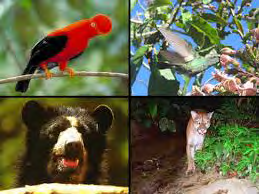
The Andean bear or spectacled bear, widely distributed in montane forests, needs large spaces to live, which is why the ACR serves as a biological corridor between Ampay and Machupicchu. The Andean bear is in the vulnerable situation in the category of VU.
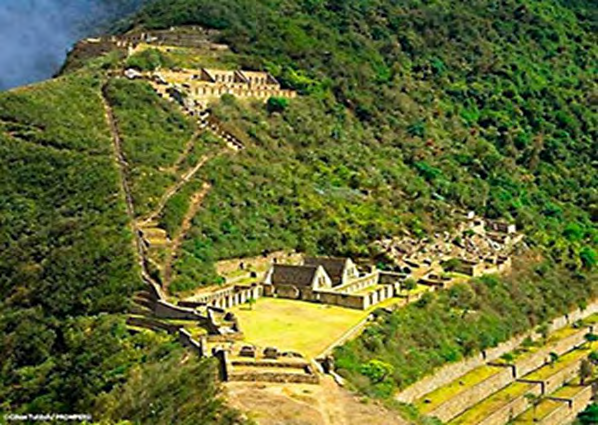
Regarding Cultural Heritage, the Choquequirao-A°P° CHOQ Archaeological Park is located within the RCA-CHOQ, which is arranged in nine areas, built as small villages around a large square where all the coming roads are located. from each area [16]. It has been possible to locate the upper square (Hanan), the warehouses (Qolqa), the main square (Huaqaypata), the lower square (Hurin), the system of cultivation platforms close to the main square, La Llacta, (Chaqra Anden), the ceremonial platform (Ushno) and the dwelling of the priests at the bottom of the hill. The Park has multiple two-story buildings with niches inside, as well as some doors and niches made with adobe jamb and irrigation channels, see figure 4, which have been progressively intervened and others are abandoned. Minimal maintenance actions can be observed (replacement plasters and original plasters have been losing stability), few archaeological studies that allow archaeological excavations to have a better study of the original architecture and filtration of rainwater that is deposited at the base of the main walls affecting the stability of the most important sectors of A° P° CHOQ.
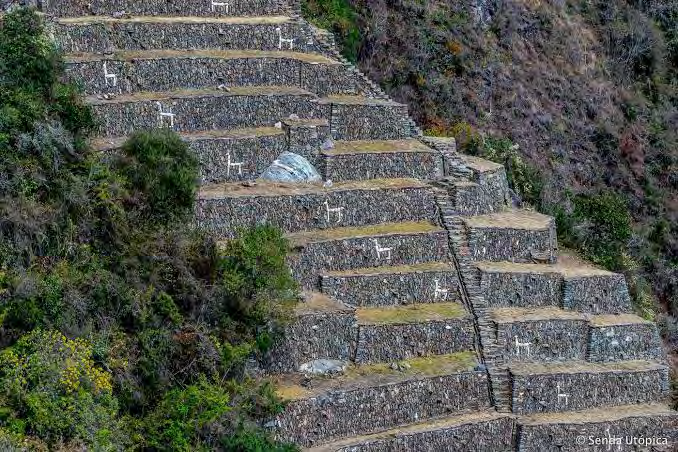
Figure 4: The Archaeological Park of Choquequirao, shows multiple two-story buildings with niches inside, accompanied by hydraulic systems for the use of the houses and you can see a system of cultivation platforms near the main square. FUENTE: Tomado de: https://www.google.com/search?- q=choquequirao+cusco&source=lnms&tbm=isch&sa=X&v ed=2ahUKEwiZ2f2v97zmAhWeDrkGHY_XCY8Q_AUoAXoE CBAQAw&biw=1920&bih=920#imgrc=oDJ4qwheyLIZdM The A°P° of CHOQ also has a great system of platforms, a characteristic of the Inca settlements, which helped in the agricultural use on the slopes of the hills, and which currently, to the sight of tourists, seem floors carpeted by vegetation in the area, see Figures 4 & 5.
One of the environmental goods and services that RCA CHOQ provides is scenic beauty, the most outstanding eco- systemic service for the development of tourism activity. In this sense, it has been implemented, for more than 10 years, as part of the tourism promotion policies deployed by the State visits to A°P° CHOQ, allowing this activity to take off. Thus, between 2005 and 2010, tourist activity grew at a rate of 3.16%, and as of 2011, due to problems of poor maintenance of accesses, insufficient and inadequate public tourist infrastructure and heavy rains registered in 2012, which caused Landslides and stones on the routes that lead to A°P° CHOQ contributed to the decrease in the flow of tourists at a rate of 0.66%, according to data from the Ministry of Foreign Trade and Tourism-MINCETUR, Table No. 01. Likewise, it can be observed that the greatest influx of tourists is registered between the months of June to August, a time when the level of rainfall decreases and is almost nil.
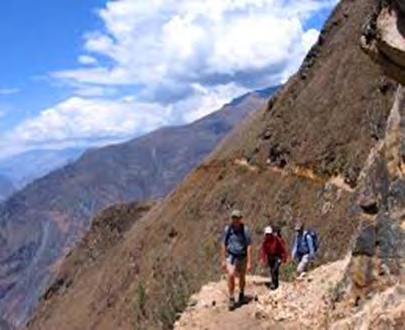
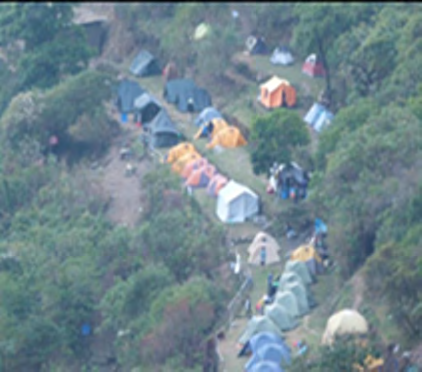
Currently, the tourist facilities in the RCA CHOQ are precarious, inadequate signage, pedestrian access to the park in critical safety and maintenance conditions, few spaces for tourists to rest and observe the landscape, lack of information centers, minimal conditions for the installation of camping areas and little presence of personnel to monitor and control along the access routes, see figure 6. On the access routes, tourists do not have adequate furniture, such as railings, garbage cans and toilets. These services can only be found when entering the park in the sector called Sunchupata and in this place is also located the ticket office administered by the Decentralized Directorate of Culture of Cusco-DDC, an entity that is in charge of collecting the entrance fees to the park, currently it is 18 dollars for tourists in general and 9 dollars for students.
| Meses/Ano | 2005 | 2006 | 2007 | 2008 | 2009 | 2010 | 2011 | 2012 | 2013 | 2014 | 2015 | 2016 | 2017 | 2018 |
|---|---|---|---|---|---|---|---|---|---|---|---|---|---|---|
| enero | 213 | 142 | 139 | 188 | 118 | 15 | 205 | 156 | 134 | 100 | 109 | 222 | 310 | 312 |
| febrero | 133 | 170 | 175 | 110 | 113 | 161 | 128 | 90 | 48 | 66 | 102 | 122 | 282 | 215 |
| mario | 383 | 267 | 341 | 449 | 203 | 1171 | 171 | 92 | 182 | 157 | 209 | 395 | 307 | 539 |
| abril | 227 | 532 | 632 | 405 | 525 | 837 | 527 | 226 | 253 | 456 | 455 | 305 | 877 | 662 |
| mayo | 607 | 687 | 489 | 741 | 529 | 705 | 685 | 120 | 459 | 572 | 445 | 592 | 1126 | 821 |
| junio | 840 | 660 | 1143 | 787 | 235 | 760 | 585 | 292 | 321 | 499 | 461 | 543 | 718 | 869 |
| julio | 1177 | 1400 | 1281 | 1434 | 0 | 738 | 1192 | 577 | 576 | 810 | 715 | 998 | 1286 | 1107 |
| agosto | 920 | 1145 | 1536 | 1238 | 795 | 1024 | 977 | 702 | 549 | 733 | 640 | 828 | 939 | 873 |
| setiembre | 823 | 760 | 862 | 912 | 720 | 745 | 667 | 479 | 355 | 627 | 593 | 590 | 733 | 753 |
| octobre | 572 | 536 | 843 | 911 | 849 | 874 | 448 | 245 | 315 | 373 | 604 | 494 | 597 | 0 |
| nouiembre | 303 | 280 | 0 | 418 | 340 | 420 | 0 | 221 | 311 | 331 | 387 | 471 | 520 | 480 |
| diciembre | 363 | 281 | 261 | 138 | 142 | 214 | 198 | 134 | 143 | 144 | 217 | 323 | 328 | 388 |
| Total Visitantes annules | 6561 | 6860 | 7702 | 7731 | 4569 | 7664 | 5783 | 3334 | 3646 | 4868 | 4937 | 5833 | 8023 | 7019 |
Table 1: Flow of tourists to A°P° Choquequirao: 2005-2018. Source: Own elaboration according to data from MINCETUR. http://datost
Table 1: Flow of tourists to A°P° Choquequirao: 2005-2018. Source: Own elaboration according to data from MINCETUR. http://datosturismo.mincetur.gob.pe/appdatosTurismo/Content2.html The knowledge of the RCA-CHOQ, the research on conservation and tourism issues in natural areas, consultations with researchers, different work meetings with those responsible for the administration of the area and repeated previous interviews with small samples of visitors, allowed to have elements to identify the attributes and levels of the scenarios, associated with conservation and tourist activity in the RCA-CHOQ; allowing to identify four important attributes: “no intervention”, “improvement in conservation”, “improvement in tourism” and “improvement in conservation and tourism”. The selection alternatives are defined below, which were presented to the interviewees.
Alternative 1: current situation of natural heritage and cultural heritage and tourism infrastructure ( 1 0 c q = , 1 0 tq = ) enario in which the area administration only develops maintenance actions, does not implement programs or restoration projects in deteriorated areas, nor scientific research activities on the ecosystems of the ACR, the snow- capped mountains, the local flora and fauna. Environmental education programs or conservation work would not be installed in the peasant communities that live in the park. Likewise, the archaeological park does not register improvements in the different enclosures, cultural conservation is not implemented or the enhancement of the nine areas of the park. With regard to tourism actions, routine and periodic maintenance activities are developed for tourist accesses and routes, tourist signage is scarce and inadequate, the service of the muleteers harms the transit of tourists and they do not provide services with their own standards in natural areas. Public tourist services, such as: camping areas, tourist viewpoints, access routes, hygienic services do not guarantee adequate enjoyment or safety for tourists, solid waste management is minimal, and management documents such as the Use Tourist Plan is not implemented.
Alternative 2: situation of no improvement in tourist infrastructure and improvement in conservation ( 2 0 tq = ,
2 1 c q = ). It consists of the implementation of projects aimed at the protection and conservation of natural resources, construction of control and surveillance posts, informational signage in the RCA, improving the capacities of technical operators in the management of natural resources, developing capacities in the population, in good agricultural practices, adequate management instruments, improve the organizational and participation capacities of Local Authorities and the population in the management of natural resources around the RCA. With regard to cultural heritage, actions are being developed to consolidate the enhancement of the complex of prioritized sectors of A°P° Choquequirao, archaeological research and preventive conservation.
The interventions would require the implementation of investment projects, which to date have not yet been executed, for the amount of S/. 49’294,749.00 and 14’288,333.00 in dollars, according to data from the Investment Bank of the National Public Investment System as of Decemberth 2017, with an exchange rate of 3.3 soles per dollar.
Alternative 3: the current state of the natural and cultural heritage is maintained, while if there are improvements in public tourism infrastructure, ( 3 1 tq = , 3 0 c q = ), which consists of the implementation of projects aimed at the “ Installation, improvement and expansion of public tourist services ”, which allow to have sufficient and adequate tourist infrastructure, with safe roads (protected with retaining walls, gabions, railings), installation of adequate bridges, improvement of works of art that allow an adequate management of rainwater in the enclosures and on the roads, installation of camping areas and tourist inns with their respective hygienic services and solid waste management, installation of a site museum and tourist viewpoints and installation of the signpost informative within the framework of international standards for natural areas. These interventions are identified in each of the investment programs of the respective entities, an investment that would demand in soles 31’650,399.00 and in dollars 9’591,030.00.
Alternative 4: joint actions in conservation and tourism are developed ( 4 1 c q = , 4 1 tq = ), projects and investment programs are implemented in both conservation and tourism, which demand in soles 80’945,148.00 and in dollars 24´528,833.00.
| Valoration Alternatives | Attribute | Description | Levels |
|---|---|---|---|
| Alternative 1 | No conservation No tourism | No improvement | Yes |
| Not | |||
| Alternative 2 | Conservation | The RCA CHOQ will be conserved in the natural and cultural heritage. | Yes |
| Not | |||
| Alternative 3 | Tourism | Improved public tourism infrastructure that will allow a satisfactory visit. | Yes |
| Not | |||
| Alternative 4 | Conservation and tourism | The RCA CHOQ will be preserved and will present a public tourist infrastructure for a satisfactory visit | Yes |
| Not | |||
| Attribute cost | Attribute cost ($) | Non-intervention | 0 |
| Intervention in tourism | 3 | ||
| Intervention in conservation | 5 | ||
| Conjoint intervention in conservation and tourism | 8 |
Table 2: Alternatives, attributes and levels used in the CJA model. Source: Own elaboration.
Levels were assigned to each of the alternatives described above, these being the characteristics of the choice of the respective attributes, for example the cost, which is an attribute of the scenarios, is described in four levels ($ 0, $ 3, $ 5 and $ 8), that represent the costs of each investment policy per visitor. The interviewees selected and ordered according to their preferences, according to the attributes of improvements in tourism and/or conservation. The attributes are independent of each other, that is, there should be no correlation between them, as indicated [17], you can see the following tables that summarize the scenarios, depending on their attributes and levels, see Table 2.
Specification of the Preference Model
The research is based on the theoretical model of Random Profit to calculate the willingness to pay, using as a methodology the Joint Analysis in its version of contingent management, which is a compensatory model and is linked to models Multi-attribute and start from the assumption that the different attribute levels can be offset against each other, making possible the existence of different products with a similar overall utility for consumers. The algorithm of the Conjoint Analysis Model is represented as follows:
( ) 1k jk U f u , u =
The utility will correspond to the value that the individual attributes to a product through the combination of factors (attributes), so that this value is the maximum for the choice made within the set of options. In other words, the level of utility obtained is an appropriate combination of attributes, weighted by the relative importance of each in the contribution of the total utility of a particular good [5, 18]. The conjoint-CJA analysis allows estimating the parameters or partial utilities associated with each attribute level, taking an interest in consumer preferences.
The structure of the CJA through the contingent ordering model is analyzed using the random utility model. The utility obtained by individual i from alternative j can be represented by ij U , J j ,..., 0 = , which can be expressed as the result of the aggregation of a deterministic and a stochastic component, so that:
ij ij ij V U ε + = . (1)
Where V_ij_ is the observable part of the total utility (deterministic component) that depends on the characteristics of the options and the person interviewed and €ij is the unobservable part (stochastic or random component).
The individual will choose alternative j if and only if ik ij U U > , j k ≠ ∀ .
Then, the probability that individual i chooses alternative j can be expressed as:
( ) ( ) ( )j k V V P j k U U P j Y P ik ij ij ik ik ij i ≠ ∀ − < − = ≠ ∀ > = = , , ε ε . The model is finally subject to the assumption that the error terms are distributed independently and identically with a distribution, which is assumed for the vector of disturbance terms ( ) iJ i ε ε ,..., 0 , of the extreme value type, Gumbel distribution [19], obtaining the so-called model conditional logit, whose expression is the following McFadden [20]:
V e j Y P ij
( ) , J j ,..., 0 = , (2)
= = J i ∑ =
V e ik
0 k It is known as McFadden’s Conditional Logit Model, where the term is the deterministic component of utility ij V that is expressed as a linear function of characteristics of individual i and option j.
On the other hand, for the estimation of the contingent ordering model, the recommendations of [21] were taken into account, who showed that any random utility model can approximate any degree of precision, through a mixed logit, with the specification appropriate mix and variables used. In Munizaga [18], it is indicated that the most interesting property of the Mixed Logit Model (MMNL) is that under certain conditions of regularity any random utility model has choice probabilities that can be approximated as closely as desired, by a Mixed Logit, by allowing the MMNL to model the presence of correlation between alternatives, it is capable of raising the assumption of independence of irrelevant alternatives typical of the multinomial logit model.
Likewise, to estimate discrete choice models from data obtained by contingent ordering, the correct relationship between the choice and ordering probabilities must first be identified. If Luce’s axiom Luce [22] holds, the ranking data can be transformed into choice data. That is, the ordering of m alternatives is equivalent to a sequence of m-1 independent choice problems of the most preferred alternative. If the ( ) iJ i ε ε ,..., 0 are independent and identically distributed with a distribution of the extreme value type (Gumbel distribution), and assuming the scalar parameter equal to 1, the probability that individual i performs the ordering where alternative 1 is preferred to alternative 2, the alternative 2 is preferred to 3, and so on, it is obtained from the product of m-1 ordinary logit likelihood functions, known as “Rank- ordered logit model”:
= ∫∏∑ = ′
′ b e e P â Ω
x T nit n
dâ ) , â( ö . (3)
ni njt n
1 â x t j
To estimate well-being, starting from the indifference condition and following the developments made by Hanemann [23], the following mathematical expression is obtained for the individual compensatory variation:
= − ∑ ∑ (4)
m m i vk v k ij ij j j CV ln e ln e α β = =
( ) 0 0
1 .
1 1 1 Donde:
1 â Represents the marginal utility of income Represents the indirect utility before the change (status quo)
0 ij v Represents marginal utility after change in conservation and tourism ij k v Represents the compensatory variation for going from the initial state to the change of a level of improvement and environmental quality k.
( ) 0 i k CV α Equation (4) must be estimated econometrically using a discrete choice model [24]; for estimating indirect profits. This model assumes that the option that generates the most utility for the individual receives the highest score, then takes the first place in the “order”. Therefore, the probability that an individual assigns the highest rating to an option is a function of the indirect utility that each option generates in a particular way.
Choice of Data Collection Method and Measurement Scale
Once the attributes and levels of each of the RCA-CHOQ scenarios have been defined and the utility model specified, the third part of the experiment design focuses on the choice of alternative goods that will be evaluated by the interviewed visitors. It is important to consider that various techniques have been developed in order to reduce the multiple possible alternatives between attributes and their levels and to be able to continue to infer utilities from their combinations. For the investigation, the orthogonal design was chosen, which has resulted in the selection of four alternatives out of the eight possible ones.
The conjoint designs are orthogonal because the variation of each attribute is completely independent of the variation of all the other attributes, that is, the correlations between the levels of the different chosen attributes are null. The attributes used in CJA should be chosen carefully to include only those that are the most representative, which can influence consumer preference, [1, 2, 3, 7, 25]. In this way, the interviewees were presented with four alternatives of choice, I ordered them according to the preference assigned to each one of them and then it was expressly built following an orthogonal design. See the following Table 3.
| Alternative 1 | Alternative 2 | Alternaticve 3 | Alternative 4 |
|---|---|---|---|
| Status quo in Conservation and Tourism | Tourism improvement | Conservation improvement | Conservation improvement |
| Statu quo in conservation | Statu quo in tourism | Tourism improvement | |
| $ 0.00 | $. 3.00 | $. 5.00 | $. 8.00 |
Table 3: Choice options Source: own elaboration.
Data collection was supported by surveys applied to 179 tourists at two RCA CHOQ departure points at different times in 2017. The maximum error made in the selection of the sample was 5% and the choice of the interviewees was random.
The questionnaire had three different parts, in the first one a series of data was obtained about the visit that the tourist makes to the RCA CHOQ, their prior knowledge and their attitude towards nature, towards the conservation of cultural heritage and towards tourism activities developed. In the second part, four differentiated choice scenarios were presented at the level of their attributes, in which the respondent responded by expressing their preferences for each of the alternatives and the third part was aimed at a group of socio-economic questions, which allow characterize the selected sample.
Regarding the alternatives presented to the interviewees, the most desired, with the greatest number of times selected as a favorite is 4, which contemplates the joint implementation of public policies for both conservation and tourism, 44.4% of the respondents have chosen this option. The Alternative that follows is 2, improvement of the levels of tourism without conservation, with an approval of 33.3% of the sample. Alternative 3, improved conservation and tourism status quo with 12.8%, and alternative 1, the initial situation without interventions, is also desired by 9.5% of those interviewed.
Estimation of the Utility Funtion
For the estimation of the CJA model, equation (3) was estimated using the rank-ordered logit Beggs [12] using the MMNL, taking into account that the utility function Vij is linear in the parameters and additively separable. The attributes described in Table 2 are included as explanatory variables. The indirect demand function (this does not depend on the “quantities” of the options but on their attributes) [26] with which the model is estimated is:
( ) ( ) 1 , , , = + − + j j ij c t i ij i j ij v v q q Z W â Y p e (5)
Equation five additionally assumes the separability of residual income from the effect of the other variables that intervene in the indirect utility function. For the estimation of well-being, starting from the indifference condition and following the developments made by Hanemann [23], the compensated variation that resembles the willingness to pay was estimated using equation (4).
Equation (4) must be estimated econometrically using a discrete choice model [24]. This model assumes that the alternative that generates the most utility for the individual receives the highest score, then takes the first place in the “order”. Therefore, the probability that an individual assigns the highest rating to an alternative is a function of the indirect utility that each alternative generates in a particular way [27, 28].
If one of the attributes is the price vector pj, the change from one level to another in any of the other attributes that define the good can be evaluated in terms of compensated variation Hanemann [23] in that sense this relationship provides the marginal utility value of income; therefore the WTP for a unit increase in the levels of other attributes other than price and this result can be obtained from the expression indicated in equation (4), in which β is the coefficient of the attribute being considered.
Results and Discussion
The application of the Conjoint Analysis model through its version of contingent management determines a rating for each alternative by the tourist-visitors, which implicitly ranks the alternatives presented, from most preferred to least preferred. To estimate the Mixed Logit Model (MMNL) has been used, very appropriate in this case, since the dependent variable ORDER refers to this ordering of the options that goes from 1 to 4 (from most preferred to least preferred).
The variables presented in this model are quite significant at the 95% confidence level and with the expected signs. The potential implementation in investment projects in conservation and tourism in the RCA Choquequirao increases the probability that it will receive the first place of management that the interviewees do, with greater attribution to improvements in tourism, greater marginal effect, see Table 4.
| Multinomial Logit Model | |||
|---|---|---|---|
| Dependent Variable ORDER | |||
| Explanatory Variables | Coefficients | Statistic value “z” | Statistical probability “z” |
| CONSERV | 0.32 | 3012 | 0.00000000 |
| TURISM | 0.73 | 5762 | 0.00000021 |
| URGCONSV | 0.27 | 3505 | 0.00000016 |
| SITUR | -0.6 | -5.157 | 0.00000000 |
| INGR | 1.60E-04 | 29.885 | 0.00000000 |
| EDUC | 0.21 | 2.089 | 0.00000000 |
| GENE | 0.23 | 2,133 | 0.00000009 |
| Log-Likelihood | -253.3321 | ||
| R2 Veall y Zimmermann | 0.74 | ||
| Chi-cuadrado | 153.459 | ||
| N° observaciones | 716 |
Table 4: MMNL Results del MMNL de Sorting Opcions Source: own elaboration. In terms of indirect utility functions, Table 4 can be
0.32 0.73 0.27 0.63 1.60 04 0.21 0.23 = + + − + − + +
ij V CONSERV TURISM URGCONSV SITUR E INGR EDUC GENE
The above function represents the indirect utility of
an individual for each of the options. In this function, the marginal effect of the attributes and of the variable combined with residual income (INGR) is positive as expected, this because as the level of conservation and tourism increases, the same as the residual income of the tourist then this receives a greater indirect utility [29].
The SITUR variable refers to the situation of the tourist infrastructure, this has the expected sign, a negative sign, since while the improvements that must be made to improve the SITUR are not taken into account, the lower the level of utility will be hint from visitors.
In the case of the variable that represents the interest that individuals have for conservation C0NSERV, it has a positive sign, and its significance is not high, the sign was to be expected, since as individuals are more concerned about the urgency in the conservation of the RCA the utility for an improvement in the conservation increases.
The estimated coefficient for the education variable also has a positive sign and is a variable with a high level of significance, this was to be expected since greater education greater indirect utility is perceived by improvements in conservation and tourism in the Choquequirao RCA.
An approximation of Veall and Zimmerman [24], the R2 is equal to 0.74, in other words, the variations of the explanatory variables of the model explain by 74% the variations of the dependent variable, which indicates a good fit of the model.
From the parameters estimated in the management model, the compensated variations “CV” are calculated, based on the formula presented in equation 4 and presented by Hanemann [22]. This CV corresponds to the marginal change in the well-being of individuals (marginal benefit) from making investments in improvements in tourism and conservation. The CV has been used as an approximation of the WTP of individuals for the proposed options, see table 3.
Referring to the interpretation of the CVs, they indicate that a representative person of the visitors to Choquequirao would be willing to pay $ 4.5 for the improvement in the tourism infrastructure proposed in the alternatives and would also be willing to contribute $ 1.9 for interventions in conservation projects. However, of particular interest is the fact that the CV for the simultaneous improvement in tourism and conservation levels is much greater than the sum of the CVs for the individual improvements [30]. In such a way that the CV added by the simultaneous implementation of investment projects in tourism and conservation is 80,718.50 dollars per year, which almost doubles the sum of the CV added from options 2 and 3, Table 5.
| Options | Compensated Variations $/ day-visit (WTP marg) | Options cost ( $/) | Compensated Variations added per year in $ (Dollars 2018) |
|---|---|---|---|
| 2 | 4.5 | 3 | 31,585.5 |
| 3 | 1.9 | 5 | 13,336.1 |
| 4 | 11.5 | 8 | 80,718.5 |
Table 5: Compensated Variations, cost of attributes and WTP added by options Source: own elaboration.
Conclusion
The established RCA CHOQ, under various legal protection documents that currently exist in the legal system of the National Service of Natural Protected Areas by the State-NSPA, must implement environmental, cultural and management policies for tourism activity respectively, in such a way way to implement the strategic objectives of your Master Plan. In this context, the research work has sought to achieve an economic instrument for the valuation of the ecosystemic services of the RCA that allow the design and implementation of adequate decision-making in order to achieve the aforementioned policies.
One of the efforts to value recreational activities, nature tourism, based on cultural and natural tourist products is one of the objectives that is intended to be achieved in this research; since the characteristics or attributes inherent to these products are goods that do not have a market price. The Conjoint Analysis-CJA in its version of contingent management is one of the methods that is adapted to our needs and, it is the one that was used to estimate the social benefits reported by improvements in investment programs and projects in both conservation and tourism in the RCA CHOQ. By implementing a portfolio of investments by the State in conservation and tourism projects in the ACR Choquequirao, the users, visitors, of this natural area would assume in financial terms the benefits of said interventions by paying 11.5 dollars, additional to the entrance fee, contributing to the economic, environmental, social and cultural sustainability of the area. The application of the CJA to determine the economic value that the visitors assign to the attributes in conservation and tourism report greater profits, jointly, than when they are implemented individually. Visitors to the RCA Choquequirao have an willingness to pay-WTP of 4.5 dollars for investment projects in tourism, while this DAP is only 1.9 dollars to develop projects in conservation and 11.5 dollars in case they will be jointly executed projects of conservation and tourism, contributing greater financial benefits for the entities that administer the area. The entities responsible for managing the Choquequirao RCA must implement tourism investment projects that include conservation projects at the same time, since social benefits would be generated almost twice as high as if these projects were implemented separately. Which would assign an economic value to RCA Choquequirao, under the option of joint execution of tourism and conservation projects equal to 80,718.50 dollars.
References
-
The research is based on the theoretical model of Random Profit to calculate the willingness to pay, using as a methodology the Joint Analysis in its version of contingent management, which is a compensatory model and is linked to models Multi-attribute and start from the assumption that the different attribute levels can be offset against each other, making possible the existence of different products with a similar overall utility for consumers. The algorithm of the Conjoint Analysis Model is represented as follows: ( ) 1k jk U f u , u = The utility will correspond to the value that the individual attributes to a product through the combination of factors (attributes), so that this value is the maximum for the choice made within the set of options. In other words, the level of utility obtained is an appropriate combination of attributes, weighted by the relative importance of each in the contribution of the total utility of a particular good [5,18]. The conjoint-CJA analysis allows estimating the parameters or partial utilities associated with each attribute level, taking an interest in consumer preferences. The structure of the CJA through the contingent ordering model is analyzed using the random utility model. The utility obtained by individual _i_ from alternative _j_ can be represented by _ij_ _U_ , _J_ _j_ ,..., 0 = , which can be expressed as the result of the aggregation of a deterministic and a stochastic component, so that: _ij_ _ij_ _ij_ _V_ _U_ ε + = . (1) Where V_ij_ is the observable part of the total utility (deterministic component) that depends on the characteristics of the options and the person interviewed and €ij is the unobservable part (stochastic or random component). The individual will choose alternative j if and only if _ik_ _ij_ _U_ _U_ > , _j_ _k_ ≠ ∀ . Then, the probability that individual _i_ chooses alternative _j_ can be expressed as: ( ) ( ) ( )_j_ _k_ _V_ _V_ _P_ _j_ _k_ _U_ _U_ _P_ _j_ _Y_ _P_ _ik_ _ij_ _ij_ _ik_ _ik_ _ij_ _i_ ≠ ∀ − < − = ≠ ∀ > = = , , ε ε . The model is finally subject to the assumption that the error terms are distributed independently and identically with a distribution, which is assumed for the vector of disturbance terms ( ) _iJ_ _i_ ε ε ,..., 0 , of the extreme value type, Gumbel distribution [19], obtaining the so-called model conditional logit, whose expression is the following McFadden [20]: _V_ _e_ _j_ _Y_ _P_ _ij_ ( ) , _J_ _j_ ,..., 0 = , (2) = = _J_ _i_ ∑ = _V_ _e_ _ik_ 0 _k_ It is known as McFadden’s Conditional Logit Model, where the term is the deterministic component of utility ij V that is expressed as a linear function of characteristics of individual _i_ and option _j_. On the other hand, for the estimation of the contingent ordering model, the recommendations of [21] were taken into account, who showed that any random utility model can approximate any degree of precision, through a mixed logit, with the specification appropriate mix and variables used. In Munizaga [18], it is indicated that the most interesting property of the Mixed Logit Model (MMNL) is that under certain conditions of regularity any random utility model has choice probabilities that can be approximated as closely as desired, by a Mixed Logit, by allowing the MMNL to model the presence of correlation between alternatives, it is capable of raising the assumption of independence of irrelevant alternatives typical of the multinomial logit model. Likewise, to estimate discrete choice models from data obtained by contingent ordering, the correct relationship between the choice and ordering probabilities must first be identified. If Luce’s axiom Luce [22] holds, the ranking data can be transformed into choice data. That is, the ordering of m alternatives is equivalent to a sequence of m-1 independent choice problems of the most preferred alternative. If the ( ) _iJ_ _i_ ε ε ,..., 0 are independent and identically distributed with a distribution of the extreme value type (Gumbel distribution), and assuming the scalar parameter equal to 1, the probability that individual i performs the ordering where alternative 1 is preferred to alternative 2, the alternative 2 is preferred to 3, and so on, it is obtained from the product of m-1 ordinary logit likelihood functions, known as “Rank- ordered logit model”: = ∫∏∑ = ′ ′ _b_ _e_ _e_ _P_ â Ω _x_ _T_ _nit_ _n_ dâ ) , â( ö . (3) _ni_ _njt_ _n_ 1 â _x_ _t_ _j_ To estimate well-being, starting from the indifference condition and following the developments made by Hanemann [23], the following mathematical expression is obtained for the individual compensatory variation: = − ∑ ∑ (4) m m i vk v k ij ij j j CV ln e ln e α β = = ( ) 0 0 1 . 1 1 1 Donde: 1 â Represents the marginal utility of income Represents the indirect utility before the change (status quo) 0 ij v Represents marginal utility after change in conservation and tourism ij k v Represents the compensatory variation for going from the initial state to the change of a level of improvement and environmental quality k. ( ) 0 i k CV α Equation (4) must be estimated econometrically using a discrete choice model [24]; for estimating indirect profits. This model assumes that the option that generates the most utility for the individual receives the highest score, then takes the first place in the “order”. Therefore, the probability that an individual assigns the highest rating to an option is a function of the indirect utility that each option generates in a particular way.
- Lessons to Learn: Trees are More than the Lungs of the World
- Community Forestry Enterprises as a Model for Sustainable Forest Development: The Case Of The "Baja Tarahumara" in Chihuahua, Mexico
- Ecological and Socio-Economic Impacts of Chromolaena odorata and Mesosphaerum suaveolens, Two Invasive Alien Species in Central and Southern Benin, West Africa
- Epigenetic Sustainability: Modeling the Human Factor as a Natural Resource through Science 4.0 and the NR3C1 Biological Pilot
- Growth-at-Risk: A Framework for Assessing Economic Vulnerability
- The Rural Territory as a Socioecological System for the Management of Public Policy for Sustainable Rural Development