
Sea Turtle Stranding Patterns in New York (2017-2020)
In this observational study, we examined spatiotemporal patterns of the sea turtle taxa, and how they are affected by human interactions. We isolated the data to only 4 species of concern in the New York area from the years 2017 to 2020. The four species of concern are Leatherback (D. Coriacea), Loggerhead (C. Caretta), Kemp’s ridley (L. Kempii), and Atlantic green sea turtles (C. Mydas). We utilized data provided by the Atlantic Marine Conservation Society (AMSEAS) to plot stranding locations of Google Earth, and graph the trends. It was determined that there is a significant spike in sea turtle strandings during the summer months (July & August) and the winter months (November & December). We used resources from NOAA to determine that the migratory patterns of the sea turtles are causing the strandings as global warming progressively makes the water warmer in the winter months as the year’s progress. Human interaction only comprises (24.6%) of the stranding cause and over half of the human interaction caused strandings are due to vessel strikes. Furthermore, we will use this data to research stranding patterns on other marine mammals, partner with organizations to raise awareness and prevent strandings as the climate changes, and conserve these vulnerable (Leatherback), endangered (Loggerhead & Green), and critically endangered (Kemp’s Ridley) sea turtles.
Sadiqah Quadery1,3*, Tayeb Abu Jazar1,3, Shahir Bey1,4 and Allison DePerte2
Introduction
A sea turtle stranding is when a sea turtle is found on the shore or floating in the water, whether sick, dead, injured, or alive (NOAA, 2018). The leatherback sea turtle (D. coriacea) [1], loggerhead sea turtle (C. caretta) [2], Kemp’s ridley sea turtle (L. Kempii) [3], and Atlantic green sea turtle (C. mydas) [4] can be found in New York waters. Analysis of stranding response efforts can tell us about changes in oceanography, and how anthropogenic (human interaction) challenges impact marine life. This analysis can also inform impacts of potential aquatic toxicology, and the impacts of diseases on certain species. In the Greater Atlantic Region, specifically New York, strandings grow in numbers during December and the summer months. Leatherback sea turtles have the widest geographic range of these turtles; they reside in the Pacific, Atlantic, and Indian Oceans. They are titled vulnerable, due to highly decreasing numbers over several years. Their nesting habitats are found primarily in tropical and coastal locations. Leatherbacks, being the only warm- blooded reptile in the world, can withstand more extreme temperatures but still prefer warmer waters [5], 2009.
Loggerheads travel across the Pacific, Atlantic, and Indian Oceans along with the Mediterranean Sea. Additionally, they are the most abundant turtle that nests in the United States, with nests found mostly in subtropical areas such as Florida, Georgia, North Carolina, and South Carolina. Over time the loggerhead turtle has become an endangered species. Loggerheads prefer warm temperatures ranging from 56-82 degrees Fahrenheit, causing them to migrate North during the summer months. Kemp’s Ridley turtles can be found from the Gulf of Mexico to New England along the coast. Their nests occur primarily within the Gulf of Mexico and are rarely found anywhere else. During the 1940s the Kemp’s Ridley turtle faced a steep population decline; today the turtle is considered an endangered species and is at risk of extinction. Kemp’s Ridley turtles prefer water temperatures of 64-68 degrees Fahrenheit. Green Turtles live in over 140 countries and nest in over 80, they are found all around the world. In the United States, their nesting places include Puerto Rico, Florida, Georgia, North Carolina, and South Carolina. However, due to excessive poaching and hunting of Green turtles, they have become an endangered species. The ideal temperature for this species is over 68 degrees Fahrenheit, which causes them to migrate North during the summer months and migrate South during the winter. Considering the spatiotemporal patterns and migratory patterns of sea turtles, we predict sea turtle strandings will be most frequent during the summer months (June-August) due to increased migration and human-created marine traffic.
Materials and Methods
The data used for our research was provided by AMSEAS. The analyzed data recorded sea turtle strandings in the greater Atlantic region, focusing mostly on the greater New York area. The data was collected on the coast of New York State (2,625mi /4224.528 km) [NOAA 1] Civilians may encounter the stranded marine life on a beach, or drive by and see it. Some may also be out on a boat and see it. The encounter is then reported to the New York State stranding hotline-–(631)-369-9829. Volunteers, marine biologists, and other professionals respond to the scene and collect data. They collect data such as the location, date/time, condition code, species, human interactions (if it can be determined), and the cause of death (if it can be determined). The data is then entered into a record (spreadsheet) of all the strandings. The data was then filtered and separated by species. Condition code frequency (Condition Code is a scale of the condition the sea turtle was found from 0-5, “0” is found alive, and “5” is fully decomposed where only a skeleton remains), temporal patterns, timeline (month and year), cause of death, and type of human interaction. Furthermore, human interaction was filtered further concerning the high frequency of vessel strikes. Using precise latitude and longitude coordinates given in the data table, the location of all strandings was then entered into Google Earth separated by species. The location of vessel strike strandings was also mapped to locate where a large portion of those incidents occur.
Results
A common trend was the frequency of sea turtle strandings during specific months. The highest frequency of sea turtle strandings occurred in July, August, November, and December. These spikes in strandings can likely be attributed to the migrational patterns of each species as well as their resistance to specific temperatures. Sea Turtles prefer warmer temperatures and migrate to locations that meet this requirement [6]. All four species migrate North during the summer months despite all their nesting being located mainly in tropical or subtropical areas [7]. This is likely to cause the spike in strandings in July and August, a higher density of turtle population leads to a higher likelihood of stranding occurring. The biggest spike occurred in December and we found it was probable that many turtles experienced hypothermia or became “cold-stunned” during the extreme temperatures of winter [5]. Leatherbacks, however, are an exception as they are capable of maintaining their body temperature within more extreme water conditions. They can withstand temperatures as low as 30-40 degrees Fahrenheit as far up North as Greenland. Our data support this idea as not a single Leatherback turtle was confirmed to have stranded naturally, they only stranded through human interaction or it could not be determined (Figures 1-3) (see Figure 4.2).
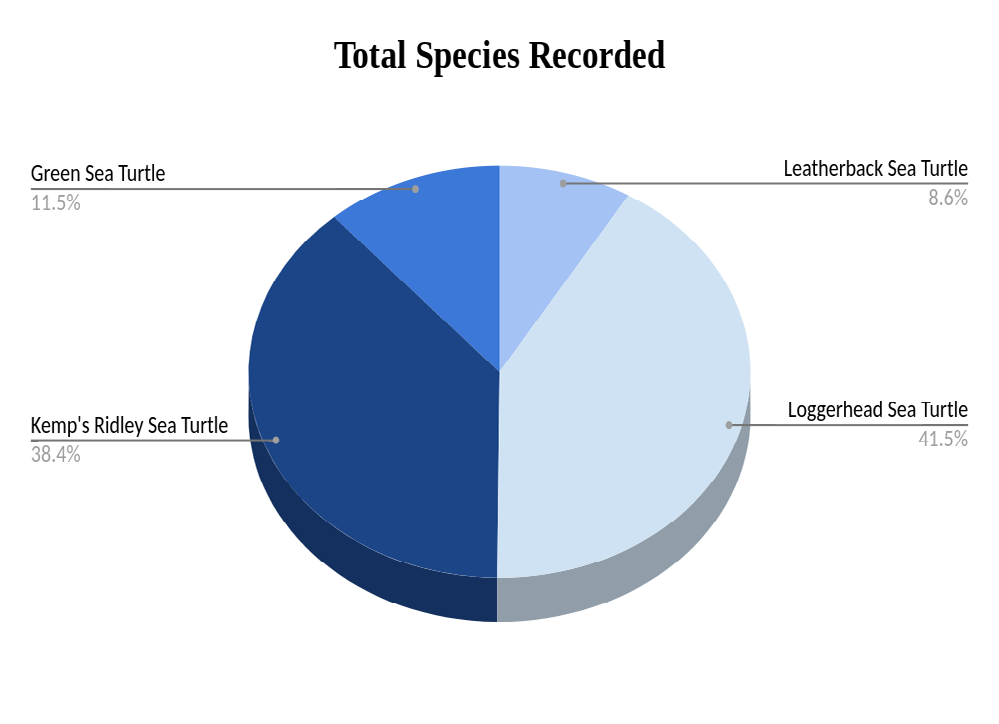
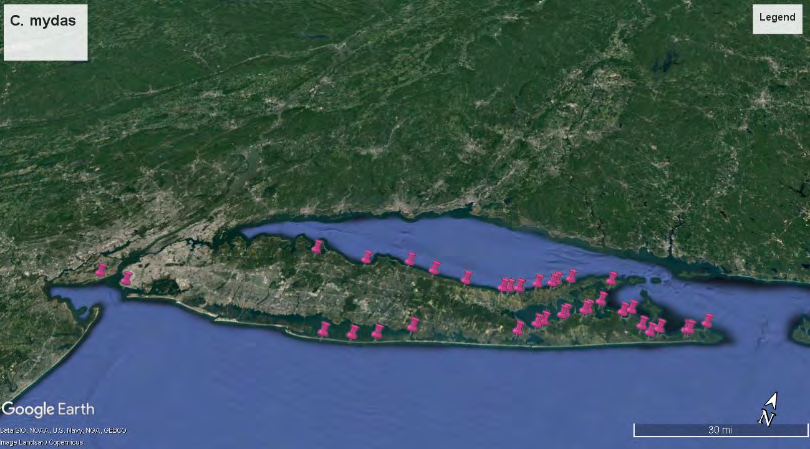
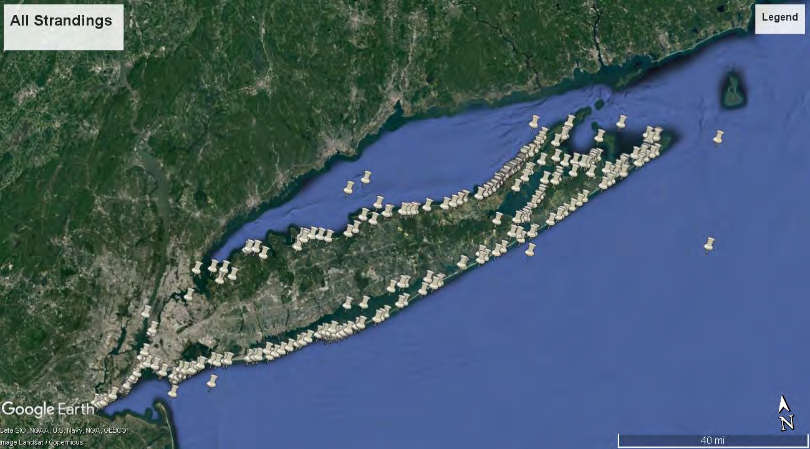
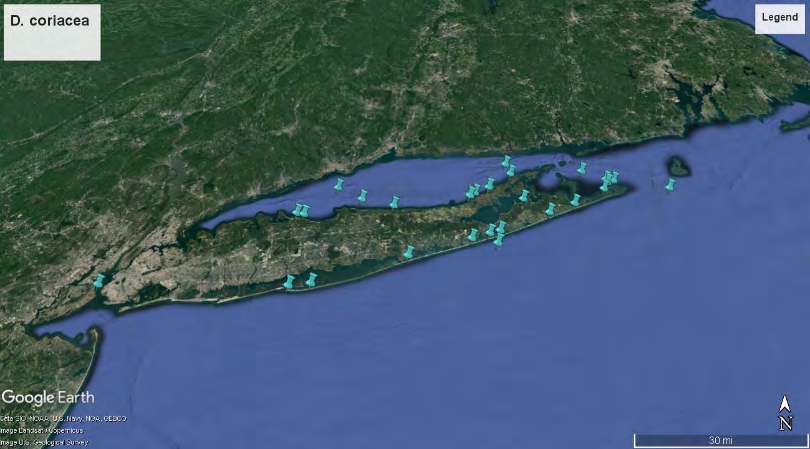
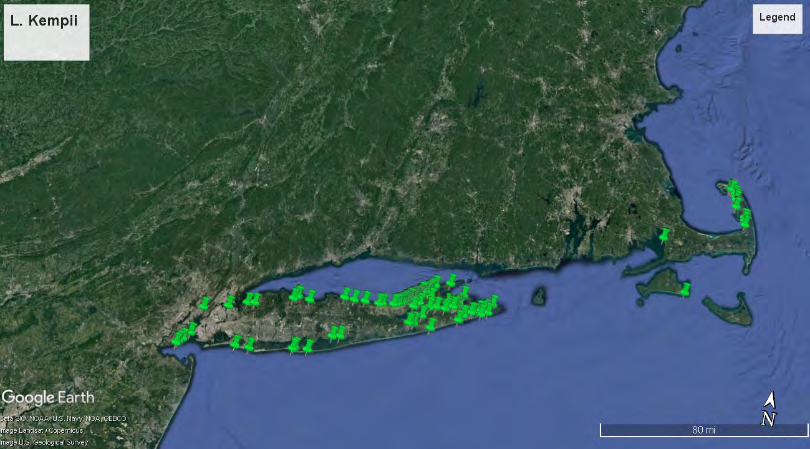
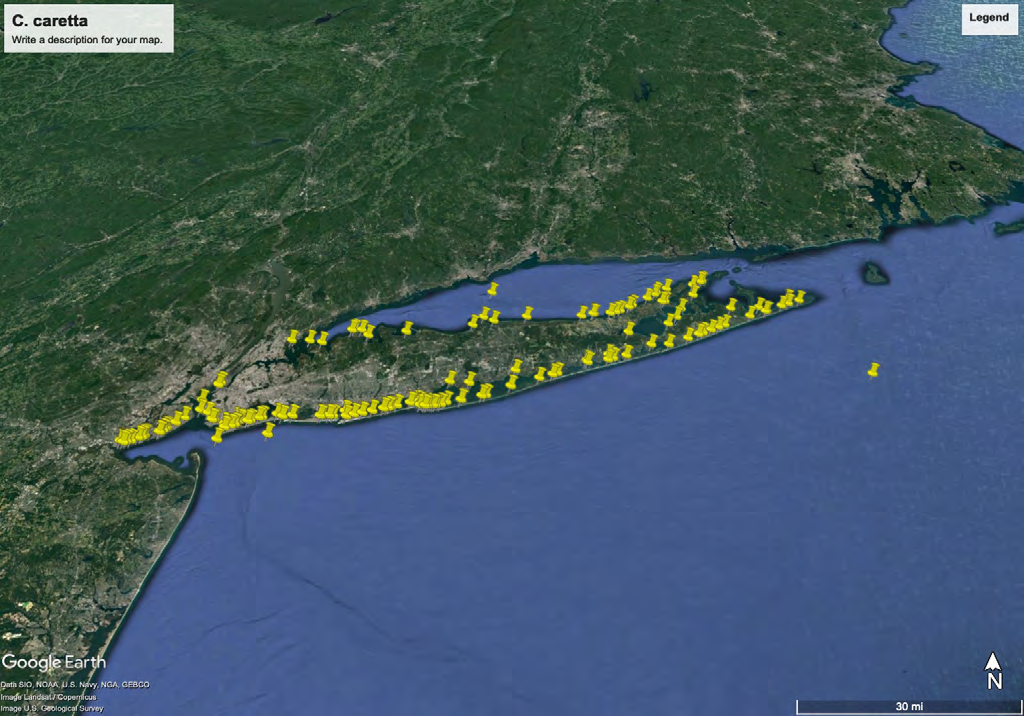
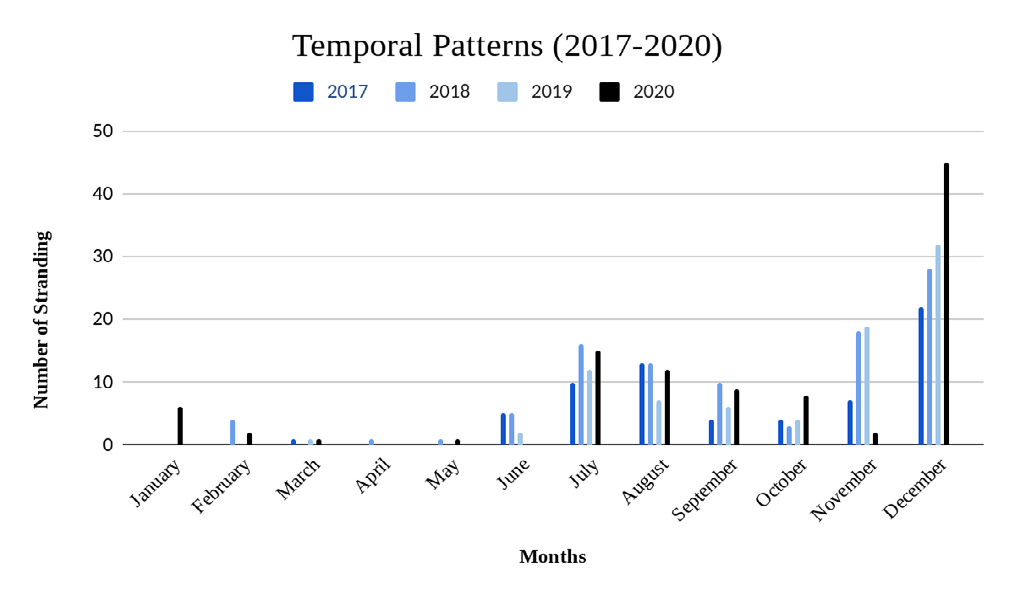
From the Google Earth data we can determine that the majority of the sea turtle strandings happen near the Long Island Sound and the Atlantic Ocean–specifically congregated around the city (Brooklyn and Staten Island) (see Figure 1). By graphing the number of turtle strandings throughout the years, we determined that (out of July, August, November, and December), December had the most frequent strandings. Throughout all the years, in December, the Kemp’s Ridley species consisted of 92 out of the 127 total strandings (Figure 4).
Initially, it was predicted that human interactions would be the primary cause of sea turtle strandings. However, after filtering through the data, it is evident that the majority of the strandings cannot be determined (CBD). Less than a quarter of the strandings were confirmed to be due to human interaction (see Figure 4).
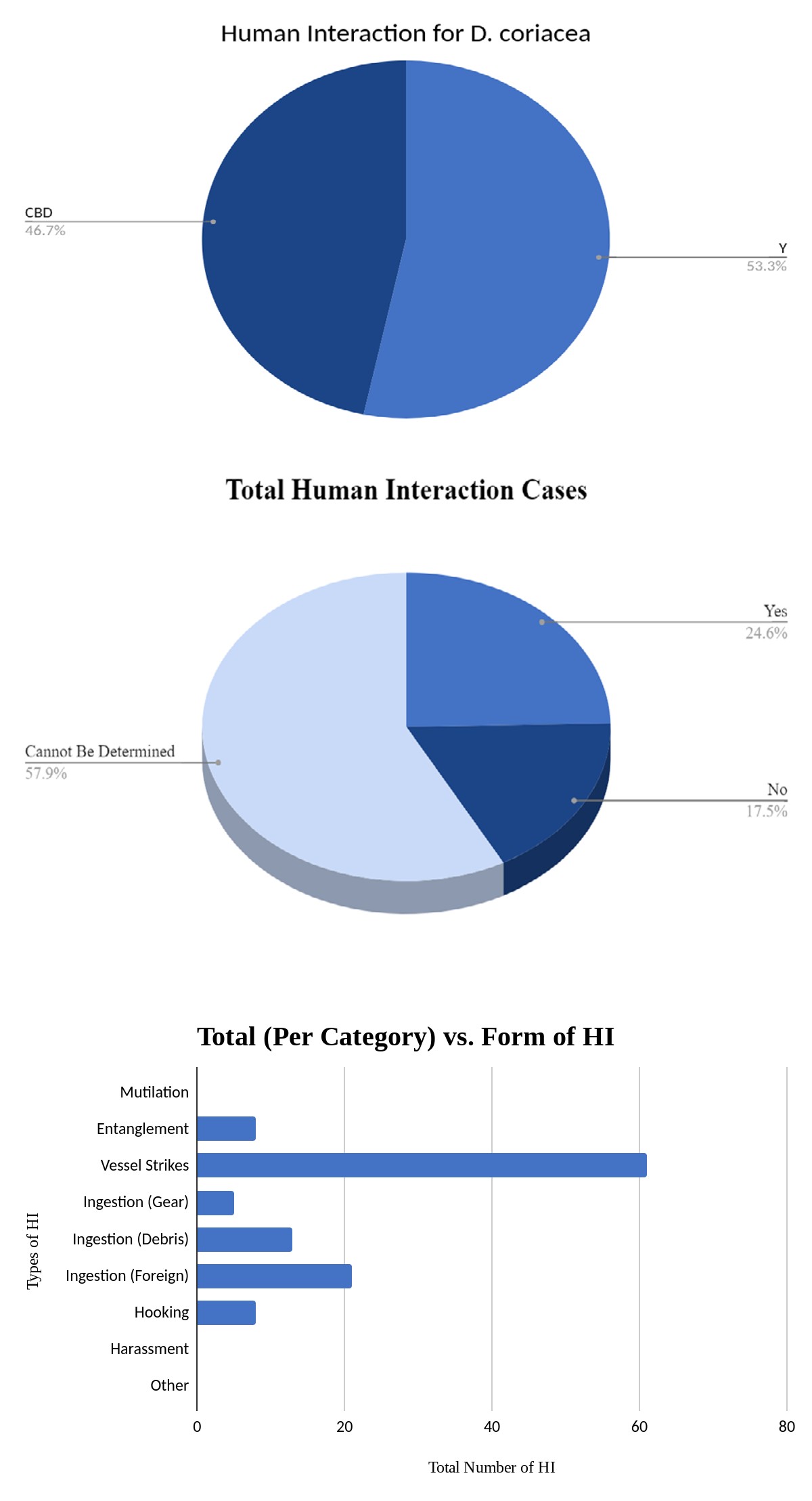
This means that strandings that couldn’t be determined had a possibility of being caused by human interaction. Out of the 24.6% of strandings due to human interaction, an overwhelming majority of them were due to vessel strikes specifically (see Figure 4.1). The data also states that D.coriacea faced the majority of human interactions compared to the other sea turtle species. Over half of the D.coriacea strandings were confirmed due to human interaction and the other percentage could not be determined (See Figure 4.2).
Discussion
During the summer months (June, July, and August) there was a noticeable increase in stranding numbers. Human interaction is usually detected amongst these strandings. It can be inferred that this is due to increased human traffic. Vessels, for example are more prevalent due to more people being out on recreational vessels. However, there is an unexpected spike in the data, specifically during November and December. During the winter/ colder times, turtles usually migrate down south for the warmer waters/ environment. As a result of climate change, temperatures of the water in the north stay warmer longer resulting in the turtles staying for a longer period of time (Dec., NY). In addition to the turtles staying longer, there can be unusual and unforeseen slumps in temperatures. This results in the turtles becoming inactive and torpid, which eventually leads to them stranding. This unfortunate event is known as cold stunning. This typically happens when temperatures reach 50°F (10°C) [7, 8, 9, 10, 11, 12, 13, 14]. This is an environmental impact and maybe a reason why human interaction cannot be determined. Large numbers of sea turtles stay behind before the temperature suddenly drops. This then leads to strandings happening in large numbers. Increased human activity and unadaptable changes in the environment lead to abnormally high numbers of fatalities. It is hard to display this kind of information with the data present due to the fact that reaching these conclusions requires further research and critical thinking. There is a point to which data can portray clear information. There
can often be discrepancies in data as seen with the data presented for the summer and December months. Moreover, our hypothesis that human interaction would cause the most strandings during the summer months was incorrect. An aspect of our research that prevented us from concluding the human interaction aspect of our hypothesis was the “cannot be determined” category referring to human interaction. Many of them cannot be determined cases may have been due to human interaction but technology and timing are limited when recording the data.
In the future, studying the migration patterns of these species would be helpful in determining and confirming the direct correlation between migration and strandings. Migration patterns would also serve as a catalyst for vessel strikes and human interaction, prevention, or awareness. This would allow us to predict the frequency of the species and be more cautious around them. This study of sea turtles allows us to examine patterns among other marine mammals as well. We hope to expand our lens by researching what causes marine mammal strandings and what resources are available for prevention. Partnering up with other environmental conservation organizations will allow us to take the first steps toward prevention; since climate change is proven to be one of the direct causes of these strandings, environmental protection is crucial.
Acknowledgments
We would like to express our utmost gratitude towards Allison DePerte, the Research Associate and Field Biologist, at the Atlantic Marine Conservation Society (AMSEAS) for actively guiding us through the process of creating a research paper, and providing insightful knowledge and valuable data about marine mammals–specifically sea turtles–which we incorporated into our research paper. We would also like to thank Andriana LaMendola, Russell Jacobs, and other Rockaway Initiative for Sustainability and Equity (RISE) staff members for guidance with our research paper. We’d also like to extend our thanks to the New York City Science Research and Mentoring Consortium–hosted by the American Museum of Natural History (AMNH)--for creating this program, which has allowed us and many more students to explore our interests, expand our knowledge of environmental science through research, and provided us with a platform to present our research. Finally, we’d like to thank the Pinkerton Foundation and Simons Foundation for funding this program, without their help we would not be able to have the opportunity to participate in an authentic and in-depth research experience at Environmentor.
References
-
(2022) Leatherback Turtle. NOAA Fisheries.
-
(2022) Loggerhead Turtle. NOAA Fisheries.
-
(2022) Kemp’s Ridley Turtle. NOAA Fisheries.
-
(2022) Green Turtle. NOAA Fisheries.
-
Schofield G, Bishop CM, Katselidis KA, Dimopoulos P, Pantis JD, et al. (2009) Microhabitat Selection by Sea Turtles in a Dynamic Thermal Marine Environment. Journal of Animal Ecology 78(1): 14-21.
-
(2022) Sea Turtle Migration. SEE Turtles.
-
(2021) Cold-Stunning and Sea Turtles-Frequently Asked Questions. NOAA Fisheries.
-
Byrd BL, Hohn AA, Altman MK, Barco GS, Friedlaender A, et al. (2014) Strandings as Indicators of Marine Mammal Biodiversity and Human Interactions off the Coast of North Carolina. NOAA Fisheries 112: 1-23.
-
Division of Marine Resources. Sea Turtles of New York. NYS Department of Environmental Conservation.
-
World Wildlife Fund (2022) Green Turtle | Sea Turtles | Species | WWF.
-
Hochscheid S, Bentivegna F, Speakman JR (2002) Regional Blood Flow in Sea Turtles: Implications for Heat Exchange in an Aquatic Ectotherm. Physiol Biochem Zool 75(1): 66-76.
-
(2022) Shoreline Mileage of the US. NOAA office for coastal management.
-
Norman SA, Huggins J, Carpenter TE, Case TJ, Lambourn MD, et al. (2011) The Application of GIS and Spatiotemporal Analyses to Investigations of Unusual Marine Mammal Strandings and Mortality Events. Marine Mammal Science 28(3): E251-E266.
-
Prado JHF, Mattos PH, Silva KG, Secchi ER (2016) Long- Term Seasonal and Interannual Patterns of Marine Mammal Strandings in Subtropical Western South Atlantic. PLoS ONE 11(1): e0146339.
- Lessons to Learn: Trees are More than the Lungs of the World
- Community Forestry Enterprises as a Model for Sustainable Forest Development: The Case Of The "Baja Tarahumara" in Chihuahua, Mexico
- Ecological and Socio-Economic Impacts of Chromolaena odorata and Mesosphaerum suaveolens, Two Invasive Alien Species in Central and Southern Benin, West Africa
- Epigenetic Sustainability: Modeling the Human Factor as a Natural Resource through Science 4.0 and the NR3C1 Biological Pilot
- Growth-at-Risk: A Framework for Assessing Economic Vulnerability
- The Rural Territory as a Socioecological System for the Management of Public Policy for Sustainable Rural Development