
Germination Responses of Araribá (Centrolobium tomentosum - Guillem. ex-Bentham - Fabaceae) when Subjected to Different types of Betterments
Dormancy is an inherent characteristic of seeds of some plant species, being on the one hand ecologically beneficial to the plants and on the other hand a barrier to be overcome in activities and seedling production. There are some methods of breaking dormancy, which are used according to the biological characteristics of each species. This is a subject still under development and of great importance within the context of ecological and forest restoration. Therefore, the species endemic to the Brazilian territory Araribá (Centrolobium tomentosum - Guillem. ex-Bentham - Fabaceae) was considered to conduct a study of dormancy breaking methods. After collecting a batch of 54 seeds, they were divided into six groups of nine units and each group was subjected to a type of treatment: control, water with cutting, water without cutting, burning with cutting, burning without cutting, and dry with cutting. The seeds were planted in plastic tubes, with substrate, placed in the same environment and subjected to the same climatic and hydration conditions. After 60 days of experimentation, it was found that the dry with cut treatment presented the best germination percentage, while in the seed lots subjected to burning processes the germination percentage was zero. The average germination time varied little between treatments. The fastest were the seeds from the control condition (average of 30 days) and the seeds from the H2O with cut condition taking the longest (34.7 days). A question arose: is there a distorted concept about dormancy breaking techniques in Araribá or are we studying a species that presents a dormancy pattern considered as complex or combined dormancy? New studies need to be conducted to advance knowledge.
Introduction
Ecological restoration and forest restoration actions are increasingly urgent to combat several current environmental problems. To make forest restoration viable, there is a need for fundamental raw material, which are the seeds.
It is known that seeds of different species have different germination potentials and vary in relation to the time they take to germinate. Technicians and researchers have acquired technical and scientific experiences to increase the germination potential of seeds and/or shorten the germination time.
Associated with the germination potential of seeds, we have the phenomenon of dormancy, which constitutes a physiological state or condition, for viable seeds, characterized by temporary inactivity. There are several modalities of seed dormancy, such as physiological, physical, combinational, morphological, and morphophysiological [1, 2]. The inactivity of the embryo occurs due to the absence of some external stimulus (for example, low humidity, inadequate temperature or light, or chemical conditions), or even immaturity of the embryo. This condition usually prevents the plant against adverse environmental situations and befriends germination (only) when environmental conditions are minimally adequate [3, 4].
However, both germination potential and dormancy are ecophysiological processes of the plants that influence the logistics, costs and success of activities such as agriculture and forest restoration and can be obstacles in these activities. In the context of forest restoration, which is an activity that normally demands rapid actions and results, breaking the dormancy may be a strategy to accelerate seedling production in greenhouses or even at the final planting site. There are several methods for breaking dormancy, some mechanical and others chemical [5].
For this study we tested dormancy-breaking methods for the species regionally known as Araribá (scientific name: Centrolobium tomentosum - Guillem. ex Bentham - Fabaceae). The biological and ecological aspects that justified the choice of this species for the present study are described as follows.
Centrolobium Tomentosum-Biological and Ecological Features
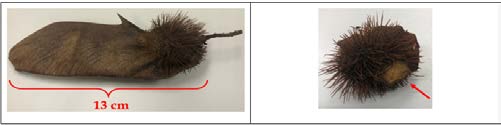
C. tomentosum is a tree species that can reach up to 35 meters in height. Its trunk has smooth, gray bark. Its crown can reach 10 meters in diameter and often develops in an emerging position in the forest. It has rusty-tomentose branches, leaves and inflorescences. Its leaves are unpaired, large and deciduous, with leaflets - usually up to 17 wide and with resinous spots on their underside. The flowers can reach up to 2 cm and appear in panicles, with a yellow papilionaceous corolla and included stamens partially fused together. The araribá has tomentose fruits (nuts) that consists of a samara that has a rigid nucleus, with small aculeus (like a sea urchin) and a calcarate appendage or wing [6]. The species considered for this study is endemic to the Brazilian territory. It occurs in all states in the Southeastern region of Brazil, in most states in the Central- Western region and in some states in the Southern and Northeastern regions. Specimens may be recorded in the Caatinga, Cerrado, and Atlantic Forest biomes, in types of vegetation: Anthropic Areas (including urban afforestation), Semi Deciduous Seasonal Forest, and Ombrophilous Forest (Rainforest).
In terms of ecological succession, it is considered initial secondary, presenting fast growth and tolerating soils with different characteristics of stoniness and fertility. On the one hand, it has a “least concern” level in terms of risk of extinction according to the IUCN database [7]. On the other hand, it has the potential to be used in projects and actions of forest restoration, as it is a hardy species that produces a large amount of biomass (litter) during growth and associating with Rhizobium, forming globose nodules and presenting nitrogenase activity, benefiting the soil [8].
According to Carvalho [9], the species does not present dormancy. However, it is recommended to leave the fruits immersed in room water for 24 to 48 hours, to favor germination. Although the literature considers that there is little or no tendency towards dormancy, it is known that some types of intervention can accelerate the germination process or increase the germination percentage in seed banks in seedling production sites.
Therefore, considering this premise, this study aimed to test the germination performance of seeds subjected to different types of treatments.
Material and Methods
Preparing Fruits and Seeds for the Experiment
Araribá fruits were collected from a single tree to avoid genetic discrepancies. The parent tree appears to be of medium age (not very young and with no signs of old age). After collection, the fruits (used 9 for each experimental condition) were treated according to the stipulated experimental conditions:
Control- The leathery-papery wing was carefully cut with pruning shears without damaging the seed part.
Water with cutting - The wing and part of each seed were cut with pruning shears. Then the seeds were submerged in drinking water for 24 hours.
Water without cutting- Only the wing of the fruit was cut. Then the seeds were submerged in drinking water for 24 hours.
Burning with cutting- After cutting the wing and part of the fruit, they were subjected to a burning process for a period of one minute. The fire was induced and maintained using paper.
Burning without cutting- After cutting only the wing, they were subjected to a burning process for a period of one minute. The fire was induced and maintained using paper. - dry with cut - the wing and a part of each seed were cut with the pruning shears.
Dry with cut- The wing and a small superficial part of each seed was cut with pruning shears (Figure 1).
The treatment modalities (submersion in water, burning and cutting) were chosen based on data from biological- related studies already carried out, which generated new curiosities, and considering that for the Cerrado biome, fire is an element present in the ecological dynamics of this biome.
All treatments were implemented at the same time. After completing the treatments according to each experimental condition, all seeds were planted in plastic, conic-shaped tubes of 207cm3 using construction sand as substrate. The seeds were covered (buried) 1cm deep with the same material used as substrate. The tube tray has 54 tubes (9 rows x 6 columns). Therefore, each column was considered a treatment, and the 9 rows were considered replicates of the treatment.
The experiment was conducted in the spring season (started on October 1st) with a time span of 60 days. The tray with the tubes was placed in an open-air ambience, protected with a plastic fiber screen normally used in greenhouses to mitigate the effects of direct and intense sunlight. On non-rainy days, equal amounts of water were administered to all tubes, from the beginning to the end of the experiment period. After starting the experiment, the local was visited daily and the experimental conditions were recorded, as well as the date on which the seedling emerged in each tube. For checking the possibility of having differences statistically significant the database was submitted to a nonparametric test of variance (Kruskal- Wallis) at p=5%. The test was run using the Bioestat 5.0 Statistical package [10].
Results
Of the total of 54 seeds sowed, considering the six experimental conditions, 40.7% germinated. The treatment that showed the highest germination rate was the “dry with cutting” (Table 1). No germination was recorded of the seeds that were burnt to try to break dormancy.The overall average time for germination was 32.3 days. Of the total number of germinated seeds, 20 (90.9%) had their germination time between 30 and 38 days.
Two outliers of 24 days occurred, one in control condition and the other in condition H2O no cutting. The Kruskal-Wallis test showed no significant difference at p=5% between the experimental conditions where germinated seeds were recorded. The seeds that had a part of tegument cut, both immersed in water and kept dried, presented the lowest variation coefficients of time of germination. This can bring implications in works developed in seedling production nurseries, as explained ahead.
| Tube / Replicate | Experimental Conditions | |||||
|---|---|---|---|---|---|---|
| Control | Dry with cut | H2O no cut | H2O with cut | Burned no cut | Burned with cut | |
| A | 30 | 38 | ||||
| B | 30 | 34 | ||||
| C | 32 | 30 | 24 | 31 | ||
| D | 36 | 35 | ||||
| E | 30 | 34 | ||||
| F | 38 | 34 | ||||
| G | 30 | 36 | 36 | |||
| H | 34 | 30 | ||||
| I | 24 | 35 | 34 | |||
| % of germination (n=9) | 44.4 | 88.9 | 44.4 | 66.7 | 0 | 0 |
| Average time of germination (days) | 30 | 32.4 | 32 | 34.7 | —-- | —-- |
| Variation Coefficient (%) | 14.4 | 10.4 | 16.9 | 6.7 | —-- | —-- |
Table 1: Time, average time and percentage of germination of the seeds of Araribá. From A to I: correspond to each seed planted i
Discussion
Studies have shown that keeping the seed immersed in water for 24-48 hours at 25oC helps to overcome dormancy. The process that occurs is the rupture of the outer tegument [11]. However, the present study demonstrated that even in dry seeds, if the tegument is ruptured with the help of pruning shears, the result can be the same or better, and it is faster, since the process of cutting is rapid. Comparing the results and their respective methods, it is possible to infer that the type of dormancy we are dealing with is mechanical and that the use of the water immersion technique can soften the tegument and somehow facilitate the emergence of the embryo (facilitate, but not necessarily stimulate). For the cutting method, the fact that it causes a rupture in the tegument facilitates the emergence of the embryo, especially the root system. Perhaps the process of sanding the seed could result in a similar outcome, but because the outer part of the seed is thorny, handling the seed can become difficult, and cutting it, as explained and tested in this study, can bring advantages.
Although, as previously reported, Araribá seeds have little or no dormancy, the present study showed that the germination potential of the seeds can fall by half if no treatment is implemented, while if a slight cut is made on the side of the seed the germination potential increases. The treatments that had cutting as an intervention action showed lower coefficient of variation values for germination time. For work involving seedling production nurseries, this information may be important, since greater uniformity of germination and growth means optimization and facilitation of the logistics of seedling management work [12, 13].
The fact that there were no survivors for the seed lots that were subjected to the burning process (dry or immersed in water) suggests that, in areas of Cerrado that experience the occurrence of fire events and have C. tomentosum seeds on the soil surface, such seeds will have little or no chance of surviving, possibly compromising the seed bank of this species. In this context, it seems more likely that individuals of the species survive fires and can resprout than that their seeds survive and germinate after fire events [14].
Final Remarks
This study showed that the seed burning procedure was not successful in germinating and breaking dormancy in the species studied.
The procedure of keeping the seeds immersed in water, which is the most common according to the literature, presented identical results in terms of germination for the seeds that were not cut.
It was demonstrated that the procedure of only cutting the seed (without immersion in water) provided the best results in terms of germination when compared to the control condition, and the seeds in the control condition (which did not undergo any type of intervention) presented a shorter germination time.
The results obtained in this study raise a question: is there a distorted concept about the techniques for breaking dormancy in Araribá (previously immersion in water, now evolving to small cuts in the epicarp) or are we studying a species that presents a dormancy pattern known as complex or combined dormancy? To adequately answer this question, new, more detailed studies need to be conducted. Perhaps other dormancy-breaking methods may be even more efficient.
Declaration of Competing Interest and Declaration of Use of Artificial Intelligence
The author declares that he has no known competing monetary interests that could have appeared to influence or manipulate the work reported in this manuscript.
The author also declares that the manuscript was elaborated manually (hard work!!!) and AI was used to improve English grammatical elements of the text.
Acknowledgements
To the Campus of the Sorocaba Institute of Science and Technology - Unesp, for providing the space to carry out the study.
Availability of Data and Material
The data is available upon request to the authors.
References
-
Nourmohammadi K, Kartoolinejad D, Naghdi R, Baskin CC (2019) Effects of dormancybreaking methods on germination of the waterimpermeable seeds of Gleditsia caspica (Fabaceae) and seedling growth. Folia Oecologica 46(2).
-
Chandel NS, Tripathi V, Singh HB, Vaishnav A (2024) Breaking seed dormancy for sustainable food production: Revisiting seed priming techniques and prospects. Biocatalysis and Agricultural Biotechnology 55: 102976.
-
Vleeshouwers LM, Bouwmeester HJ, Karssen CM (1995) Redefining seed dormancy: an attempt to integrate physiology and ecology. Journal of Ecology pp: 1031- 1037.
-
Hilhorst HW, Bentsink L, Koornneef M (2024) Dormancy and germination. In: Handbook of seed science and technology. CRC Press, USA, pp: 271-301.
-
Kildisheva OA, Dixon KW, Silveira FA, Chapman T, Di Sacco A, et al. (2020) Dormancy and germination: making every seed count in restoration. Restoration Ecology 28: S256-S265.
-
Diaz P (1992) Araribá (Centrolobium tomentosum Guillem. Ex BenthamFabaceae): Revisão bibliográfica de essência nativa de grande potencial silvicultural. Revista do Instituto Florestal 4(2): 430-434.
-
Lima AG, Kuntz J (2020) Centrolobium in Flora e Funga do Brasil. Jardim Botânico do Rio de Janeiro, Brasil.
-
Sujii PS, Schwarcz KD, Grando C, de Aguiar Silvestre E, Mori GM, et al. (2017) Recovery of genetic diversity levels of a Neotropical tree in Atlantic Forest restoration plantations. Biological Conservation 211: 110-116.
-
Carvalho PER (2003) Espécies arbóreas brasileiras. Embrapa Florestas, Colombo-PR, Brasil.
-
Ayres M, Ayres M JR, Ayres DL, Dos Santos As (2007) BioEstat 5.0 Aplicações estatísticas nas áreas das ciências biológicas e médicas. Sociedade civil Mamirauá/ CNPq, Belém, pp: 324.
-
Fowler JSP, Biancheti A (2000) Dormência em sementes florestais. Embrapa Colombo pp: 28.
-
GallegosCedillo VM, Nájera C, Gruda NS, Signore A, Gallegos J, et al. (2024) An indepth analysis of sustainable practices in vegetable seedlings nurseries: A review. Scientia Horticulturae 334: 113-342.
-
Thapliyal M, Phular K, Namitha NK, Rawat S (2025) Forest Seed Technology: Seed Biology, Collection, Quality Evaluation, Storage and Certification. In: Textbook of Forest Science. Springer Nature Singapore, Singapore pp: 659-678.
-
Hissae Hayashi A, AppezzatodaGlória B (2009) Resprouting from roots in four Brazilian tree species. Revista de Biologia Tropical 57(3): 789-800.
- Lessons to Learn: Trees are More than the Lungs of the World
- Community Forestry Enterprises as a Model for Sustainable Forest Development: The Case Of The "Baja Tarahumara" in Chihuahua, Mexico
- Ecological and Socio-Economic Impacts of Chromolaena odorata and Mesosphaerum suaveolens, Two Invasive Alien Species in Central and Southern Benin, West Africa
- Epigenetic Sustainability: Modeling the Human Factor as a Natural Resource through Science 4.0 and the NR3C1 Biological Pilot
- Growth-at-Risk: A Framework for Assessing Economic Vulnerability
- The Rural Territory as a Socioecological System for the Management of Public Policy for Sustainable Rural Development