
Perfluoro Curcumin Strongly Interacts with ABC Transporter (ABCG2): A Molecular Docking Study
Cancer stem cells remain one of the most common reasons for drug resistance and therapeutic failure. The membrane transporter protein ABCG2 has been shown to be over expressed and efflux anti-cancer drugs from cancer stem cells. Despite therapeutic development, the cancer drug resistance and tumor recurrence have increased dramatically in last few years. Thus, identification of potential inhibitor for ABCG2 can be an effective therapeutic approach for cancer through targeting cancer stem cells. In this article, we have performed molecular docking between Curcumin derivatives and ABCG2. Perfluoro Curcumin out of 29 Curcumin derivatives showed highest binding energy, -10.1 kcal/mol with ABCG2, suggest that the Curcumin derivative can be used an effective inhibitor against ABCG2. Perfluoro Curcumin strongly interacted with the ABCG2 at their ligand binding site through hydrophobic interaction. These findings shed light on the molecular characteristics of the binding of Curcumin derivatives with ABCG2 and thus may significantly contribute in designing and optimizing therapeutic strategies against cancer through targeting cancer stem cells by using these agents.
Introduction
Drug resistance in cancer is one of the concerning areas of scientific community where several studies are being done. Several studies have demonstrated that cancer stem cells play important role in cancer drug resistance [1, 2]. Cancer stem cells possess an effective efflux of anti-cancer drugs through family of transmembrane proteins known as ABC (ATP-binding cassette) proteins (ABCG2) which is the main cause of development of drug resistance in cancer through cancer stem cells [3]. ABC (ATP-binding cassette) transporters are the members of super family which transports various substrates through membrane (extracellular and intracellular) and serve as potential player in innate and acquired Multi-drug Resistance (MDR) of various cells including cancer stem cells. ABCG2, a member of ABC transporters, act as a resistance marker in both cancer cells and cancer stem cells and helps in determination of prognosis of malignancies and drug bioavailability [4]. The protein is a half transporter with one nucleotide binding domain and one membrane spanning domain and consists of six transmembrane segments that take up the energy released form ATP-hydrolysis and primarily involve in passage of endogenous materials as well as xenobionts [5, 6]. Because of the nature of ABCG2 transporter (half size transporter), it was assumed that it works as a homo-dimer, however, the new emerging studies confirmed that ABCG2 is a homo-dodecamer with least stable units of homo-tetramer. The ABCG2 protein is also expressed at high levels in radiation resistant cancer cells. Several attempts are being made to inhibit the function of ABCG2 through allosteric Inhibitors, miRNA’s etc [7, 8, 9].
Curcumin is an age old and an incredible folk remedy with enumerable benefits [10, 11, 12, 13, 14]. Additionally, its use in the traditional medicine augmented and hence drew attention of scientists because of its biological effects, minimal side effects [15, 16, 17]. This pharmacological product is derived from a plant Curcuma longa L. (Zingiberaceae), and is basically a phyto polyphenol pigment. Furthermore, it has a broad range of chemotherapeutic properties such as antioxidant activity, antitumor and anti-inflammatory activities [18, 19, 20, 21, 22]. Hence, these pharmacologically feasible properties are an account of the inhibitory effects it has over other metabolic enzymes. Although, the major shortcoming of curcumin is its inability to remain stable at the physiological conditions due to its short half-life and other factors. Improvisations have been made in the stability and activity to design curcumin derivatives and are studied [23, 24, 25]. To name some widely studied because of their properties are bis-dimethoxy Curcumin (bDMC), diacetyl Curcumin (DAC) and perfluoro curcumin (PFC) [26]. Since the curcumin is already proved to exhibit anti-cancer activity, its derivatives can be used for inhibiting the action of ABCG2 in cancer resistance. Hence, these study aims find the interactions between the ABCG2 protein and Curcumin derivatives by employing the computational methods (In silico) and also to find the ideal inhibitor with highest binding energy and take it further for in vitro analysis.
Methodology
Preparation of Ligands
The ligands, Curcumin and its derivatives structure were taken from the chemical database of PubChem (https://pubchem.ncbi.nlm.nih.gov). The ligands were converted into the PDB format from the file format of sdf with the help of Open Babel software [27]. In order to simplify the further analysis, ligands were converted to PDBQT format using the graphical user interface version of Autodock Tool 4 (ADT).
Preparation of Receptor/Membrane Transporter
The atomic coordinates of the protein ABCG2 was downloaded from the RCSB PDB database (PDB ID-6ETI) [28]. Before analysis or docking, the assignation of charges, solvation parameters and fragmental volumes to the protein was done using the Autodock Tool 4 (ADT). Further, to simplify the analysis, the protein was also saved to PDBQT format [29].
Molecular Docking
In order to study the free binding energies and interactions between the Curcumin, its derivates and protein ABCG2 the command line version of Autodock Vina was used. During the period of docking, the protein was considered to be rigid and ligands were considered to be flexible [30]. The configuration file for the grid parameters was generated using Auto Grid. The size of the grid was set to 64 × 60 × 126 xyz points with grid spacing of 1 Å and dimensions (x, y, and z): 148.019, 151.205 and 184.481 for the grid center. The application was also used to know/predict the aminoacids in the active site of the protein that interact with the ligands. The results less than 1.0 Å in positional root-mean-square deviation (RMSD) were considered ideal and clustered together for finding the favorable binding.
Network Analysis
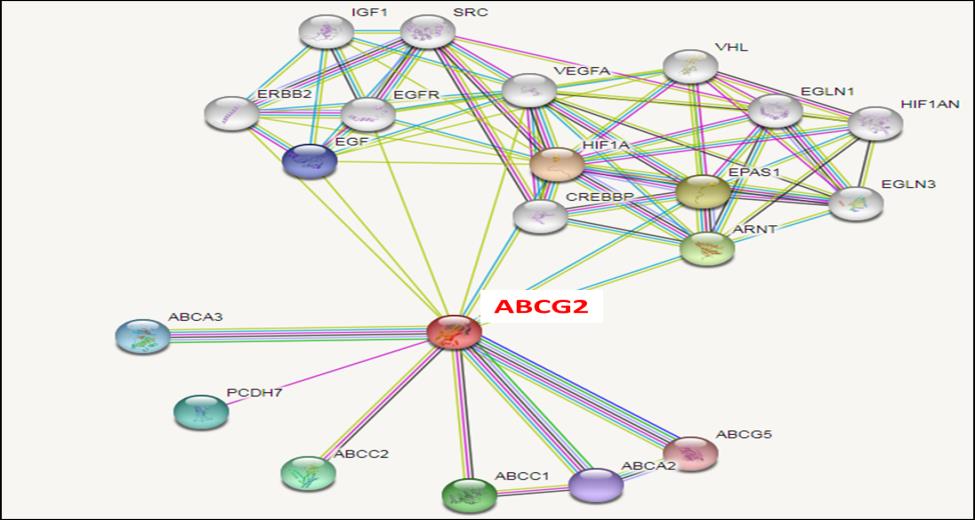
Protein (ABCG2) network analysis was done with STRING, a tool for the Protein-Protein Interaction Networks (https://string-db.org/).
Results and Discussion
Drug discovery relies heavily on molecular docking to understand the interactions between ligand/inhibitor and target/protein. Molecular docking is a computational method that attempts to predict noncovalent binding between macromolecule (receptor/protein) and a small molecule (ligand/inhibitor). In order to understand the effect of Curcumin and its derivatives on cancer stem cells, we have performed molecular docking of Curcumin derivatives with ABCG2, which is a transporter protein, involves in anti-cancer drug efflux from cancer stem cells.
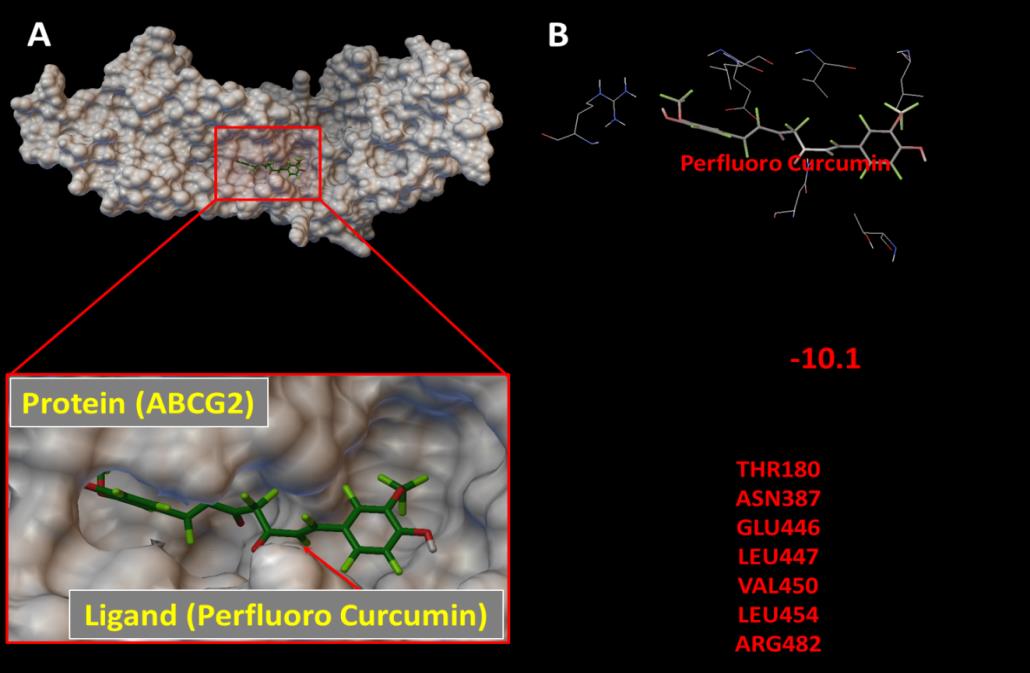
showed more than -8 kcal/mol binding energy with ABCG2 (Table 1). Perfluoro Curcumin showed highest binding energy, -10.1 kcal/mol with ABCG2 (Figure 1).
| S No | Curcumin Derivatives | Structure | Binding Energy (Kcal/mol) | ||||||||
|---|---|---|---|---|---|---|---|---|---|---|---|
| 1 | Perfluoro Curcumin | -10.1 | |||||||||
| 2 | Disalicyloyl Curcumin | -9.1 | |||||||||
| 3 | Curcumin beta-D-glucuronide | -8.9 |
| 4 | Curcumin-difluorinated (CDF) | -8.3 | |
|---|---|---|---|
| 5 | Ferrocenyl Curcumin | -8.3 | |
| 6 | Curcumin Dimer 2 | -8.1 | |
| 7 | Curcumin Glucuronide | -8.1 | |
| 8 | Pyrazole-curcumin | -8 | |
| 9 | 4-Benzylidene curcumin | -7.9 | |
| 10 | Curcumin Dimer 3 | -7.9 | |
| 11 | Curcumin ED | -7.9 | |
| 12 | Monovalinoyl Curcumin | -7.9 | |
| 13 | Curcumin Monoglucoside | -7.8 | |
| 14 | Mono-methacryloyl-curcumin | -7.8 | |
| 15 | Keto-curcumin | -7.7 | |
| 16 | Di-valinoylcurcumin | -7.5 | |
| 17 | cis-Curcumin | -7.4 | |
| 18 | Curcumin Sulfate | -7.4 | |
| 19 | Diethylamino-curcumin | -7.4 | |
| 20 | Allyl Curcumin | -7.3 | |
| 21 | Tetrahydrodiferuloylmethane | -7.3 | |
| 22 | Demethoxycurcumin | -7.2 | |
| 23 | Bis(3,4-Dihydroxy-trans- cinnamoyl)methane | -7.1 | |
| 24 | Di-O-(2-Thienoyl) curcumin | -7.1 | |
| 25 | Bisdemethoxycurcumin | -7 | |
| 26 | [18FP]-curcumin | -6.6 | |
| 27 | Curcumin | -6.3 | |
| 28 | Di-O-allylcurcumin | -6.3 | |
| 29 | Tetrahydro Curcumin | -5.6 |
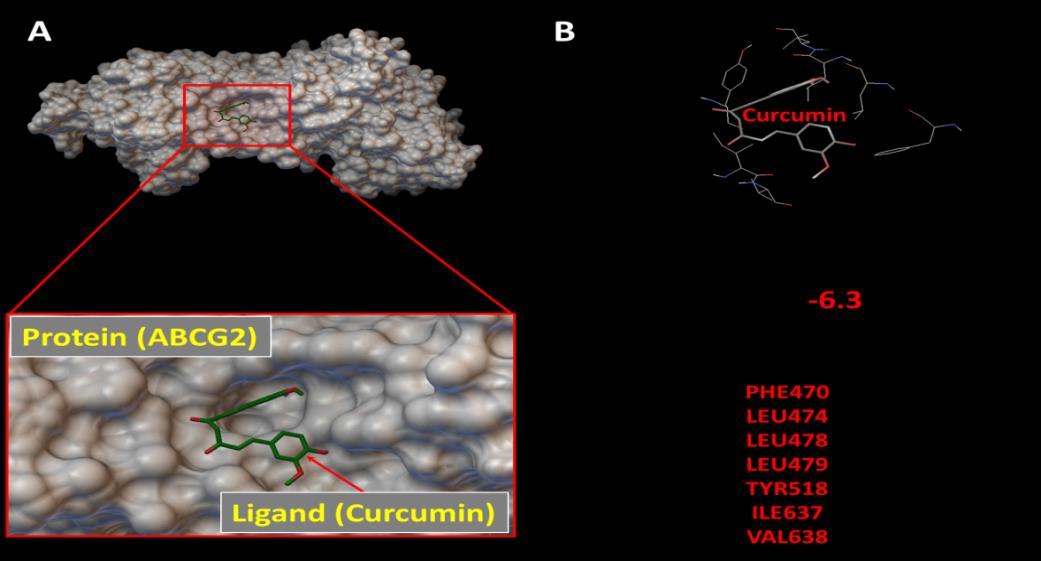
Whereas, Curcumin showed -6.3 kcal/mol binding energy with ABCG2. Each docking result generated top ten best binding conformations of the ligand (Curcumin derivatives) and the best binding poses. The 3D view of ABCG2-Perfluoro Curcumin interactions (Figure 1) and ABCG2-Curcumin interactions (Figure 2) of the best poses generated by ADT are shown in molecular surface representation. As clearly showed in Figure 1, important interactions can be found between ligand (Perfluoro Curcumin) and the residues THR180, ASN387, GLU446, LEU447, VAL450, LEU454, and ARG482 which directly participate in the catalytic mechanism of ABCG2. The protein-ligand complex is stabilized mainly by hydrophobic interactions. All the top docked poses generated by each docking routine exhibited well- established bonds with one or more amino acids in the binding pocket of ABCG2. The top-ranked pose with lowest docked binding affinities and high docking scores is generally used as a standard selection in most of the docking programs.
Molecular docking study of Curcumin derivatives showed strong binding affinity with ABCG2, suggest that Curcumin derivatives can be used as an inhibitor for ABCG2 to mitigate cancer drug resistance problem. As mentioned in Figure 3, protein network analysis of ABCG2, ABCG2 is linked with other cancer associated proteins which play important role in cancer progression. Inhibition of ABCG2 with Curcumin derivatives can also inhibit EGFR, VEGFR and other signalling pathways in cancer stem cells.
Conclusion
The present investigation sheds a new light on the potential interactions between Curcumin derivatives and ABCG2, ABC (ATP binding cassette) transporter which is a family of transmembrane proteins, which plays important role cancer drug resistance through effluxing anti-cancer drugs from cancer stem cells. This study indicates the involvement of hydrophobic interactions between ABCG2 and Perfluoro Curcumin, a Curcumin derivative with -10 kcal/mol binding energy. These findings suggest that Perfluoro Curcumin can act as an effective and potential inhibitor for ABCG2. Further in vitro and in vivo validation will help us to understand the molecular mechanism (s) of Perfluoro Curcumin on ABCG2.
Conflict of Interest
Authors declare no conflict of interest.
Acknowledgements
We thank you all authors for carefully reading the manuscripts and providing their valuable inputs.
References
-
Phi LTH, Sari IN, Ying-Gui Y, Sang-Hyun L, Kim KS, et al. (2018) Cancer Stem Cells (CSCs) in Drug Resistance and their Therapeutic Implications in Cancer Treatment. Stem Cells Int 2018: 1-16.
-
Han L, Shi S, Gong T, Zhang, Sun X (2013) Cancer stem cells: therapeutic implications and perspectives in cancer therapy. Acta Pharm Sin B3 3(2): 65-75.
-
Kathawala RJ, Gupta P, Ashby CR, Chen ZS (2015) The modulation of ABC transporter-mediated multidrug resistance in cancer: A review of the past decade. Drug Resist Update 18: 1-17.
-
Mohammad IS, He W, Yin L (2018) Understanding of human ATP binding cassette super family and novel multidrug resistance modulators to overcome MDR. Biomedicine and Pharmacotherapy100: 335-348.
-
Mo W, Zhang JT (2012) Human ABCG2: Structure, function, and its role in multidrug resistance. International Journal of Biochemistry and Molecular Biology 3(1): 1-27.
-
Taylor NMI, Manolaridis I, Jackson SM, Kowal J, Stahlberg H, et al. (2017) Structure of the human multidrug transporter ABCG2. Nature 546(7659): 504-509.
-
Hegedüs C, Truta-Feles K, Antalffy G, Várady G, Német K, et al. (2012) Interaction of the EGFR inhibitors gefitinib, vandetanib, pelitinib and neratinib with the ABCG2 multidrug transporter: Implications for the emergence and reversal of cancer drug resistance. Biochem. Pharmacol 84(3): 260-267.
-
Zhang SZ, Yang XN, Morris ME (2004) Flavonoids are inhibitors of breast cancer resistance protein (ABCG2)-mediated transport. Mol Pharmacol 65(5): 1208-1216.
-
Liu Q, Ren T, Fresques T, Oppliger W, Brad J, et al. (2012) Niles Selective ATP-competitive inhibitors of TOR suppress rapamycin-insensitive function of TORC2 in _Saccharomyces cerevisiae._ ACS Chem Biol 7(6): 982-987.
-
Shi J, Zhang X, Shi T, Li H (2017) Antitumor effects of curcumin in human bladder cancer _in vitro_. Oncol Lett 14(1): 1157-1161.
-
James MI, Iwuji C, Irving G, karmaker A, Higgins JA, et al. (2015) Curcumin inhibits cancer stem cell phenotypes in ex vivo models of colorectal liver metastases, and is clinically safe and tolerable in combination with FOLFOX chemotherapy. Cancer Lett 364(2): 135-141.
-
Ferri C, West K, Otero K, Kim YH (2018) Effectiveness of Curcumin for Treating Cancer During Chemotherapy. Altern Complement Ther 24(1): 13- 18.
-
Zhou QM, Wang XF, Liu XJ, Zhang H, Lu YY, et al. (2011) Curcumin improves MMC-based chemotherapy by simultaneously sensitising cancer cells to MMC and reducing MMC-associated side- effects. Eur J Cancer 47(14): 2240-2247.
-
Shi J, Zhang X, Shi T, Li H (2017) Antitumor effects of curcumin in human bladder cancer in�vitro. Oncol Lett 14(1): 1157-1161.
-
Modaresi M, HarfBol MR , Ahmadi F (2017) A review on pharmacological effects and therapeutic properties of curcumin. J Med Plants 2(62): 1-17.
-
Belcaro G, Hosoi M, Pellegrini L, Appendino G, Ippolito E, et al. (2014) A controlled study of a lecithinized delivery system of curcumin (meriva®) to alleviate the adverse effects of cancer treatment. Phyther Res 28(3): 444-450.
-
Duarte VM, Han E, Veena MS, Salvado A, Suh JD, et al. (2010) Curcumin enhances the effect of cisplatin in suppression of head and neck squamous cell carcinoma via inhibition of IKKβ protein of the NFκB pathway. Mol Cancer Ther 9(10): 2665-2675.
-
Perrone, D, Ardito F, Giannatempo G, Dioguardi M, Troiano G, et al. (2015) Biological and therapeutic activities, and anticancer properties of curcumin (Review). Experimental and Therapeutic Medicine 10(5): 1615-1623.
-
Seyed Fazel N, Maria D, Moghaddam AH, Habtemariam S, Nabavi SM (2014) Curcumin and liver disease: From chemistry to medicine. Compr Rev Food Sci Food Saf 13(1): 62-77.
-
Hatcher H, Planalp R, Cho J, Torti FM, Torti SV (2008) Curcumin: From ancient medicine to current clinical trials. Cellular and Molecular Life Sciences 65(11): 1631-1652.
-
Motterlini R, Foresti R, Bassi R, Green CJ (2000) Curcumin, an antioxidant and anti-inflammatory agent, induces heme oxygenase-1 and protects endothelial cells against oxidative stress. Free Radic Biol Med 28(8): 1303-1312.
-
Huang Y, Cao S, Zhang Q, Zhang H, Fan Y, et al. (2018) Biological and pharmacological effects of hexahydrocurcumin, a metabolite of curcumin. Arch Biochem Biophys 646: 31-37.
-
Borik RM, Fawzy NM, Abu-Bakr SM, Aly MS (2018) Design, synthesis, anticancer evaluation and docking studies of novel heterocyclic derivatives obtained via reactions involving curcumin. Molecules 8(6): 23.
-
Qudjani E, Iman M, Davood A, Ramandi MF & Shafiee A. Design and synthesis of curcumin-like diarylpentanoid analogues as potential anticancer agents. Recent Pat Anticancer Drug Discov 11(3): 342-351.
-
Youssef D, Nichols CE, Cameron TS, Balzarini J, De Clercq E, et al. (2007) Design synthesis, and cytostatic activity of novel cyclic curcumin analogues. Bioorganic Med Chem Lett 17(20): 5624-5629.
-
Basile V, Ferrari E, Lazzari S, Belluti S, Pignedoli F, et al. (2009) Curcumin derivatives: Molecular basis of their anti-cancer activity. Biochem Pharmacol 78(10): 1305-1315.
-
O Boyle NM, Banck M, James CA, Morley C, Vandermeersch T et al. (2011) Open Babel: An Open chemical toolbox J Cheminform 3: 33.
-
Jackson SM, Manolaridis L, Kowal J, Zechner M, Nicholas MI, et al. (2018) Structural basis of small- molecule inhibition of human multidrug transporter ABCG2. Nat Struct Mol Biol 25: 333-340.
-
Morris G, Huey R, Lindstrom W, Sanner MF, Belew RK, et al. (2009) AutoDock4 and AutoDockTools4: Automated docking with selective receptor flexibility. J Comput Chem 30(16): 2785-2791.
-
Trott O, Olson A (2010) AutoDock Vina: inproving the speed and accuracy of docking with a new scoring function, efficient optimization and multithreading. J Comput Chem 31(2): 455-461.
- Research Progress of Induced Pluripotent Stem Cells and Their Clinical Application Prospects
- Nishan Al-Kamal is the Starting Point of A Feminist Scientist
- Current Concepts and Future Perspectives of Stem Cell Therapy in Peripheral Arterial Disease
- Stem Cell and Oxidative Stress-Inflammation Cycle
- Adipose Derived Mesenchymal Stem Cells Origin, Characteristics and Promises
- Mitochondria Targeted Antioxidants can Improve In Vitro Embryo Production in Buffalo