
Stem Cell Diversity and Therapeutic Aspects of Hyperglycemia
Animal body is made up of many different types of cell. Most cells are specialized to perform particular functions. As for instance, the red blood cells carry oxygen around animal bodies through the blood, but they are unable to divide. Stem cells provide new cells for the body as it grows, and replace specialized cells that are damaged or lost [1]. They can divide over and over again to produce new cells and as they divide, they can change into the other types to make up the body [2,3]. There are mainly three types of stem cells-embryonic, adult and induced pluripotent [4].
Introduction
Animal body is made up of many different types of cell. Most cells are specialized to perform particular functions. As for instance, the red blood cells carry oxygen around animal bodies through the blood, but they are unable to divide. Stem cells provide new cells for the body as it grows, and replace specialized cells that are damaged or lost [1]. They can divide over and over again to produce new cells and as they divide, they can change into the other types to make up the body [2, 3]. There are mainly three types of stem cells-embryonic, adult and induced pluripotent [4].
Hyperglycemia is a condition in which the blood glucose level gets high through an abnormal metabolism of carbohydrates, often termed as diabetes. Hormone that is involved in glucose transportation with the help of GLUT channels in cell is insulin. When body does not able to make insulin from pancreatic β-cells due to dysfunction or damaged, is called diabetes type 1 while in Type 2, body is not able to use glucose [5].
A number of techniques have been used in the past to treat hyperglycemia that includes insulin delivery, glucose monitoring systems, whole pancreatic and islet cell transplantation or ß-cell generation either from pancreatic ducts or stem cells [6, 7]. Islet transplantation has been effective therapy for producing sustained insulin level in the patients [8, 9] but due to the lack of donor for the islets transplantation, this technique has not been widely used.
Imperfection of the Conventional Approaches to Treat Hyperglycemia
In many current cases, hyperglycemia is not controlled by the drugs because they do not provide sufficient control on the blood glucose level [10]. Whole pancreas transplantation was an effective treatment but it had some serious issues like surgery and long term immunosuppression. The failure of many conventional processes was a bad situation not only for the patient and relatives but also for the whole society. The cost of the treatment was very high due to the increase in the number of the patients of diabetes. So, the development in the treatment of the diabetes was very important for the patient and society also [11].
Therapeutic Cloning Approach
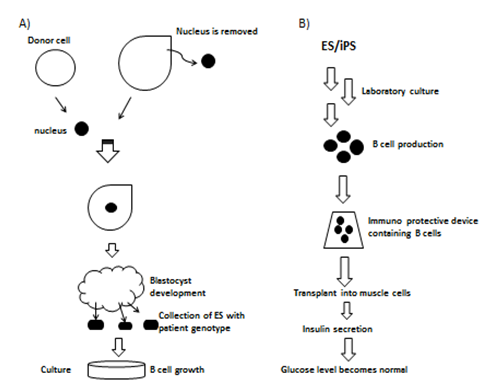
The transferred nucleus of somatic cell from breast tissue into a donor oocyte from which nucleus has re-moved is used to clone mammalian species. The oocyte is re-placed by nucleus transfers genetic info of donor. This method was firstly used to clone Dolly sheep. Blastocysts can establish in vitro from oocytes and ESC that genetically identical to donor (Figure 1A). This production of cells from embryonic stem cells has become a good source for hyperglycemia treatment [12, 13].
Stem Cell Therapy Approach
Cells, tissues and organs can sometimes be permanently damaged or lost by disease, injury and genetic conditions [14]. Stem cell therapy has emerged as one of the most effective way of treating hyperglycemia nowadays hence it can then be transplanted into the body to replace those that are damaged or lost.
The use of adult stem cells: Adult stem cells are currently used to treat some conditions, for example: Blood stem cells are used to provide a source of healthy blood cells for people with thalassemia, and cancer patients who have lost their own blood stem cells [15].
The Use Of Embryonic Stem (ES) Cells
The mammalian body contains about 200 different cell types; all derive from fertilized egg cell. Human embryonic stem cells (hESCs) have been a good alternative source of repair and used to produce Beta cells [9, 16]. The fertilized human egg distributes and raises the primary embryo, at blastula stage that comprises cluster of totipotent cell. Such ESC can be proliferated in-definitely in vitro and can also be induced to differentiate into numerous different lineages in vitro [12]. These embryonic stem cells are being used to produce functional Beta cells and can be transplanted to patient for the treatment of diabetes as shown in the Figure 1B.
The Use Of Induced Pluripotent Cells
IPS have high replicative capacity and pluripotency and these cells can be differentiated into the insulin producing cells [17]. These cells are highly similar to ES cells with having high differentiation ability. These are also able to maintain the normal telomere length. These cells can also differentiate in to the three germ layers to form embryonic body. These three germ layers ectoderm, mesoderm and endoderm can be differentiated in to the different kinds of cells. Thus, pancreatic beta cells can be made and used for the treatment of diabetes. This process is also shown in the Figure 1B.
The Use of A Cell Precursor and Fetal Pancreatic Stem Cells
Previously vast improvements have made in empathetic fetal endocrine growth. These give significant guide and efforts to produce islet cells in vitro. Endocrine predecessor cells in developing pancreas that modulate cellular signaling, can be used in vitro to grow endocrine precursor cells, taken either from embryonic pancreas from aborted fetuses or using pancreatic duct cells. In 2013 the fetal pancreatic cell was used to produce active insulin producing cells that was an excellent work by the biotechnologists. In this work, the fetal pancreatic progenitor cells were taken from the aborted embryos and were isolated by using markers (PDX1 and NGN3) [18, 19] .Then the scientists cultured them and some islets like structures were formed and started to produce insulin producing cells. Interestingly those cells showed the high efficiency than the normal Beta cells of the body [20].
The Use of Mesenchymal Stem Cells (MSCs)
Mesenchymal stem cell therapy is best among autologous adult stem cells. Mesenchymal stem cells are less pluripotent than embryonic stem cells. It renders the efficiency of MSCs to be differentiated into insulin secreting stem cells. Moreover, MSCs can be isolated from different sources such as- umbilical cord, bone marrow and pancreatic stroma. Autologous MSCs from diabetic patients are still remarkably different from ESCs, because of prolonged exposure to hyperglycemia. Studies in transgenic mice showed that stem cells engineered to produce insulin did much more efficiently in hyperglycemic environment hence MSCs are niche cells [21].
Conclusion
By using these different kinds of stem cell technologies, insulin producing cells can be made to cure diabetes. Among all stem cells, fetal pancreatic cells are the best-known stem cells that have high efficiency than any other stem cells. Human fetal pancreatic stem cells have excellent capacity for proliferation; these may be induced to differentiate into insulin-producing cells resulting in the formation of islet- like structures in vitro. These are capable of secreting insulin and help to reduce hyperglycemia after transplantation in diabetic animals and resulted islets might become a potential source for islets transplantation.
References
-
Newgard CB (2001) Lessons from the bioengineered beta- cell. J Diabetes Complications 15: 11.
-
Koren G (1993) Ethics of drug research in pregnancy, infancy and childhood. In: Koren G, et al. (Eds.), Textbook of Ethics in Pediatric Research. Florida, Krieger pp: 171- 181.
-
Mathis D, Vence L, Benoist C (2001) Beta-cell death during progression to diabetes. Nature 414: 792-798.
-
Ryan EA, Lakey JR, Rajotte RV, Korbutt GS, Kin T, et al. (2001) Clinical outcomes and insulin secretion after islet transplantation with the Edmonton protocol. Diabetes 50(4): 710-719.
-
Groth CG, Tibell A, Wennberg L, Korsgren O (1999) Xenoislet transplantation: Experimental and clinical aspects. J Mol Med 77(1): 153-154.
-
Sutherland DE, Gruessner RW, Dunn DL, Matas AJ, Humar A, et al. (2001) Lessons learned from more than 1,000 pancreas transplants at a single institution. Ann Surg 233(4): 463-501.
-
Berney T, Ricordi C (2000) Islet cell transplantation: The future? Langenbeck’s Arch Surg 385(6): 373-378.
-
Ramiya VK, Mariast M, Arfors KE, Schatz DA, Peck AB, et al. (2000) Reversal of insulin-dependent diabetes using islets generatedin vitro from pancreatic stem cells. Nature Med 6(3): 272-282.
-
Bonner Weir S, Taneja M, Weir GC, Tatarkiewicz K, Song KH, et al. (2000) In vitro cultivation of human islets from expanded ductal tissue. Proc Natl Acad Sci USA 97(14): 7999-8004.
-
Ezquer M, Arango-Rodriguez M, Giraud-Billoud M, Ezquer F (2014) Mesenchymal Stem Cell Therapy in Type 1 Diabetes Mellitus and Its Main Complications: From Experimental Findings to Clinical Practice. J Stem Cell Res 4: 8.
-
El-Badawy A, El-Badri N (2016) Clinical Efficacy of Stem Cell Therapy for Diabetes Mellitus: A Meta-Analysis pLos One 11(4): e0151938.
-
https://journals.plos.org/plosone/article/ figure?id=10.1371/journal.pone.0151938.g00
-
Millman JR, Pagliuca FW (2017) Autologous Pluripotent Stem Cell–Derived β-Like Cells for Diabetes Cellular Therapy. ADA 66(5): 1111-1120.
-
Zeeshan N, Naveed M, Irshad, Asif DF, Ahsan A, et al. (2017) Stem Cell Technology for the Treatment of Diabetes J Cell Sci Ther 8: 2.
-
(2017) What is a stem cell?.
-
Soria B, Roche E, Berna G, Leon-Quinto T, Reig J, et al. (2000) Insulin-secreting cells derived from embryonic stem cells normalize glycemia in streptozotocin-induced diabetic mice. Diabetes 49(2): 157-162.
-
Slack JM (1995) Developmental biology of the pancreas. Development 121(6): 1569-1580.
-
Wandzioch E, Zaret KS (2009) Dynamic signaling network for the specification of embryonic pancreas and liver progenitors. Science 324(5935): 1707-1710.
-
Hayek A, Beattie GM (1997) Experimental transplantation of human fetal and adult pancreatic islets. J Clin Endocrinol Metab 82(8): 2471-2475.
-
Noguchi H (2010) Production of pancreatic beta-cells from stem cells. Curr Diabetes Rev 6(3): 184-190.
-
Lumelsky N, Blondel O, Laeng P, Velasco I, Ravin R, et al. (2001) Differentiation of embryonic stem cells to insulin-secreting structures similar to pancreatic islets. Science 292(5520): 1389-1394.
- Research Progress of Induced Pluripotent Stem Cells and Their Clinical Application Prospects
- Nishan Al-Kamal is the Starting Point of A Feminist Scientist
- Current Concepts and Future Perspectives of Stem Cell Therapy in Peripheral Arterial Disease
- Stem Cell and Oxidative Stress-Inflammation Cycle
- Adipose Derived Mesenchymal Stem Cells Origin, Characteristics and Promises
- Mitochondria Targeted Antioxidants can Improve In Vitro Embryo Production in Buffalo