
Traditional Medicines used in Respiratory Tract Infection by Some Ethnic Tribes of Tripura- Survey
Respiratory tract infection is a common symptom for Covid-19 caused by a virus called SARS-CoV-2. Ethnic people rely upon traditional and indigenous plant resources to cure several disorders, including respiratory tract infections. The present study is a assembling of some primary data obtained from the survey in some tribal village of Tripura, Northeast India. All the plants used in cure respiratory tract infections were collected, identified, and herbariums were submitted to Tripura University Herbarium center. All the information received during the survey has been documented and the pharmacological activities of the plants have also been explored.
Introduction
Tripura is a small hilly state of Northeast India (23.8400° N, 91.2800° E) established in 1972 having eight districts and a total land area of 10,491.69 km2 inhabited by 12 major ethnic tribes( Chakma, Chaimal, Garo, Halam, Jamatia, Kuki, Lusai, Mog, Noatia, Reang Tripuri /Debbarma and Uchai) [1]. The climatic conditions and substantial forest resources help the ethnic people to live in hilly areas and practice traditional healing methods by using locally available plant resources to cure several health disorders. The rural ethnic population depends substantially on nature for their survival. They hold a strong sense of traditional knowledge for natural resources and environment. The main objective of this work was identification and documentation of the indigenous plants used to cure respiratory tract infections.
Materials and Methods
Site selection and Survey for Data Collection
The ethnic communities of Tripura can be divided into three major groups: (1) Bodo group consisting of Tripuri or Debbarma, Jamatia, Reang, Uchai, Noatias, and Garos; (2) Kuki group consisting of Koloi, Halam, and Lusai; and (3) Arakan group consisting of Chakmas, Mog, Noatia, and Uchai tribes. More than half of the population comes under Boro group followed by Kuki and Arakan groups [2].
![Figure 1: Map showing the survey areas. Source: www.google.com [3]](/fulltextimages/6167/fig_1.jpeg)
Debbarma/ Tripuri and Chakma are considered the oldest community of this land. Among all the tribes, Halam
and Jamatia tribes are selected for the survey as per their population size and availability. The villages considered for study are, Balicheera village (24°25’43.6”N 92°14’53.5”E) under Kadamtala RD Block and Atharobola village (23°37’10.5”N 91°27’13.5”E) under Killa RD block (Figure 1).
Survey and Sample Collection
The surveys were conducted from January to August 2017 in two selected villages for a total of 40 households. The houses in the villages were selected randomly and data were collected using pre-designed questioners. The traditional healers and old aged villagers were selected for gathering information about the indigenous plants used in respiratory tract infection by these tribes. All the available plants were collected identified by the taxonomist of the department of Botany, Tripura University and the herbariums were prepared accordingly and submitted to Tripura university herbarium center.
Result and Discussion
After detailed survey a total of 23 plant species were been identified having contribution in healing of Respiratory tract infection by Halam and Jamatia tribe traditionally. It has also been realised that the availability of plants and their number in the local forest and vicinity of their villages are dwindling at alarming rate (Table 1).
| Scientific Name | Family | Local name | Tribe name | Part used | Treatment | |
|---|---|---|---|---|---|---|
| 1 | Adhatoda vasica | Acanthaceae | Ada | Halam | Leaves | Cough, Bronchitis, Asthma |
| 2 | Allium capa | Amaryllidaceae | Peyaj | Halam | Stem, Leaves | Cough |
| 3 | Allium sativum | Amaryllidaceae | Risun | Jamatia | Bulb | Cough, Bronchitis |
| 4 | Aloe vera | Asphodelaceae | Aloy | Halam | Aerial parts | |
| 5 | Ananas comosus | Bromeliaceae | Ananas buo | Halam | Fruit | Cough |
| 6 | Andrographis paniculata | Acanthaceae | kalomegh | Jamatia | Leaves | Cough |
| 7 | Azadiracta indica | Meliaceae | Neem | Halam | Leaves | Cough |
| 8 | Capsicum annum | Solanaceae | Gul moso | Jamatia | Fruit | Bronchitis |
| 9 | Citrus maxima | Rutaceae | Jambura | Halam | Fruit | Bronchitis |
| 10 | Citrus reticulate | Rutaceae | Komla bukur | Jamatia | Peel | Cough |
| 11 | Citrus assamensis | Rutaceae | Ada jamir | Jamatia | Fruit | Cough |
| 12 | Cymbopogon citrates | Poaceae | Chabalang buo | Halam | Leaves | Cough |
| 13 | Datura stramonium | Solanaceae | Duthura | Jamatia | Seeds, flowers, leaves, fruit | Hopping cough |
| 14 | Desmodium gangeticum | Fabaceae | Mahatita | Halam | Roots | Cough, Asthma |
| 15 | Emblica officinalis | Phyllanthaceae | Amolodi | Jamatia | Bark, Fruit | Cough, Cold |
| 16 | Glycyrrhiza glabra | Fabaceae | Mitti challuai | Halam | Roots, bark | Cough |
| 17 | Jatropha curcas | Euphorbiaceae | Jiol | Jamatia | Leaves | Bronchities |
| 18 | Mangifera indica | Anacardiaceae | Thaichuk | Jamatia | Flower, Leaves, Bark | Cough, Asthma |
| 19 | Musa paradisiaca | Musaceae | Mathbuo | Halam | Leaves, Flower | Whooping cough |
| 20 | Ocimum enuiflorum | Lamiaceae | Kala tulsi | Jamatia | Leaves, seed | Bronchities, Cough, Cold |
| 21 | Oryza sativa | Poaceae | Moiram | Halam | Fruits, leaves, stem | Cold |
| 22 | Zingiber officinale | Zingiberaceae | Haching | Jamatia | Stem | Flu, Bronchities |
| 23 | Tinospora cordifolia | Menispermaceae | Guduchi | Halam | Stem | Flu |
Table 1: List of the plans use in Respiratory tract infection by Halam and Jamatia tribe.
All the plant species were listed in alphabetical order by their scientific name, family, local name, tribe name, Plant parts used in treatment.
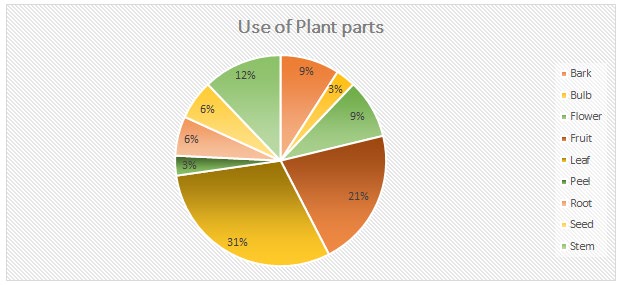
All 23 plant species are been identified taxonomically with the help of botany department Tripura University. Some plants were as being used in combination for the treatment of respiratory tract infection by traditional healers in Tripura. Maximum plants used for respiratory healing belongs to Rutaceae family followed by Acanthaceae, Amaryllidaceae, Fabaceae and Solanaceae family. Most frequently used plant part is leaf followed by Fruit and Stem (Figure 2).
Conclusion
Throughout the survey and interview conducted in the villages and data analysis done after survey it is obvious that the phytochemicals constituents present in the plant parts have the potentiality of curing the common respiratory disorders without or with very less side-effects. However, regular or frequent use of these plants can uplift the conditions of many chronic respiratory disorders. It has also been observed that the food habits of the tribal people are well mixed with the use of many medicinal plants and are also used as a regular and common practice. The 23 plants listed above are very commonly known to the tribe and are well accepted for use in cooking and daily and in most of the tribal cuisines. It has been observed that the leaves followed by fruits, stem bark and flowers are most used plant parts in their plant remedies. The traditional healings practice by the elderly peoples of the tribal community has an evolved science of their understanding for plants, while living with the nature which has helped them to develop simple and effective remedies for respiratory problems.
Acknowledgement
The authors are highly grateful to ethnic people of Tripura to share their traditional knowledge and also to the taxonomist of Department of botany, Tripura University to identify the collected plants.
References
-
Nath N, Ghosh S, Rahaman L, Kaipeng DL, Sharma BK (2019) An overview of traditional rice beer of North- east India: ethnic preparation, challenges and prospects. Indian journal of traditional knowledge. 18(4): 744-757.
-
Ghosh S, Rahaman, L, Kaipeng DL, Deb D, Nath N, et al. (2016) Community wise evaluation of rice-beer prepared by some ethnic tribes of Tripura. Journal of Ethnic Foods 3(4): 251-256.
- Management of Ear Keloid with Ksharsutra: A Case Study
- Yoga and Global Sustainability: A Holistic Path to One Earth, One Health
- Autoimmune Diseases in Ayurveda: A Narrative Review with Classical and Modern Perspectives
- Management of Cluster Headache Associated with Pituitary Apophysitis by CERT (Chakrasiddh Energy Release Technique): A Case Report on Energy Rebalancing
- Zygophyllum Geslini Coss : Biochemicals and Antioxidant Activity
- Observations of a Beginner Vaidya