
Can Javanicins be Potential Inhibitors of SARS-Cov-2 C-3 like Protease? An Evaluation through Molecular Docking Studies
Objectives: Corona virus SARS-CoV-2, otherwise known as COVID-19 has created a pandemic from which any respite seems far away. Since its outbreak in late December in 2019, till as of June 9, 2020 the virus has infected 7,237,929 people throughout practically every country of the world and caused deaths of 409,630 persons. Thus far, despite the best efforts of scientists, any vaccine or drug against COVID-19 is yet to be discovered. The objective of the present study was to evaluate through molecular docking studies a number of quassinoid compounds (javanicins) present in the plant Picrasma javanica regarding their ability to bind to the main protease of COVID-19 [C3-like protease or 3CLpro, (PDB ID: 6LU7)]. Methods: Molecular docking (blind) were done with the help of AutodockVina. Results: We observed that of the twelve javanicins studied, nine showed moderate to strong binding affinities to the main protease of COVID-19. Furthermore, the binding in each case was to the active site of the protease. We observed that the javacinins bound to the region, which the protease inhibitor N3 has been shown to bind. Conclusion: It is therefore very likely that the javanicins are inhibitors of the coronavirus main protease. Since the protease plays an essential part in viral replication, javanicins merit further study for their potential use as therapeutic agents.
Introduction
Corona viruses belong to the family Coronaviridae and are named such because of spike-like proteins resembling a crown on their surface. Most persons have seasonal attacks of flu caused by this family of viruses, but usually they cause mild fever and cold symptoms, which goes away within a week at the most. However, since 2000, the world has witnessed the emergence of three serious corona virus diseases, SARS (Severe Acute Respiratory Syndrome), MERS (Middle East Respiratory Syndrome), and the latest, namely SARS-CoV-2 otherwise designated by the World Health Organization (WHO) as COVID-19. Among the three, COVID-19 has proved to be the most serious for two major reasons. Since its outbreak in late December in 2019, till as of June 9, 2020 the virus has infected 7,237,929 people throughout practically every country of the world and caused deaths of 409,630 persons. Thus far, despite the best efforts of scientists, any vaccine or drug against COVID-19 is yet to be discovered. The extreme contagiousness of the virus along with the occurrences of repeat spikes in infections has caused serious dents in the world economy and severe unemployment in many countries because of the necessity of keeping people and families isolated from each other through lockdowns and quarantines.
A number of synthetic drugs originally intended for other uses like use against other viruses or even malaria has been tested against COVID-19 both with COVID patients as well as in silico studies. Three such synthetic drugs have shown promise in molecular docking studies (methisazone, CGP42112A, and ABT450) [1] but nothing further has been reported regarding clinical trials of these compounds. The repeated failures of existing allopathic drugs, and absence of other viable allopathic drugs or vaccines is turning the attention of scientists to the plant kingdom and traditional medicinal systems, which has always been a major source of discovery of many important allopathic medicines [2].
A 3D-homology model of 3CLpro was screened against a medical plant library containing 32,297 potential antiviral phytochemicals/traditional Chinese medicinal compounds and nine hits were obtained in this molecular docking approach [3]. Baicalein, isorhamnetin, kaempferol, luteolin, and naringenin were among the 10 plant-based compounds postulated to be effective against COVID-19 on the basis of molecular docking studies with COVID-19 proteins like the 3CLpro [4]. Four traditional Chinese medicines, namely HuoxiangZhengqi, LianghuaQingwen, ShuefengJidue, and XueBijing have shown promising results in the treatment of COVID-19 [5].
Picrasma javanica Blume belongs to the Simaroubaceae family and can be found in Indonesia, India and other tropical countries. Since the plant has indigenous uses as an antiviral [6], it was of interest to evaluate through molecular docking studies whether phytochemicals reported from the plant can bind to 3CLpro of SARS-CoV-2. For a comparative analysis we also assessed through molecular docking studies whether the same phytochemicals of Picrasma javanica can bind to SARS 3C-like protease. For purposes of this paper we selected 12 quassinoid compounds from this plant, namely javanicins B, E-K, M, N, P and Q. Javanicins have a novel C-20 structure and belong to des-4-methylated picrasane type quassinoids. Various javanicins have been isolated from leaves, roots and bark of Picrasma javanica. Javanicins E, F, G and M were isolated from the barks of the same plant [7]. Javanicin N was isolated from the wood of Picrasma javanica, and javanicins P and Q from leaves of the same plant [8]. Javanicin B was isolated from the bark of the plant [9]. Javanicins K, L, O, R, S and T were isolated from leaves and stems of the same plant [10]. Javanicins H, I and J were isolated from leaves of the same plant [11].
A number of phytochemicals have been screened thus far through molecular docking analysis of binding of the compounds to the C3-like protease of COVID-19. Some phytochemicals (belonging mostly to the flavonoid group) have shown promise but has not resulted in practical use as anti-COVID drugs. Yet molecular docking remains a powerful tool for initial screening of possible anti-COVID compounds as well as other types of antiviral compounds. In this study, we for the first time report molecular docking screening analysis of javanicins from Picrasma javanica against 3CLpro of SARS-CoV-2 and SARS.
Methods
Three-Dimensional Structure of COVID-19 and SARS major Protease (3C-like protease)
We have used the pdb file (6LU7) of the main protease of SARS-CoV-2 3C-like protease or SARS-CoV-2 3CLpro as published by Professor Zihe Rao and his colleagues [12]. Inhibitor (called N3) was removed from the pdb file before using the protein’s structure in our molecular docking studies. The interacting residues of N3 with the protease amino acids include His41, Met49, Phe140, Leu141, Asn142, Gly143, His163, His164, Glu166, Leu167, Pro168, Gln189, Thr190, and Ala191. The active residues of SARS- CoV-2 3C-like protease are His41 and Cys145. Monomeric form of protein was used for molecular docking. The same protease from SARS (pdb: 3M3V) was used for docking studies with the same javanicin phytochemicals. The two proteases (SARS-CoV 3CLpro and SARS-CoV-2 3CLpro) share a 96% sequence identity and have a highly similar three dimensional structure [13].
Compounds used in Docking Studies
We have studied javanicins (quassinoid type of phytochemicals) known to occur in Picrasma javanica. Not all quassinoid type phytochemicals present in various parts of the plant were studied. We instead concentrated on the javanicins in this study, and even then not all javanicins present in the plant were studied but only a few selected at random. Ligand molecules were downloaded from Pubchem [14] in sdf format. They were optimized with the force field type MMFF94 using Openbable softwares and saved as pdbqt format.
Ligand Molecular Docking Studies
We have conducted molecular docking (blind) using AutoDock Vina [15]. We report ΔG values as an average of values from five independent runs of the docking program. In our figures, we show the pose of phytochemicals bound to SARS-CoV-2 main protease as obtained from PyMOL and displayed in Discovery Studio [16, 17].
Phytochemicals
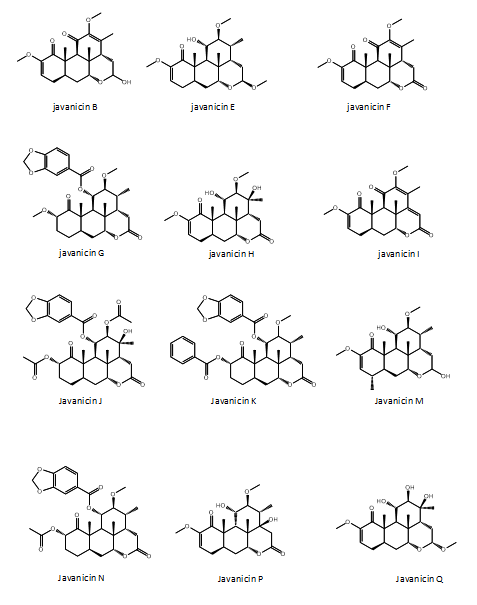
Phytochemicals present in Picrasma javanica were obtained from the various papers published by Koike and his group [7, 8, 9, 10, 11] and their 3D structures were obtained from PubChem. It was not possible to cover all phytochemicals of Picrasma javanica; we concentrated essentially on twelve javanicin compounds reported to be isolated from various parts of the plant. The structures of these javanicins are shown in Figure 1.
Results and Discussion
The predicted binding affinities of the javanicins with C3-like protease of SARS and SARS-CoV-2 are shown in Table 1. Javanicin G showed the most affinity for SARS-CoV-2 3CLpro with a binding energy of -8.2kcal/mol. Two other javanicins, namely javanicins N and K also demonstrated high binding energies of -7.9 and -7.8 kcal/mol, respectively. Javanicin E gave the lowest binding energy of -6.6 kcal/mol followed by javanicin P with a binding energy of -6.7 kcal/ mol. It is to be noted that javanicins G, K and N also gave high binding energies with the C-3 like protease of SARS. Interestingly, unlike the C-3 like protease of SARS-CoV-2, all twelve javanicins showed high binding affinities with C-3 like protease of SARS, indicating that these classes of compounds may be potentially effective therapeutic agents against both SARS and SARS-CoV-2.
| Phytochemical | Binding energy (𝛥G = kcal/mol) | |
|---|---|---|
| SARS-CoV-2 | SARS | |
| Javanicin B | -7 | -7.8 |
| Javanicin E | -6.6 | -7.4 |
| Javanicin F | -7.3 | -7.7 |
| Javanicin G | -8.2 | -8.5 |
| Javanicin H | -6.9 | -7.5 |
| Javanicin I | -7.2 | -8 |
| Javanicin J | -7.2 | -8.1 |
| Javanicin K | -7.8 | -8.3 |
| Javanicin M | -7.2 | -7.9 |
| Javanicin N | -7.9 | -7.4 |
| Javanicin P | -6.7 | -8.1 |
| Javanicin Q | -7 | -7.5 |
Table 1: Binding affinities of javanicins present in Picrasma javanica with C3-like protease of COVID-19 (SARS-CoV-2) and SARS.
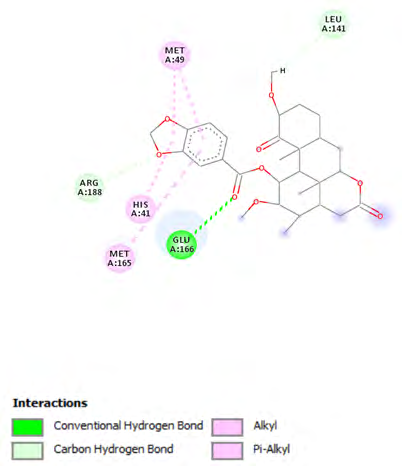
The binding of javanicin G with the 3C-like protease of SARS-CoV-2 is shown in Figure 2. As mentioned earlier, the interacting residues of an inhibitor N3 with the protease amino acids has been shown to be His41, Met49, Phe140, Leu141, Asn142, Gly143, His163, His164, Glu166, Leu167, Pro168, Gln189, Thr190, and Ala191. The active residues of SARS-CoV-2 3C-like protease have been shown to be His41 and Cys145.
2D ligand interaction diagram of representative docked poses of Javanicin G (Figure 2) shows that Javanicin G establishes interactions with several of the residues (Met165, Glu166, His41, Met49) of the protease that are known to interact with known covalent and non-covalent inhibitors hitherto published. But most of these interactions seem to involve various parts of the benzdioxole ester side group attached to the main quassin-type polycyclic scaffold. Javanicin G and other quassinoids do not appear to have any strong electrophilic group to form any covalent adduct with the active site Cys. Therefore these molecules are unlikely to act covalently. Excluding Javanicin N, the predicted binding affinities of the javanicins were better against the SARS protease than the SARS-2-COV-2 protease.
Conclusion
In future, Javanicin G and ideally most of the other javanicins should be tested for physical interaction with the proteases and any possible inhibition of the function of these proteases.
Acknowledgement
The authors are grateful to Professor Dr. Abdul Hamid, CEO, Agrarian Research Foundation for support.
References
-
Shah B, Modi P, Sagar SR (2020) In _silico_ studies on therapeutic agents for COVID-19: Drug repurposing approach. Life Sci 252.
-
Rates SMK (2001) Plants as source of drugs. Toxicon 39(5): 603-613.
-
ul Qamar MT, Alqahtani SM, Alamri MA, Chen LL (2020) Structural basis of SARS-CoV-2 3CLpro and anti-COVID-19 drug discovery from medicinal plants. J Pharmaceut Anal.
-
Huang YF, Bai C, He F, Xie Y, Zhou H (2020) Review on the potential action mechanisms of Chinese medicines in treating Coronavirus disease 2019 (COVID-19). Pharmacol Res, pp: 158.
-
Tong T, Wu YQ, Ni WJ, Shen AZ, Liu S (2020) The potential insights of Traditional Chinese Medicine on treatment of COVID-19. Chin Med 15: 51.
-
Alves IABS, Miranda HM, Soares LAL, Randau KP (2014) Simaroubaceae family: botany, chemical composition and biological activities. Rev Bras Farmacogn 24(4): 481-501.
-
Koike K, Mitsunaga K, Ohmoto T (1990) New quassinoids from Indonesian _Picrasma javanica_. Structures of javanicins E, F, G and M. Chem Pharm Bull 38(10): 2746- 2749.
-
Koike K, Ishii K, Mitsunaga K, Ohmoto T (1991) Javanicins N, P and Q, new quassinoids from _Picrasma javanica_. Chem Pharm Bull 39(4): 939-941.
-
Koike K, Ohmoto T (1990) Quassinoids from _Picrasma_ _javanica_. Phytochem 29(8): 2617-2621.
-
Koike K, Ishii K, Mitsunaga K, Ohmoto T (1991) New des- 4-methylpicrasane quassinoids from _Picrasma javanica_. J Nat Prod 54(3): 837-843.
-
Koike K, Ishii K, Mitsunaga K, Ohmoto T (1991) Quassinoids from _Picrasma javanica_. Phytochem 30: 933-936.
-
Liu X, Zhang B, Jin Z, Yang H, Rao Z (2020) The crystal structure of COVID-19 main protease in complex with an inhibitor N3.
-
Zhang L, Lin D, Sun X, Curth U, Drosten C, et al. (2020) Crystal structure of SARS-CoV-2 main protease provides a basis for design of improved α-ketoamide inhibitors. Science 368(6489): 409-412.
-
Ihlenfeldt WD (2018) Pub Chem. In: Applied Chemoinformatics, pp: 245-258.
-
Trott O, Olson A (2010) Autodock Vina: Improving the Speed and Accuracy of Docking. J Comput Chem 31(2): 455-461.
-
Studio D (2015) Dassault Systemes BIOVIA, Discovery Studio Modelling Environment, Release 4.5. Accelrys Software Inc, pp: 98-104.
-
Ganesan K, Xu B (2017) Polyphenol-rich lentils and their health promoting effects. Int J Mol Sci 18(11).
- Management of Ear Keloid with Ksharsutra: A Case Study
- Yoga and Global Sustainability: A Holistic Path to One Earth, One Health
- Autoimmune Diseases in Ayurveda: A Narrative Review with Classical and Modern Perspectives
- Management of Cluster Headache Associated with Pituitary Apophysitis by CERT (Chakrasiddh Energy Release Technique): A Case Report on Energy Rebalancing
- Zygophyllum Geslini Coss : Biochemicals and Antioxidant Activity
- Observations of a Beginner Vaidya