
Management of Ear Keloid with Ksharsutra: A Case Study
Keloids (benign growth) are one of the causes of psychosomatic disturbance in patients. It can develop after ear piercing, minor or major wounds, burns, and surgical interventions. The theory behind keloid formation is the imbalance between increased collagen and extracellular matrix synthesis and decreased degradation of these products. Inflammatory mediator transforming growth factor beta has been proposed to influence the dysregulation of collagen remodeling in the scar healing process. The term keloid, meaning ‘crab claw,’ was first coined by Alibert in 1806. According to Ayurveda, Keloid can be correlated with Arbuda or Vrangranthi. Clinicians have explored different remedies for keloid prevention and treatment, such as steroids, anti- inflammatories, and chemotherapeutic molecules to suppress keloid recurrence. Various treatment modalities like pressure therapy, cryotherapy and lasers, intralesional steroid therapy, radiation, laser therapy, and surgical excision are generally performed for keloids, but they are not so promising. It was always a challenge for a surgeon. The present paper presents an auricular keloid treated with Ksharsutra ligation. Considering the recurrence of keloid, ksharsutra ligation is supposed to be the best alternative procedure.
Introduction
The term keloid was originally described in the 1800s as “cheloid,” which is derived from the Greek root “chele,” which means “crab claw” [1]. A benign hyperproliferative growth of dense fibrous tissue that develops from an abnormal healing response to a cutaneous injury is termed Keloid. The term hyperproliferative refers to an abnormally rapid growth or reproduction of cells outside the border of the original wound. This can occur in various contexts, such as in certain types of anaemia, skin disorders, or cancers. These keloids usually appear as shiny, smooth, globular growths on one or both sides of the ear pinna, and are frequently seen in darkly pigmented people on the pinna or lobule. Various treatment modules for the keloid were studied to prove their clinical and scientific efficacy. Several treatment modalities so far described in managing keloids are surgical excision [2], intralesional steroidal injections, compression therapy with silicon sheets, cryotherapy, laser, α-2b interferon, and chemotherapeutic agents like 5-fluorouracil. Surgical excision eliminates the lesion but the main disadvantage is ≥50% recurrence if used alone. The disadvantage with the other procedures is incomplete ablation of the lesion leaving poor aesthetic results. To remove the lesions totally and to prevent recurrence requires “surgical excision in combination with one or more of the other modalities of treatment” [2].
Though these treatments are supposed to be effective are not affordable to every patient instead Ksharsutra in Ayurveda is found to be effective in such conditions. Ksharsutra is used for excision and healing too. It is one of the simple, cost-effective procedures described by Acharya Sushruta for various diseases like Arsha, Bhagandara, etc. Ksharsutra has properties of incision, excision, debridement, and scrapping, along with antiseptic and aerostatic properties.
According to Ayurveda, the keloid of the ear pinna can be co-related to Arbuda or Vranagranthi [3]. Arbuda is the mass or growth that occurs at the pinna or lobule, and Vranagranthi is the result of any trauma to the body. According to Ayurvedic principles, these are mamsa dhatu pradoshaja vyadhi [4] (disease having abnormal involvement of muscular and fibrous tissue), and the application of ksharasutra is the important treatment modality. This Ksharasutra ligation action on tissue begins with severe irritation and inflammation of local tissue, initiating cutting action and pressure of ligation, causing a lack of blood supply to the keloid mass and leading to tissue necrosis [5]. So in the present study, sincere effort has been made to assess the efficacy of ksharsutra ligation on keloid.
Aim
To study the efficacy of Ksharsutra Ligation on Keloid
Objective
- To study the anatomy and pathophysiology of keloid
- To study the mode of action of Ksharsutra on keloid **
- Pathophysiology of keloid formation** The primary goal in the clinical management of skin wounds, whether unintended or iatrogenic, is to support the natural dynamic process of wound healing to re-establish baseline skin integrity, function, and aesthetics. Scar formation occurs over distinct phases, including haemostasis, inflammation, proliferation, and remodelling [6]. 1. Haemostasis: After an injury to the skin, exposed elements in various layers of the skin, in addition to vasoactive and inflammatory chemical mediators, contribute to clot formation for haemostasis and attract inflammatory cells to the site for the inflammatory phase [7]. Key chemical mediators include transforming growth factor beta (TGF-β), interleukin-1 (IL-1), interleukin-6 (IL-6), tumor necrosis factor (TNF), and vascular growth factor (VEGF) [7]. In this phase, neutrophils are the first to be seen active at the injury site to rid the area of debris and possibly infectious material [6]. 2. The inflammatory phase occurs over, on average, three days [6]. Additionally, different subtypes of leukocytes that secrete growth factors, as well as chemotactic proinflammatory cytokines that recruit cell types needed for the proliferative phase, are also present in this phase [6, 7]. Endothelial cells, macrophages, and fibroblasts are present to help create granulation tissue, new vasculature, and the extracellular matrix (ECM) that will replace clots in the wound and help migrating cells adhere and function.2 Within the ECM, Type III collagen is present at this stage of healing. Next, re-epithelization occurs due to the recruitment of keratinocytes [7]. 3. The proliferative phase will occur over subsequent weeks [6]. Then, fibroblasts convert into myofibroblasts, which are responsible for wound contracture [8]. The final healing phase is remodelling. During the remodelling phase, the ECM and granulation tissue degrade via proteases while mature Type I collagenous matrix and scar tissue form [8]. Furthermore, vascular cells and the myofibroblasts degrade in an organized fashion [8]. The balance of synthesis and the disintegration of cell types is essential to provide optimal wound healing [6, 7, 8]. 4. The remodelling phase occurs over months [6]. A deviation in any phase of healing can result in aberrant and sometimes excessive scar formation [6, 7, 8].
Materials and Methods
A surgical linen thread size 20 is taken. The thread is coated evenly with Snuhiksheera (latex of Euphorbia nerifolia) all around the linen with the help of a clean gauze piece and is hung inside the cabinet for drying. The procedure should be repeated for 11 days. Then the 12th coating of Snuhiksheera is done, and Apamarga Kshar is applied over the wet thread immediately and hung in the cabinet for drying. This procedure is done continuously for 7 days. Then 3 coatings with Snuhiksheera and fine powder of Haridra churna are done. The Ksharsutra is made of 21 coatings [9].
Case Report
A 34-year-old female patient came with the complaint of painless cystic swelling on the right ear helix for 6 months.
History of present illness
As per the history given by the patient, the same cystic swelling occurred 2 years ago due to trauma from an ear piercing, at that time, surgical excision was done, and she got complete relief. After 1.5 years, swelling recurs at the same spot. Then she visited Kashibha Ayurved Hospital Savli for further management.
History of past illness
No H/O of typhoid, malaria, jaundice, asthma, or any other major illness
Local Examination
**
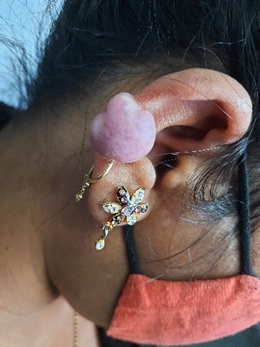
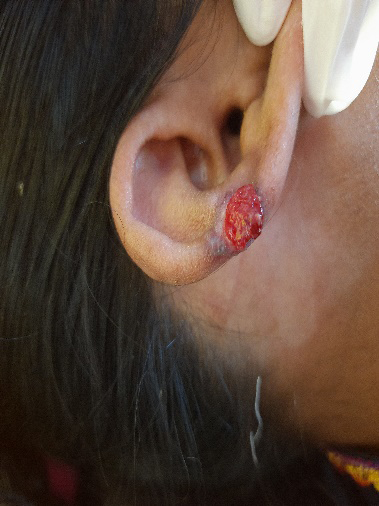
- Inspection Right Ear: External Auditory Canal was clear and the Tympanic membrane was intact Painless cystic swelling was noted on the right ear helix
- Palpation** 1. Pulsation & Tenderness absent 2. Shape-irregular 3. Surface -soft 4. Edges – well defined 5. Mobility – mobile 6. Consistency – uniform all over 7. Fluctuation- absent 8. Temperature-normal 9. Transillumination test- negative
Investigation
All routine investigations, i.e. CBC, ESR, BSL (F, PP), Urine (R, M), BT, CT, and HIV HBsAg, were done and are within the normal limit.
Surgical Intervention
**
- PurvaKarma (preoperative): Patient consent was taken and a detailed explanation of the procedure was given. 1. Inj TT-0.5cc IM was given 2. A xylocaine sensitivity test was done 3. All vitals are recorded
- Pradhanakarma (Operative): Under aseptic conditions, local anesthesia was given with xylocaine 2% around the base of the keloid. A superficial skin incision was made with a 15-no blade around the base of the keloid. A sterile ksharsutra was ligated tightly on the incision site. After ligation, a povidone-iodine dressing was applied.
- Paschatkarma (post-operative):** The Antibiotics Tab Moxikind CV 625 mg and Tan Enzoflam were given twice a day for five days.
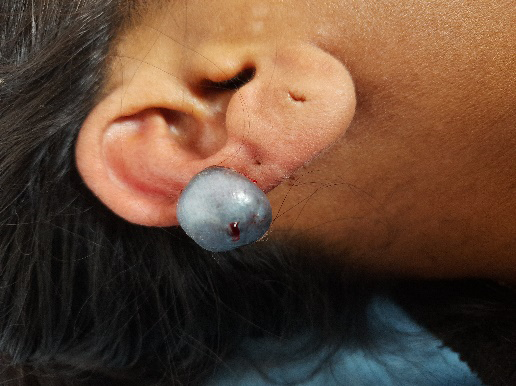
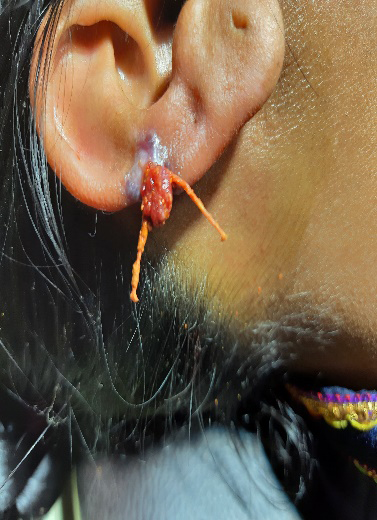
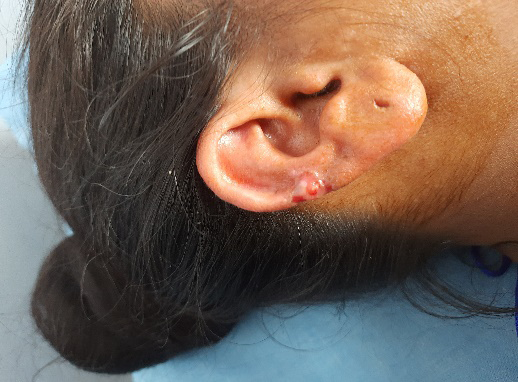
The ksharsutra was kept for three days. On the fourth day, discoloration of the keloid was seen, and its mass was ready to slough out. Cleaning and dressing were done with the application of fresh Kharsutra. On the coming follow-up, the keloid fell with the remnant of cell debris and necrosed tissue, which was cleaned with betadine and a gauze piece. A fresh ksharsutra was tied, and the dressing was done. On the 12th day, the keloid completely fell off, and cauterization was done, followed by dressing with betadine. The patient was asked to visit when the wound was completely healed.
Mode of action of Ksharsutra on keloid
**
- Shnuhi (Euphoria Nerifolia):** It is commonly known as Indian Spurge tree. Rasa, Veerya, and Vipaka of snuhi are Katu, Ushna & Katu respectively. Snuhi is having Katu, Tikshna and Guru guna with kaphavathara properties. Ksheer or Latex is one of the main ingredients in the preparation of Ksharsutra. It is strongly alkaline, which causes chemical cauterization. Its action on tissue begins with severe irritation and subsequent inflammation of local tissue, causing local tissue necrosis. This debris of necrosed tissue is cleared out, giving way for fresh budding granulation tissue over the wound. Also, one of the studies conducted by Rasik A M et al. proves the wound healing activity of Snuhiksheer [10, 11, 12].
- Haridra (curcuma longa), or turmeric, is a widely recognized herb in Ayurveda known for its anti-inflammatory, antiseptic, and antioxidant properties. It plays a significant role in wound healing processes due to its ability to fight infections and promote tissue regeneration.
- Apamargakshar (Achyranthes Aspara) has a controlled chemical cauterizing action on living tissue, causing its destruction and subsequent regression of raised scar tissue through its tikshna guna. The excess collagen fibres within the keloid are burned away, leading to a reduction in size and prominence.
Results
Management of keloid with treatment like intralesional steroidal injections, compression therapy with silicon sheets, cryotherapy, laser, α-2b interferon, chemotherapeutic agents like 5-fluorouracil, and excision are quiet frustrating because of recurrence so here Ksharsutra application used in the study found to be effective in terms to prevent the same (Figures 1-6).
Discussion
According to the reference of Shabdakalpadruma, the word Kshara + sutra is derived from the root Kshara means to melt away or to perish, and the word Sutra means thread. Ksharsutra is a thread that is made up of caustic material and helps in destroying the devitalized tissue and disintegrating the skin or other tissues. Kshara acts as an incision, puncture, and scarification to relieve the derangements of the Tridosha and uniformly affect the diseased. Therefore, it is considered superior to all surgical and parasurgical measures [13].
Kshara is considered superior to all surgical and Para surgical measures because they perform the work of incision, puncture, and scarification to relieve derangements of the tridosha and uniformly affect the diseased part to which they are applied. As per Sushruta, Kshar possesses the following qualities, Tridoshaghna, Saumyata, Dahana, Pachana, Daran, Katuka, Ushna, Tikshna, Vilayana, Shodhana, Ropana, Shoshana, Stambhana , Lekhana , Krimighna , It normalizes Aama, Kapha, visha, medodhatu. In addition to that Acharya Charak attributed two more properties Laghu & Bhedana [14]. Vagbattachrya stated that Kshar acts by extracting all the toxins from the disease site and curing the disease without reoccurrence [15].
Acharya Sushruta has mentioned the use of Kshara to treat many diseases like Vrana, Bhagandara, Arsha, Ashmari, etc. This has proven to be the standard treatment. Kshara described is useful orally and externally. The Ksharsutra procedure is simple, very safe, effective, and with minimal or no complications. It is unhazardous and easily acceptable by the patients. Ksharsutra performs the following actions: scraping, excision, draining, penetrating, debridement, and healing. Ksharsutra has the following properties Tridoshaghna, Pachana, Dahana, Ushna, Darana, Tikshna, Shodhana, Katuka, Vilayana, Shoshana, Ropana, Lekhana, Stambhana and Krimighna, etc. which makes it unique in its treatment modality.
Auricular Keloid can be compared with Arbuda (abnormal growth) or Vranagranthi (result of any trauma to the body). These are considered as Manspradoshaja Vyadhi and application of Ksharsutra is one of the important treatment modalities [16].
Conclusion
The present study proves the efficacy of ksharsutra ligation on ear pinna keloid with minimum blood loss, and considering the rate of recurrence, if Agnikarma is done after the excision of keloid by kshatsutra will show remarkable results [17]. Though Ksharsutra is found to be effective, the sample size should be increased to establish its long-term effectiveness.
Conflict of Interest
The authors declare no conflict of interest.
References
-
Lee SS, Yosipovitch G, Chan YH, Goh CL (2004) Pruritus, pain, and small nerve fiber function in keloids: A controlled study. Journal of the American Academy of Dermatology 51(6): 1002-1006.
-
Narakula GK, Shenoy RK (2008) A prospective clinical review of “multi model” approach for treating ear keloids. Indian Journal of plastic surgery: official publication of the Association of Plastic Surgeons of India 41(1): 2-7.
-
Ambikadatta S (2008) Sushruta Samhita of Sushruta, Sutra Sthana, 11th Chapter, 2nd (Edn.), Varanasi; Choukhambha Orientalia Varanasi 37.
-
Yadavaji T (2005) Charaka Samhita of Charaka, Sutrasthana, 28 Chapter, 2nd (Edn.), Varanasi; Chowkhambha Sanskrit Series 180.
-
Akoz T, Erdogan B, Gorgu M, Deren O (2010) Combined approach to the treatment of earlobe keloids. Plast Reconstr Surg.1998;101:857–8. Actas Dermosifiliogr 101(3): 235-241.
-
Wang PH, Huang BS, Horng HC, Yeh CC, Chen YJ (2018) Wound healing. J Chin Med Assoc 81(2): 94-101.
-
Bolognia JL, Schaffer JV, Cerroni L (2018) Eming SA. Biology of wound healing. Dermatology 4: 2413-2424.
-
Chu EA, Byrne PJ, Odland RM, Goding GS (2015) Skin flap physiology and wound healing. In: Flint PW, et al. (Eds.), Cummings Otolaryngology. Philadelphia, PA: W. B. Saunders, pp: 1124-1136.
-
Deshpande PJ, Sharma RK (1973) Non operative Treatment of high rectal fistula in ano by a new technique, review follow up of 200 cases Americal Journal of protocol 24: 49.
-
Sorab G (2021) Critical Analysis of Snuhi - Euphorbia Neriifolia (Upavisha- Poisonous Plant) and its Application as a Therapeutic Aid. AYUSHDHARA 8(5): 3498-3505.
-
Rasik AM, Shukla A, Patnaik GK, Dhawan BN, Kulshrestha DK, et al. (1996) wound healing activity of latex of Euphorbia Nerifolia linn, Indian Journal of harmacology, Accepted for publication, pp: 107-109.
-
Hanumantrao RV, Sandip M (2021) International Journal of Pharmaceutical Research and Applications 6(3): 309- 313.
-
(2002) Dalhanachaya commentary Nibandhasangraha on Sushruta Samhita of Mahrishi Sushruta Sutrasthana, 11 Chapter, Varanasi: Chowkhambha Orientalia, pp: 45.
-
(1996) Pandit Kasinatha Pandey commentary on Charaka Samhita of Maharishi Charak, Vimana Sthana, Varanasi: Chaukhamba Bharti Academy, pp: 678.
-
Atri Dev Gupta (2012) commentary on Astanga Hridya of Acharya Vaghbhatta, Varanasi: Chaukhamba Praharshan, pp: 225.
-
Ambikadatta S (2008) Sushruta Samhita of Sushruta, ,Sutra Sthana,Ch Chapter 11,verse no.3,4,6.16.2 nd edition,Varanasi;Choukhambha Orientalia Varanasi, pp: 37.
-
Amrut S, Amit N, Madhukar L, Hema K, Shital B (2014) A clinical study for the management of Ear Pinna Keloid by Ksharsutra and Agnikarma. Int J Res Ayurveda Pharm 5(3): 261-265.
- Yoga and Global Sustainability: A Holistic Path to One Earth, One Health
- Autoimmune Diseases in Ayurveda: A Narrative Review with Classical and Modern Perspectives
- Management of Cluster Headache Associated with Pituitary Apophysitis by CERT (Chakrasiddh Energy Release Technique): A Case Report on Energy Rebalancing
- Zygophyllum Geslini Coss : Biochemicals and Antioxidant Activity
- Observations of a Beginner Vaidya
- Assays for Anti-Cancer Screening of Medical Plants: A Review