
In Silico Studies on Binding of Vernonia Amygdalina Phytochemicals to Main Protease (Mpro) of SARS-CoV-2
Objectives: The corona virus SARS-CoV-2 emerged in late December 2019 and since then has created a global pandemic, which shows no signs of abating as of this date. As of July 9 2021, the virus has been responsible throughout the world for 186,357,958 infections and 4.026,907 deaths. Any drugs against this virus remains to be discovered. Several vaccines have been approved by the World Health Organization but administering the vaccines have been difficult because of production shortages and distribution anomalies between rich and poor nations. Towards finding a new and affordable antiviral drug against SARS-CoV-2, we evaluated the in silico binding capabilities of several phytochemicals of an African plant, Vernonia amygdalina Del. (Asteraceae) to the main protease (Mpro) of SARS-CoV-2, which plays an integral part in the replication of the virus. Methods: Binding of phytochemicals to Mpro were carried out through molecular docking (blind) with the help of AutoDockVina program. Results: We observed that of the ten phytochemicals studied, seven showed moderate to strong binding affinities to Mpro. Furthermore, the binding of these seven phytochemicals in each case was to at least one of the two amino acids forming the catalytic dyad of Mpro, indicating that the Mpro catalytic site was involved. The highest binding affinity was shown by luteolin7-O-glucuronide with a binding energy (ΔG) of -8.7 kcal/mol. Conclusion: Binding to the catalytic site can lead to Mpro inhibitory activity. Since the protease plays an essential part in viral replication, the phytochemicals from Vernonia amygdalina merit further antiviral activity studies for their potential as lead compounds or drugs.
Introduction
The current pandemic COVID-19 caused by the zoonotic virus SARS-CoV-2 is the latest among the three major coronaviruses causing or have caused serious viral outbreaks among human beings. Although seven corona viruses are known to affect human beings, four of them cause only minor colds or flu-like symptoms with rarely major consequences. The first major coronavirus to affect humans and to be recognized as a global public health threat emerged in China in 2002 and was named SARS-CoV for Severe Acute Respiratory Syndrome coronavirus. The next major coronavirus to emerge in 2012 in Saudi Arabia was named MERS (Middle East Respiratory Syndrome) coronavirus or MERS-CoV. The latest to emerge in Wuhan, China is named as Severe Acute Respiratory Syndrome coronavirus 2 or SARS-
CoV-2, and is the causative agent of the disease known as COVID-19 or coronavirus disease 2019 [1].
As of July 9 2021, SARS-CoV-2 has been responsible throughout the world for 186,440,028 infections and 4.028,692 deaths [https://www.worldometers.info/ coronavirus/]. Only some remote Pacific Island countries have been left unscathed; otherwise, the virus has struck rich and poor countries alike. The number of infected cases per million has been 104,142 in USA, 22,064 in India, and 88,572 in Brazil. So far no drugs have been discovered, which can cure the disease. A number of drugs like remdesivir, lopinavir, ritonavir, tocilizumab, ivermectin, hydroxychloroquine, and dexamethasone have been tried but with limited success or conflicting results [2].
Several vaccines have recently obtained approval of World Health Organization (WHO) against COVID-19. These vaccines include Pfizer-BioNTech, Moderna, Johnson & Johnson, Oxford-AstraZeneca, Sputnik V, and Sinovac. Although generally proven to be safe, some adverse effects/ contraindications have been reported for the vaccines [3, 4, 5, 6, 7]. Moreover, experts believe that at least 70% of the population of a country needs to be vaccinated or become infected by the disease and then get cured to develop ‘herd immunity’ [8]. Considering that the world population is now nearing 8 billion and with the exception of Johnson & Johnson, the other vaccines need two doses to be fully vaccinated, that calls for at least 11-12 billion doses of the vaccine(s) to be administered to the world population, which is difficult to achieve considering the remoteness of many regions of the world and because of production shortages and distribution anomalies between rich and poor nations. Moreover, some of the vaccines need around -70 degrees Celsius for storage, a facility not adequately available in the low income countries (LICs) and low middle income countries (LMICs). Then again some people are averse to vaccines or have been misinformed as to vaccine effects, which has led them not to get vaccinated [9, 10]. Another major possible problem for vaccines is that SARS-CoV-2 virus has given rise to several ‘variants of concern’, against which existing vaccines may not be fully effective [11]. This concern with vaccines and inability of existing conventional (allopathic) antiviral and ‘repurposed’ drugs to cure COVID-19 is making researchers turn to the plant kingdom for lead compounds and novel drugs against COVID-19.
Vernonia amygdalina Del. (Asteraceae) is a plant belonging to the daisy family; in English, it is known as ‘bitter leaf’. The plant can be found in tropical African countries and grows to about 2-5 meters in height. The plant is used for malaria treatment in Uganda; decoctions of roots and leaves are used in African ethnic medicines to treat hiccups, fever, kidney problems, and stomach disorders. The various pharmacological properties reported of the plant include anti-malarial, anti-thrombotic, anti-diabetic, antioxidant, and anti-inflammatory as reviewed by Alara and others [12].
Others have mentioned the uses of the plant in ethnic remedies for fever, diarrhea, cough, and headache notably, all these are symptoms seen in COVID-19 patients. The plant is also used for malaria treatment. Aqueous extracts of the plant also reportedly stimulated immune response by increasing the levels of white blood cells and CD4+ [13, 14]. In silico studies with plant metabolites like terpenes, iridoids, and lignans demonstrated interactions with the host enzyme transmembrane protease serine 2 (TMPRSS2), which enzyme facilitates viral entry into host cells [15]. Leaves and roots of the plant are administered orally to control Herpes zoster, herpes simplex virus, coughs, and human immunodeficiency virus in sub-Saharan African countries [16].
We had been screening phytochemicals from different plants through in silico (molecular docking) studies for their binding affinities to main protease (Mpro) of SARS-CoV-2 as a preliminary step towards discovery of potential anti- COVID-19 drugs [17, 18]. The objective of this study was to evaluate binding affinities of several Vernonia amygdalina phytochemicals to the main protease (Mpro) of SARS-CoV-2 through molecular docking studies. The plant seemed to be a suitable candidate considering its reported pharmacological activity as an immunostimulant, ethnic uses against a number of COVID-19 symptoms, and in silico demonstration of its interaction with TMPRSS2.
Methods
Three-Dimensional Structure of SARS-Cov-2 Main Protease (Mpro)
We have used the pdb file (6LU7 with 2.16 Å resolution) of the main protease of SARS-CoV-2 main protease (SARS- CoV-2 Mpro) as published by Rao and his colleagues [19]. Mpro, also known as a chymotrypsin-like cysteine protease (or 3CLpro), plays a vital role in SARS-CoV-2 gene expression and replication. Inhibitor (called N3) was removed from the pdb file prior to using the protein’s structure in our molecular docking studies. The interacting residues of N3 with Mpro amino acids have been shown to include His41, Met49, Phe140, Leu141, Asn142, Gly143, His163, His164, Glu166, Leu167, Pro168, Gln189, Thr190, and Ala191. The active residues of SARS-CoV-2 3C-like protease forming a catalytic dyad are His41 and Cys145. Monomeric form of protein was used for molecular docking. The monomeric unit consists of three domains; domain I consists of amino acid residues 8-101, domain II consists of amino acid residues 102–184, and domain III consists of amino acid residues 201–306. Domain III is involved in the dimerization and catalytic activation of Mpro.
Compounds used in Docking Studies
We have studied phytochemicals of Vernonia amygdalina as reported by Alara and others [12]. Ligand molecules were downloaded from Pubchem Ihlenfeldt WD, [20] in sdf format. They were optimized with the force field type MMFF94 using Openbable softwares and saved as pdbqt format [17].
Ligand Molecular Docking Studies
Molecular docking (blind) studies were done using AutoDock Vina [21]. Therefore, the grid box in AutoDock Vina was generated aiming to cover up the whole protein molecule. Blind molecular docking process was selected (although the active sites for Mpro are so far known to be in domains 1 and 2), for that enabled us also to look for any possible binding of the ligands to domain 3 of Mpro, which is involved in the dimerization and catalytic activation of the protease [22, 23]. We report ΔG values as an average of values from five independent runs of the docking program. In our figures, we show the pose of phytochemicals bound to SARS- CoV-2 main protease as obtained from PyMOL and displayed in Discovery Studio [24].
Lipinski’s Rule of Five
Lipinski’s Rule of 5 was followed to determine the drug like properties of the constituents of Vernonia amygdalina in the present work [25, 26].
Results and Discussion
The predicted binding energies of the phytochemicals with Mpro of SARS-CoV-2 are shown in Table 1 and their structures are given in Figure 1.
| Phytochemical | Binding energy ($\text{G} = \text{kcal/mol}$) |
|---|---|
| Hydroxyvernolide | -7 |
| Luteolin | -7.4 |
| Luteolin-7-O-glucoside | -7.9 |
| Luteolin-7-O-glucuronide | -8.7 |
| Vernodalin | -6.5 |
| Vernodalol | -6.1 |
| Vernolepin | -6.6 |
| Vernolide | -7.1 |
| Vernomenin | -7.3 |
| Vernomygdin | -7.2 |
| Lopinavir | -8.2 |
Table 1: Binding affinities of phytochemicals present in _Vernonia amygdalina_ with Mpro of SARS-CoV-2. Phytochemical Binding en
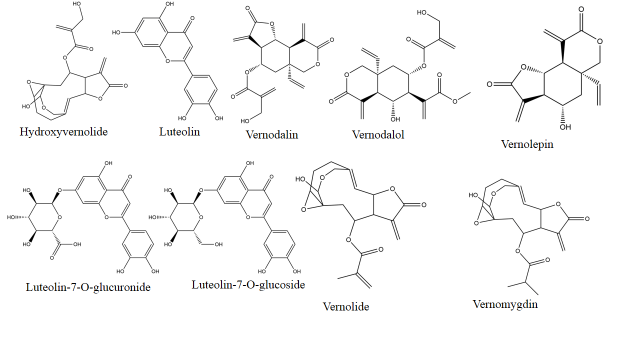
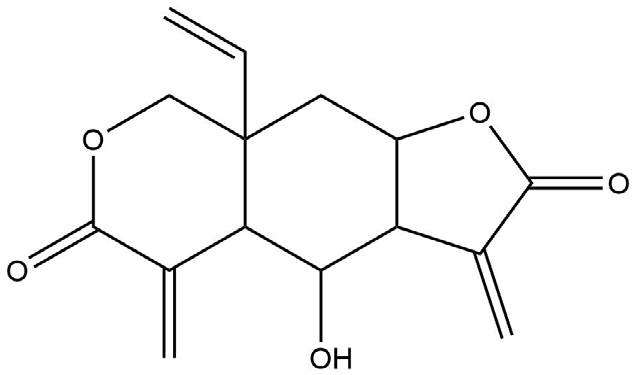
We observed that of the ten phytochemicals studied, seven showed moderate to strong binding affinities to Mpro with predicted binding energies of less than -7.0 kcal/mol. Furthermore, as shown in Figures 2 and 3, the binding of a number of the phytochemicals in each case was to at least one of the two amino acids forming the catalytic dyad of Mpro, indicating that the Mpro catalytic site was involved.
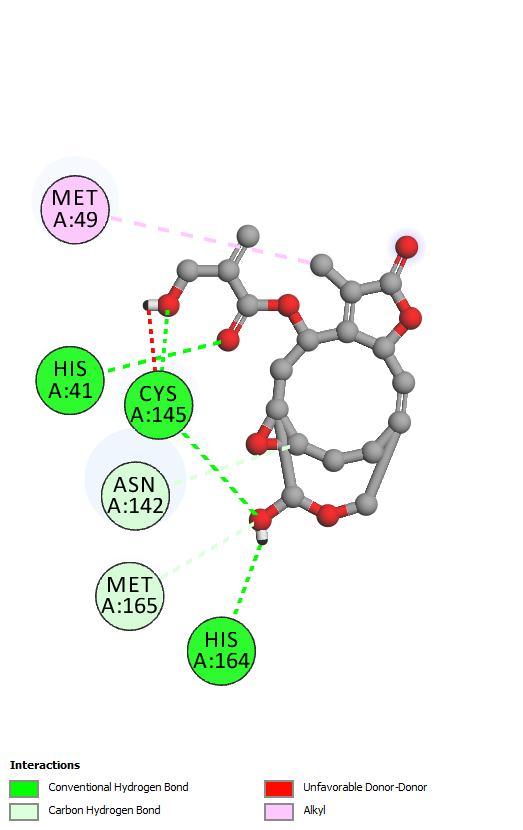
The highest binding affinity was shown by luteolin-7-O- glucuronide with a predicted binding energy (ΔG) of -8.7 kcal/ mol; interestingly, the antiviral drug lopinavir showed a low predicted binding energy of -8.2, which was lower than the other phytochemicals except for luteolin-7-O-glucuronide. The interaction of hydroxyvernolide and luteolin with Mpro is shown in Figure 2.
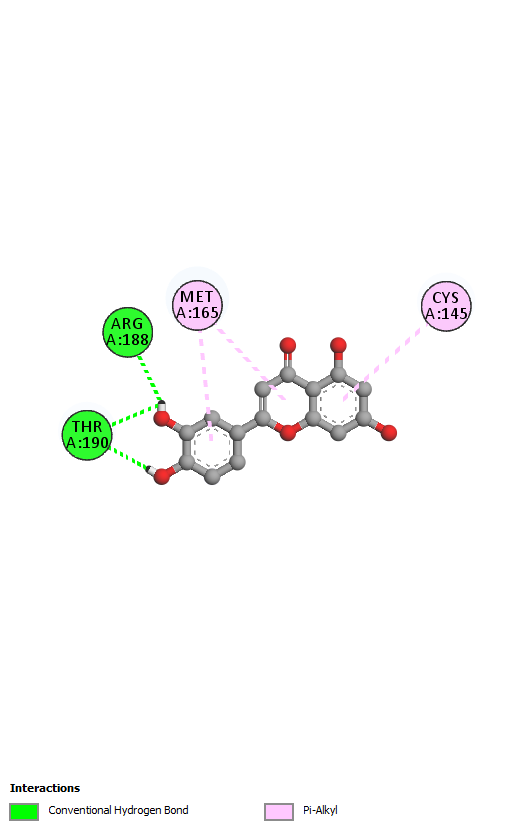
Hydroxyvernolide interacts with both amino acid residues His41 and Cys145 of the catalytic dyad of Mpro besides interacting with amino acid residues Asn142, His164 and Met165 in domain II of Mpro. Luteolin interacts with amino acid residues Cys145 (one of the catalytic dyad amino acids), as well as domain II amino acid Met165 and linker loop amino acids Arg188 and Thr190 between domains II and III. Interaction with both Cys145 and linker loop amino acids can disrupt both catalytic activity and modify active site accessibility as observed before with other proteins [27].
The interaction of luteolin-7-O-glucuronide with Mpro is shown in Figure 3 (left) and that of luteolin-7-O-glucoside on the right. Besides the catalytic dyad amino acids His 41 and Cys145, luteolin-7-O-glucuronide interacts with five other amino acid residues in domain I (Thr24, Thr25, Thr26, Cys44 and Ser46), domain II amino acids Gly143 and Met165, and domain II-III linker loop amino acid residue Gln189. The interacting residues of inhibitor N3 with Mpro amino acids have been shown to include His41, Met49, Phe140, Leu141, Asn142, Gly143, His163, His164, Glu166, Leu167, Pro168, Gln189, Thr190, and Ala191, the last three being linker loop
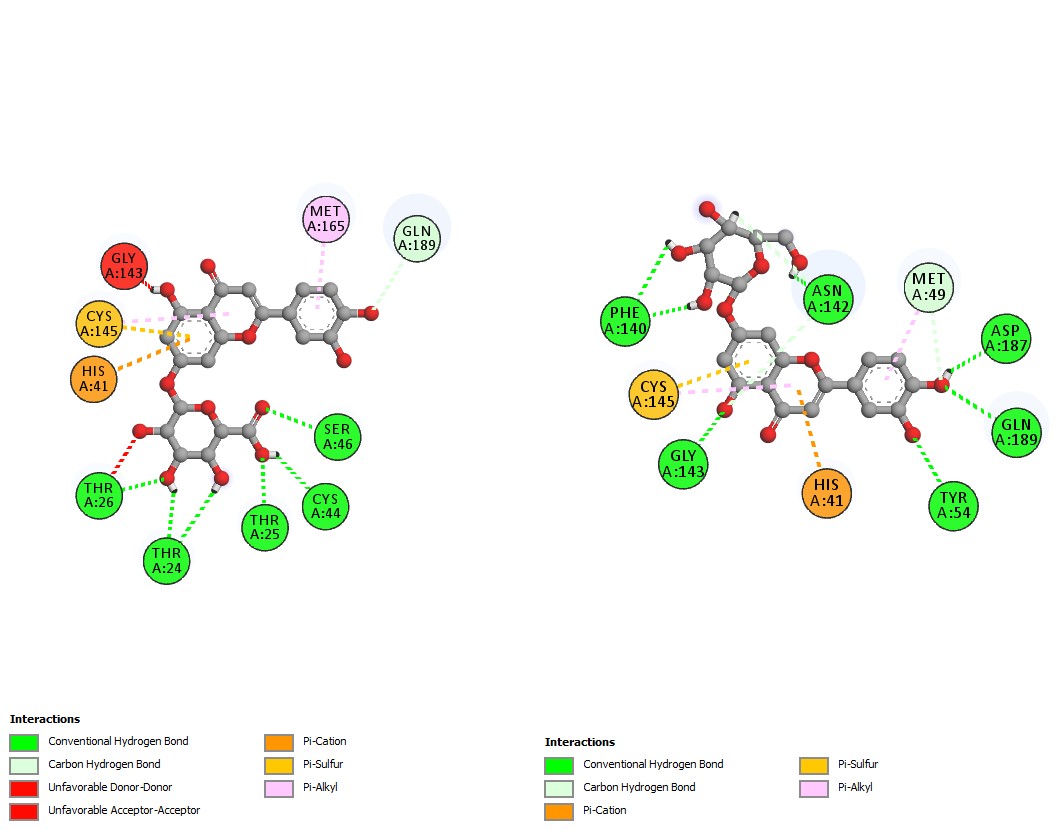
amino acids. Gly143 and Gln189 of Mpro are common amino acids binding to both N3 and luteolin-7-O-glucuronide. At the same time, the common amino acid residues of Mpro interacting with both N3 and luteolin-7-O-glucoside are His41, Met49, Phe140, Asn142, Gly143, and Gln189. The results would suggest that both luteolin-7-O-glucuronide and luteolin-7-O-glucoside can be potentially strong inhibitors of Mpro.
Various phytoconstituents of Vernonia amygdalina have also been reported in silico studies to bind to and be potential inhibitors of Mpro. These constituents include vernodaline, vernolide, hydroxyvernolide, 1,5-dicaffeoyl- quinic acid, chlorogenic acid, and luteolin-7-O-glucoside [28]. The present study indicates a similar finding that a number of Vernonia amygdalina phytochemicals can be potential inhibitors of Mpro.
Lipinski’ Rule of 5 (Ro5) was used to determine the potential of the phytochemicals as possible drugs. The results are shown in Table 2. The rule states that molecules, which are poorly absorbed by intestinal wall (that is oral bioavailability is not good) would present any two or more of these characteristics: molecular weight more than 500, lipophilicity (log P ˃5), hydrogen-bond (HB) donor groups (expressed as the sum of OHs and NHs groups) more than 5, more than 10 HB acceptor groups (expressed as the sum of Os and Ns atoms), and molar refractivity outside a range of 40-130. The two phytochemicals of Vernonia amygdalina with the highest binding abilities showed 2 violations each of Lipinski’s Ro5. However, Lipinski’s rule has its violations and it may be mentioned that a number of drugs (like artovastatin and montelucast) have more than two violations of the rule [25].
| Compounds Name | Molecular weight | Number of H-Bond Acceptors | Number of H-Bond Donors | Log P | Molar Refractivity | Number of Violation |
|---|---|---|---|---|---|---|
| Hydroxyvernolide | 378.37 | 8 | 2 | 1.53 | 90.67 | 0 |
| Luteolin 7-O-glucuronide | 462.36 | 12 | 7 | 1.55 | 108.74 | 2 |
| Luteolin 7-O-β-glucoside | 448.38 | 11 | 7 | 1.83 | 108.13 | 2 |
| Luteolin | 286.24 | 6 | 4 | 1.86 | 76.01 | 0 |
| Vernodalin | 360.36 | 7 | 1 | 2.16 | 89.97 | 0 |
| Vernodalol | 392.4 | 8 | 2 | 2.66 | 98.05 | 0 |
| Vernolepin | 276.28 | 5 | 1 | 1.72 | 69.93 | 0 |
| Vernolide | 362.37 | 7 | 1 | 2.45 | 89.51 | 0 |
| Vernomenin | 276.28 | 5 | 1 | 1.77 | 69.93 | 0 |
| Vernomygdin | 364.39 | 7 | 1 | 2.36 | 89.98 | 0 |
| Lopinavir | 628.8 | 5 | 4 | 3.44 | 187.92 | 2 |
Table 2: Physico-chemical properties of phytochemicals of Vernonia amygdalina.
Luteolin, luteolin-7-O-glucuronide, and luteolin-7-O- glucoside interacts with linker loop amino acid residues of Mpro. The linker loop region containing the amino acids between domain II and III have been hypothesized should be the dominant target for any drug discovery against COVID-19 Bzówka M, et al. [29], because this region contribute to the dimer formation, which is the active state for Mpro. Luteolin is a plant-derived flavonoid, which has been reported previously to bind to and inhibit various SARS-CoV-2 targets, the chief among them being the papain-like protease of the virus.
There may arise a question related to the phytochemicals (luteolin and derivatives) and the antiviral drug lopinavir, used as control in the present study. The question relates to the lesser binding energy of lopinavir (that is higher binding affinity) to Mpro compared to luteolin and luteolin-7-O-glucoside, but not 7-O-glucuronide (Table 1). However, luteolin has zero violations versus lopinavir (with 2 violations), luteolin-7-O-glucoside, and luteolin-7- O-glucuronide with two violations each of Lipinski’s Ro5, making luteolin more available following oral administration. In addition, lopinavir is effective only when administered with ritonavir (another antiviral drug) and may cause hepatic impairment, hemophilia, pancreatitis, and other autoimmune disorders [30, 31]. Taken together, the in silico studies suggest that luteolin may be a better candidate as an inhibitor and therapeutic for SARS-CoV-2. It is further to be taken into account that luteolin is present in a number of edible plant items like celery, peppers, carrots, peppermint, olive oil, thyme, oregano and rosemary which makes the compound readily available and affordable to a much wider section of the population than vaccines or current antiviral drugs [32].
Summary and Conclusion
A number of phytochemicals of the plant Vernonia amygdalina were seen in silico (molecular docking) studies to possess moderate to high binding affinities to the main protease Mpro of SARS-CoV-2, making them suitable for further antiviral studies as therapeutics for COVID-19.
Acknowledgements
The study was funded by the authors.
Conflicts of interest
The authors declare that they have no conflicts of interest
References
-
Costa GDV, Moreli ML, Saivish MV (2020) The emergence of SARS, MERS and novel SARS-2 coronaviruses in the 21st century. Arch Virol 165(7): 1517-1526.
-
Smith T, Bushek J, LeClaire A, Prosser T (2020) COVID-19 drug therapy, Elsevier.
-
Meo SA, Bukhari IA, Akram J, Meo AS, Klonoff DC, et al. (2021) COVID-19 vaccines: comparison of biological, pharmacological characteristics and adverse effects of Pfizer/BioNTech and Moderna vaccines. Eur Rev Med Pharmacol Sci 25(3): 1663-1669.
-
Tobaiqy M, Elkout H, MacLure K (2021) Analysis of thrombotic adverse reactions of COVID-19 AstraZeneca vaccine reported to Eudra Vigilance database. Vaccines 9(4): 393.
-
(2021) What are the side effects of the Johnson & Johnson vaccine?
-
Jeong M (2021) Sputnik V COVID-19 vaccine: How much do we know about its side effects? Medical News Today.
-
Jeong M (2021) Sinovac COVID-19 vaccine: What are the side effects?
-
Prajapati S, Narasimha KGV (2020) Assumption of Herd Immunity against COVID-19: A plausibility and hope or a terrible thought in modern-day to save the life. J Infect Dis Epidemiol 6: 147.
-
(2021) Current World Population.
-
Kerr JR, Freeman ALJ, Marteau TM, van der Linden S (2021) Effect of information about COVID-19 vaccine effectiveness and side effects on behavioral intentions: two online experiments. Vaccines 9(4): 379.
-
Gupta RK (2021) Will SARS-CoV-2 variants of concern affect the promise of vaccines? Nat Rev Immunol 21(6): 340-341.
-
Alara OR, Abdurahman NH, Mudalip SKA, Olalere OA (2017) Phytochemical and pharmacological properties of Vernonia amygdalina: A review. J Chem Eng Ind Biotechnol 2: 80-96.
-
(2004) Plant Resources of Tropical Africa, PROTA, _Vernonia amygdalina_ Delile.
-
Im E, Ae A, Bn U, Po U (2016) Immuno-modulatory properties of prebiotics extracted from Vernonia amygdalina. Afr J Tradit Complement Altern Med 13(6): 11-17.
-
Rahman N, Basharat Z, Yousuf M, Castaldo G, Rastrelli L, et al. (2020) Virtual screening of natural products against type II transmembrane serine protease (TMPRSS2), the priming agent of coronavirus 2 (SARS-COV-2). Molecules 25(10): 2271.
-
Maroyi A (2014) Alternative medicines for HIV/AIDS in resource-poor settings: insight from traditional medicines use in sub-Saharan Africa. Trop J Pharm Res 13(9): 1527-1536.
-
Hasan A, Mahamud RA, Bondhon TA, Jannat K, Rahmatullah M, et al. (2020) Can Javanicins be Potential Inhibitors of SARS-Cov-2 C-3 like Protease? An Evaluation through Molecular Docking Studies. Nat Ayurvedic Med 4(2): 1-5.
-
Hossain S, Jahan R, Hasan A, Jannat K, Rahmatullah M, et al. (2020) Spices and Plants as Home Remedies for COVID-19: A Survey in Rajbari District, Bangladesh. Nat Ayurvedic Med 4(3).
-
Liu X, Zhang B, Jin Z, Yang H, Rao Z (2020) The crystal structure of COVID-19 main protease in complex with an inhibitor N3. Biological Macromolecular Structures Enabling Breakthroughs in Research and Education.
-
Ihlenfeldt WD (2018) PubChem. In: Applied Chemoinformatics, pp: 245-258.
-
Trott O, Olson A (2010) Autodock Vina: Improving the Speed and Accuracy of Docking. J Comput Chem 31(2): 455-461.
-
Amin SkA, Banerjee S, Singh S, Qureshi IA, Gayen S, et al. (2021) First structure-activity relationship analysis of SARS-CoV-2 virus main protease (Mpro) inhibitors: an endeavor on COVID-19 drug discovery. Mol Divers, pp: 1-12.
-
Gimeno A, Truyol MJ, Montes OMJ, Macip G, Espinoza SB, et al. (2020) Prediction of novel inhibitors of the main protease (M-pro) of SARS-CoV-2 through consensus docking and drug reposition. Int J Mol Sci 21(11): 3793.
-
Studio D (2015) Dassault Systemes BIOVIA, Discovery Studio Modelling Environment, Release 4.5. Accelrys Software Inc, pp: 98-104.
-
Giménez BG, Santos MS, Marcio F, Fernandes JP (2010) Evaluation of blockbuster drugs under the Rule-of-five. Pharmazie 65(2): 148-152.
-
Rakib A, Ahmed S, Islam MA, Haye A, Uddin SMN, et al. (2020) Antipyretic and hepatoprotective potential of _Tinospora crispa_ and investigation of possible lead compounds through in silico approaches. Food Sci Nutri 8(1): 547-556.
-
Subramanian K, Mitusińska, K, Raedts J, Almourfi F, Joosten HJ, et al. (2019) Distant Non-Obvious Mutations Influence the Activity of a Hyperthermophilic Pyrococcus furiosus Phosphoglucose Isomerase. Biomolecules 9(6): 212.
-
Falang KD, Poyi CO, Ajima U, Bukar BB, Amagon KI, et al. (2020) Combinatorial evaluation of antiviral activity of some Nigerian medicinal plants on SARS-CoV-2. J Complement Alternat Med Res 12(1): 38-50.
-
Bzówka M, Mitusińska K, Raczyńska A, Samol A, Tuszyński JA, et al. (2020) Structural and evolutionary analysis indicate that the SARS-CoV-2 Mpro is a challenging target for small-molecule inhibitor design. Int J Mol Sci 21(9): 3099.
-
Ansari WA, Ahamad T, Khan MA, Khan ZA, Khan MF, et al. (2020) Luteolin: A dietary molecule as potential anti- COVID-19 agent. Research Square pre-print, pp: 2-10.
-
(2021) Kaletra, INN-lopinavir-ritonavir-European Medicines Agency, Annex I: Summary of Product Characteristics.
-
Manzoor MF, Ahmad N, Manzoor A, Kalsoom A (2017) Food based phytochemicals their derivatives, sources and medicinal benefits. Int J Agric Life Sci 3(2): 195-207.
- Management of Ear Keloid with Ksharsutra: A Case Study
- Yoga and Global Sustainability: A Holistic Path to One Earth, One Health
- Autoimmune Diseases in Ayurveda: A Narrative Review with Classical and Modern Perspectives
- Management of Cluster Headache Associated with Pituitary Apophysitis by CERT (Chakrasiddh Energy Release Technique): A Case Report on Energy Rebalancing
- Zygophyllum Geslini Coss : Biochemicals and Antioxidant Activity
- Observations of a Beginner Vaidya