
Investigation of Phytochemicals and In-vivo Antidiabetic Evaluation of Leaves and Bark of Engelhardtia Colebrookiana Lindl
Diabetes mellitus is a complex metabolic disorder resulting from either insulin insufficiency or insulin dysfunction. Diabetes mellitus affects most of the people in both developed and developing countries. The treatment of diabetes with synthetic drugs is costly and chances of side effects are high. Phytomedicine has been used since ancient times in various parts of the world where access to modern medicine is limited. Present study was designed to check the anti-diabetic activity of methanolic extract of Engelhardtia colebrookiana Lindl.. Locally known as samma or samnaon Alloxan induced diabetic rabbits. Animals were divided into five groups. Group I: In this group rabbits were considered as normal control. Group II: In this group rabbits were considered as diabetic control. Group III: In this group rabbits were given by Glucophage. Group IV: In this group rabbits were given by oral dose of 1g of methanolic extract of Engelhardtia colebrookiana’s barkper day. Group V: In this group rabbits were given oral dose of 1g of methanolic extract of Engelhardtia colebrookiana’s leaves per day. The leaves extract significantly reduces the blood glucose level and body weight along with these it was found very effective in improving serum insulin level as compared to other groups and no side effect was observed in the rabbits during treatment.
Introduction
Diabetes mellitus (DM) is a metabolically disturbed state or a condition which is characterized by persistent hyperglycemia due to disturbed metabolism of fat, carbohydrates and protein [1]. Diabetes affects both the production and action of insulin in the body of diabetic person. Insulin permits the blood sugar or blood glucose to enter in the cells of the body so that it can be utilized in the production of energy [2]. DM is caused by both hereditary and environmental factors [3]. Diabetes mellitus is clinical syndrome. Deficiency of insulin is one of the major cause of hyperglycemia. It is a global burden number of victims of diabetes are increasing day by day. Approximately 6.4% people among ages 20-79 were affected by diabetes in 2010. Its victim’s percentage will increase to 7.7% by year 2030 [4]. Another estimate shows that people affected by diabetes are 2.8% of total world population and it is predicted that this number will increase to more than 5.5% by the year 2025. Plants are the utmost part of the daily nutrition and drug either directly or indirectly. Mostly the plants have alkaloids, flavonoids, terponoids and carotenoids these compounds are beneficial in the treatment of diabetes [5]. Medicinal plants has a long history in sense of treatment of diabetes mellitus, diabetes was cured and managed by indigenous medicinal plants prior to the development of insulin injection therapy [6]. Both insulin dependent and non-insulin dependent diabetes mellitus is treated and cured by herbal plant therapy in all over the world with less and minimized side effects. Historically medicinal plants have been utilized in treating diabetes as they show hypoglycemic effects with beneficial properties in curing diabetes. Herbs with hypoglycemic properties increases insulin emission, allow the adipose and muscles cells to uptake glucose and inhibit glucose absorption from the cells of intestine. Plants show antioxidant activity and are helpful in the delay of onset of diabetes and its complication [7]. Engelhardia colebrookiana is known by a number of names like samma, and samna etc., Engelhardia is one of the genus of seven species of the family juglandaceae native to south region of East Asia from northern region of India east to Indonesia, Philippines, Tawain and Pakistan.
Materials and Methods
Sampling of Plant Part
Fresh leaves and bark of E. colebrookiana was collected from mountain of Dungi District Kotli Azad Kashmir and authenticated by the department of Botany, Mirpur University of science and technology Bhimber campus AJ&K.
Preparation of Extract
The shade dried E. colebrookianaL. Leaves and bark were powdered mechanically by using grinder and then stored in an air tight jar. Soxhlet apparatus was been used for the extraction. The extraction was passed out by hot percolation method using. The solvent used was methanol About 100 gm of powder was removed with 600 ml of methanol. The extract was concentrated to dryness under controlled temperature 40-50°C. The percentage yield was found to be 10.15%. The extract was preserved in refrigerator till further use.
Phytochemical Screening
Phytochemical analysis of methanolic extract of both bark and leaves of E. colebrookianaL. was done to check the chemicals present in it and for this qualitative analysis was done. Phytochemical analysis of tannins, saponins, flavonoids, anthraquinones and alkaloids were done according to the methods of were used [8, 9]. Test for Alkaloids: To examine the presence of alkaloids 0.5 to 0.6g of the Methanolic extract of leaves and bark of E. colebrookianaL. plant was taken and then it was mixed into eight ml of 1% HCl, It was then warmed and further on filtered.2ml of the filtrate were taken and treated them separately with both reagents (Maeyer’s and Dragendorff‘s), and it was checked if alkaloids were absent / present in turbidity or precipitate formation. Test for Saponins: To test saponins presence 0.5g of the Methanolic extract of leaves and bark of E. colebrookiana plant was dissolved carefully into boiling water by test tube. Test cooling aqueous extracts were carefully mixed and further on vigorously to froth, and height of the froth was also checked to analyze the saponin contents occurred in the sample. Then after, 2.0g of powdered plant material was taken, to boil it in distilled water by using a test tube in boiling water and furthermore it was also filtered and bath. 10ml of the filtrate was dissolved along with 5ml of distilled water and it was shaken vigorously to the formation of stable persistent froth. Three drops of olive oil was taken and the frothing was mixed with then it was shaken vigorously for the formation of emulsion thus a characteristic of saponins. Anthraquinones Test: Anthraquinones test was done by using 1.0g of Methanolic plant extract was boiled into 6 ml of 1% HCl it was filtered. Filtrate was shaken well along with 5ml ofbenzene and then after, the layer of benzene was carefully removed. 10% NH4OH was added and the colour in the alkaline phase was observed. Formation of pink/violet or red colour indicated the presence of anthraquinones. Coumarins Test: To examine the presence of coumarins, 0.5g of the moistened Methanolic extract of both in a test tube, leaves and bark of E. colebrookiana plant was taken and then after, the mouth of tube was shielded with filter paper by treating it with the usage of 1m NaOH solution. Test tube was placed for few minutes in boiling water and then the filter paper was removed carefully and then it was examined under the UV light, for yellow fluorescence indicated the presence of coumarins. Sterols and Terpenes Test: For the presence of sterol and terpenoids a combined test is performed in which 0.5g of Methanolic extract of leaves and bark of E. colebrookiana plant was shaken along with petroleum ether to remove the colouring material. Residue was extracted carefully with 10ml chloroform and moreover chloroform layer was dried with anhydrous sodium sulphate. 5ml of chloroform layer was added to mix with 0.25ml of acetic anhydride and then two drops of concentrated sulphuric acid was added. Different colours were observed to indicate the presence of sterol or terpenes. Green colour was the indication of the presence of sterols while pink to purple colour was indication for terpenes and triterpenes respectively. Steroids Test: Presence of steroids is indicated when 0.5g of the Methanolic extract of leaves and bark of E. colebrookiana segment of plant was taken to mix with 2ml of acetic anhydride followed by 2ml of sulphuric acid respectively. The colour change appearance from violet to blue or green in sample was the indication of steroids. Terpenoids Test (Salkowski Test): Salkowski test was performed to check the terpenoids presence. 0.5ml of Methanolic extract of leaves and bark of plant was mixed in 2ml of chloroform which further on followed by the addition of 3ml concentrated (H2SO4). A layer of the reddish brown coloration was formed at the interface which was indication of a positive result for the terpenoids presence. Flavonoids Test: To check the presence of flavonoids 0.5g of the Methanolic extract of plant was shaken with petroleum ether to remove the fatty materials (lipid layer). The defatted residue was dissolved in 20 ml of 80% ethanol and filtered. The filtrate was used for the following tests (a) 3ml of the filtrate was mixed with 4ml of 1% potassium hydroxide in a test tube and the colour was observed. A dark yellow colour indicated the presence of flavonoids. (b) Some drops of 1% aluminium solution were added to the portion of each filtrate and a yellow colour appearance was observed, which was the indication of flavonoids presence. Tannins Test: Tannins are checked by mixing 25g of the methanolic extract of leaves and bark of E. colebrookiana extract in 10ml distilled water and then after it was filtered. 1% aqueous Iron chloride (FeCl3) solution was carefully added to the filtrate. The appearance of intense green, purple, blue or black color indicated the presence of tannins in the test samples. About 0.5g of extract was added in 10ml of water in a test tube and then it was filtered to check tannins. A few drops of 0.1% ferric chloride was added and observed for brownish green or blue-black coloration. Phlobatannins Test: Aqueous fraction of the methanolic extract of leaves and bark of E. colebrookiana was taken and it was boiled with 1% aqueous hydrochloric acid, which resulted in the formation of red precipitate and it was indication of the presence of phlobatannins. Cardiac glycosides Test (Keller-Killani Test): Keller- Killani test is performed for cardiac glycosides by using the5ml of plant ethanolic extract, and it was slowly mixed with 2 ml of glacial acetic acid which contains one drop of ferric chloride (FeCl3) solution, followed by the addition of 1 ml concentrated sulphuric acid respectively. Brown ring formation was observed at the interface which was the sign of the presence of deoxy sugar of cardenoloides. A violet ring may appear beneath the brown ring, while in the acetic acid layer, a greenish ring also formed gradually throughout the layer.
Antidiabetic Activity
Experimental animal
Female domestic rabbits (Oryctolagus cuniculus) weighing approximately 1-1.5Kg were used in this research and they were carried in the lab one week before to the start of research in order to reduce the strain effect. During whole research they were fed with bottle green vegetables, grains and Cynodondactylon. Induction of Diabetes in Rabbits
Optimization of Dose
Initially different doses of Alloxan were given to make the rabbits diabetic. For this purpose animals were divided into four groups. First group was given a dose of 60mg second was given a dose of 75mg, third was given a dose of 90m and the fourth was given a dose of 105mg. None of the rabbit from first group become diabetic. Only one rabbit from the second group treated with 70mg dose become diabetic. 80% rabbits died belonging to fourth group, which is treated with 100mg dose of Alloxan. All rabbits of third group which is treated with 85mg dose of Alloxan. This dose was also proved effective by Alam, et al. [10]. So dose was given in the ratio of 85mg by weight and this dose was proved very effective.
Alloxan Induction
Alloxan monohydrate was injected intravenously to the rabbits after 12 hour fasting and the procedure followed for it was as given by Akhtar, et al. [11]. Rabbits were held properly but before injecting Alloxan lignocane were applied on their ear and xylene was also applied on their ear which made their veins more prominent. Required dose of Alloxan was mixed in the measured volume of saline solution and without wasting a single minute it was injected in the marginal ear vein of rabbit with the help of 3cc. syringe. Before induction of Alloxan, 2 grams of glucose was dissolved in 10 cc. of distilled water was given orally to every rabbit in order to avoid the hypoglycemic attack. Dose of Alloxan was selected very carefully depending not only upon the weight of rabbits but also general health condition of rabbits. Required dose was dissolved in saline solution in order to make 5% Alloxan solution. After eighth day of administration of dose their blood glucose level was checked with the help of glucometer.
The phytochemicals existing in plant extract were recognized with diverse reagents. The results indicated that alkaloids, sterols, steroids, terpenoids, including tannins, flavonoids, phlobatannins and cardiac glycosides were present while anthraquinones, saponin and cumarins were absent in the bark extract of E. colebrookiana. While results indicated that alkaloids, sterols, steroids, terpenoids, flavonoids, tannins, phlobatannins and cardiac glycosides were present while anthrquinones, saponin, tanin and cumarins were absent in the extract of E. colebrookiana as shown in Table 1.
Treatment of Diabetes
Experimental Design
Experimental animals (Oryctolagus cuniculus) were divided into five groups. Group I: In this group five rabbits were present and they were considered as normal control. Group II: This group consists of five rabbits and was considered as diabetic control. Group III: These groups consists of five rabbits and were given Glucophage which is most commonly used for diabetic patient. Group IV: These groups consists of five rabbits and were given oral dose of 1g of methanolic extract of Engelhardia colebrookiana’s bark per day. Group V: In this group five rabbits were present and they were given oral dose of 1g of methanolic extract of Engelhardia colebrookiana’s leaves per day.
Procedure Followed
After making the rabbits diabetic they were given the decided doses of methanolic extract of leaves and bark of Engelhardia colebrookiana extract and these doses were 1mg each. Total duration of experimental work is 15 days and during these day different analysis were done. Their diabetes was checked after every 3 days. On 7th day and 15th day their blood samples were collected and sent for their serum insulin test from Armed Forces Institute of Pathology (AFIP). On 15th day they were finally slaughtered and their pancreas was separated.
Statistical analysis
Statistical analysis was done and all results of experiment were evaluated by using two ways ANOVA by using software “Graph Pad prism 6”. Level of significance was considered to be 0.05.
Results and Discussion
| Observation | Presence/Absence | Presence/Absence | ||
|---|---|---|---|---|
| Constituents | Bark | Leaves | ||
| Alkaloids | Precipitation, turbidity | Precipitation, turbidity | + | + |
| Anthraquinones | No reaction | Formation of emulsion | - | - |
| Saponins | No reaction | No reaction | - | - |
| Sterols | Green colour | No reaction | + | - |
| Coumarins | Pink to purple color appear | Pink to purple color appear | - | + |
| Steroids | Green color appear | Green color appear | + | + |
| Terpenoids | Radish brown color | Radish brown color | + | + |
| Flavonoids | Yellow coloration appear | Yellow coloration appear | + | + |
| Tannins | Intense green and then black color appear | No reaction | + | - |
| Phlobatannins | Red precipitation | Red precipitation | + | + |
| Cardiac glycosides | Brown ring form | Brown ring form | + | + |
Table 2: Qualitative analysis of methanolic extract of bark and leaves of Engelhardia colebrookiana.
Present = + Absence = - Table 1: Qualitative analysis of methanolic extract of bark and leaves of Engelhardia colebrookiana. The glucouse level in blood of normal control and treatment groups were monitored at every third day by using Gluco sure Star gluco meter for 15 days to evaluate the effect of extract of _Engelhardtia colebrookiana_L. The results showed that blood glucose levels measured at day 15 of rabbits treated with leaves (T group) were145.3±0.66, rabbits treated with1g of bark (T group) were 190.6±0.6rabbits treated with Glucophage (TC group) were (273.3±0.8) are significantly lower than diabetic group (509.3±0.3) as shown in Table 2 and Figure 1.
| Blood glucose level | |||||
|---|---|---|---|---|---|
| Nc | Dc | Tc | T | T' | |
| D3 | 123.3±0.8 | 494.3±0.3 | 489.6±0.8 | 470.3±0.8 | 479.6±0.3 |
| D6 | 122.3±0.3 | 486.6±0.8 | 460.6±0.6 | 422±0.5 | 350.6±0.3 |
| D9 | 118±0.5 | 502.3±0.6 | 400.6±0.8 | 334.3±0.8 | 281±0.5 |
| D12 | 120.3±0.3 | 506±0.5 | 347.3±0.6 | 263.6±0.8 | 198.3±0.3 |
| D15 | 119±0.57 | 509.3±0.3 | 273.3±0.8 | 190.6±0.6 | 145.3±0.6 |
Table 3: Effect of methanolic extract of Engelhardtia colebrookiana’s leaves on Blood Glucose Level of Oryctolagus Table 2: Effec
Table 2: Effect of methanolic extract of Engelhardtia colebrookiana’s leaves on Blood Glucose Level of Oryctolagus Table 2: Effect of methanolic extract of Engelhardtia colebrookiana’_s leaves on Blood Glucose Level of _Oryctolagus cuniculus: 3 is the first treatment day and 15 is the last blood glucose checking day. Normal control (Nc) Diabetic control (Dc) Treatment control; (Tc) Treated with bark extract (T) Treated with leaves extract (T`)
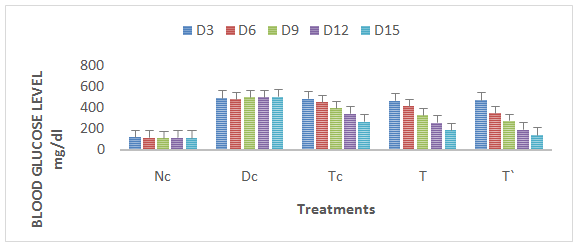
Figure1: Blood Glucose Level: 3 is the first treatment day and 15 is the last blood glucose checking day. Normal control; Nc Diabetic control; Dc Treatment control; Tc Treated with bark extract; T Treated with leaves extract T`.
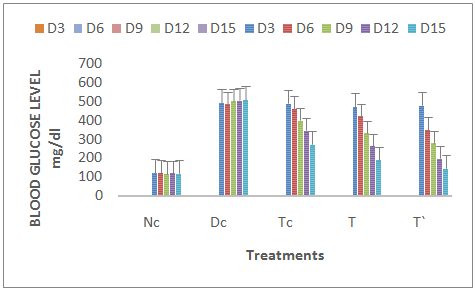
The weights of normal control and treatment groups were monitored at every third day by using digital weighing machine for 15 days to evaluate the effect of alcohlic extract of Engelhardia colebrookiana. The results showed that weights measured at day 15 of rabbits treated with 1g extract of leaves(T` group) were
1.12±0.08, rabbits treated with1g extract of bark (T group) were 1.19±0.07 and rabbits treated with Glucophage were 1.29±0.03are significantly lower than diabetic group (1.67±0.01) as shown in Table 3 and Figure 2.
| Nc | Dc | Tc | T | T' | |
| D3 | 1.48±0.003 | 1.56±0.0057 | 1.62±0.003 | 1.59±0.003 | 1.57±0.06 |
| D6 | 1.49±0.03 | 1.57±0.006 | 1.54±0.03 | 1.5±0.005 | 1.47±0.06 |
| D9 | 1.45±0.08 | 1.62±0.005 | 1.44±0.05 | 1.44±0.05 | 1.40±0.03 |
| D12 | 1.46±0.08 | 1.66±0.003 | 1.38±0.03 | 1.32±0.03 | 1.24±0.08 |
| D15 | 1.47±0.03 | 1.67±0.01 | 1.29±0.03 | 1.19±0.07 | 1.12±0.08 |
Table 4: Weight of rabbits: 3 is the first treatment day and 15 is the last weight measuring day.
with 1g extract of leaves (T`group) were 4.93±0.08 and rabbits treated with1g extract of bark (T group) were 3.23±0.08and rabbits treated with Glucophage were 1.43±0.12are significantly higher than diabetic group (0.1±0.06) as shown in Table 4 and Figure 3.
| N | D | TC | T | T' | |
| D7 | 9.13±0.57 | 0.07±0.06 | 1.53±0.08 | 2.33±0.03 | 4.2±0.12 |
| D15 | 9.03±0.66 | 0.1±0.06 | 1.43±0.12 | 3.23±0.08 | 4.93±0.08 |
Table 5: Blood Serum Insulin Level: D7 is the first checking day of serum insulin and D15 is the second day of checking Table 4:
Table 4: Blood Serum Insulin Level: D7 is the first checking day of serum insulin and D15 is the second day of checking Table 4: Blood Serum Insulin Level: D7 is the first checking day of serum insulin and D15 is the second day of checking serum insulin of rabbits. Normal control: Nc; Diabetic control: Dc; Treatment control: Tc; Treated with bark extract; T: Treated with leaves extract T`.
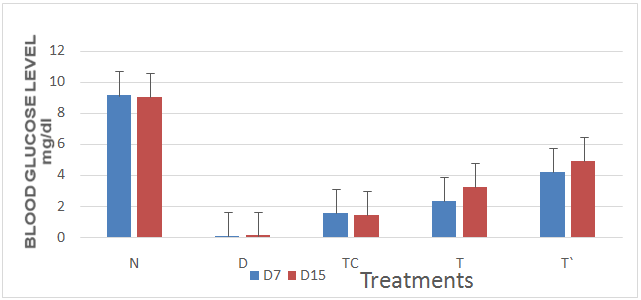
The present study was conducted to find that which part of Engelhardtia colebrookiana L. was more effective against diabetes. After careful experiment, different results were found with different treatments. The methanolic extract of leaves was more effective than Glucophage and methanolic extract of bark. To get more accurate findings the measurement of blood glucose level was taken three times after 3 days, 6 days, 9 days, 12 days and 15 days. When blood glucose levels measured at day 15 of rabbits treated with leaves (T` group) were145.3±0.66 , rabbits treated with1g of bark (T group) were 190.6±0.6rabbits treated with Glucophage (TC group) were (273.3±0.8) are significantly lower than diabetic group (509.3±0.3). Similarly when weight was measured at day 15 of rabbits treated with 1g extract of leaves(T` group) were 1.12±0.08, rabbits treated with1g extract of bark (T group) were 1.19±0.07 and rabbits treated with Glucophage were 1.29±0.03are significantly lower than diabetic group (1.67±0.01). Similarly when serium insulin level was measured at day 15 rabbits treated with 1g extract of leaves (T`group) were 4.93±0.08and rabbits treated with1g extract of bark (T group) were 3.23±0.08and rabbits treated with Glucophage were 1.43±0.12are significantly higher than diabetic group (0.1±0.06).
Many studies showed that blood glucose level is associated with cells and insulin level also depends upon these cells. In Alloxan diabetic rabbits this level decreased due to destruction of cells. With the use of compound recipe of plants improvement of blood glucose and serum insulin level was observed by the slowly improvement of cells [6].
Conclusion
It can be concluded from above discussion that the use of methanolic extract of leaves of Engelhardtia colebrookiana_L. is very effective against diabetes as compared to use of methanolic extract of bark and most commonly used medicine in world glucophage. It was also proved correct by the results of the phytochemical analysis of methanolic extract of leaves and bark of _Engelhadtia colebrookiana L. All those compounds are present in it, which are effective remedy of diabetes like alkaloids, saponins, sterols, steroid, terpenoids, flavonoids, tannins, phlobatannins and cardiac glycosides. Its leaves extract reduces the blood glucose level and body weight along with these it was found very effective in improving serum insulin level and no side effect was observed in the rabbits during treatment. Its continuous use can repair the beta cells of pancreas and one can enjoy a healthy life. As we know that patients of diabetes are increasing day by day and many side effects of allopathic medicines are in common observation. So it is highly suggested that instead of using allopathic medicines and insulin injections. One should use this shrub for long time without any side effect. Its continuous use confidently improves the condition of a diabetic patient.
References
-
Kumar PJ, Clark M (2002) Textbook of Clinical Medicine. Pub: Saunders (London) 1099-1121.
-
Vankudri NR (2010) A Thesis on Phytochemical investigation and pharmacological evalution of the Argyreiacuneata leaves for antidiabetic activity.
-
Harrison LC, Honeyman MC (1999) Cow's milk and type 1 diabetes: the real debate is about mucosal immune function. Diabetes 48(8): 1501-1507.
-
Shaw JE, Sicree RA, Zimment PZ (2010) Global estimate of the prevalence of diabetes for 2010 and 2030. Diabetes Res Clin Pract 87(1): 4-14.
-
Patel DK, Prasad SK, Kumar R, Hemalatha S (2012) An overview on antidiabetic medicinal plants having insulin mimetic property. Asian Pacific J Tropical Biomed 2(4): 320-330.
-
Wadood N, Nisar M, Rashid A, Wadood A, Nawab G, et al. (2007) Effect of a compound recipe (medicinal plants) on serum insulin levels of alloxan induced diabetic rabbits. J Ayub Med Coll Abbott 19 (1): 32-38.
-
Kavishankar GB, Lakshidevi N, Murthy SM, Prakash HS, Niranjana SR (2011) Diabetes and medicinal plants: an overview. Int J Pharm Biomed Sci 2(3): 65- 80.
-
Sofowora A (2006) Medicinal Plants and Traditional Medicines in Africa. 2nd (Edn.), Spectrum Books Ltd., Ibadon, Nigeria, pp: 151-153, 209-214.
-
Harborne JB (1991) Phytochemical Methods, A Guide to Modern Techniques of Plant Analysis, Chapman and Hall, London, pp: 176-201.
-
Alam MA, Haque ME (2006) Anticociceptive effect of the crude ethanolic extract of Cratevanurvalabuch on mice. Bangl J Vet Med 4: 65-68.
-
Akhtar MS (1992) Hypoglycaemic activities of some indigenous medicinal plants traditionally used as antidiabetic drugs. J Pak Med Assoc 42(11): 271-277.
-
Wild S, Roglic G, Green A (2004) Globsal prevalence of diabetes mellitus; Estimates for year 2000 and projections for 2030. Diabetes Care 27(5): 1047- 1053.
-
Raman A, Lau C (1996) Anti-diabetic properties and phytochemistry of Momordica charantia L. (Cucurbitaceae). Phytomedicine 2(4): 349-362.
-
Okwu DE, Josiah C (2006) Evaluation of the chemical composition of two Nigerian medicinal plants. Afr J Biotechnol 5(4): 357-361.
-
Aiyelaagbe OO, Osamudiamen PM (2009) Phytochemical screening for active compounds in Mangiferaindica leaves from Ibadan, Oyo State. Plant Sci Res 2(1): 11-13.
-
Cousens G (2008) There is a cure for diabetes: The Tree of Life 21 day program. California: North Atlantic Books, pp: 191-192.
- Psychogenic Erectile Dysfunction in Late Adulthood: A Case Report on Clinical Intervention and Intimacy Restoration
- Clinical Trials on COVID-19 in 2025: A New Chapter in Global Health Research
- Innovations and Challenges in Contemporary Medical Clinical Trials: An Editorial Perspective
- Innovations and Challenges in Contemporary Medical Clinical Trials: A Critical Perspective
- Reimagining Clinical Trials: The Power of Continuous Feedback from Medical Reports
- Factors Influencing Brain Drain: Perspectives from a Medical School in Turkey