
Iodine: An Essential Trace Element
Iodineisan important trace element for health. This element is found in nature, mostly in the marine environment, where it accumulates in marine organisms. The diet is the main source of iodine, being foods of marineorig in such as seaweed or Shellfish Theater presents a greater dietary contribution. A deficit intake of this element can lead to serious effects such as hypothyroidism, goiter or cretinism. However, excessive intake of this element may result in hyperthyroidism, thyroid cancer, among other effects. The new trends in food have caused an increase in the consumption of food, as these are one of the most important sources of iodine can pose to health risk, in cases of excessive consumption of algae.
Introduction
Iodine (I) with a molecular weight of 126.9 g/mol is a non-metal belonging to the group of halogens. As an element of high electro negativity, it is widely distributed in nature, especially its concentrations in the marine environment, where it can reach levels around 50 - 60 μg/L of sea water [1]. It can be found in three different ionic forms due to its oxidation states. The most frequent one in marine waters is iodide (I-) whose oxidation state is 1-, generally, it is found forming salts such as potassium iodide (KI) or sodium iodide (NaI). Also, it can be found as iodates (IO3-, IO4-), whose oxidation states are 5+ and7+.
Iodine is an essential trace element for humans [2]. This element is necessary because it is part of the hormones of the thyroid [3]. Iodine deficiency in the body can lead to serious problems such as hypothyroidism, cretinism, goiter, etc [3]. The EFSA (European Food Safety Authority) has set a recommended daily intake (RDI) of 150 μg/day for adults [4].
However, excess iodine can cause both hypothyroidism and hyperthyroidism. Likewise, the American institution Institute of Medicine has established a value of admissible daily intake (ADI) of 1100 μg/day for adults [5].
An adequate intake of iodine is necessary for the proper functioning of the thyroid gland and, therefore, to maintain normal levels of thyroid hormones. In some countries for this reason, the use of iodized salts has been resorted to in order to cover the daily iodine requirements [6, 7].
Iodine Chemistry
Iodine (I), of atomic number 53, is an element belonging to the group of halogens. Its atomic mass is 126.9 Da and its oxidation states are 1-, 1+, 3+, 5+ and 7+. It is one of the most stable elements of the group of halogens due to its low electro negativity, which is 2.66 on the Pauling scale, whose value is lower compared to fluorine which is 3.98. Like the rest of the elements belonging to the group of halogens, iodine is found as a diatomic molecule, I2. However, unlike the other halogens, iodine can be in the solid state, but it is volatile at room temperature. The electronic configuration of iodine is [Kr] 4d105s25p5. This configuration allows you to capture an electron to form a stable structure, for that reason, iodine tends to gain an electron [8].
Iodine Sources
Natural Sources
The release of iodine in the environment comes, mainly, from the leaching of soils. Soils and rocks of volcanic origin have higher iodine content [4]. When the leaching of soils and rocks occurs in marine sediments, the released iodine accumulates in marine organisms. The minerals in which iodine is found are iodargirite (AgI), marshite (CuI), bellingerite (Cu (IO3)2·2H2O), among others [9]. Anthropogenic Sources No anthropogenic sources are known of iodine [10]. Environmental pollution due to high iodine content is practically nonexistent. Mainly, this element is used in the pharmaceutical industry, photography and dyes. However, if it is known the environmental repercussion derived from the use of isotopes of iodine, especially iodine-129, whose half-life is 16 million years. Iodine-129 is a major environmental pollutant [11]. Its continued use since 1940 has caused a dangerous increase of this isotope in the environment, with a greater accumulation in surface and groundwater [12, 13].
Distribution of iodine in the Environment
Iodine is found in the earth's crust at a concentration of approximately 0.14 mg/kg. While, the concentration of this element in the seawater is around 0.052 mg/L.
Iodine cycle in nature
As for the iodine cycle in nature, it is found naturally in the marine environment. The iodine is found in the marine soils as IO3-, where is absorbed by the phytoplankton and reduced to I-. Then, the iodide is absorbed by seaweeds and transformed to I2. Finally, is evaporated in the form of organic compounds of molecular iodine (I2), which are then deposited in a terrestrial environment with rain.
Dietary sources of iodine
The main source of iodine is diet, with marine-based foods such as algae or seafood, which have the highest levels in this element [14, 15]. In addition, cases of hyperthyroidism associated with high algae consumption have been detected [16].
Table 1 shows the average concentrations of iodine found in different types of food by Leufroy, et al. [17]. Shellfish and seaweed is the food group with the highest mean content of iodine which is normal because seawater contains the highest iodine levels.
Considering the iodine concentrations, the intake of seaweeds will contribute greatly to the recommended daily intake of iodine.
| Number of samples | Iodine concentration (mg/kg dry weight) | Reference | |
|---|---|---|---|
| Fruits | 34 | 0.014 | [17] |
| Green vegetables | 11 | 0.427 | [17] |
| Shellfish | 9 | 46.2 | [17] |
| Fish | 41 | 1.57 | [17] |
| Seaweed (Kombu) | - | 394 | [18] |
| Seaweed (Wakame) | - | 14 | [18] |
Table 1: Iodine concentrations (mg/kg) in different food groups
Metabolism
Iodine, once ingested, is reduced in the intestine to iodide. Iodide is absorbed almost entirely by the small intestine. The absorption of iodide is around 90% of the total ingested [4]. Once absorbed, it passes into the blood and is distributed through the tissues, accumulating in the thyroid glands, mostly. In healthy adults, with normal levels of iodine in the body, most of the ingested iodine is excreted with urine.
Importance in the Human Organism
Iodine is an essential element for the human being because it is part of the thyroid hormones (Figure 1) [16].
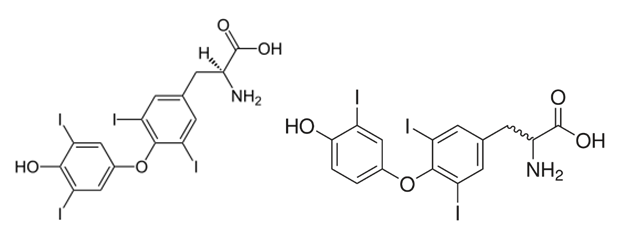
A deficient iodine intake can cause serious problems such as hypothyroidism, cretinism, among others [3]. For this reason, various organizations such as the American institution "Institute of Medicine" or the European Food Safety Agency have set guide values for recommended daily intake of iodine, being 150 μg/day for adults [4, 5].
The deficient iodine intake is a health public concern in certain areas of Europe. A solution to this problem is the fortification of some food with iodine as for example, the iodization of table salt.
However, excessive intake of iodine can produce an inhibition of the synthesis of thyroid hormones, as happens in cases of iodine deficiency. Also, it can lead to an excessive secretion of thyroid hormones, causing hyperthyroidism, goiter, hyperactivity, tachycardia, thyroid cancer, etc [19, 20, 21].
Conclusions
Iodine is an essential element necessary for the proper functioning of the thyroid. However, some diets such as vegans or vegetarians, based on the consumption of products such as algae, can pose a health risk due to a high intake of this element. It is necessary greater control in the levels of iodine in food from the sea to avoid high intakes.
References
-
Hetzel BS, Maberly GF (1986) Iodine. Mertz, Weds. Trace Element in Human and Animal Nutrition Academic Press Inc Orlando.
-
Zimmermann MB (2011) The role of iodine in human growth and development. Semin Cell Dev Biol 22(6): 645-652.
-
Shelor CP, Campbell CA, Kroll M, Dasgupta PK, Smith TL, et al. (2011) Fenton Digestion of Milk for Iodine analysis. Anal Chem 83(21): 8300-8307.
-
EFSA (European Food Safety Authority) (2014) Scientific Opinion on Dietary Reference Values for iodine. EFSA J 12(5): 3660.
-
IOM (Institute of Medicine) (2001) Food and Nutrition Board of the Institute of Medicine of the National Academies. Dietary Reference Intakes for Vitamin A, Vitamin K, Arsenic, Boron, Chromium, Copper, Iodine, Iron, Manganese, Molybdenum, Nickel, Silicon, Vanadium, and Zinc. National Academy Press, Washington, USA.
-
Melse Boonstra A, Jaiswal N (2010) Iodine deficiency in pregnancy, infancy and childhood and its consequences for brain development. Best Pract Res Clin Endocrinol Metab 24(1): 29-38.
-
Wisnu C (2008) Determination of iodine species content in iodized salt and foodstuff during cooking. Int Food Res J 15(3): 325-330.
-
Fuge R, Johnson CC (2015) Iodine and human health, the role of environmental geochemistry and diet, a review. Appl Geochem 63: 282-302.
-
Railsback LB (2003) An Earth Scientist’s Periodic Table of the Elements and Their Ions. Geology 31(9): 737-740.
-
Leblanc C, Colin C, Cosse A, Delage L, La Barre S, et al. (2006) Iodine transfers in the coastal marine environment: the key role of brown algae and of their vanadium-dependent haloperoxidases. Biochimie 88(11): 1773-1785.
-
Kolmykova L, Korobova E (2017) Iodine distribution in natural waters of different chemical composition in relation to water-bearing soils and rocks and water fractions in areas subjected to radioiodine contamination. EGU General Assembly Conference Abstracts 19: 1610.
-
Xing S, Hou X, Aldahan A, Possnert G, Shi K, et al. (2015) Iodine-129 in snow and seawater in the Antartic: level and source. Environ Sci Technol 49(11): 6691-6700.
-
Herod MN, Suchy M, Cornett RJ, Kieser WE, Clark ID, et al. (2015) The atmospheric transport of iodine-129 from Fukushima to British Columbia, Canada and its deposition and transport into groundwater. Water Resour Res 51(12): 9628-9645.
-
Hou X, Chai C, Qian Q, Yan X, Fan X (1997) Determination of chemical species of iodine in some seaweeds (I). Sci Total Environ 204(3): 215-221.
-
Chance R, Baker AR, Küpper FC, Hughes C, Kloareg B, et al. (2009) Release and transformations of inorganic iodine by marine macroalgae. Estuar Coast Shelf Sci 82(3): 406-414.
-
Blanco A (2006) Química Biológica. 8th (Edn.), Editorial ElAteneo.
-
Leufroy A, Nöel L, Bouisset P, Maillard S, Bernagout S, et al. (2015) Determination of total iodine in French Polynesian foods: Method validation and occurrence data. Food Chem 169: 134-140.
-
Shah M, Wuilloud RG, Kannamkumarath SS, Caruso JA (2005) Iodine speciation studies in commercially available seaweed by coupling different chromatographic techniques with UV and ICP-MS detection. J Anal At Spectrom 20: 176-182.
-
Bürgi H (2010) Iodine excess. Best Pract & Res Clin Endocrinol & Metab 24(1): 107-115.
-
Andersson M, de Benoist B, Rogers L (2010) Epidemiology of iodine deficiency: Salt iodisation and iodine status. Best Pract Res Clin Endocrinol Metab 24(1): 1-11.
-
Untoro J, Timmer A, Schultink W (2010) The challenges of iodine supplementation: a public health programme perspective. Best Pract Res Clin Endocrinol Metab 24(1): 89-99.
- Psychogenic Erectile Dysfunction in Late Adulthood: A Case Report on Clinical Intervention and Intimacy Restoration
- Clinical Trials on COVID-19 in 2025: A New Chapter in Global Health Research
- Innovations and Challenges in Contemporary Medical Clinical Trials: An Editorial Perspective
- Innovations and Challenges in Contemporary Medical Clinical Trials: A Critical Perspective
- Reimagining Clinical Trials: The Power of Continuous Feedback from Medical Reports
- Factors Influencing Brain Drain: Perspectives from a Medical School in Turkey