
Evaluation of Irradiance Issued by Different Modes of Photoactivation with and without the use of Luminous Bridge
Introduction: The process of photoactivation of the resinous materials begins when the blue light penetrates the photosensitive agent (photoinitiator). In order to attenuate the generation of stresses during the polymerization process, some studies have used different photoactivation approaches, such as low intensity in continuous light, high intensity in continuous light, photoactivation in steps (Soft-Start) and High intensity in High light. Goals: To compare the irradiance emitted by a single device in relation to the methods of photoactivation with and without the use of the transparent tip. Methods: The study was the photopolymerizer from the Dental Clinic of FCMS/SUPREMA, in one level (n = 8) – DABI ATLANTE DB 686 device and two photoactivation modes: Soft - Start and High, with and without the use of the tip. The response variable was the values of irradiance emitted after the tests with the two types of photoactivation with and without use of tip, through the measurement with radiometer Hilux LED MAX. Results: Mean values of irradiance were significantly higher when high photoactivation mode was used (p <0.05) and when no tip was used (p <0.05). Conclusion: From the results found in this study, it can be concluded that the high method presented higher values of irradiance when compared to the soft-start method.
Introduction
Currently the Dentistry is based on the adhesive principles, since the great majority of its procedures depends on this property, which is achieved mainly by the resinous materials, whether in the form of adhesive systems, resin cements, flow resins, conventional or compactable composite resins, basically changing the concentration of charges between them [1, 2].
The process of photo activation of the resinous materials begins when the blue light penetrates the photosensitive agent (photoinitiator), usually the camphorquinone, which absorbs light in the visible spectrum with maximum absorption at 468 nm. To promote the beginning of this reaction, different light sources are available in the market, such as: halogen lamp, argon laser, plasma arc light and LEDs [3, 4].
The blue light that triggers this whole photoactivation process is exteriorized from the photoactivating apparatus by means of light-conducting tips which may be fiber optic or polymer [5]. Fiber optic tips prevent light scattering by providing suitable photoactivation of the resin materials. The polymer tips that were recently introduced in the dental market have advantages in terms of cost and versatility of use [6, 7].
In order to attenuate the generation of stresses during the polymerization process, some studies have used different photoactivation approaches, such as low intensity in continuous light, high intensity in continuous light, photoactivation in steps (Soft-Start) and High intensity in High light. The main objective of these methods is to prolong the pregel phase of the dental composites, allowing longer time for the monomer flow and, consequently, the tensions generated by the polymerization contraction [8, 9].
The action of the Soft-Start method consists in prolonging the pregel phase of the dental composites, allowing a longer flow time of the monomers. This technique will promote better marginal adaptation of the restoration, due to the relaxation of the tensions occurred in the composite during the initial polymerization phase. However, in this case, the rate of exposure to light is decreased, which may interfere with the degree of polymerization of the composite and, consequently, affect the hardness of the material [10].
Mehl, et al. evaluated the mechanical properties of composite resins when activated by the "Soft-start" method, which consists of initial activations with reduced power density, finishing the polymerization with total power density [11]. Unlike the High method, where monomers are transformed into polymers uniformly and thus, they create more resistant polymer chains [10, 12].
It is important to emphasize that the composites are influenced not only by the quality of photoactivating light but also by the type of material used, including resin cement composition and inorganic material content, which is responsible for the longevity of the material in the buccal cavity [13, 14].
Due to the introduction of different types of composite resin and different polymerization techniques, this study aimed to compare the irradiance emitted by a single device in relation to the photoactivation methods with and without the use of the transparent tip.
Methods
Experimental Design
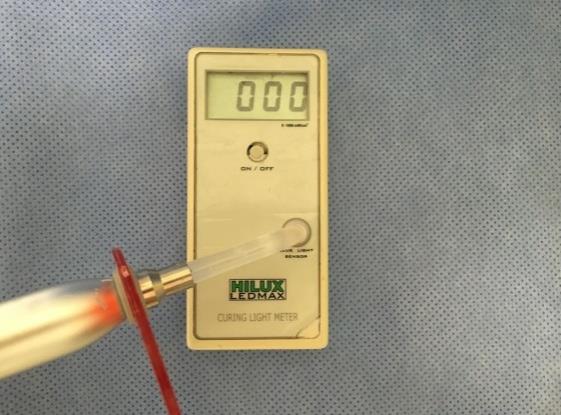
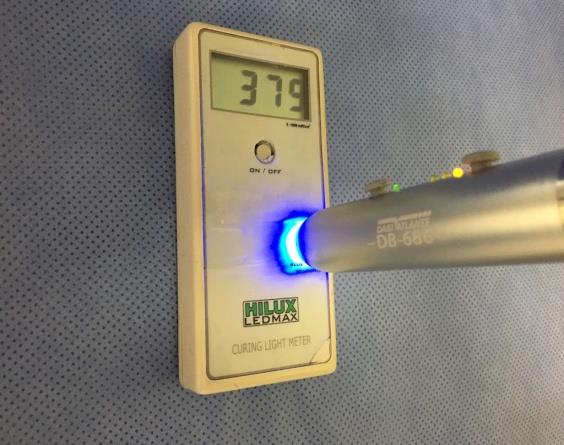
The DABI ATLANTE DB 686 device and two photoactivation modes: Soft-Start (Figure 1) and High (Figure 2), with and without the use of the nozzle tip. The response variable was the values of irradiance emitted after the tests with the two types of photoactivation with and without nozzle use, through the measurement with Hilux LED MAX radiometer (Figure 3).
Diogo de Azevedo M, et al. Evaluation of Irradiance Issued by Different Modes of Photoactivation with and without the use of Luminous Bridge. Med J Clin Trials Case Stud 2018, 2(4): 000173.
Reading the irradiance of the devices
The present in vitro study was of experimental quantitative character, whose sample, not probabilistic. All photoactivating devices come from the FCMS / SUPREMA Dental Clinic and included in this study all devices that had tips without any type of groove, breakage or any type of adhered resinous material. To read the irradiance was used the radiometer provided by the company SDI, which was calibrated every 4 readings. The first reading (Figure 1) was performed with the transparent tip directly against the radiometer sensor and after 20 seconds of flashing the device emitted the irradiance value generated for each tested photoactivation mode. The second reading (Figure 2) was performed without the transparent tip, with the hand piece directly against the radiometer sensor and after 20
Results
Methodology of Statistical Analysis
After the exploratory analysis of the data, a variance analysis (ANOVA) was applied, considering in the statistical model that the measurements were performed in the same apparatus. The analyzes were done through program R15, considering the level of significance of 5%.
Results
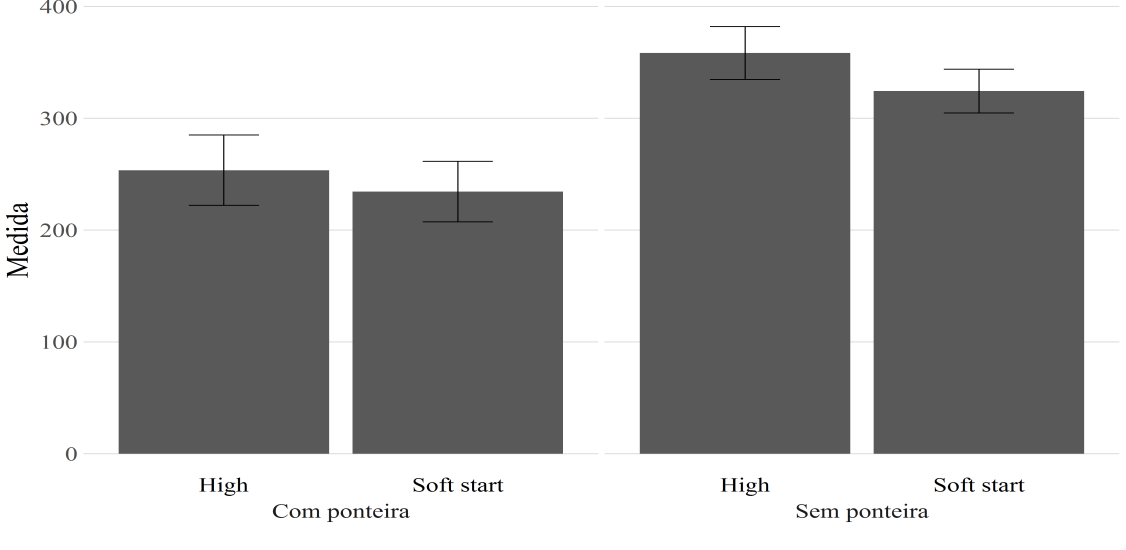
Table 1 and figure 4 show the results of the irradiance analysis as a function of the photoactivation mode and the tip. It was observed that the averages of irradiance were significantly higher when high photoactivation mode was used (p <0.05) and when no tip was used (p <0.05).
| Tip | Photoactivationmode | ||
|---|---|---|---|
| High | Soft-start | ||
| With | 253,50 (31,41) | 234,38 (26,97) | b |
| Without | 358,25 (23,72) | 324,250 (19,54) | a |
| A | B | ||
Table 1: Mean (standard deviation) of the irradiance as a function of the photoactivation mode and the tip.
Distinguished letters (upper and lower case) indicate significant differences (p≤0.05). Result of analysis of variance (ANOVA): Pointer: p <0.0001, Photoactivation: p = 0.0012, Pointer × Photoactivation: p = 0.3079.
Diogo de Azevedo M, et al. Evaluation of Irradiance Issued by Different Modes of Photoactivation with and without the use of Luminous Bridge. Med J Clin Trials Case Stud 2018, 2(4): 000173.
Discussion
Considering the results of this study, it can be noted that when the apparatus was used without the transparent tip, the irradiance values were significantly higher, regardless of the photoactivation mode tested. This is in agreement with the literature, when the quality of the emitted light is of fundamental importance for the clinical success of restorative procedures performed with the resin materials [16].
The intensity of the light multiplied by the exposure time results in the total energy or energy density, which should be approximately J / cm² 17. If the light curing unit has a light intensity of less than 400 mW / cm², the ideal properties of the resins will not be reached and in this way, the material tends to fail more easily [17]. The reduction of the light intensity is imperceptible to human eye, as well as the polymerization efficiency of the composite resins, since the most superficial layer is polymerized, so it is up to the operator to have knowledge about the perfect functioning of the apparatus to request the technical service periodically [18].
According to Poulos, et al. the degradation suffered by the components of the photopolymerizer in a short time generates reduction of light intensity and some criteria must be taken into account with regard to interference in the value of light emitted by each such as: type of tip used (dark, transparent), residues found at the tips of the appliances, charging of the appliance (partial, total), the time of acquisition and operation of these [19].
Some LCUs have the pre-programmed photoactivation mode or can be performed with conventional device by increasing the distance between the guide light tips of the irradiated material, so the approach of the tip gradually increases the irradiance [20]. Miranda, et al. have reported that devices with built-in tips tend to emit a more continuous light regardless of the mode of photoactivation tested. This is because the light is less likely to disperse to the irradiated surface.
As for the polymerization techniques, it is known that the soft-start mode has been developed in an attempt to reduce the voltage caused by the polymerization contraction, and can generate polymers with different structures [21, 22]. When compared to the continuous (conventional) technique, the late pulse technique showed a decrease in contraction tension, allowing the material to flow between the wrists and to relax the tension [23]. However, some studies disagree, believing that there is no difference in the generation of tension [24].
Benefits of the soft-start method in reducing polymerization shrinkage stress and marginal gap have Diogo de Azevedo M, et al. Evaluation of Irradiance Issued by Different Modes of Photoactivation with and without the use of Luminous Bridge. Med J Clin Trials Case Stud 2018, 2(4): 000173.
been widely discussed. Several articles attest the potential value of soft-start polymerization techniques: the late pulse, ramp and step. These studies justify the use of these techniques [25, 26, 27, 28]. However, other authors claim not to observe great advantage in their use and contend the possibility of reducing the mechanical properties of the resinous composite [29, 24].
Although some articles demonstrate that the Soft-start mode is more effective, and others that there is no difference, the present study contradicts, thus showing that the High mode excelled presenting a significant difference.
Conclusion
From the results found in this study, it can be concluded that: - The high method presented higher values of irradiance when compared to the soft-start method. - Although the device used recommends the use of the coupled tip, the irradiance values were significantly lower when compared to the use of the tip.
References
-
Burges JO, Degoes M, Walker R, Ripps AH (1999) An evaluation of four light-curing units comparing soft and hard curing. Pract Periodont Aesthet Dent 11(1): 125-132.
-
Lloret PR (2002) Bonding strength to dentin of different thicknesses of composite resin: polymerization with halogen light X Argon laser [master's dissertation]. São Paulo: Faculty of Dentistry, University of São Paulo.
-
Alonso RC, Cunha LG, Correr GM, Cunha Brandt W, Correr-Sobrinho L, et al. (2006) Relationship between bond strength and marginal and internal adaptation of composite restorations photocured by different methods. Acta Odontol Scand 64(5): 306-313.
-
Cunha LG, Alonso RC, Pfeifer CS, Correr-Sobrinho L, Ferracane JL, et al. (2007) Modulated photoactivation methods: Influence on contraction stress, degree of conversion and push-out bond strength of composite restoratives. J Dent 35(4): 318-324.
-
Pergoraro TA, da Silva NR, Carvalho RM (2007) Cements for use in esthetic dentistry. Dent Clin North Am 51(2): 453-471.
-
Arrais CA, Giannini M, Rueggeberg FA (2009) Effect of sodium sulfinate salts on the polymerization characteristics of dual-cured resin cement systems exposed to attenuated light-activation. J Dent 37(3): 219-227.
-
Giorgi MCC, Dias CTS, Paulillo LAMS (2008) Influence of led and halogen photo activating sources and exposure time on knoopmicrohardness of dental composites. Cienc Odontol Bras 11(4): 18-23.
-
Baratieri LN, Monteiro SJ (2002) Restorative Dentistry: Fundamentals &Techniques. São Paulo: Santos.
-
Santos MJMC, Silva, Souza JR MH, Mondelli RFL (2002) New concepts related to the photopolymerization of composite resins. JBD 1(1): 14-21.
-
Cunha LG, Alonso RC, Correr GM, Brandt WC, Correr- Sobrinho L, et al. (2008) Effect of different photo activation methods on the bond strength of composite resin restorations by push-out test. Quintessence Int 39(3): 243-249.
-
Mehl A, Hickel R, Kunzelmann KH (1997) Physical properties and gap formation of light-cured composites with and without 'softstart- polymerization’. J Dent 25(3-4): 321-330.
-
Consani S, Pereira SB, Sonhoreti MA, Correr Sobrinho L (2002) Effect of the methods of photo activation and insertion on the hardness of composite resins. Pesqui Odontol Bras 16(4): 355-360.
-
Nomoto R, Uchida K, Hirasawa T (1994) Effect of light intensity on polymerization of light-cured composite resins. Dent Mater J 13(2): 198-205.
-
Price RB, Felix CA, Andreou P (2005) Knoop hardness of ten resin composites irradiated with high power LED and quartz-tungsten-halogen lights. Biomaterials 26(15): 2631-2641.
-
R Core Team (2017) A: A language and environment for statistical computing. R Foundation for Statistical Computing, Vienna, Austria. Diogo de Azevedo M, et al. Evaluation of Irradiance Issued by Different Modes of Photoactivation with and without the use of Luminous Bridge. Med J Clin Trials Case Stud 2018, 2(4): 000173.
-
Stahl F, Ashworth SH, Jandt KD, Mills RW (2000) Light emitting diode (LED) polymerization of dental composites: flexural composites: flexural properties and polymerization. Biomaterials 21(13): 1379-1385.
-
Reis A, Loguércio AD (2007) Direct restorative dental materials: from fundamentals to clinical application. 1st (Edn.), São Paulo: Livraria Santos Editora, pp: 277.
-
Pereira SK, Porto CLA, Mendes AJD (2001) Effects of different photopolymerization systems on the surface hardness of the composite resin. J Bras Clin Estet Odont 5(26): 156-161.
-
Poulos JG, Styner D (2000) Polymerization lamp: changes in the yield of light intensity with working time. Journal of Clinical Dentistry 6: 47-53.
-
Miranda DA, Catelan A (2018) Living Polymerization Techniques and Their Utility in Material Synthesis. Ann Clin Case Rep 3: 1494.
-
Aguiar FHB, Braceiro AT, Ambrosano GMB, Lovadino JR (2005) Hardness and diametral tensile strength of a hybrid composite resin polymerized with different modes and immersed in ethanol or distilled water media. Dent Mater 21(12): 1098-1103.
-
Aguiar FH, Oliveira TR, Lima DA, Paulillo LA, Lovadino JR (2007) Effect of light curing modes and ethanol immersion media on the susceptibility of a microhybrid composite resin to staining. J Appl Oral Sci 15(2): 105-109.
-
Ilie N, Felten K, Trixner K, Hickel R, Kunzelmann KH (2005) Shrinkage behavior of resin-based composite irradiated with modern curing units. Dent Mater 21(5): 483-489.
-
Chan DC, Browning WD, Frazier KB, Brackett MG (2008) Clinical evaluation of the soft-start (pulse- delay): polymerization technique in Class I and II composite restorations. Oper Dent 33(3): 265-271.
-
Ilie N, Jelen E, Clementino-Luedemann T, Hickel R (2007) Low shrinkage composite for all dental application. Dent Mater J 26(2): 149-155.
-
Sahafi A, Peutzfeldt A, Asmussen E (2001) Effect of pulse-delay curing on in vitro wall-to-wall contraction of composite in dentin cavity preparations. Am J Dent 14(5): 295-296.
-
Visvanathan A, Ilie N, Hickel R, Kunzelmann KH (2007) The influence of curing times and light curing methods on the polymerization shrinkage stress of a shrinkage-optimized composite with hybrid-type prepolymer fillers. Dent Mater 23(7): 777-784.
-
Yoshikawa T, Burrow MF, Tagami J (2001) A light curing method for improving marginal sealing and cavity wall adaptation of resin composite restorations. Dent Mater 17(4): 359-366.
-
Asmussen E, Peutzfeldt A (2001) Influence of pulse- delay curing on softening of polymer structures. J Dent Res 80(6): 1570-1573. Diogo de Azevedo M, et al. Evaluation of Irradiance Issued by Different Modes of Photoactivation with and without the use of Luminous Bridge. Med J Clin Trials Case Stud 2018, 2(4): 000173.
- Psychogenic Erectile Dysfunction in Late Adulthood: A Case Report on Clinical Intervention and Intimacy Restoration
- Clinical Trials on COVID-19 in 2025: A New Chapter in Global Health Research
- Innovations and Challenges in Contemporary Medical Clinical Trials: An Editorial Perspective
- Innovations and Challenges in Contemporary Medical Clinical Trials: A Critical Perspective
- Reimagining Clinical Trials: The Power of Continuous Feedback from Medical Reports
- Factors Influencing Brain Drain: Perspectives from a Medical School in Turkey