
Anaesthetic Challenges for Laparoscopic Bilateral Adrenalectomy in a Rare Case of Cushing’s Syndrome-A Case Report
Perioperative management of Cushing’s syndrome for laparoscopic bilateral adrenalectomy is a challenging task for anaesthetist. Laparoscopic bilateral adrenalectomy is an uncommon and complex procedure, in addition to that the associated comorbid conditions makes anaesthesiologist’s job even more challenging. In this case report we would like to share an anesthetic experience for laparoscopic bilateral adrenalectomy in a rare case of Cushing’s syndrome.
Introduction
Cushing’s syndrome is a multifactorial syndrome, with its etiology either being endogenous or exogenous cortisol raise [1]. It could be ACTH dependent (80% of the cases) or independent (20% of the cases) one. ACTH overproduction may be of pituitary origin (85% cases) or result of ectopic tumour secretion (15% cases) [1]. Our patient presented with ACTH dependent hypercortisolism with no ectopic source, or no pituitary micro or macro adenoma detected. Hence it was considered as a rare variant of hypercortisolism from adrenal source [2]. Treatment of Cushing syndrome was towards normalizing cortisol levels and its various systemic effects. Inadequate treatment of Cushing’s syndrome may result in cortisol storm or crisis, a life threatening complication [3].
Surgical therapy is considered as a second line of management, when medical therapy has failed [4]. In this patient, in view of the undetectable etiology, medical treatment could not be fully accomplished and hence laparoscopic bilateral adrenalectomy was the treatment of choice [2]. Perioperative optimization of the patient involves a team comprising of surgeons, medical endocrinologists and anaesthesiologists. The an anaesthesiologist should be aware of the involved high perioperative morbidity and mortality of Cushing’s syndrome and plays a vital role in perioperative management of various issues like glycaemic control, fluctuations in blood pressure, electrolytes neutralization, respiratory system issues, and laparoscopy and positioning related issues [1, 5]. With all the mentioned factors in mind we systematically approached our patient posted for laparoscopic bilateral adrenalectomy and was managed successfully.
Case Report
A 44 year old male patient came for preoperative assessment for elective bilateral laparoscopic adrenalectomy. He initially came with complaints of progressive weakness, particularly of thigh muscles for the last 6 months. He was hospitalized 3 months ago with extreme fatigability, weakness and history of frequent falls. He was found to have high blood pressure, elevated blood sugars and deranged electrolytes (hypokalemia). He was diagnosed with cortisol storm due to Cushing’s syndrome. Previous surgical history included appendicectomy and liposuction 6 years ago with an uneventful perioperative period.
In the Preanaesthetic clinic, general examination revealed moon facies, truncal obesity and bruising with striae. Hemodynamic parameters recorded a blood pressure of 150/110; pulse rate of 102/min and his room air saturation was 94%. Patient had poor effort tolerance (extreme fatigability while climbing stairs) otherwise cardiorespiratory reserve was normal. Electrocardiogram showed sinus tachycardia with no other abnormalities. Echocardiography findings were normal. Laboratory investigations of complete blood count, serum electrolytes, and renal function test and coagulation profile were done. Serum electrolytes showed severe hypokalemia, which was corrected by the endocrinologist (Serial potassium values: 1.7, 5----- 3.9). Urinary VMA & Metanephrines were NEGATIVE. Initially cortisol levels were 21.3 microgram/dl and reduced to16.7microgram/dl in immediate preoperative period with anti-glucocorticoid treatment. His ACTH value was 105pg/ml.
Anaesthetic Management
Pre-operative optimization of serum electrolytes, blood pressure and adequate glycemic control were achieved. On the day of surgery, patient was kept nil per oral as per guidelines, routine morning doses of antihypertensive drugs tablet clinidipine 2mg, tablet metoprolol 50mg and tablet Aldactone 100mg were continued, premedications with intravenous pantoprazole 40mg and palonosetron 75 mcg were administered half an hour prior surgery. Pre-induction hemodynamics were blood glucose of 170mg/dl, blood pressure of 130/90 mmHg, heart rate of 104/min and saturation of 94% with Karthickraja V, et al. Anaesthetic Challenges for Laparoscopic Bilateral Adrenalectomy in a Rare Case of Cushing’s Syndrome – A Case Report. Med J Clin Trials Case Stud 2018, 2(6): 000189.
wide bore IV cannula secured and continuous monitoring of non-invasive blood pressure, pulse oximetry and 12 lead electrocardiogram, EtCO2, surgery was proceeded as scheduled. Patient was given intravenous hydrocortisone 100mg and intravenous fentanyl 2mcg/kg was given prior to induction. After three minutes of pre-oxygenation, patient was induced with intravenous propofol 1% 2mg/kg, and after achieving adequate muscle relaxation with cisatracurium, airway was secured with 8 size endotracheal cuffed tubes without any difficulty. Maintenance of an aesthesia was with volatile agent desflurane with oxygen: nitrous oxide at a ratio of 50:50 along with reduced supplemental weight adjusted doses of cisatracurium. Intraoperative intravenous dexmedetomidine 50 mcg was given for its analgesic purpose and to maintain smooth hemodynamics. For temperature maintenance forced air warming device was used.
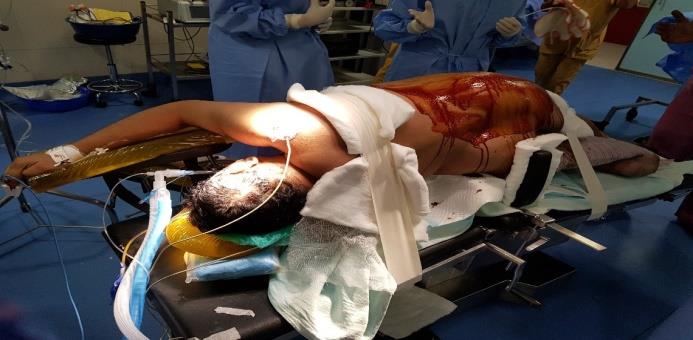
Patient was positioned in the left and right lateral position with raised kidney bridge corresponding to the site of gland operated on. Initially right sided resection of adrenal gland was done without major blood loss and hemodynamic instability. After positioning in right lateral position for left sided adrenalectomy, falls in blood pressure up to 80/45mmHg was observed and managed with boluses of intravenous ephedrine and small dose of phenylephrine and intravenous fluid boluses. At this point of time, we were already four hours into surgery and we administered another dose of intravenous hydrocortisone 100mg. Intraoperative CBG was under control, doesn’t need any insulin. With laparoscopic insufflation of CO2, desaturation occurred up to 70% in pulse oximetry and was managed with lung recruitment maneuvers with PEEP of 7mmHg and the saturation improved to 98%.
Intraoperative urine output was adequate throughout the surgery (>0.5ml/kg/hr). After a long duration of approximately 600 minutes of intraoperative period, bilateral adrenal glands were removed successfully without much hemodynamic instability. Patient was reversed and extubated after good spontaneous breathing attempts. After extubation patient was monitored in the ICU and was supplemented with overnight 2 litres of oxygen support by facemask. Post extubation CBG was 400mg/dl and was started on insulin sliding scale and henceforth hourly CBG was checked for tight glycemic control. Postoperatively apart from routine intravenous analgesics, intravenous steroids injection Hydrocortisone 100mg every 8th hourly and Enoxaparin 40mg subcutaneously once daily for deep vein thrombosis Copyright© Karthickraja V, et al.
prophylaxis were prescribed. On the first postoperative day patient had minimal breathing difficulty and found to have bilateral atelectasis. It was managed conservatively with regular interval chest physiotherapy, incentive spirometry and early mobilization. Patient was discharged on the 5th post-operative day with glucocorticoids cover.
Discussion
Cushing’s syndrome patients are usually managed with medical treatment for hypercortisol related symptoms. In this patient bilateral adrenalectomy was carried forward due to the recent cortisol storm and undetectable extra-adrenal source [4]. Perioperative management for bilateral adrenalectomy is crucial for an anesthesiologist and surgeons. Cushing syndrome patients are prepared for surgery with cortisol release controlling drugs, anti ACTH secreting drugs and anti- glucocorticoids [6]. Preoperative optimization includes hypertension control, strict glycaemic control and normalization of electrolytes derangements if any. This patient was managed with triple antihypertensive agents including spironolactone for blood pressure and regular insulin for glycaemic control.
Dyselectrolytemia particularly hypokalemia is worrisome in Cushing’s syndrome patients. In this case, he was well managed with oral potassium chloride therapy and optimized preoperatively. The cushingoid features of these patient needs a special consideration as they can pose a difficult airway situation [7]. In our patient he however did not need any extra interventions for securing the airway. Intraoperative period was well managed except a brief period of desaturation and hypotension. It is mandatory to remember that these Karthickraja V, et al. Anaesthetic Challenges for Laparoscopic Bilateral Adrenalectomy in a Rare Case of Cushing’s Syndrome – A Case Report. Med J Clin Trials Case Stud 2018, 2(6): 000189.
patients are more prone to develop respiratory complications because of truncal obesity, poor muscle tone, and poor exercise tolerance. Apart from disease per se, the positioning and procedure related complication increases the respiratory compromise [1]. The lateral decubitus position and laparoscopic CO2 insufflations potentiates respiratory compromise, leading to intrapulmonary shunts and resulting in desaturation. In our patient desaturation was managed with use of lung recruitment manoeuvres and attained normal saturation within few minutes.
These patients are also more prone to develop hypotension, because of multiple antihypertensive and reduced cortisol effects after surgery. We managed hypotension with extra dose of steroids, minimal phenylephrine and fluid boluses. Cushing’s syndrome patients are more prone for deep vein thrombosis in the perioperative period [4]. In this patient duration of surgery and the disease warrants deep vein thrombosis prophylaxis. Intraoperatively we continued sequential compression device and postoperatively followed with low molecular weight heparin. With above all precautions, patient was extubated on table and shifted to surgical intensive care unit. It is worthwhile to remember that in Cushing syndrome fast tracking is essential to reduce immediate and long term postoperative respiratory complication [8, 9, 10].
Conclusion
The condition of this patient was very challenging for us, because of his cortisol-dependent comorbidities like diabetes, hypertension, electrolyte disturbances and poor physical fitness. Taking into consideration the physical condition of the patient, with adequate preoperative optimization, and appropriate intraoperative period management strategies, laparoscopic bilateral adrenalectomy was successfully performed.
References
-
Dhiman A, Sandeep Kumar K, Rajat C, Gargi N, Jishnu N, et al. (2015) Laparoscopic Bilateral Adrenalectomy in a Patient of Cushing Disease due to Pituitary Microadenoma: A Challenge for the Anaesthesiologist 3(4:23): 2254-6758.
-
Vella A, Thompson GB, Grant CS, van Heerden JA, Farley DR, et al. (2001) Laparoscopic Adrenalectomy Copyright© Karthickraja V, et al. for Adrenocorticotropin-Dependent Cushing’s Syndrome. J Clin Endocrinol Metab 86(4): 1596-1599.
-
Sharma A, Subramaniam R, Misra M, Joshiraj B, Krishnan G, et al. (2015) Anaesthetic Management of Emergent Laparoscopic Bilateral Adrenalectomy in a Patient with a Life-Threatening Cortisol Crisis. A A Case Rep 4(2): 15-18.
-
Lynnette K Nieman, Beverly MK Biller, James W Findling, M Hassan Murad, John Newell-Price, et al. (2015) Treatment of Cushing's Syndrome: An Endocrine Society Clinical Practice Guideline. J Clinical Endocrinology & Metabolism 100(8): 2807- 2831.
-
Stavros G, Memtsoudis Cephas Swamidoss, Maria Psoma, Anesthesia for Adrenal Surgery, Adrenal Glands book, pp: 287-297.
-
Sharma ST, Nieman LK (2011) Cushing's syndrome: All variants, detection and treatment. Endocrinol Metab Clin North Am 40(2): 379-391. Karthickraja V, et al. Anaesthetic Challenges for Laparoscopic Bilateral Adrenalectomy in a Rare Case of Cushing’s Syndrome – A Case Report. Med J Clin Trials Case Stud 2018, 2(6): 000189.
-
Khan ZH, Gharabaghian M, Nilli F, Ghiamat M, Mohammadi M (2007) Easy Endotracheal Intubation of a Patient Suffering from both Cushing's and Nelson's Syndromes Predicted by the upper lip bite test despite a Mallampati Class 4 airway. Anesth Analg 105(3): 86-87.
-
Domi R, Sula H (2011) Cushing syndrome and the anaesthesiologists. Indian J Endocrinol Metab 15(3): 209-213.
-
Manickam A, Parameswari A, Vakamudi M (2012) Anaesthetic management of a patient with Cushing's syndrome and non-compaction cardiomyopathy for adrenal tumour resection. Indian J Anaesth 56(4): 401-404.
-
Handler J (2010) Cushing’s syndrome with uncontrolled hypertension, occasional hypokalemia, and two pregnancies. J Clin Hypertens 12(7): 516- 520. Copyright© Karthickraja V, et al.
- Psychogenic Erectile Dysfunction in Late Adulthood: A Case Report on Clinical Intervention and Intimacy Restoration
- Clinical Trials on COVID-19 in 2025: A New Chapter in Global Health Research
- Innovations and Challenges in Contemporary Medical Clinical Trials: An Editorial Perspective
- Innovations and Challenges in Contemporary Medical Clinical Trials: A Critical Perspective
- Reimagining Clinical Trials: The Power of Continuous Feedback from Medical Reports
- Factors Influencing Brain Drain: Perspectives from a Medical School in Turkey