
Work Related Injuries and Occupational Safety in Iraq Occupational Safety in the State Company for Refractories in Baghdad Example
Background: An injury is defined as wound or trauma; harm or hurt; or damage inflicted on the human body of the injured by an external force. The injury is a suspected bodily lesion resulting from acute overexposure to energy interacting with the body in amounts or rates that exceed the threshold of physiological tolerance. Occupational accidents cause direct and indirect or hidden costs for the whole society. Global estimates by ILO show that the occupational problems are bigger than earlier believed. Especially, figures of occupational fatal and non-fatal accidents in developing countries were greatly underestimated. The previous international estimations have been based on existing information from industrial countries. The fatality rate and an absolute number of deaths for developing countries were estimated based on regional estimates. Objective: This study was conducted to describe the work-related injuries in Iraq Materials and Methods: This is a cross-sectional qualitative study. This study has described a group of studies related to the topic of work injuries and occupational accidents. The authors reviewed fifteen studies reported in (Medline, WHO Portal, ILO, ELDIS, POPLINE, PubMed) databases that have assessed the work-related injuries and Occupational injuries. Data extracted from eligible studies included work-related injuries and occupational injuries. Outcomes: The results of this study show that there are increased in the number of accidents in years 2000 and 2001, and there was an increase in the average of accidents frequencies in years of 1999 and 2002. This study also found that the highest percentage of accidents were happened in mills department (35%), followed by ovens department with percentage (20%). The highest percentage of accidents was occurred among the workers with the primary level of education, diploma level and tertiary level respectively (37.5%),(10%) and (15%). The most percentage of accidents was occurred in the age group of (26-30%) years, followed by the age group of (31-35%) years. Conclusion: According to the results of this study which have adapted from one study conducted in 2011, the community there needs to conduct more studies about the work related injuries and how prevent it.
Introduction
An injury is defined as wound or trauma; harm or hurt; or damage inflicted on the human body of the injured by an external force [1]. The injury is a suspected bodily lesion resulting from acute overexposure to energy interacting with the body in amounts or rates that exceed the threshold of physiological tolerance [2]. Accident and injury are undesirable results of a production process, and energy interaction is a key element in the occurrence of harm [3]. There are two types of energy exposures lead to the occupational injuries are acute and chronic. Sudden energy transfer causes traumatic injuries to the body of the victim during short duration exposure. Tayyari and Smith, were define cumulative trauma disorders (CTDs) or repetitive strain injuries (RSIs) as injuries caused by chronic exposure to repetitive motions or forceful exertions [4]. Occupational injuries remain a priority for public health in developed countries, although incidence rate trends have been declining in recent years [5, 6]. Global estimates by ILO show that the occupational problems are bigger than earlier believed. Especially, figures of occupational fatal and non-fatal accidents in developing countries were greatly underestimated. Also, a recent study from US has shown that between 33% and 69% of all occupational injuries were missed off the reported injuries [7]. Previous international estimates have been based on existing information from industrial countries. The fatality rate and an absolute number of deaths for developing countries were estimated based on regional estimates. However, many studies from different countries have shown that a ratio between fatal and non- fatal accident is quite constant if accurate recording systems exist [8, 9]. The difference in accident rates between developed and developing countries is remarkable. While many enterprises in developed countries are taking zero accident policy for their goal, enterprises in developing countries are unable to determine their hazards. Furthermore, nowadays many enterprises operate in different regions and countries, and this often makes accident prevention programs more challenging [10]. Occupational accidents cause direct and indirect or hidden costs for the whole society. There are many variations of the proportion of the costs, but usually the percentage of indirect costs is much bigger than direct costs. On the other hand, these economic calculations are made in industrialized countries that have established specific compensation and social security systems. Often in developing countries an accident that occurs in the workplace does not cause direct costs [11, 12]. Wilson listed the common immediate and root causes of accidents as following [13]:
| Immediate causes | Substandard conditions |
|---|---|
| Root causes | |
| Substandard practices | Substandard conditions |
| Operating equipment without authority | Inadequate or improper protective equipment |
| Failing to follow established procedures | Defective tools, equipment, materials |
| Making safety devices inoperable | Fire and explosion hazards (hidden) |
| Failing to use personal safety equipment | Poor housekeeping, disorder workplace |
| Servicing equipment that is in operation | Hazardous environmental conditions |
| Working while under the influence of alcohol/drugs | Inadequate training, expertise, etc. |
| Personal factors | Job factors |
| Inadequate physical/physiological capability | Inadequate leadership/supervision |
| Inadequate mental/psychological capability | Inadequate engineering |
| Physical or physiological stress | Inadequate purchasing |
| Mental or psychological stress | Inadequate maintenance |
| Lack of knowledge | Inadequate tools and equipment |
| Lack of skill | Inadequate work standards |
Table 1: Common immediate and root causes of incidents as listed by Wilson [13].
Ibadi AK. Work Related Injuries and Occupational Safety in Iraq Occupational Safety in the State Company for Refractories in Baghdad Example. Med J Clin Trials Case Stud 2019, 3(1): 000202.
In Iraq, occupational injuries or work related injuries are considered very common. That is related of a group of causes [14]. 1- Behavioral causes related to worker such as:
A. Careless of the worker to the safety conditions and losing of focusing during working time.
B. Lacking of provisionality and experiences.
C. Increasing of worker confidence.
D. Wrong deal with machines.
2- Causes belong to the work environment.
A- Unavailable of isolated materials for machines.
B- Using of destroyed equipment and tools.
C- Nothingness of arrangement and regulations in the workplace.
D- Inadequate of lighting and ventilation in the workplace.
E- Exposed to the noise during working time.
F- Do not use the personal safety equipment during timework.
Material and Methods
A cross-sectional qualitative study. This study has described a case study related to the topic of work injuries and occupational accidents. The author have reviewed one study in the study location because lacking studies that have been studied the working related injuries. The researcher was reviewed a group of studies reported in (Medline, WHO Portal, ILO, ELDIS, POPLINE, PubMed) databases that have assessed the work-related injuries and occupational injuries. Data extracted from eligible studies included work-related injuries and occupational injuries.
Occupational Safety in the State Company for Refractories in Baghdad as example: Al-Kubaisi [15,16].
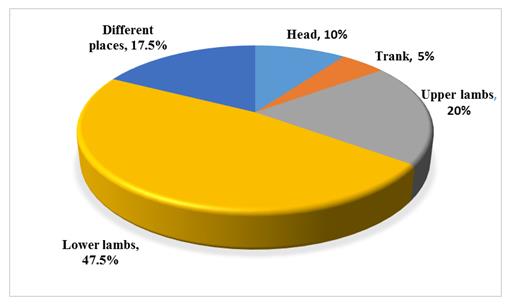
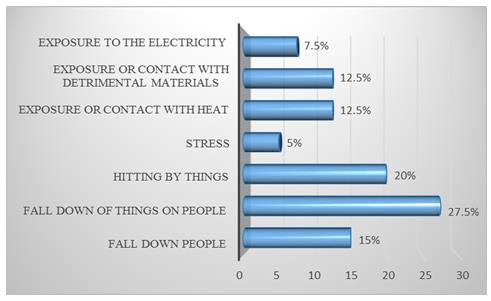
The work accidents were considered an important problem that has faced the state company for refractories. This study aims to know the most important factors that have caused work accidents in this company. Studying and analyzing this problem in this company was dependent on studying of (40) accidents case for the period 1998-2002. This research has discussed the nature of work accidents in this company and their year number. Also showed the distribution of work accidents according to departments, type of accident, location Human body, age, and education level. The findings of this study again reveal that there are increased in the number of accidents in years 2000 and 2001. This study also found that there was an increase in the average of accidents frequencies in years of 1999 and 2002. The researcher was concluded that there was a lack of precise of registration of simple accidents; that was very clear because there were only the hard accidents. The researcher was concluded that this study will contribute in establish of the efficient safety program for this company, to help them to prevent of work accidents.
The Results of this Study
Table 1 reveals that the number of events, number of worker, total number of working hours and frequency of accidents.
| Total | ||||||||||||||
|---|---|---|---|---|---|---|---|---|---|---|---|---|---|---|
| Number | Number | |||||||||||||
| number of | Average of | |||||||||||||
| Years | of | of | ||||||||||||
| working | frequencies | |||||||||||||
| events | workers | |||||||||||||
| hours | ||||||||||||||
| 1998 | 6 | 184 | 441600 | 13.5 | ||||||||||
| 1999 | 4 | 190 | 456000 | 8.7 | ||||||||||
| 2000 | 11 | 264 | 873600 | 12.5 | ||||||||||
| 2001 | 10 | 404 | 969600 | 10.3 | ||||||||||
| 2002 | 9 | 408 | 979200 | 9.1 |
| Department | Number of accidents | Percentage | ||||||
|---|---|---|---|---|---|---|---|---|
| Mills | 14 | 35% | ||||||
| Ovens | 8 | 20% | ||||||
| Pressures | 4 | 10% | ||||||
| Electricity | 4 | 10% | ||||||
| Storages | 4 | 10% |
Ibadi AK. Work Related Injuries and Occupational Safety in Iraq Occupational Safety in the State Company for Refractories in Baghdad Example. Med J Clin Trials Case Stud 2019, 3(1): 000202.
| Projects | 3 | 7.50% |
|---|---|---|
| Maintenance | 3 | 7.50% |
| Total | 40 | 100% |
| Educational status | Number of accidents | Percentage | ||
|---|---|---|---|---|
| Primary level | 15 | 37.50% | ||
| Secondary level | 4 | 10% | ||
| Tertiary level | 6 | 15% | ||
| Diploma | 8 | 20% | ||
| Bachelor | 3 | 7.50% | ||
| High diploma | 4 | 10% | ||
| Total | 40 | 100% |
The results of this table reveal that the highest percentage of accidents was happened among the workers with the primary level of education. The diploma level of education comes in the second with percentage (20%) followed by tertiary level with percentage 15%.
| Age group (years) | Number of accidents | Percentage |
|---|---|---|
| 26-30 | 16 | 40% |
| 31-35 | 14 | 35% |
| 36-40 | 5 | 12.50% |
| 41-45 | 3 | 7.50% |
| 46-50 | 2 | 5% |
| Total | 40 | 100% |
Table 5: Classification of accidents according to the age of
Ibadi AK. Work Related Injuries and Occupational Safety in Iraq Occupational Safety in the State Company for Refractories in Baghdad Example. Med J Clin Trials Case Stud 2019, 3(1): 000202.
Conclusion
The results of this study show that there are increased in the number of accidents in years 2000 and 2001, and there was an increase in the average of accidents frequencies in years of 1999 and 2002. This study also found that the highest percentage of accidents were happened in mills department (35%), followed by ovens department with percentage 20%. The largest percentage of accidents was occurrence among the workers with the primary level of education, diploma level, and tertiary level respectively (20%), (15%). The most percentage of accidents was an occurrence in the age group of (26-30%) years, followed by the age group of (31-35%) years.
References
-
Webster (2002) Webster’s Third New International Dictionary: Unabridged. Merriam Webster Inc. [INLINE_TABLE:4:1] [INLINE_TABLE:4:0]
-
Tayyari F, Smith JL (1997) Occupational ergonomics: principles and applications. London: Chapman & Hall.
-
Hämäläinen P, Takala J, Saarela KL (2006) Global estimates of occupational accidents. Safety Science 44(2): 137-156.
-
Benavides FG, Lopez-Ruiz M, Castejon E (2008) Secular occupational injury trends in Spain, 1904- 2005. Labor Risks Prev Arch 11: 141-147.
-
Leigh JP, Marcin JP, Miller TR (2004) An estimate of the US government’s undercount of nonfatal occupational injuries. Journal of Occupational and Environmental Medicine 46(1): 10-18.
-
Dupré D (2001) Accidents at work in the EU 1998– 1999. Statistics in focus, theme pp: 3-16.
-
Takala J (1999) Global estimates of fatal occupational accidents_._ Epidemiology 10(5): 640-646.
-
Larsson T (2000) The diffusion of employer responsibility. In: Frick K, Langaa Jensen P, Quinlan M, Wilthagen T (Eds.), Systematic Occupational Ibadi AK. Work Related Injuries and Occupational Safety in Iraq Occupational Safety in the State Company for Refractories in Baghdad Example. Med J Clin Trials Case Stud 2019, 3(1): 000202. Health and Safety Management-Perspectives on an International Development. Elsevier Science Ltd, Oxford.
-
Andreoni D (1986) Cost of occupational accidents and diseases. Geneva, International Labour Organization, Occupational Safety and Health Series pp: 54.
-
Larsson TJ, Betts NJ (1996) The variation of occupational injury cost in Australia; estimates based on a small empirical study. Safety Science 24(2): 143- 155.
-
Wilson L (1998) Basic learnings in industrial safety and loss management. Association of Professional Engineers, Geologists, and Geophysicists of Alberta (APEGGA) and the Industrial Safety and Loss Management Program (ISLMP), Faculty of Engineering, University of Alberta, Edmonton, pp: 72.
-
Jamel H (1985) Occupational safety. Foundation of Technical Education. Baghdad. [INLINE_TABLE:5:0]
-
Fingerhut L, Harrison J, Mulder S (2004) International Classification of External Causes of Injuries. Inj Prev 10(2): 127. Ibadi AK. Work Related Injuries and Occupational Safety in Iraq Occupational Safety in the State Company for Refractories in Baghdad Example. Med J Clin Trials Case Stud 2019, 3(1): 000202.
- Psychogenic Erectile Dysfunction in Late Adulthood: A Case Report on Clinical Intervention and Intimacy Restoration
- Clinical Trials on COVID-19 in 2025: A New Chapter in Global Health Research
- Innovations and Challenges in Contemporary Medical Clinical Trials: An Editorial Perspective
- Innovations and Challenges in Contemporary Medical Clinical Trials: A Critical Perspective
- Reimagining Clinical Trials: The Power of Continuous Feedback from Medical Reports
- Factors Influencing Brain Drain: Perspectives from a Medical School in Turkey