
Chronic Perionyxis: Is there a Hidden Nail?
Retronychia is a specific form of proximal perionyxis with chronic evolution. If not known the diagnostic can be difficult.The treatment is surgical and does not recur once treated with avulsion. Herein, we report a new case that exhibited persistent perionyxis in a 46-year-old woman.
Introduction
Retronychia is a phenomenon of posterior incarnation of the nail plate, responsible for inflammation of the proximal sinus fold proximal. This is a newly described entity. We report a new case, revealed by chronic proximal perionyxis.
Case Report
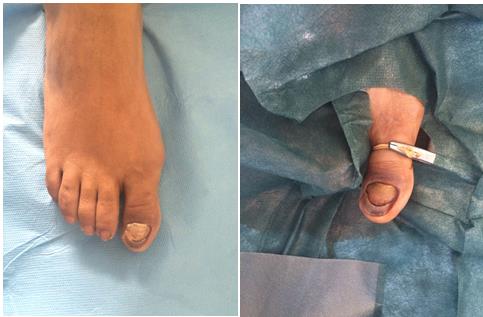
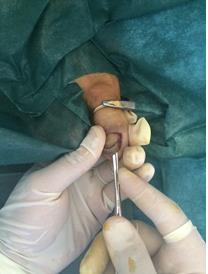
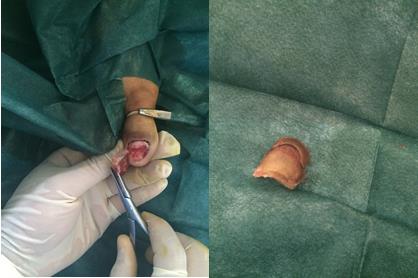
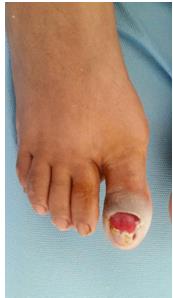
A 46-year-old woman, with no notable pathological antecedents, consulted for a painful periungual inflammation of the right big toe that begin 6 months earlier, with stunted nail growth. In addition, the patient had already consulted a dermatologist, who prescribed fluconazole without improvement. The clinical examination found a painful perionyxis of the right big toe with subungual yellow hyperkeratosis, a flow of serosity through the nail fold and thickening of the proximal fold. The inflammatory assessment was normal and the X-ray of the foot was no evidence of osteitis. The diagnosis of retronychia (Figure 1) was suspected and avulsion of the nail confirmed the diagnosis (Figure 2). No complications was noted after surgery (Figure 3) and the patient does not present a recurrence after 2 years of decline
Discussion
The stopping of the nail growth at the interrogation, the proximal paronychia and the oozing through the proximal nail fold are the 3 clinical signs that leed us to evoke a retronychia. It’s a rare condition. Other clinical signs are possible, such as the yellowish coloring of the tablet, the furrows of Beau and the thickening of the proximal fold [1].
The term "retronychia", invented in 1999, comes from "retro", meaning backwards and "onychia", meaning nail Kaoutar M. Chronic Perionyxis: Is there a Hidden Nail?. Med J Clin Trials Case Stud 2019, 3(4): 000231.
[2]. It describes a specific form of proximal perionyxis with chronic evolution. Under normal circumstances, the basal alignment between the nail plate and the matrix is maintained by the proximal nail fold, which acts as a strap. In the retroonychia, there is a loss of continuity between the tablet and the matrix with disruption of their alignment, which prevents the newly formed nail from pushing the tablet forward as during the formation of the furrows of Beau or during usual onychomadhesis. The tablet is then pushed backwards and forwards, causing its posterior embedding in the ventral part of the proximal fold [3]. This induces peri-nail inflammation with formation of a granulation tissue and an exudate which accumulates under the nail, thus determining a chronic proximal perionyxis with arrest of nail growth [3, 4].
Mechanical triggering factors are likely to be the cause of retronychia, including anteroposterior pressure applied to the free edge of the fingernail or repeated microtrauma (walking in tight shoes) [3, 4]. Nail deformation can also promote the loss of alignment [3].
The literature demonstrates that surgical nail avulsion is the curative treatment of retronychia, as illustrated by our case, since it eliminates the non-viable yellowish pad and allows normal nail regrowth resulting in complete healing without relapse or recurrence [2, 3].
Conclusion
Retronychia is a pathological entity still unknown. It must be suspected in front of a persistent perionyxis with a nail that no longer grows [4]. The knowledge of this condition allows rapid management avoiding Copyright© Kaoutar M.
inappropriate local care and unnecessary antibiotic therapy.
References
-
Reigneau M, Pouaha J, Créa T, Trutchet F (2012) Annales de Dermatologie et de Vénéréologie 139(12): 224.
-
De Berker DA, Renal J (1999) Proximal ingrowing to nail: Retronychia. J Eur Acad Dermatol Venereol 12: 126. Kaoutar M. Chronic Perionyxis: Is there a Hidden Nail?. Med J Clin Trials Case Stud 2019, 3(4): 000231.
-
Dahdah MJ, Kibbi AG, Ghosn S (2008) Retronychia: report of two cases. J Am Acad Dermatol 58(6): 1051- 1053.
-
De Berker DA, Richert B, Duhard E, Piraccini B, Andre J (2008) Retronychia: proximal ingrowing of the nail plate. J Am Acad Dermatol 58(6): 978-983. Copyright© Kaoutar M.
- Psychogenic Erectile Dysfunction in Late Adulthood: A Case Report on Clinical Intervention and Intimacy Restoration
- Clinical Trials on COVID-19 in 2025: A New Chapter in Global Health Research
- Innovations and Challenges in Contemporary Medical Clinical Trials: An Editorial Perspective
- Innovations and Challenges in Contemporary Medical Clinical Trials: A Critical Perspective
- Reimagining Clinical Trials: The Power of Continuous Feedback from Medical Reports
- Factors Influencing Brain Drain: Perspectives from a Medical School in Turkey