
Recurrent Bullous Diabeticorum Rare Presentation of a Common Disease: A Case Report
Background: Bullosis diabeticorum (BD), also known as the bullous disease of diabetes and diabetic bullae, is a rare, no inflammatory, blistering condition of unknown etiology occurring in diabetic patients. Case Presentation: A 74-year-old Asian male presented with a sudden onset of blisters. He had a past medical history of uncontrolled diabetes mellitus type2. The physical examination revealed no erythematous skin denudations on the palmar and dorsal surface of both hands. The diagnosis was confirmed on a skin biopsy of the lesion. The bullae healed with no complications in 3 weeks. Conclusion: We present to you a case to illustrate the rare occurrence of diabetic bulla in a diabetic patient especially patients with poor glycemic control. It is a
Introduction
Bullosis diabeticorum (BD), also known as the bullous disease of diabetes and diabetic bullae, is a rare, noninflammatory, blistering condition of unknown etiology occurring in diabetic patients [1]. While Cantwell, and Martz gave a name to the condition in 1967, Krane was the first one to report it in the year 1930. It is multifactorial in origin. It has been reported to involve approximately 0.5% of diabetic patients of the United States population [2]. An awareness of BD may help clinicians to take prompt action and improve patient comfort while averting secondary infections. This case underscores the importance of considering this rare complication as a possibility while managing diabetic patients.
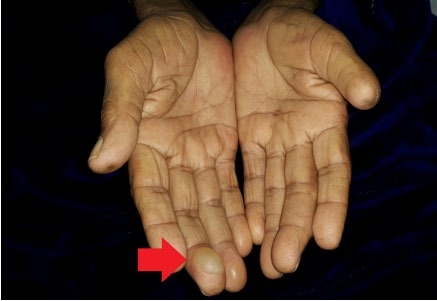
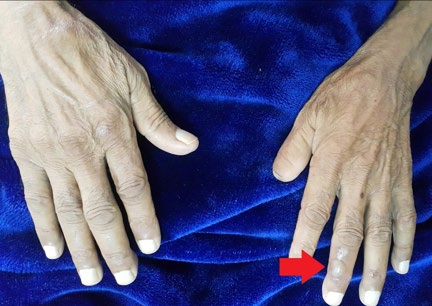
A 74- year-old man with known type-2 diabetes for two years presented with acute onset, asymptomatic, spontaneous, tense blisters of five days duration on both hands. The patient was on human insulin and he gave no history of trauma or friction. His thumb was amputated back in 2013 due to a previous attack of bullous diabeticorum causing osteomyelitis. He used to maintain meticulous hand and foot hygiene. On examination, tense, non-tender blisters on a non-erythematous base was seen on the palmar and dorsal surface of fingers of hands as shown in Figure 1. Bullous diabeticorum on dorsal surface of hands as shown in Figure 2.
| ESR | 51 mm/h |
|---|---|
| Hemoglobin | 127 g/L |
| White blood cells | 19.2 x x109/L |
| Red blood cells | 4.2 x 10¹²/L |
| Platelets | 326.2 x 10⁹/L |
| Blood Glucose level | 325 mg/dl |
|---|---|
| HbA1C | 8% |
Table 1 & 2: His baseline investigations were sent. Complete blood picture and other investigations.
Histo-pathology of the lesion showed a subepidermal bulla lacking any inflammatory infiltrate. A direct immunofluorescence test was negative, thus excluding any immunobullous disease. No treatment was given. The patient recovered by himself in about 3 weeks. He had residual depigmentation with no scarring. His clinical, histopathological, and immunofluorescence patterns, led to the diagnosis of bullous diabeticorum. His random blood glucose level at discharge was 125 mg/dl.
Discussion
Diabetic bulla is a spontaneous, recurrent, noninflammatory, and blistering condition that usually affects the acral, hands, and distal skin of lower extremities. The blisters are usually large and not symmetrical in shape [3]. These serous fluid-filled tense bullae (sized few mm to cm) may even at times be hemorrhagic [4]. They are usually found in patients with diabetes, diabetic bulla may also appear in prediabetic patients [5]. Larsen reported a yearly incidence of 0.16% [6]. Although most diabetic bullae heal within 2 weeks -6 weeks of palliative treatment, and usually do not exhibit scarring [7, 8, 9, 10, 11, 12].
Conclusion
Bullosis diabeticorum may be multifactorial in nature, blood glucose level regulation plays a central role in all of the proposed etiologies. This case emphasizes the importance of adequate glucose control and how particularly hyperglycemia and lack of adequate glucose control may lead to increased dermatological morbidity. However, evidence regarding this association is lacking and additional research is required to prove it.
References
-
James WD, Berger TG, Elston DM (2006) Andrew’s diseases of the skin. 10th (Edn.), Saunders Elsevier.
-
Jacqueline M, Junkins-Hopkins Bullous Disease of Diabetes. e-Medicine.
-
Ghosh SK, Bandyopadhyay D, Chatterjee G (2009) _Bullosis diabeticorum_: a distinctive blistering eruption in diabetes mellitus. Int J Diabetes Dev Ctries 29(1): 41-42.
-
Larsen K, Jensen T, Karlsmark T, Holstein PE (2008) Incidence of _bullosis diabeticorum_—a controversial cause of chronic foot ulceration. International Wound Journal 5(4): 591-596.
-
Lopez PR, Leicht S, Sigmon JR, Stigall L (2009) _Bullosis_ _diabeticorum_ associated with a prediabetic state. Southern Medical Journal 102(6): 643-644.
-
Larsen K, Jensen T, Karlsmark T, Holstein PE (2008) Incidence of _Bullosis diabeticorum_–a controversial cause of chronic foot ulceration. Int Wound J 5(4): 591-596.
-
Brenner MA (1986) Cutaneous stigmata frequently found in the diabetic limb. Clin Podiatr Med Surg 3(3): 523-532.
-
Lipsky BA, Baker PD, Ahroni JH (2000) Diabetic bullae: 12 cases of a purportedly rare cutaneous disorder. Int J Dermatol 39(3): 196-200.
-
Bodman M, Friedman S, Clifford LB (1991) _Bullosis_ _diabeticorum_. A report of two cases with a review of the literature. J Am Podiatr Med Assoc 81(10): 561-563.
-
Paltzik RL (1980) Bullous eruption of diabetes mellitus. _Bullosis diabeticorum_. Arch Dermatol 116(4): 474-476.
-
Oursler JR, Goldblum OM (1991) Blistering eruption in a diabetic. _Bullosis diabeticorum_. Arch Dermatol 127(2): 247- 250.
-
Pirotta SS, Johnson JD, Young G, Bezzant J (1995) _Bullosis_ _diabeticorum_. J Am Podiatr Med Assoc 85(3): 169-171.
- Psychogenic Erectile Dysfunction in Late Adulthood: A Case Report on Clinical Intervention and Intimacy Restoration
- Clinical Trials on COVID-19 in 2025: A New Chapter in Global Health Research
- Innovations and Challenges in Contemporary Medical Clinical Trials: An Editorial Perspective
- Innovations and Challenges in Contemporary Medical Clinical Trials: A Critical Perspective
- Reimagining Clinical Trials: The Power of Continuous Feedback from Medical Reports
- Factors Influencing Brain Drain: Perspectives from a Medical School in Turkey