
Role of Continuous Irrigation Suction (CIS) System in Wound Bed Preparation
Non healing wound is a common problem encountered by plastic surgeon. There are various causes due to which the wound becomes none healing. There are various causes for delay in wound healing like persistence of infection,presence of foreign body,lack of moisture,lack of growth factors,lack of aseptic environment etc. . However, there is no well-established method that can accelerate the wound healing rate recently we had come across the role of a modified continuous irrigation suction system in wound bed preparation and we have used it in a patient with non-healing ulcer and have found it to be useful.
Introduction
Adult wound healing comprises of three stages: the inflammatory phase, the proliferative phase, and the remodelling phase. These 3 stages have to occur in sequence to result in wound healing. Wound bed preparation is a novel concept and can be comprise of T.I.M.E concept, T for tissue: non-viable or deficient. I for infection/inflammation, M for moisture balance, E for edge. Large wounds often require a graft or a flap for wound coverage, which require the wound bed preparation [1, 2]. The continuous irrigation suction system has been in use since the 1970’s and have underwent many modifications. The system allows for continuous irrigation with antibiotic or irrigation fluid and provide continuous suction which allows for earlier wound healing.
Materials and Methods
This study was conducted in the department of Plastic Surgery at tertiary care center after getting the departmental ethical committee approval.
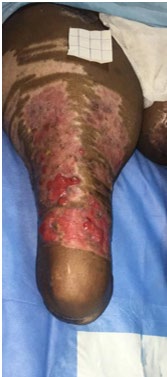
Informed written consent was taken from the patient. The details of the patient in study are as follows: 37 year old female with no known co morbidities with h/o road traffic accident 4 months back and underwent right below knee amputation due to vascular injury and degloving injury of the left lower limb for which serial debridement was done in cardiothoracic and general surgery department. Now, the patient presented to plastic surgery department with extensive raw area over the left lower limb and non-healing ulcer over the right below knee amputation stump (Figure 1). The regular dressing and antibiotic changes could not lead to wound healing. Wound bed preparation was done using modified CIS system.
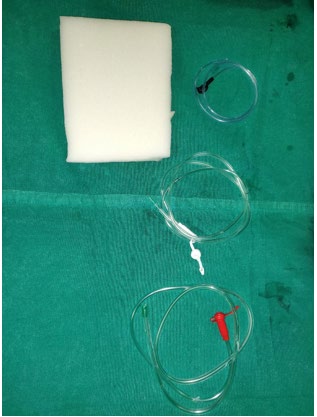
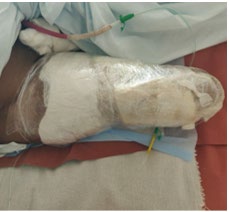
The modified continuous irrigation suction system was prepared using (1) 16F nasogastric tube which was used as suction tube (2) 8F infant feeding tube for flushing (3) 14 F nasogastric tube which is used as the irrigating fluid (4) polyvinyl alcohol white foam sponge (5) suction apparatus (Figure 2). The 8F infant feeding tube was inserted into the 16F nasogastric tube to provide an overlap of about 3 cm, and acted to provide flush of the suction tube to avoid blockage. The wound was continuously irrigated with antibiotic solution through the 14F tube according to the wound culture and sensitivity and a continuous suction of -125mm Hg through the 16 F tube .The modified CIS system was applied every three days (Figure 3). After 4 session of CIS system usage wound bed was reassessed.
Results
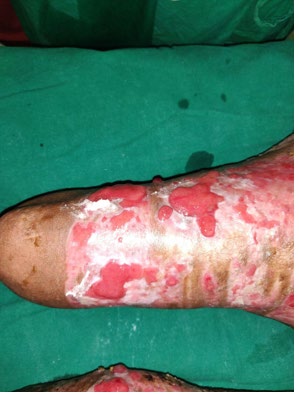
The wound bed showed good granulation tissue (Figure 4). Modified CIS system is found feasible as adjuvant modality of wound bed preparation.
Discussion
Wound bed preparation was redefined as ‘the global management of wound to accelerate endogenous healing or to facilitate the effectiveness of other therapeutic measures’. Wound bed preparation has been given by the acronym T.I.M.E with T for tissue: non-viable or deficient. I for infection/inflammation, M for moisture balance. E for epidermis which was later changed to E for edge. Wound debridement, control of inflammation form essential parts of wound bed preparation that stimulate the edge of the wound to migrate, however if they fail, advanced therapies can be used.
The continuous suction irrigation methods have been used before in medical treatment of infections, intra- abdominal abscesses, non-healing ulcers etc. It works on the principle of continuous irrigation of the ulcers to provide adequate moisture and removal of the microorganisms, hence providing control of infection [3]. The CIS has been modified before and was provided with an irrigation tube to avoid occlusion of the irrigation tube with debris, clot, infected material. The sterile environment provided by the CIS allows for wound healing and prevents development of infection which is detrimental for wound healing. The CIS In our study we have used the modified CIS for preparation of the wound bed and have been found to be useful. The amount of granulation tissue has increased and has allowed for better healing of the wound.
Conclusion
The modified CIS allowed for wound bed preparation as it allowed for better granulation tissue formation. However
this is single patient study and needs large population based studies for widespread use of the same.
References
-
Bhagavathi RG, Joseph J, Muram Reddy H, Sabapathy SR, Vahanan Natarajan M, et al. (2020) Modified Continuous Irrigation Suction System as A Tool in Limb Salvage with Impending Implant Exposure and Eschar. Indian J Plast Surg 53(2): 313-314.
-
Schultz GS, Sibbald RG, Falanga V, Ayello EA, Dowsett C, et al. (2003) Wound bed preparation: a systematic approach to wound management. Wound Repair Regen 11(1): S1-28.
-
Tribble DE (1972) An improved sump drain-irrigation device of simple construction. Arch Surg 105(3): 511- 513.
- Psychogenic Erectile Dysfunction in Late Adulthood: A Case Report on Clinical Intervention and Intimacy Restoration
- Clinical Trials on COVID-19 in 2025: A New Chapter in Global Health Research
- Innovations and Challenges in Contemporary Medical Clinical Trials: An Editorial Perspective
- Innovations and Challenges in Contemporary Medical Clinical Trials: A Critical Perspective
- Reimagining Clinical Trials: The Power of Continuous Feedback from Medical Reports
- Factors Influencing Brain Drain: Perspectives from a Medical School in Turkey