
Efficacy of Nasal Smear Eosinophil Count in Detecting Allergic Rhinitis in Children
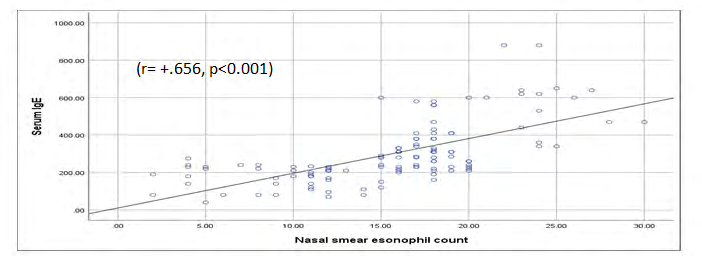
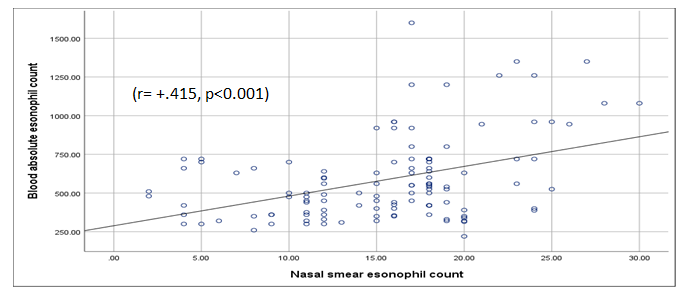
Introduction: Nasal smear eosinophil count is a simple test as well as noninvasive, can be repeated and inexpensive method for diagnosis of allergic rhinitis. Objective: To assess the eosinophil count in nasal smear as a diagnostic test for children with allergic rhinitis. Methods: This cross-sectional study was conducted at the Department of Laboratory medicine and Paediatrics, BSMMU, Dhaka from September 2019 to August 2020 in 120 children (Age up to 18 years both sex). Diagnosed patients of allergic rhinitis according to ARIA-WHO guideline with history and clinical feature who fulfilled the inclusion criteria were selected as study population. Nasal smears for eosinophil were stained using Giemsa stain and observed eosinophil under light microscope. Peripheral blood eosinophil count was estimated by hematology auto-analyzer (SYSMEX-XN 2000) and rechecked manually. The serum total IgE level was performed based on sandwich principle of ELISA. Results: Pearson’s correlation coefficient test revealed significant positive correlation between nasal smear eosinophil count with serum IgE and blood absolute eosinophil count. Conclusion: Nasal smear eosinophil count was significantly raised alone with absolute eosinophil count and serum IgE level with the severity of allergic rhinitis in children.
Introduction
Parents suffering from allergic rhinitis have a higher risk of developing allergy for children. Nowadays, it has become a common disease worldwide, affecting a large number of the population. It is estimated that over 20%–50% of the world’s population suffer from IgE mediated allergic disease such as rhinitis, asthma, rhino-conjunctivitis, eczema and anaphylaxis [1]. The prevalence of allergic diseases is about 20%-25% in Bangladesh (ISAAC, 2000). In spite of new techniques nasal smear eosinophil count for diagnosis of allergic rhinitis is important for diagnosis and prognosis of allergic rhinitis. The diagnosis of allergic rhinitis is based on a typical history of allergic symptoms and investigation. When two or more symptoms out of sneezing, watery rhinorrhea, nasal obstruction and nasal purities persist for ≥1 hour on most days, allergic rhinitis is strongly suspected. Some diagnostic tests like Skin Prick Test (SPT), Radio-Allergosorbent Test (RAST), estimation of IgE antibodies and Enzyme linked Immunosorbent assay (ELISA) are used for the diagnosis of rhinitis. But these are expensive, complicated, invasive and difficult to collect sample from children. Moreover it may be not possible to perform in peripheral set up [2]. Nasal smear eosinophil count could be a useful test for diagnosis of allergic rhinitis, which is simple, easy to perform, cost effective and would help early diagnosis and to assess patient outcome after treatment. The aim of the present study was designed to evaluate the diagnostic value of nasal smear eosinophil count for allergic rhinitis.
Materials and Methods
Study design: Cross sectional study
Place of study: This study was conducted at the Department of Laboratory medicine and Paediatrics, Bangabandhu Sheikh Mujib Medical University, Dhaka.
Duration of Study Period: September 2019 to August 2020 Study Population: Children with allergic rhinitis attended in Paediatrics OPD of BSMMU.
Sampling method: Purposive sampling
Study Procedure
- After ethical clearance from Institutional Review Board (IRB), diagnosed cases of allergic rhinitis attending in outpatient Department of Pediatric, BSMMU, were selected.
- After full explanation regarding the aims, objectives of the study and necessity of the investigations were explained to patients or guardian. Informed written consent was taken from patients or guardian.
- Blood and nasal secretion of allergic patient were drawn for serum IgE and eosinophil count. All tests were done in the Department of Laboratory Medicine, BSMMU.
Sample size: Sample size of patients of allergic rhinitis was 236. But due to pandemic situation based on the availability of patients, ultimately 120 patients among 236 patients were included in this study.
Nasal smear preparation: Nasal secretion was collected by asking the child to blow his/her nose into a plastic wrap and then placed on a glass slide. If insufficient secretion is obtained, cotton tipped swab was inserted into a nostril and left for 60 seconds and transferred onto a glass slide. A smear was made and allowed to air dry. The smear was stained using Giemsa stain and observed eosinophil under light microscope [3].
Blood sample collection: Blood sample was collected from antecubital vein under asepsis with 0.5% chlorhexidine gluconate. About 4 ml venous blood was collected into two plastic screw-capped tubes. Tube was labeled with the patient’s identification number. Sample processing and storage for IgE: Collected blood sample was kept in upright position for 30 minutes and then centrifuged in 3000 rpm for 5 minutes. After centrifugation, serum sample was separated in Eppendorf tube and marked accordingly. Sample containing Eppendorf tubes were then stored in -20˚C temperature and analysis was done in separate occasions. Peripheral blood smear preparation for eosinophil count: A small drop of blood was placed about 1 or 2 cm from one end of a pre-cleaned slide and immediately with a pre- cleaned edge was placed at an angle of 45 degrees and moved backwards to make contact with the drop. The drop of blood was spread quickly along the line of contact of spreader with the slide and allowed to air dry. Peripheral blood smear was studied using Leishman’s stain. Eosinophil count obtained from CBC which was estimated by hematology auto-analyzer (SYSMEX-XN 2000) using commercially available cartridge in the department of Laboratory Medicine.
Results
| Area Under the Curve | ||||
|---|---|---|---|---|
| Test Result Variable(s): Serum IgE | ||||
| AUC | Std. Error | p-value | Asymptotic 95% Confidence Interval | |
| Lower Bound | Upper Bound | |||
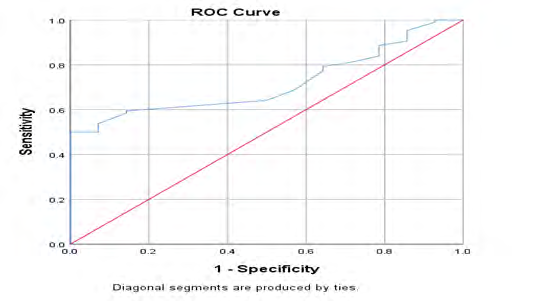
| .717 | .053 | .008 | .614 | .821 |
Table 1: ** Serum IgE.
Cut of value = 231.5 Sensitivity = 59.4% Specificity = 85.7% Table 1: Serum IgE.
| Area Under the Curve | ||||
|---|---|---|---|---|
| Test Result Variable(s): Blood absolute esonophil count | ||||
| AUC | Std. Error | p-value | Asymptotic 95% Confidence Interval | |
| Lower Bound | Upper Bound | |||
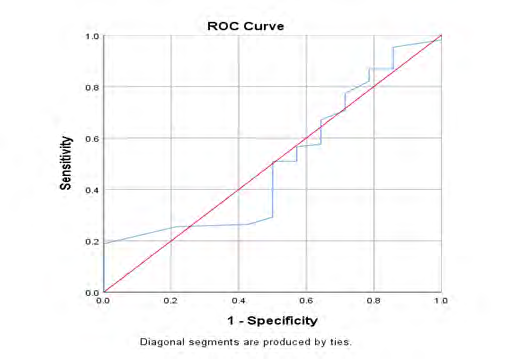
| .506 | .083 | .938 | .345 | .668 |
Table 2: ** Blood absolute esonophil count.
Cut of value = 5717.5 Sensitivity = 50.9% Specificity = 50.0% Table 2: Blood absolute esonophil count.
Discussion
Allergic rhinitis is one of the most common disorders of upper respiratory tract. Several biomarkers associated with allergic rhinitis have been the subject of research in last few decades. Nasal eosinophil provides valuable and timely diagnostic information for allergic rhinitis. Accumulation of eosinophil granulocytes is a characteristic feature of allergic diseases. It plays a pathogenic role in allergic disorders. During allergen challenge, eosinophils increase in number and release mediators. Therefore, there is a possible relation between nasal smear eosinophil counts with allergic rhinitis. This study aimed to evaluate the nasal smear eosinophil count as an alternative diagnostic in children with allergic rhinitis. In this study it was compared eosinophil count in nasal smear, peripheral blood smears and serum IgE level in children with different types of allergic rhinitis patient.
Total 120 patients attending in the outpatient department of Paediatrics in BSMMU were included. This study showed the relationship among severity of allergic rhinitis with different level of serum IgE, which was found statistically significant. Corsico, et al., have found that serum IgE level is significantly increased with severity of allergic rhinitis in children [4]. Ciprandi, et al. also have found that serum lgE concentration significantly differed among the different group of allergic rhinitis patients, which is statistically significant [5]. This study showed that blood eosinophil count is significantly increased with the severity in children with allergic rhinitis, which is statistically significant. Blood eosinophil count increased with severity of allergic rhinitis. Children with allergic rhinitis had significant blood eosinophil count. Lee, et al., found that there was a statistically significant difference of the blood eosinophil count among the 4 groups (Intermediate mild, intermediate moderate, Persistence mild and Persistence moderate) of allergic rhinitis patients. Nasal smear eosinophil count increase alone with severity of rhinitis [6]. Patel & Nagpal had found (91.43%) patients had a positive smear for eosinophils [2].
There was a good correlation of nasal smear eosinophil with severity of clinical score. These findings are nearly consistent with the findings of current study. Pearson’s correlation coefficient test was done in order to assess the correlation between nasal smear eosinophil counts with serum IgE. In the present shows the strong positive correlation of nasal smear eosinophil count with serum IgE. Pearson’s correlation coefficient test also assesses the correlation between nasal smear eosinophil counts with blood absolute eosinophil count. In the present study showed a moderate significant correlation of nasal smear eosinophil count with blood absolute eosinophil count. No such study was done to see the correlation between nasal smear eosinophil count with blood absolute eosinophil count and serum IgE. From the current study results, the nasal eosinophilia might be a contributing factor to the diagnosis of allergic rhinitis as compared to blood eosinophilia. It may help the physicians as an additional tool for diagnosed allergic rhinitis. It is a simple test for clinical use, which can be done in a small set up with minimal laboratory facilities. As blood collection from children is an invasive and complicated procedure, in that case nasal smear eosinophil count is an easy procedure. Therefore, measurement of nasal smear eosinophil in allergic rhinitis patients is a simple, cost effective and reproducible marker which can be easily determined.
Conclusion
Nasal eosinophil count contributes in diagnosis of allergic rhinitis. Nasal smear eosinophil count was significantly raised alone with absolute eosinophil count and serum IgE level with the severity of allergic rhinitis in children.
References
-
Chowdhury MA, Kabir AL, Alam MM (2009) Allergic rhinitis, asthma and atopic diseases: Bangladesh perspective. Bangladesh Journal of Othorhinolaryngology 14(2): 66-70.
-
Patel AK, Nagpal TP (2014) Comparison of blood absolute eosinophil count and nasal smear eosinophils with symptoms and severity of clinical score in patients of allergic rhinitis. Indian Journal of Allergy, Asthma and Immunology 28(2): 74-77.
-
Murayama N, Murayama K (2018) Nasal Discharge Eosinophils in Childhood Asthma Patients as a Predictive Factor for Persistent Asthma. Mediators of inflammation 2018: 2563978-2563978.
-
Corsico AG, De Amici M, Ronzoni V, Giunta V, Mennitti MC, et al. (2017) Allergen-specific immunoglobulin E and allergic rhinitis severity. Allergy & Rhinology (Providence) 8(1): 1-4.
-
Ciprandi G, De Amici M, Giunta V, Marseglia GL (2010) Comparison of serum specific IgE and skin prick test in polysensitized patients. International Journal of Immunopathology and Pharmacology 23(4): 1293- 1295.
-
Lee CH, Jang JH, Lee HJ, Kim IT, Chu MJ, et al. (2008) Clinical characteristics of allergic rhinitis according to allergic rhinitis and its impact on asthma guidelines. Clinical and experimental otorhinolaryngology 1(4): 196-200.
- Psychogenic Erectile Dysfunction in Late Adulthood: A Case Report on Clinical Intervention and Intimacy Restoration
- Clinical Trials on COVID-19 in 2025: A New Chapter in Global Health Research
- Innovations and Challenges in Contemporary Medical Clinical Trials: An Editorial Perspective
- Innovations and Challenges in Contemporary Medical Clinical Trials: A Critical Perspective
- Reimagining Clinical Trials: The Power of Continuous Feedback from Medical Reports
- Factors Influencing Brain Drain: Perspectives from a Medical School in Turkey