
JIPMER Protocol for Teleconsultation during COVID-19- Plastic Surgery Experience
Aim is to study the role of Telemedicine during COVID-19 crisis. At the time of pandemic when safe distancing practices and staying at home are being practiced it becomes imperative that social distancing is maintained even during clinical practice and doctor-patient interactions in healthcare institutes. A practical method of following this practice would be to adopt the utility of telemedicine practices.
Introduction
In December 2019 World Health Organization declared COVID-19 (Corona Virus Disease-2019) as a pandemic affecting various countries including India. WHO advised social distancing to prevent spread of disease from health care workers to patients, from one patient to another patient, from patient to attendant, from attendant to attendant. Telemedicine plays an important role in patient healthcare worker interaction transcending physical distant barriers, thus preventing spread of disease. Online consultations have become the norm. Patient follow up and consultations can be done through telemedicine without the patient being called to the healthcare facility amidst the growing corona pandemic. Implementation and usage of telemedicine requires following certain rules and guidelines for its proper execution and prevention of unnecessary medicolegal issues. This study was conducted in the department of plastic surgery, Jawaharlal Institute of Postgraduate Medical Education and Research (JIPMER) during the COVID-19 crisis highlighting Conceptual Paper the role of telemedicine in providing teleconsultations while following necessary guidelines as provided by the institution.
Materials and Methods
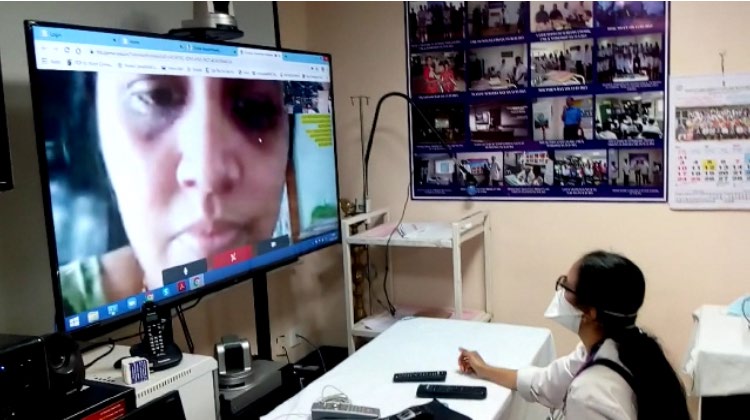
This study was conducted in the plastic surgery department in a tertiary care center in the month of March- August 2020. Informed consent was taken from the patient. Departmental ethics committee clearance was obtained. The patients were attended through teleconsultations (Figure 1), through the institute telemedicine portal using the JIPMER in-house software as well as the departmental telemedicine follow-up clinic. Various guidelines and rules regarding telemedicine and teleconsultations were searched and implemented during the teleconsultation sessions. Before initiating the process of teleconsultation, the healthcare providers were briefed about the procedure as a whole including various guidelines to be followed. At the end of the teleconsultation sessions feedback was taken from the health care worker and patients regarding their experience and any difficulties faced by them if any.
Steps to be Followed
Step 1: Patient or Caregiver makes contact with the department’s assigned telemedicine number or e-mail ID with the following details: (1) Name, Age, Gender (2) Hospital Number (3) Copy of CCR front sheet bearing these details (4) Copy of Aadhaar Card, Voter ID card, Bank Passbook (with photo attested), Driving license etc., and (5) Copy of the record of the recent (including the latest) visits made to JIPMER Step 2: Physician verifies these details to his satisfaction. If in doubt, a video call may be made to ensure patient identification based on above records. (or) Physician can try to verify the registered mobile number of the patient by cross-checking with the hospital database (in case of voice calls) Physician introduces oneself to the patient (by Name, Designation, Department, JIPMER Step 3: In case the patient has not made any previous contact with the department (or) In case the patient has a fresh complaint that is not a part of pre-existing illness (or) In case the patient has not followed up within the last 6 months at JIPMER. Consider it as a “New Case” (briefly mentioned in Box A) Step 4: Consent for telemedicine consultation is to be given by the patient. It is implied when patient initiates the consultation. A verbal consent can still be taken. Caregiver consent is valid only in the case of minors, or when patient in incapacitated, or if the patient has explicitly given consent for an identified caregiver to teleconsult on his/her behalf.
Step 5: Physician has to assess if there is an emergency (or) if there is a need for in-person consultation to provide optimum medical care. Physician ends the telemedicine consultation and advises for in-person medical consultation either at the nearest healthcare facility or JIPMER as per circumstances such as patient location and the patient’s condition. Step 6: Physician proceeds with history taking, examination, review of available investigations and arrive at a Diagnosis or Provisional Diagnosis. Physician may advise for examination by nearby healthcare worker or RMP as available or. Step 7: Physician can give general health advice for every patient as well as counseling that is specific for the patient’s health condition. A prescription may be issued only if physician is satisfied with the teleconsultation assessment further investigations if it is essential before proceeding further with the consultation.
Step 8: The prescription is sent to the patient after duly signing it and stamping it in the prescribed format. It is usually sent to the patient. Only upon the patient’s consent it can be sent to any pharmacist directly (as in patients who have only voice call facility).
Medications that can be Prescribed Box A: New Case situations: (patient should be having JIPMER file) may be handled at the physician’s discretion for cross-department referrals. Voice: Consultation Of new case may be handled with drugs in List O#. Video: Consultation of new case may be handled with drugs in List A#.
Box B: Follow-up Situations: The medications that the patient is already taking may be prescribed again (List A#). Medications required for optimization of illness- management (List B#) may be added on #- List O, List A, List B, List C are as per the Telemedicine Guidelines issued by the Board of Governors in supersession of the Medical Council of India, 25th Mar 2020. Documents to be maintained to avoid medicolegal issues.
It is suggested that the physician use the single page format given in this document for documentation of consultation notes as well as the prescription.
The patient may be advised to take a print out of it and paste it onto their CCR.
The departments may retain the teleconsultation documents with themselves or MRD to be later attached to the patient’s CCR Patients must be asked to buy medications locally from a pharmacy close to their homes and avoid travel to JIPMER just for the sake of free medications. Otherwise, it would defeat the purpose of lockdown and the efforts to curb the spread of COVID infection
Results
Proper knowledge about the teleconsultation process helped in finding answers to frequently asked questions and doubts regarding telemedicine. Healthcare workers were able to carry out teleconsultations and provide necessary healthcare at the time of corona pandemic.
Discussion
WHO defines telemedicine as “The delivery of health care services, where distance is a critical factor, by all health care professionals using information and communication technologies for the exchange of valid information for diagnosis, treatment and prevention of disease and injuries, research and evaluation, and for the continuing education of health care providers, all in the interests of advancing the health of individuals and their communities” [1]. Telemedicine is the death of distance. Telemedicine gains even more importance during special conditions like a global pandemic like COVID-19. Practicing social distancing is the need of hour and telemedicine aids patients in accessing healthcare facilities from remote areas.
The COVID pandemic has changed the way healthcare facilities around the world function. There is an upsurge of telemedicine consultations worldwide especially for non- COVID health conditions. Thus, it has become an utmost necessity to equip oneself with all the techniques and varied methods of practicing telemedicine.
Various questions and doubts emanate regarding proper implementation of telemedicine, especially in the minds of many who are not exposed to teleconsultation especially in developing countries. More so in primary healthcare facilities.
Video consultation is an important part of telemedicine and teleconsultation. These may be utilized in surgical context especially during initial visits of the patients, postoperative follow up of the patient, wound, surgical site etc. Through video consultation one can evaluate the wound healing, discharge, presence of exudate, etc. Patients can also send photos and videos to the consultant and progress of their physiotherapy sessions and rehabilitation etc. Notably, novel adaptations of remote consulting have been developed for nonurgent settings such as ‘store and-forward telemedicine’ which allows the collection of relevant patient data e.g. patient complaints and physical findings by transfer of images or video to the consultant for later evaluation. Also, multidisciplinary approach can also be carried out through telemedicine, wherein the surgeon and the physiotherapist both can engage in teleconsultation with the patient at the same time [2]. Video consultation is ideal for postoperative and routine patient follow up.
Successful implementation of teleconsultation through video conferencing requires various platforms and technical support. The issues of time lag and poor audio-visual quality due to insufficient bandwidth can be significant enough to inhibit meaningful communication, resulting in poorer patient and clinical satisfaction. Many healthcare facilities lack sufficient bandwidth for video call services. 11 Mbps is a minimum for a high-quality call, but 50 Mbps is ideal [3, 4, 5]. Many specifically designed platforms are currently available for remote consultation [3]. Patients can access video or telephone consultation services either directly through a link or app, or via clinician referral following completion of an online form. Non healthcare specific products such as Skype, WhatsApp and Facetime can also be used for teleconsultation.
Clinical good practices guidelines need to be followed during teleconsultation as during routine consultation. Patient needs to be registered and his/her identity needs to be confirmed during teleconsultation. The treating doctor needs to maintain data of the patient details for future consultations. Although consent is considered to be implied by the patient accepting the invite and entering the consultation it is best practice to take and record consent for a virtual appointment. If the session is being recorded, prior consent needs to be taken for the same [6].
Regarding confidentiality, the clinician needs to be in a private, well-lit space, and should ask the patient to do the same in order to ensure the physical privacy of the consultation on either end. It is vital for all staff in the consultation to introduce themselves, whether they are on camera or not. Reassuring patients that their privacy is to be respected is particularly important on video calls [7]. Chaperones may be offered as in real practice. It is advisable to know beforehand if a family member, friend or another healthcare professional will be accompanying the patient during the consultation addressing. While it is not necessary to look at the camera to demonstrate that one is paying attention, the patient should be informed if the clinician is taking notes, both to ensure nothing is missed and to avoid the appearance of rudeness. As with normal practice, summarizing key points at the end of the consultation is an effective way to establish nothing was misunderstood due to interference [7]. Before closing the connection, the patient should be informed that the call is going to end.
There are medicolegal aspects of teleconsultation during online consultations, patients seek help from clinicians with limited information and thus online consulting can pose a risk for both parties. Often proper patient evaluation is not possible especially physical examination is not possible.
All these can at times cause hinderance in making a proper diagnosis and starting appropriate treatment. The patient and the clinician must understand the shortcomings of the process.
Conclusion
In our study we found that remote consultations are convenient for patients and cost effective for organisations especially during the time of pandemic but also may raise misgivings among clinicians who worry about clinical risk and technical aspects. If proper rules and guidelines are followed teleconsultation can easily be made part of our routine medical practise even at the primary healthcare level. If we are to truly integrate remote consulting into routine medical services then awareness and education about these services must be implemented across all levels of medical training.
References
-
WHO (1998) A health telematics policy in support of WHO’s Health-For-All strategy for global health development: report of the WHO group consultation on health telematics, 11–16 December, Geneva, 1997. Geneva, World Health Organization.
-
Peter K, Gregory H, Ishta S (2020) The rules for online clinical engagement in the COVID era. JPRAS.
-
Tool 4: Virtual consultations — Royal College of Surgeons.
-
Donaghy E, Atherton H, Hammersley V, Hannah McN, Bikker A, et al. (2019) Acceptability, benefits, and challenges of video consulting: A qualitative study in primary care. British Journal of General Practice 69: E586–E594.
-
Almathami HKY, Win KT, Vlahu GE (2020) Barriers and Facilitators That Influence Telemedicine-Based, Real- Time, Online Consultation at Patients’ Homes: Systematic Literature Review. J M Internet Res 22(2): e16407.
-
COVID-19 Information Governance advice for staff working in health and care organisations - NHSX.
-
(2020) Specialty guides for patient management during the coronavirus pandemic Clinical guide for the management of remote consultations and remote working in secondary care during the coronavirus pandemic.
- Psychogenic Erectile Dysfunction in Late Adulthood: A Case Report on Clinical Intervention and Intimacy Restoration
- Clinical Trials on COVID-19 in 2025: A New Chapter in Global Health Research
- Innovations and Challenges in Contemporary Medical Clinical Trials: An Editorial Perspective
- Innovations and Challenges in Contemporary Medical Clinical Trials: A Critical Perspective
- Reimagining Clinical Trials: The Power of Continuous Feedback from Medical Reports
- Factors Influencing Brain Drain: Perspectives from a Medical School in Turkey