
A Descriptive Study to Assess the Knowledge and Attitude Regarding Behavioural Disorders in Children among Primary School Teacher in Selected Government Primary School in Nadiad Taluka
Introduction: Behavioural disorders are defined as patterns of behaviours in children that are disruptive and that have resulted in problems at schools, home or in social situations. As children grow into early childhood, their world expands, and they become increasingly independent. Aim: The aim of the study was to assess the knowledge and attitude of government primary school teachers regarding behavioural disorders in children, and to explore the association between knowledge, attitude, and demographic variables. Methods: The descriptive research design was used. purposive sampling technique was used to select samples. A selfadministered questionnaire was used to examine their sociodemographic profile, structured questionnaire for knowledge and Likert`s scale was used to assess attitude. Result: The result shows that total 100 government primary school teachers had participated, the result revealed that 94 (94%) teachers had adequate knowledge and 6 (6%) had moderate knowledge and for the attitude 98 (98%) had favourable attitude and 2 (2%) had moderate attitude. Conclusion: This study concluded that government primary school teachers mostly had adequate knowledge and favourable attitude regarding behavioural disorders in children.
Sharma S¹*, Chauhan M², Patel M², Katara M², Bhoi M² and Chavda N²
¹Assistant professor, Dinsha Patel College of Nursing, India ²Nursing Student, Dinsha Patel College of Nursing, India
Introduction
As children grow into early childhood, their world will begin to open up. They will become more independent and begin to focus more on adults and children outside of the family. They will want to explore and ask about the things around them even more. And their interactions with family and those around them will help to shape their personality and their own ways of thinking and moving [1].
In today’s fast paced world, almost every mother will tell you that she has a problem child on her hands. But this is really not the common case. One has to face basic problems and tensions while bringing up the child. But these problems are common to most parents, and are not necessarily symptomatic of a behavioural disorder that requires psychological counselling or treatment [2].
Behavioural disorders are defined as patterns of behaviours in children that are disruptive and that are disruptive and that have resulted in problems at schools, home or in social situations.
There is no single cause of behavioural disorders. Common risk factors that increase the chances of a child developing a behavioural disorder, however, include: prenatal alcohol/drug exposure, permissive parenting, lack of or inconsistent parental discipline, parental modelling of alcohol/drug use, sensation seeking, child abuse, peer rejection, poverty, school failure/phobia, poor attachment with parents, lack of adult supervision, and deviant friend groups [3].
Sometimes behaviours might be viewed as problems because they do not confirm to what a child is expected to do in a particular setting. In such cases, recognizing a child’s needs and characteristics can help parents, teachers, and caregivers adapt experiences and provide interventions and accommodations that will help ease stress and allow kids to engage with their environment in a way that works for their individual needs [4].
Methods
This descriptive study was conducted after institutional ethical committee approval. A structured knowledge questionnaire and Likert’s attitude scale was circulated to 100 government primary school teachers from the selected government primary schools in Nadiad taluka by purposive sampling technique from 03/07/2024 to 05/07/2024. For knowledge questionnaires, the total score is 10. The category was calculated as <50% inadequate knowledge, 51-74% moderate knowledge, >75% adequate knowledge. For attitude scale, the total score is 50. The category was calculated as, <50% unfavourable attitude, 51-74% moderate favourable attitude, >75% favourable attitude. The teachers were included from selected government primary schools in Nadiad taluka. The association between knowledge and attitude with their selected demographic data.
Results
Demographic data of shows that out of 100 samples of primary school teachers were belonging 37(37%) to 40- 50 years of age, 56(56%) were males, 67(67%) had PTC as educational status, 83(83%) had >10 years of experience, 65(65%) were living with joint family, 92(92%) were married, 50(50%) had 2 children in the family, 87(87%) said No regarding attending any training of behavioural problems (Table 1).
| SR NO. | Demographic Variable | Frequency | Percentage |
|---|---|---|---|
| 1 | Age | ||
| 20-30 years | 10 | 10 | |
| 30-40 years | 20 | 20 | |
| 40-50 years | 37 | 37 | |
| Above 50 years | 33 | 33 | |
| 2 | Gender | ||
| Male | 56 | 56 | |
| Female | 44 | 44 | |
| 3 | Educational Status | ||
| B.A.Ed. | 16 | 16 | |
| M.A.B. Ed | 14 | 14 | |
| M.A.M. Ed | 3 | 3 | |
| PTC | 67 | 67 | |
| 4 | Years of Experience | ||
| A) Less than 3 years | 10 | 10 | |
| B) 4-6 years | 5 | 5 | |
| C) 7-10 years | 2 | 2 | |
| D) Above 10 years | 83 | 83 | |
| 5 | Types of Family | ||
| A) Nuclear family | 35 | 35 | |
| B) Joint family | 65 | 65 | |
| 6 | Marital Status | ||
| A) Married | 92 | 92 | |
| B) Unmarried | 6 | 6 | |
| C) Divorce | 1 | 1 | |
| D) Widow and widower | 1 | 1 | |
| 7 | Number of Children in Family | ||
| A) None | 11 | 11 | |
| B) 1 | 30 | 30 | |
| C) 2 | 50 | 50 | |
| D) 2 or above | 9 | 9 | |
| 8 | Have you attended any training of behavioural problems? | ||
| A) Yes | 13 | 13 | |
| B) No | 87 | 87 |
Table 1: frequency and percentage distribution of demographic variables among Primary school teachers N=100.
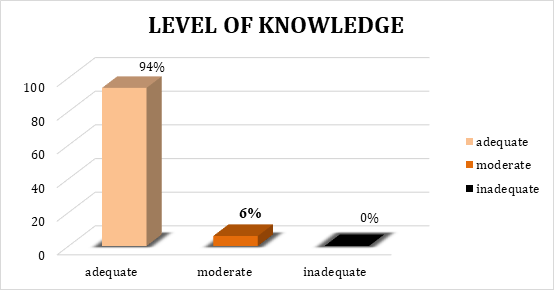
The higher number of government primary school teachers had adequate level of knowledge 94(94%) (Table 2).
| Level of Knowledge | Frequency | Percentage |
|---|---|---|
| Inadequate | 0 | 0 |
| Moderate | 6 | 6 |
| Adequate | 94 | 94 |
Table 2: frequency and percentage distribution of knowledge among primary school Teachers N=100.
The above table 2 shows the level of knowledge regarding behavioural problems among primary school teachers. Out of 100 primary school teachers none of them have inadequate knowledge, 6(6%) have moderate knowledge, 94(94%) have adequate knowledge.
The higher number of government primary school teachers had favourable attitude (Table 3).
| Level of Attitude | Frequency | Percentage |
|---|---|---|
| Favourable | 98 | 98 |
| Moderate | 2 | 2 |
| Unfavourable | 0 | 0 |
| Total | 100 | 100 |
Table 3: frequency and percentage distribution of attitude among primary school teachers N = 100.
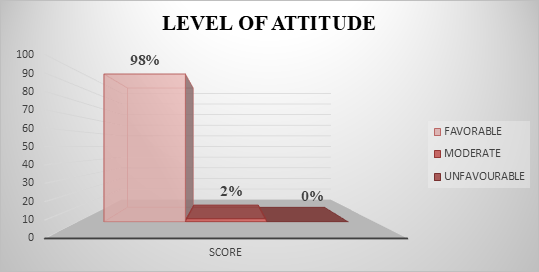
This above table 3 shows the level of attitude regarding behavioural problems among primary school teachers. Out of 100 teachers none of have unfavourable attitude, 98(98%) have favourable attitude, 2(2%) have moderate favourable attitude.
Karl Pearson’s formula was used to find out the association between knowledge and attitude of primary school teachers towards primary school children’s. The observed r value was r= 0.77 that means there is a positive correlation between knowledge and attitude. The association between demographic variable, knowledge and attitude and selected demographic variables was done with Chi square formula. The obtained X 2 value in all variables is less than the table value of X 2 at 0.05 level of significance. Hence the obtained 2 value is significant and other X 2 value is not significant. There is no association between demographic variable, knowledge and attitude and (H1) Hypothesis is rejected. All the selected variables were found to be not significant.
Discussion
A study conducted by Rani R, et al. [5] conducted A Study to Assess the Knowledge and Attitude Regarding Selected Behavioural Disorders among Mothers of Preschool Children in Rural Areas of Faridkot, Punjab. A quantitative approach and descriptive research design were used for the study. The sample size was 100 mothers of preschool children, selected by non-probability purposive sampling technique. The data was collected by a self-structured knowledge questionnaire and attitude scale. The result revealed that the mean ± SD for the level of knowledge and attitude of mothers of preschool children were 19.79±2.84 and 39.96 ± 7.87 respectively. The relationship between knowledge and attitude was found to be 0.6. Hence, it was concluded that there was a moderate relationship between knowledge and attitude scores among mother’s preschool children. From the findings of the study following conclusions were drawn the majority of mothers of preschool children had average knowledge and the majority of mothers of preschool children had a positive attitude [5]. Another study was conducted by Chavan AN, et al. [6] conducted a study on effectiveness of planned teaching on knowledge regarding and attitude towards behavioural problems of primary school children among their teachers. The study was conducted on 60 primary teachers from selected primary schools. Investigators prepared questionnaire and five-point Likert scale was used to collect data for this one group pretest post-test study. The result shows the difference in the mean for knowledge and attitude was statistically significant at 5% level of the significant. It concluded that the effectiveness of structured teaching programme where the pretest name was less than the post- test mean knowledge score (14.8+3.37, 22.75+2.80). Thus, the planned teaching is effective intervention [6]. According
to Kalpana T [7]. The study conducted on Effectiveness of Structured Teaching Programme regarding Childhood Behavioral Problem on Knowledge and Attitude on Selected Primary School Teachers, portance Tirupathi A. P. India. The research design applied for this study will be one group pretest post - test design. The study was conducted at the government elementary school with 30 primary school teachers by using non - probability purposive sampling will be adapted to select the samples of the study. The result shows the mean pre - test and post - test knowledge scores of respondents was 17.97 and 27.02 respectively.2. The mean pre - test and post - test attitude scores of respondents were 70.13 and 86.8respectively.3. Comparison of the mean pre - test and post - test knowledge scores the „t‟ value 15.052 significant at 0.05 levels which indicate that there is a significant difference between the knowledge level of the teachers before and after the implementation of the structured teaching program [4]. comparison of the mean pre - test and post - test attitude score, the „t‟ value 11.336 significant at 0.05 level which indicate that there is a significant difference between the attitude level of the teachers before and after the implementation of the structured teaching program there is no association between the post - test knowledge and attitude scores of the teachers. The study revealed that there is inadequate knowledge and attitude regarding childhood behavioral problems for the teachers [7].
Our study states that government primary school teachers had adequate knowledge and favorable attitude regarding behavioral disorders in children.
Conclusion
According to finding of this study, maximum government primary school teachers had adequate knowledge and favorable attitude. There is positive correlation of r=0.77 between knowledge and attitude. There is significant association between demographical variable gender with knowledge and attending previous training of behavioural disorders with attitude, while other demographic variables are not significantly associated. This shows importance of knowledge, that will significantly affect the attitude regarding the behavioural disorders in children.
Limitation
Since the study focuses only on 100 government primary school teachers in specific government school in Nadiad taluka, the findings may not be applicable to the general population. The teachers who are taking class from 1to 8 standard and the teachers who were willing to participate in the research study. As a descriptive study, the study only assess levels of knowledge and attitude in the teachers.
Conflicts of Interest
None. References
1. (2024) Preschoolers (3-5 years old of Age). Centers for Disease Control and Prevention.
2. (2024) Introduction to Behaviour Disorders.
3. (2024) Common Behavioural Disorders in Children. Medical News Today.
4. Cherry K (2022) Types of Behavioural Disorders in Children. Verywell Mind.
5. Rani R, Kaur G, Kaur R (2022) A Study to Assess the Knowledge and Attitude Regarding Selected Behavioral Disorders among Mothers of Preschool Children in Rural Areas of Faridkot, Punjab. International Journal of Neonatal Care and Pediatric Nursing 3(2).
6. Chavan AN, Tendulkar VD (2018) Effectiveness of Planned Teaching Programme on Knowledge and Attitude towards Behavioural Problems of Primary School Children among their Teachers. Global Journal for Research Analysis 7(2): 84-88.
7. Kalpana T (2023) Effectiveness of Structured Teaching Programme Regarding Childhood Behavioural Problem Knowledge and Attitude on Selected Primary School Teachers, Tirupathi, A.P. India. International Journal of Science and Research (IJSR) 12(11): 741-746.
- Teaching Cognitive Behavioral Therapy to Graduate Psychiatric Mental Health Nurse Practitioner Students: Utilizing A Mixed Methods Course Evaluation
- The Role of Pharmacogenetic Testing in Clinical Practice: A Path toward more Effective, Personalized and Cost-effective Care
- Implementing Screening with the GAD-7 in an Outpatient Mental Health Setting: A Quality Improvement Project
- Social Media and Health Promotion
- Impact of Covid-19 Pandemic on the Academic Performance and Attitude of Nursing Students towards E-Learning
- A Study to Assess the Knowledge Regarding Ill Effects of Tobacco Consumption on Health among Adolescents in Selected Higher Secondary School in Nadiad City