
The Relationship between Nanoparticles and Homeopathic Medicine: A Mini Review
Homeopathic medicine, rooted in the late 18th century by Samuel Hahnemann, operates on the principle of "like cures like" and involves administering highly diluted substances to treat symptoms. Despite its widespread use, homeopathy faces skepticism due to the extreme dilutions often beyond Avogadro's number, implying no molecules of the original substance remain. Recent advancements in nanotechnology suggest a potential role for nanoparticles in homeopathic remedies, bridging traditional practices and modern science. This mini-review explores the preparation of homeopathic remedies, which involves serial dilution and succussion, and presents evidence from a 2010 IIT Bombay study that detected nanoparticles in highly diluted homeopathic solutions. These findings challenge conventional views and propose potential mechanisms of action for homeopathic remedies, including biological interactions, energy transfer, and catalytic effects. While the presence of nanoparticles offers a plausible explanation for homeopathy's effects, the field remains controversial, necessitating rigorous, reproducible studies to validate these findings. This review highlights the integration of nanotechnology into homeopathic research, suggesting a promising path toward scientific acceptance and a deeper understanding of homeopathy's place in modern medicine.
Abbreviations
DNA: Deoxyribonucleic Acid.
Introduction
Homeopathic medicine, a system of alternative medicine developed in the late 18th century by Samuel Hahnemann, is based on the principle of “like cures like.” It posits that a substance causing symptoms of a disease in healthy people would cure similar symptoms in sick people when administered in highly diluted forms. Despite its widespread use and anecdotal success, homeopathy has faced skepticism from the scientific community due to its principles and the high dilutions involved, often beyond Avogadro’s number, implying that no molecules of the original substance remain. In recent years, advancements in nanotechnology have opened new avenues of investigation, leading to intriguing hypotheses about the role of nanoparticles in homeopathic remedies. This article explores the relationship between nanoparticles and homeopathic medicine, aiming to bridge the gap between traditional practices and modern science [1].
Nanoparticles: A Brief Overview
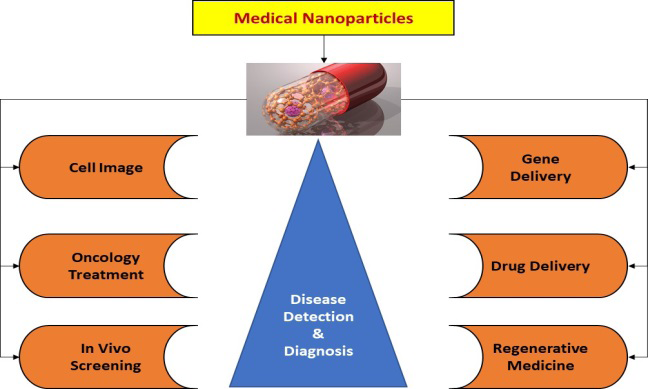
Nanoparticles are particles between 1 and 100 nanometers in size. They possess unique physical and chemical properties due to their small size and high surface area-to-volume ratio. These properties have been harnessed in various fields, including medicine (Figure 1), electronics, and environmental science. In medicine, nanoparticles are used for targeted drug delivery, imaging, and as therapeutic agents due to their ability to interact at the cellular and molecular levels. Nanoparticles are particles with at least one dimension less than 100 nanometers. Due to their small size, they exhibit unique physical and chemical properties that differ significantly from their bulk counterparts. These properties make nanoparticles particularly useful in various fields, including medicine, electronics, and materials science. In medicine, nanoparticles are used for targeted drug delivery, imaging, and as therapeutic agents due to their ability to interact with biological systems at the molecular level [2].
Homeopathy and Nanoparticles: The Connection
Preparation of Homeopathic Remedies
Homeopathic remedies are prepared through a process called potentization, which involves serial dilution and succussion of a substance. Critics argue that the extreme dilutions leave no trace of the original substance, making it scientifically implausible for the remedy to have any effect. However, recent studies suggest that nanoparticles of the original substance may remain even at high dilutions. One of the core principles of homeopathy is the process of dilution and dynamization (also known as potentization). Homeopathic remedies are prepared by repeatedly diluting a substance in water or alcohol and then vigorously shaking the solution. Critics argue that this process often results in dilutions so extreme that no molecules of the original substance remain. However, recent research suggests that nanoparticles of the original substance may persist in homeopathic solutions, potentially providing a scientific basis for their efficacy [3].
Evidence of Nanoparticles in Homeopathic Remedies
Several studies have detected the presence of nanoparticles in homeopathic remedies, even at high dilutions. For instance, a study conducted by Chikramane, et al. [4] found that homeopathic remedies contained measurable amounts of nanoparticles of the starting material. These findings challenge the notion that homeopathic solutions are devoid of any active ingredients and suggest that nanoparticles may play a role in the observed therapeutic effects. Research conducted by IIT Bombay in 2010 provided compelling evidence for the presence of nanoparticles in homeopathic medicines. Using electron microscopy and other analytical techniques, the researchers detected nanoparticles of the starting materials in highly diluted homeopathic solutions. This finding challenges the conventional understanding that no molecules remain in high-potency homeopathic preparations and opens the door to understanding the possible mechanisms of action [4].
Mechanisms of Action
The unique properties of nanoparticles might explain some of the mechanisms of action proposed for homeopathic remedies. Due to their small size, nanoparticles can easily penetrate biological membranes, interact with cellular components, and modulate biological pathways. This interaction at the nanoscale could trigger physiological responses that align with the principles of homeopathy, such as stimulating the body’s self-healing processes. The presence of nanoparticles in homeopathic remedies suggests several potential mechanisms of action: Bhattacharyya SS, et al. [5] Numerous prospective devices, comprising nucleic acid impairment, cell barrier and cell tissue damage concluded depths and hovels, disruption of standard chamber structure and utility, protein oxidation, interruption of electron conveyance, inhibition of cell division, establishment of reactive oxygen species and squalor.
Biological Interaction: Nanoparticles can interact with biological systems at the molecular level. They may bind to specific receptors or enzymes, triggering physiological responses that contribute to healing. Adjacent to inflowing of biotic solutions, wangled to nanomaterials can hastily interrelate thru innumerable biomolecules, which principally encompass the three ensuing aspects i.e., adsorption of biomolecules on the exterior of nanomaterials, founding protein aura, modernization and revolution of efficient proteins and redox Chakraborty S, et al. [6]. Bio-Nano interfaces with well-defined alliances, concerning nanoscale entities and organic structures, nevertheless not restricted to peptides, proteins, lipids, DNA and other biomolecules, cells and cellular receptors and organisms. Biological nanoparticles are logically stirring nanoparticles of 1–100 nm are assorted configurations with wide ranging biological roles. Biological nanoparticles are often biocompatible and consume reproducible edifice, potentially the biomedical solicitations of natural nanoparticles are miscellaneous. Energy Transfer: Homeopathy posits that the process of succussion transfers energy to the diluent, which may be stored and transmitted by nanoparticles. This energy could influence cellular functions and promote healing. The efficiency of homeopathy is hitherto to be recognized by medical science, which seldom to auxiliary predictable remedial usage of solemn illnesses or contagions. While Homeopathic medicines are not deliberated in solitary unfavourable, nevertheless measured hazardous if a person trusts as an additional for conservative healing action while allocating through grim of ailments or toxicities Dantes F, et al. [7]. If preferred to cogitate homeopathy the researches are precise efficiency, pursue the amenities of an enumerated. Catalytic Effects: Nanoparticles may act as catalysts in biochemical reactions, enhancing the body’s natural healing processes even in the absence of the bulk material. Nanomaterial-based catalysts are usually heterogeneous catalysts broken up into metal nanoparticles in order to enhance the catalytic process. Metallic nanoparticles partake great superficial zone, which can upsurge catalytic activity. Nanoparticle catalysts can be effortlessly unglued and salvaged which emergence the resulting three chattels i.e., accurate dimension, extraordinary facade to capacity, aggregate the figure of grains on the apparent mode Loudon I [8]. These are furthermost imperative motives for the advent of catalytic properties in nanomaterials Voluminous conjugated polymers are notorious to retain great immersion which constants the unusual fluorescence quantum competence. In electroluminescent strategies, dynamism repositions the extensively hired as a tactic for amendment the radiation colour and ornamental the quantum adeptness.
Scientific Scrutiny and Future Research
While the presence of nanoparticles in homeopathic remedies offers a plausible explanation for their effects, the field remains controversial. Critics argue that more rigorous, reproducible studies are needed to validate these findings and understand the precise mechanisms involved. Double- blind, placebo-controlled trials, coupled with advanced Nano technological analysis, could provide the scientific rigor required to establish the efficacy of homeopathic treatments Chakraborty S, et al. [6]. Cellulosic nanomaterials partake validated prospective solicitations in an inclusive grouping of industrial divisions, comprising with dynamism, healthiness, precaution and nutriment. In forthcoming, nanotechnology might be empowering objective to fruitage vitality to their atmosphere Bell IR, et al. [9]. New Nano-materials and theories are presently existence to technologically advanced the budding, intended for fabricating drive from effort, graceful, deviations in illness, glucose and supplementary cradles with great transfiguration of competence.
Future Directions
The convergence of nanotechnology and homeopathy opens up new avenues for research and potential validation of homeopathic principles. Future studies should focus on.7 The versatility of nanomaterials principal is supremacy bases for convenient, as thriving to assimilation of corporeal atmospheres and biomedical systems. Nanotechnology has directed to the development of smaller and more efficient devices with tremendous molecular scale because Homoeopathic medicines equipped at such high attenuations with no corporeal existence of unfluctuating a solitary fragment of the inventive constituent is alleged to academically incredible but it has been Upadhyaya RP, et al. [10]. Nanoparticles can exist and envisioned to target categorical cells or tissues, like malicious growth cells, and conveyance the medication impartial when they attain at unprejudiced spot. One of the core reimbursements of Nano medicine to facade the triumph which reinstates the specific body cells or tissues, assembly the usage further accurate and effective.
Characterizing Nanoparticles: Detailed characterization of nanoparticles presents in homeopathic remedies, including their size, composition, and concentration. Homoeopathic
drug dynamization theory was introduced by Dr. Samuel Hahnemann in 5th edition of Organ on of Medicine in 1926. Absenteeism of contemporary technical aid to sustenance this theory commanded to resilient disparagement from contemporary beneficial method, awaiting the routine of new-fangled tools like altered microelectronic optical microscope which verified the occurrence of nanoparticles in Homoeopathic ultra-diluted medicines, intact it reveal the assets parallel to nanoparticles like genetic factor appearance, electromagnetic, machine-driven, photosensitive, thermal, biochemical, organic and substantial goods instigating enriched bioavailability, amplified reactivity and adsorptive capability resultant in adaptive vagaries of Hormesis Loonat A, et al. [11]. These scientific proofs partake linked the widespread cavity amid the Homoeopathic Philosophy and Modern Science. Mechanistic Studies: Investigating the biological mechanisms through which these nanoparticles interact with cells and tissues. Homeopathic medicines are primed through a representative procedure recognized as potentization, where sequential enfeeblements are implemented with resilient blows at apiece phase of attenuation. Homeopathy is debated because most medications do not encompass solitary fragment of the equivalent or preparatory ingredient Upadhyaya RP, et al. [10]. To explore a potential nanoscience tool of exploit of homeopathic medicines and revolutionary pure trials were prescribed, examined under perusing, alongside with nominated range of Nano diffusion. Homeopathic medicines exhibited nanoparticles and conglomerates crystalline nature and were rich in silicon. Throughout the ferocious blows in potentization, evidence arising from consecutively dilute preliminary element powerfully be encrypted by epitaxy on silicon-rich crystalline nanoparticles extant in subsequent homeopathic medicine. Clinical Trials: Conducting well-designed clinical trials to assess the efficacy of nanoparticle-containing homeopathic remedies in treating specific conditions. Nanoparticles partake developed a vital fragment of medicine, commencing aiding in diagnostic tests to serving as immunotherapy agents and more Hormesis Loonat A, et al. [11]. Their ultra-small size around the thickness of a strand of DNA these particles are skilful at triumph esoteric tissues and targeting precise areas. The nanoparticles are effective for remedy provision of the treatment to the physique, because they optimistic to identical indeed to novelty unhealthy cells and transmit the dose to themselves. This revenue the unique discern to suffice through minus dosage and thereby scarcer adjacent special effects [12].
Conclusion
Despite the intriguing discovery of nanoparticles in homeopathic remedies, the association between these tiny particles and the efficacy of homeopathic medicine remains a contentious topic within the scientific community. The mere presence of nanoparticles does not automatically endorse all aspects of homeopathic practice, nor does it definitively explain how these remedies may work. This ambiguity underscores the necessity for further research to identify whether there is a direct and significant connection between nanoparticles and therapeutic effects.
One of the main challenges in this area of study is the highly individualized nature of homeopathic treatments. Homeopathy often involves personalized prescriptions based on the unique symptoms and constitution of each patient, making it difficult to design and conduct large- scale, controlled clinical trials. Such trials are essential for generating robust scientific evidence and for understanding the potential mechanisms through which homeopathic remedies might work.
Nevertheless, the discovery of nanoparticles in these remedies invites a reconsideration of the traditional criticisms directed at homeopathy. It suggests that there could be scientific underpinnings—such as the action of nanoparticles—that warrant further exploration. This intersection of ancient medicinal practices and modern scientific techniques, particularly nanotechnology, opens up new avenues for understanding how these remedies might exert their effects.
As research in this field continues, it could lead to a broader acceptance and a more nuanced understanding of homeopathy within the scientific community. This evolving perspective may help to bridge the gap between skeptics and proponents, and potentially validate the experiences of millions of people who rely on homeopathic remedies. However, the path from skepticism to widespread scientific acceptance is complex and fraught with challenges. The integration of nanotechnology into the study of homeopathic medicine represents a promising, albeit preliminary, step towards potentially substantiating the field within the broader context of modern medicine.
References
-
Gupta H, Kadam N, Patil S, Thakur M (2022) Homeopathy as a Nanomedicine: A Scientific Approach. In: Sarma H, Gupta S, et al. (Eds.) Engineered Nanomaterials for Innovative Therapies and Biomedicine. Nanotechnology in the Life Sciences, Springer, Cham; pp: 405-424.
-
Aabel S, Fossheim S, Rise F (2001) Nuclear magnetic resonance (NMR) studies of homeopathic solutions. Br Homeopath J 90(01): 14-20.
-
Barrett S (2009) Homeopathy: An nano particlesas a usage of medicine: the ultimate fake. Acessoem 30(12): 9.
-
Belon P, Elia V, Elia L, Montanino M, Napoli E, et al. (2008) Conductometric and calorimetric studies of the serially diluted and agitated solutions. J Therm Anal Calorimetry 93(2): 459-469.
-
Bhattacharyya SS, Das J, Das S, Samadder A, Das D, et al. (2012) Rapid green synthesis of silver nanoparticles from silver nitrate by a homeopathic mother tincture Phytolacca Decandra. Zhong Xi Yi Jie He Xue Bao 10(5): 546-554.
-
Chakraborty S, Stalin S, Das N, Choudhury ST, Ghosh S, et al. (2012) The use of nano-quercetin to arrest mitochondrial damage and MMP-9 upregulation during prevention of gastric inflammation induced by ethanol in rat. Biomaterials 33(10): 2991-3001.
-
Dantes F, Rampes H (2000) Do homeopathic medicines provoke adverse effects? A systematic review. Br Homeopath J 89: S35-S38.
-
Loudon I (2006) A brief history of homeopathy. Journal of the Royal Society of Medicine 99(12): 607-10.
-
Bell IR, Schwartz GE (2015) Enhancement of adaptive biological effects by nanotechnology preparation methods in homeopathic medicines. Homeopathy 104(2): 123-38.
-
Upadhyaya RP, Nayak C (2011) Homeopathy emerging as Nano medicine. International Journal of High Dilution Research-ISSN 1982-6206 10(37): 299-310.
-
Loonat A, Pellow J, Abrahamsen H, Chandran R (2022) Can nanoparticles in homeopathic remedies enhance phototherapy of cancer? A hypothetical model. Homeopathy 111(03): 217-225.
-
De Barros SD, Senra JD, Lachter ER, Malta LF (2016) Metal-catalysed cross-coupling reactions with supported nanoparticles: Recent developments and future directions. Catalysis Reviews 58(4): 439-496.
- Solution-Processed Chiral Perovskites for Biomedical Applications
- Nanotechnology in Health Chemistry and Medicine: Current Challenges and Future Directions
- Human Exposure to Micro- and Nanoplastics: Pathways, Toxicity, and Intervention Strategies
- Exosome Nanomedicine for Cancer Therapy
- Micro and Nanoplastics–Plastisphere, Biotoxicity, Impact on Human Health, and Mitigation Strategies
- Process Validation of Cefixime Powder for Suspension Dosage Form, 50 mL