
Embodying the Abstract ‘Time Variable’ of the Universe through Thermodynamics and the Theory of Space Quantization (TSQ)
The world of general physics, cosmology, astronomy, and space physics has progressed rapidly with diversity and multidisciplinary research discoveries and inventions over the last two centuries. However, despite this significant advancement in science, the mystery of the physical variable ‘time,’ or what ‘time’ truly is, remained unresolved until the discovery of the Theory of Space Quantization (TSQ) or the Topological Theory of Quantum Gravity (TTQG). In this short review article, the development of the concept of time in TSQ is discussed and explained from the perspectives of topology, geometry, and thermodynamics. The impact on traditional thoughts or concepts in physics after incorporating the ‘time variable’ is also highlighted.
Abbreviations
TTQG: Topological Theory of Quantum Gravity; TSQ: Theory of Space Quantization; PBF: Pull Back Force; PFF: Push Forward Force; Tt: Temperature-time; h: Planck’s Constant.
Introduction
In science, the concepts of ‘time’ and ‘distance’ have been interwoven with each other since the very primitive age. The Earth moves around the Sun, and the duration of one complete revolution of Earth around the Sun was considered to be 24 hours. One hour was divided into minutes and seconds on an arbitrary scale by scientists collectively. However, the physical variable ‘duration’ could not be explained by mechanics, Newton’s laws of motion, quantum physics, relativity theories, and other such theories.
As a matter of fact, the universe rests on thermodynamics. All the happenings of the universe—for example, the movements of stars and planets, and human activities— are all related to ‘energy,’ which is in turn related to ‘force,’ ‘distance,’ and ‘work done.’ That is what thermodynamics is. Any proposed theory must first be justified by thermodynamics and then connected to the ‘space-time’ of the universe. Many well-established scientific theories have not been justified or scrutinized with respect to ‘space-time’ and ‘thermodynamics.’ If these were re-examined through the principles of thermodynamics and space-time, many of them would be found obsolete and would need to be abandoned or superseded by new theories.
In Newton’s laws of motion, the motions of objects have been addressed, but the surroundings or the ‘space- time’ of the universe was not considered. The Newtonian
laws of motion and the gravitational laws have never been scrutinized with respect to the laws of thermodynamics.
In TSQ, unifying the concepts of ‘thermodynamics’ and ‘space-time’ [1, 2, 3, 4, 5, 6, 7, 8, 9, 10, 11, 12], the physical variable ‘time’ has been embodied, moving away from its so-called state of abstractness.
Quantum Nature of Space
In the TSQ, the space ahead of us is shown to exist in the following equilibrium. (Direct Space) ↔ (Inverse Space or Reciprocal Space) The space is composed of ‘space points,’ and any event taking place in the direct space is reciprocated as an inverse event in the reciprocal space. In Figure 1, it is shown that if a circle is formed in the direct space by adjoining the space points, then a 2D saddle would be formed in the reciprocal space as reciprocation. The product of the areas of the circle and the 2D saddle would be unity, as shown below:
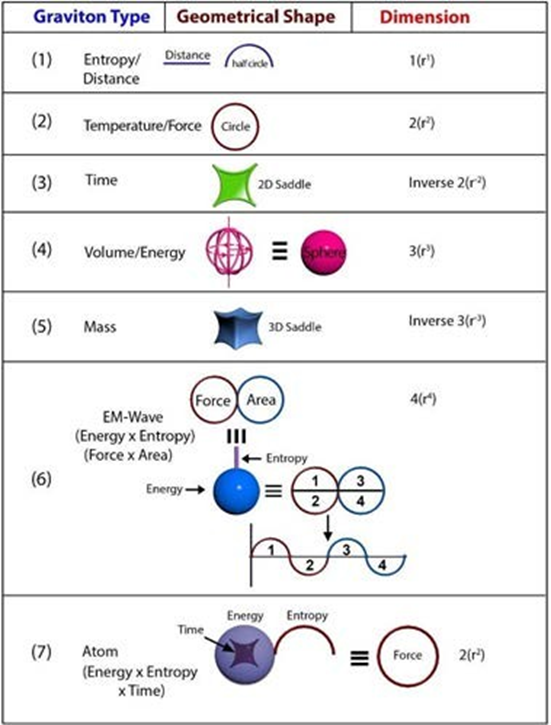
( ) ( ) 2 2 Area of the circle Area of the 2D saddle 1/ 1.00 r r π π = × (1) The circle (radius r) and the 2D-saddle are multiplicative inverse to each other since the product of the two is unity.
The physical variables like entropy, force, energy, EM –wave, space expansion, etc. in the forms of quantum (of different topology or geometry) belong to the direct space of the universe and the physical variables like order, time, mass, squeezing EM-waves, space inversion in the similar fashion belong to the reciprocal space of the universe.
The geometries of the entire space quantum as revealed through TSQ are shown in Figure 2 below:
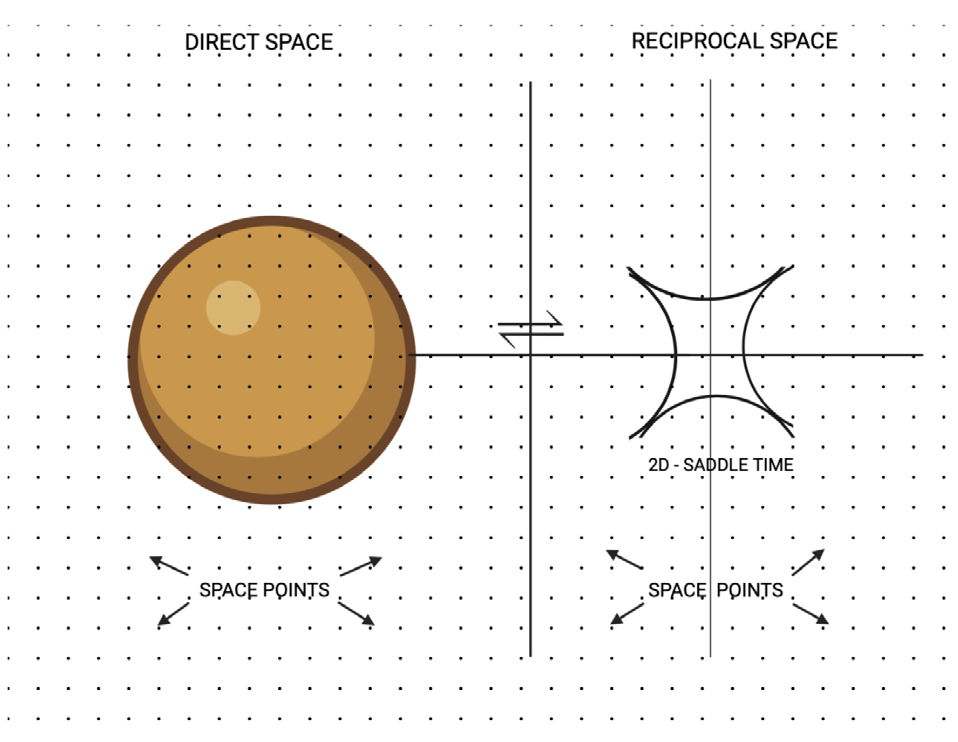
Evolution of the Dimension and Topology of ‘Time’ Variable of the Universe
In TSQ any physical variable of the universe has to be defined in a tripartite fashion in regard to its physics of formation, mathematical expression and the geometrical shape as shown below in Figure 3.
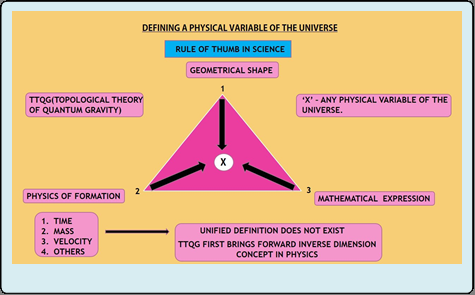
The theories of conventional physics though dealt with numerous physical variables but did never present any physical variable in the fashion as shown in Figure 3 above.
Regarding the ‘time’ variable it is to be noted that Energy , entropy and time are very much related to each other and the mathematical statement of the famous Heisenberg’s uncertainty principle is Et =h (E stands for energy, t stands for time and h stands for Planck’s constant). It has been proved in TSQ that the well-known Planck’s constant is an entropy parameter only. So, (energy x time = Entropy). However, none of the research theories in physics has been able to define time in regard to energy and entropy. The underlying reason behind the same was the lack of the thinking in the line of quantized ‘time-space’ and the failure to link the subject thermodynamics with it.
The following are the salient principles of TSQ and which are to be noted as the starting point to learn what ‘time’ is? [13, 14, 15, 16, 17, 18, 19, 20, 21].
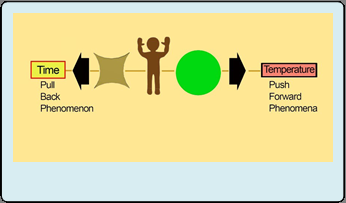
- Time is an attractive force quantum which is trying to hold the universe.
- Time is a pullback force (PBF) belonging to the reciprocal space of the universe.
- Temperature on the other hand is a push forward force (PFF) which is trying to elongate the universe and is a variable of the direct space.
- The geometry or topology of time is a 2D saddle
- The geometry or topology of temperature is a circle
- Time (t) and temperature (T) are multiplicative inverse to each other such that:
- Tt = 1.00
- Pressure is a dimensionless parameter and which is a hybrid of PBF and PFF, such that
- P = (PPF x PBF) = Tt = 1.00
- The index of equilibrium and non-equilibrium of any physical or chemical phenomena of the universe is related to the product of T and t: [22, 23, 24, 25, 26, 27, 28, 29, 30, 31, 32, 33, 34]
- Tt > 1.00 - non-equilibrium
- Tt < 1.00 - non-equilibrium
- Tt = 1.00 – equilibrium The equilibrium relationship between time and temperature in the form of Tt = 1.00 is being represented by Figure 4 below:
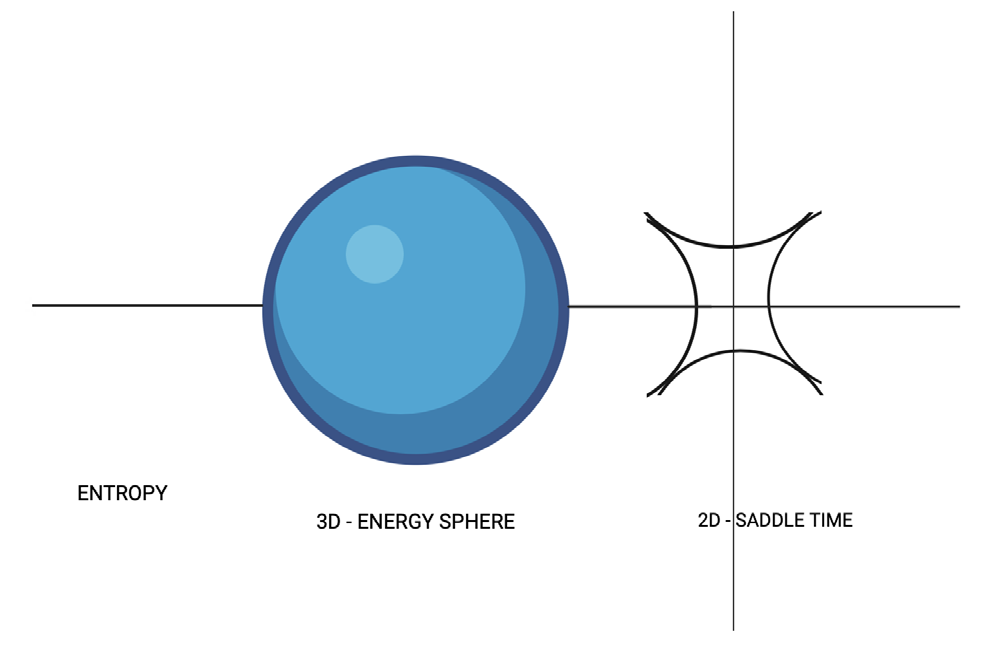
In TSQ energy is represented by a 3D sphere, time is a 2D saddle and entropy is a line segment and an atom is being represented as (energy x entropy x time) as shown in Figure 5 below:
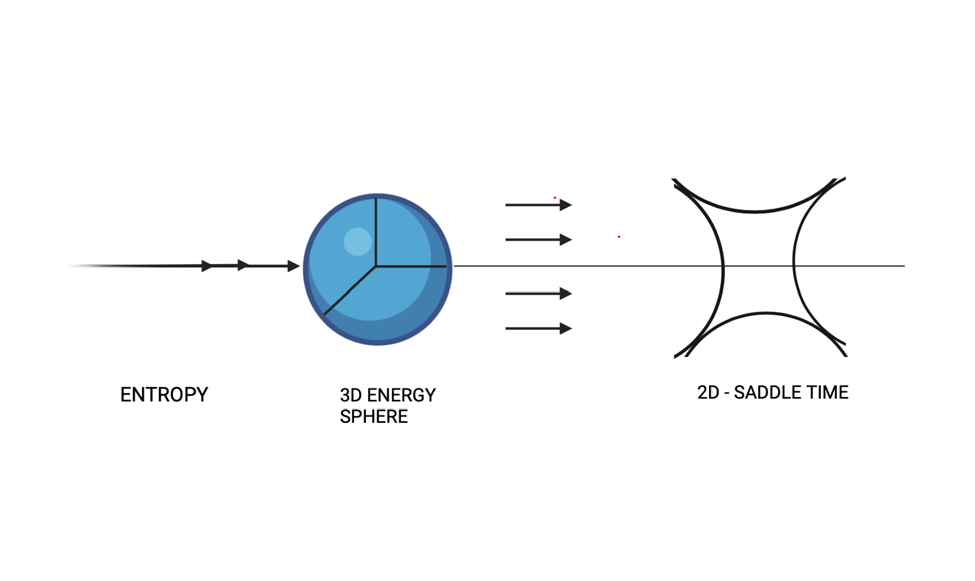
Now when the magnitude of energy is small, the sphere would be lower in size and the attractive pull of the ‘time’ 2D saddle will pull back the entropy line strongly and as a result the entropy would be under tension and would not be able to elongate. So the time saddle through the energy sphere will be pulling back entropy. So, time equated to ‘how energy is pulling pack the entropy’. The mathematical representation of ‘time’ would be equation 2, (Figure 6) ( ) ( ) ( ) 3 2 Time entropy / energy 3 / 4 3/ 4 2 saddle r r r D π π = = = = (2)
On the other hand when the energy sphere is larger in magnitude then in spite of the presence of the time attractive force, the energy sphere pushes forward the entropy line being the dominant force as shown in Figure 7 below:
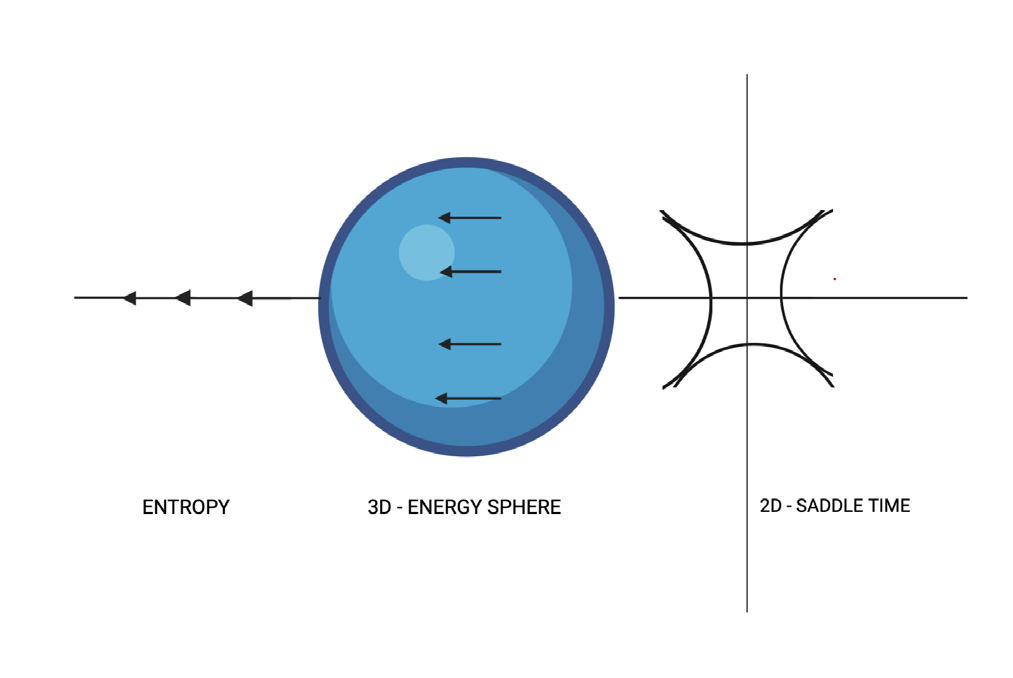
So ‘temperature’ is being defined as ‘how much or the extent to which the energy sphere pushes forward the ‘entropy’, and which is being mathematically represented by equation 3 ( ) ( ) ( ) 3 2 Temperature energy / entropy 4 / 3 4 / 3 Circle r r r π π = = = = (3) Both temperature and time are the quantum forces of the universe but these were unexplored earlier.
Changing Concepts of Physics
The defining of time in TSQ has led to the following changes in the concept of conventional physics [35, 36, 37, 38, 39, 40, 41, 42, 43, 44, 45, 46, 47]:
The Main Points are Highlighted only • ‘Velocity’ merges with the concept of volume.
• ‘Acceleration’ is effectively a concept of ‘space expansion’ rather than a concept of incremental velocity. Its dimension reaches from 3D to 5D.
• EM-wave turns out to be a hybrid of two force circles in its integrated form and in the differential form it resembles a typical EM-wave profile.
• The phenomenon of gravitation emerges as the result of the overlapping of two ‘inverse space expansion’ fields and the dimension is inverse 10 dimensions.
• Cold Nuclear fusion is not an experimental artifact but a real phenomenon of the universe and the dimension reaches to inverse 7 dimensions.
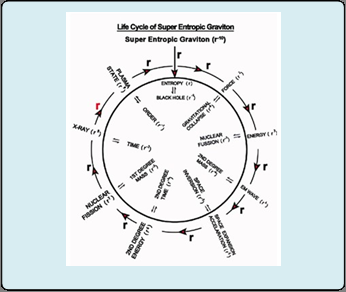
• All the cosmological and astronomical phenomena of the universe is being explained by a universal graviton cycle as is shown in Figure 8 below:
Conclusion
The discovery of the theory of space quantization (TSQ) has re-directed the conventional physics, cosmology, astronomy, theories of gravitation and relativities from their own positioning to a different horizon altogether. The conventional theories of physics have three options left;
- Some of them have to be abandoned,
- Some of them has to be superseded by the TSQ driven newer or modified form of the theories and
- Some of them have to be diverted towards the concepts of TSQ for landing in a stable position and make their foot holds stronger.
References
-
Jones JE (1924) On the determination of molecular fields. Proceedings of the Royal Society of London 106(738): 463-477.
-
Lim TC (2003) The relationship between Lennard-Jones (12-6) and Morse potential Functions. Zeitschrift für Naturforschung A 58(11): 615-617.
-
Zhang L (2013) The Van der Waals force and gravitation force in matter. ArXiv, 1303.3579.
-
Bonneville R (2016) An alternative model of particle physics in a 10-dimension (pseudo) Euclidian space- time. ArXiv.
-
Menon KK, Quarashi T (2017) Wave-particle duality in asymmetric beam interference. Physical Review A 98: 022130.
-
Zslavski OB (2005) Ultimate gravitational mass defect. Gen Rel Grav 38(5): 945-951.
-
Bolotin YUL, Yanoksky VV (2017) Modified Planck units. arXiv.
-
Paul GH (2009) Maxwell’s equation. In: 1st (Edn.), Wiley- IEEE Press.
-
Jackson JD (1998) Classical electrodynamics. In: 3rd (Edn.), Wiley.
-
(2022) Fundamental physical constants - Extensive listing. NIST.
-
Halliday D, Resnick R (1974) Fundamentals of physics. Feynman Lecture on Physics.
-
Loudon R (2000) The quantum theory of light. In: 3rd (Edn.), Oxford University Press, pp: 448.
-
Duffin W (1990) Electricity and magnetism. In: 4th (Edn.), McGraw-Hill Education.
-
Serway RA, Jewett JW, Wilson K, Wilson A, Rowlands W (2016) Physics for global scientists and engineers. In: 2nd (Edn.), Cengage 1.
-
Rybicki GB, Lightman AP (1979) Radiative processes in astrophysics. John Wiley & Sons, pp: 325.
-
McQuarrie DA, Simon JD (1979) Physical chemistry: A molecular approach. In: 1st (Edn.), University Science Books, pp: 1279.
-
Michael B (2013) Physics for engineering and science. In: 2nd (Edn.), McGraw-Hill Education, pp: 444.
-
Rybicki GB, Lightman AP (1979) Fundamentals of radiative transfer. In: Radiative processes in astrophysics (Edn.), John Wiley & Sons, pp: 20-28.
-
Purcell ME, David J (2013) Electrical energy in a crystal lattice. In: Electricity and magnetism, 3rd (Edn.), Cambridge University Press, pp: 14-20.
-
Maxwell JC (1873) A treatise on electricity and magnetism. Clarendon Press 2: 500.
-
Nobel Prize in Physics (1921).
-
Arore MG, Singh M (1994) Nuclear chemistry. Anmol Publications, pp: 1-11.
-
Goldston RJ, Rutherford PH (1995) Introduction to plasma physics. Institute of Physics Publishing.
-
Sharma KS (2008) Atomic and nuclear physics. Pearson Education India.
-
Verdenne G, Attetia JL (2009) Gamma-ray bursts: The brightest explosions in the universe. In: 1st (Edn.), Springer.
-
Schrödinger E (1926) An undulatory theory of the mechanics of atoms and molecules. Physical Review 28(6): 1049-1070.
-
Griffiths DJ (2004) Introduction to quantum mechanics. In: 2nd (Edn.), Prentice Hall.
-
Atkins PW (1977) Molecular quantum mechanics parts I and II: An introduction to quantum chemistry. Oxford University Press.
-
Atkins PW (1974) Quanta: A handbook of concepts. Oxford University Press.
-
Einstein A (1916) The foundation of the general theory of relativity. Annalen der Physik 354(7): 769-822.
-
Grøn O, Hervik S (2007) Einstein’s general theory of relativity: With modern applications in cosmology. In: 1st (Edn.), Springer.
-
Lemkhl D (2018) General relativity as a hybrid theory: The genesis of Einstein’s work on the problem of motion. General Relativity and Quantum Cosmology 67: 176-190.
-
Hess PO (2016) The black hole merger event GW150914 within a modified theory of general relativity. Monthly Notices of the Royal Astronomical Society 462(3): 3026- 3030.
-
Chrimes AA, Levan AJ, Stanway ER, Lyman JD, Fruchter AS, et al. (2019) Chandra and Hubble Space Telescope observation of dark gamma-ray bursts and their host galaxies. Monthly Notices of the Royal Astronomical Society 486(3): 3105-3117.
-
Bergh SVD (2011) The curious case of Lemaitre’s equation no. 24. Journal of the Royal Astronomical Society of Canada 105(4): 151.
-
Nussbaumer H, Bieri L (2011) Who discovered the expanding universe. The Observatory 131(6): 394-398.
-
Way MJ (2013) Dismantling Hubble’s legacy. American Astronomical Society 471: 97-132.
-
Wald RM (1984) General relativity. The University of Chicago Press.
-
Wald RM (1999) Gravitational collapse and cosmic censorship. In: Iyer BR (Eds.), Black holes gravitational radiation and the universe, Springer 100: 69-86.
-
Overbye D (2015) Black hole hunters. NASA.
-
Montgomery C, Orchiston W, Whittingham I (2009) Michell, Laplace, and the origin of the black-hole concept. Journal of Astronomical History and Heritage 12(2): 90- 96.
-
Abbott BP, Abbott R, Abbott TD, Abernathy MR, Acernese F, et al. (2016) Observation of gravitational waves from a binary black hole merger. Physical Review Letters 116(6): 061102.
-
Event Horizon Telescope Collaboration, Kazunori A, Antxon A, Walter A, Keiichi A, et al. (2019) First M87 Event Horizon Telescope results. I. The shadow of the supermassive black hole. The Astrophysical Journal 875(1): 1-17.
-
Shapiro SL, Teukolsky SA (1983) Black holes, white dwarfs, and neutron stars: The physics of compact objects. John Wiley & Sons.
-
(2017) Introduction to black holes.
-
Singh J (1995) Space-time waltz. In: 1st (Edn.), Wiley Eastern Ltd.
-
Penrose R (2002) Gravitational collapse: The role of general relativity. General Relativity and Gravitation 34(7): 1141-1165.
- Asymmetry Irreversible Heterogeneity Quantum Cosmology Grand Mathematical PHYSICS
- Early Universe: Hadronic Crystals Coherent Micro Gravitational Wave Emitters PHYSICS Part II
- The Solar System Constraint Maze: A Scientific Dead-End Revealing the Interuniversal Machine
- Assessment of Radiofrequency Radiation from 2G and 3G Mobile Phone Handsets
- Early Universe Magneto-Gravitational Coupling Genesis Physics: Part I
- Falsifiability of the Classical Law of Gravitation and Unveiling the Time-temperature Entanglement of the Universe