
The Structure of the Universe
The proposed article is a development of the topics of gravity, the inverse temperature dependence of gravity forces, black holes, galaxies. All interaction schemes are built on the basis of the laws of classical mechanics of Newton, the planetary model of the structure of the Rutherford atom, classical thermodynamics. The basis of all constructions in this article is the model of the structure of the Universe. The process of boiling water in a saucepan is accepted as a model of the structure of the Universe. The article rejects all existing models of the structure of the Universe.
Introduction
The proposed article is a development of the direction with comments presented in the articles [1, 2, 3, 4]. The article rejects the existing dominant ideas about the structure of the Universe [5]. The existing ideas are full of contradictions [6]. The only thing that connects the existing versions and the proposed hypothesis is the full recognition of the action of the Second Law of Thermodynamics. However, according to the existing versions and ideas, the action of this law should lead the matter of the Universe to chaos. In reality, matter strives for ordering [4, 5]. The proposed series of articles and this article explain this desire for ordering. The action in conjunction with the inverse temperature dependence of gravitational forces and the second law of thermodynamics explains this desire. In other words, the second law of thermodynamics can be called the law of cooling of matter. The action of these laws in conjunction leads to the separation of matter, condensation of matter. This in turn leads to the ordering of the structure of the Universe. Without the action of these laws, the Universe would be a homogeneous amorphous mass.
Main Part
The Original Model of the Structure of the Universe The process of boiling water in a saucepan is proposed as the initial model of the structure of the Universe. This process is characterized by heat supply from the outside, the process of steam formation, the process of steam condensation, the formation of steam bubbles, and heat removal. The processes of steam formation and steam condensation occur simultaneously in different phases, in different places in space, upon reaching the required temperature and other conditions. Convective processes, the processes of formation, movement, and collapse of steam bubbles create a certain dynamics of matter (water) in the space of the saucepan. Convective processes are characterized by the formation of a resulting vector of matter movement from a warm zone to a cold one and vice versa in a counter flow. The formation, movement, and collapse of steam bubbles enhance this dynamic process. In this model, what is interesting is that there is a constant heat supply, there is a natural heat removal, there is the dynamics of matter associated with the cooling of matter, there are many centers of formation of steam bubbles, there are phase transitions of the aggregate state of matter, there is a closed cycle of heating and cooling, the simultaneity of local processes in different phases. The application of this model guarantees the fulfillment of the laws of conservation of matter and energy.
Construction of a real model of the structure of the Universe As stated above, we will take the process of boiling water in a saucepan as the initial model. The multitude of centers of simultaneous formation of steam bubbles allows us to abandon the cosmological singularity [7] in the real model. In the real model, the number of steam bubbles can be taken equal to the number of Black Holes. A steam bubble in the real model can correspond to the center of new matter generation.
Another thing is that the generation of new matter can manifest itself beyond the visible Universe. To build a real model of the structure of the Universe, we can use a closed cycle of matter transformation associated with a Black Hole. In the real model, the number of simultaneously occurring cycles is equal to the number of Black Holes. In the real model, all these cycles occur simultaneously in different phases, making up a general picture of the structure of the Universe. Figure 1 (taken from article [2]) shows a separate closed cycle of matter transformation. Within the framework of such a cycle, we can talk about a certain singularity. In this cycle, processes 1-2 and 2-3 occur within the boundaries of a Black Hole.
Process 1-2 corresponds to the stage of destruction of intermolecular, interatomic and intra-atomic bonds of matter – formation of some kind of stuffing of matter. Process 2-3 begins in the center of the Black Hole, then follows the ejection of matter beyond the Black Hole. By analogy with the indicator diagram of a two-stroke internal combustion engine, this section of the cycle corresponds to the stage of fuel combustion, heat supply to matter. As a result of this heat supply, a significant increase in temperature occurs with the ejection of matter beyond the Black Hole. Only assumptions can be made about the type of fuel. For example, in section 1-2, stuffing of matter is formed. Here we can assume, for example, that the process of electron-positron annihilation takes place. The process of electron-positron annihilation occurs with the release of a huge amount of thermal energy. The amount of energy released can be judged by the expression E=mc2.
Again, here we can assume that not the entire mass of matter participates in the annihilation process, but some part. Or, we can assume that almost all matter is transformed into energy, into the energy of the subsequent emission. Then, in the process of emission, energy is transformed into matter, as some matter cools. We can assume that the emission of matter beyond the Black Hole occurs at near-light speed. The ejected matter is in a state of aggregation corresponding to the previously formed mince. In this state, matter is not affected by gravity at the initial stage of the emission. This is probably Hawking radiation.
The movement of matter inside the Black Hole from the outside to the center and the emission (sections 1-2, 2-3) probably occurs according to the principle of a hydraulic siphon. The outer layer of the black hole has the properties of gravity, the mince and the inner part are not subject to gravity. The outer layer forms a rigid, stable structure. The zone of annihilation processes inside, in the center of the black hole, has a high temperature. The mince has no structure of matter, does not have heat transfer properties, so high temperature is not transferred to the outer part of the Black Hole. Point 3 outside the black hole corresponds to the initial state of the formation of matter in the form of atoms, molecules in the cooling process. Probably, this emission of matter is the future dark matter. Dark matter is matter that moves in space relative to us at a superluminal speed. For this dark matter, we are dark matter, our visible Universe. Our visible Universe is the Universe that satisfies the conditions of visibility, i.e. material objects do not exceed the speed of light relative to us.
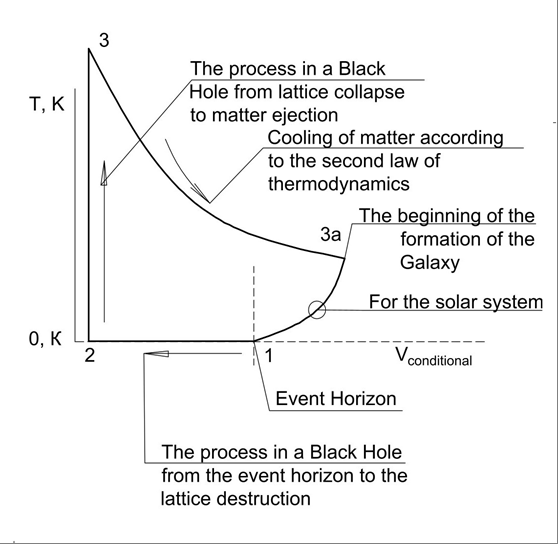
In Figure 1, it is necessary to clarify some very important points. Sections 1-2 and 2-3 correspond to the processes occurring inside the Black Hole. Section 3-1 corresponds to the processes occurring in the surrounding space. Section
3-1 is significantly longer and longer than sections 1-2 and 2-3. Figure 1 shows a closed cycle for a conventional mass of matter approximately equal to the mass of a galaxy. In section 3-1, the process of matter expansion occurs. The long duration and expansion in section 3-1 create the effect of matter expansion in the Universe. This effect is created by the simultaneous operation of all cycles in different phases in the Universe. Section 2-3 supplies heat to matter. This section gives impetus to all processes in the Universe, both in the macrocosm and in the microcosm. In the microcosm, process 2-3 gives rotation to electrons around the nuclei of atoms. The speed of rotation is reflected in the temperature of matter. In process 2-3, part of the initial stuffing is spent on heat production, part of the initial stuffing is the initial material for the future process 3-1. Both parts go through process 2-3. As a result, a difference is formed in the amount of matter at the entrance to the black hole and at the exit. The amount of matter at the exit is less than at the entrance. The difference is spent on obtaining heat for the ejection of matter from the black hole. Thus, the classical law of conservation of matter is fulfilled. Here it should be noted that the difference in the amount of matter at the entrance and exit of the black hole also creates the effect of expansion of the Universe, the effect of rarefaction of the Universe. Section 3a-1 corresponds to the processes of matter occurring in the galaxy. Matter in the galaxy is in a state of compression. This is a reflection of a dual process - expansion on the scale of the Universe, compression on the scale of the galaxy.
Conclusion
The proposed model of the structure of the Universe has the right to exist, at least. The proposed model is intended to form a new direction in the study of the structure of the Universe. The proposed model is based on the concepts of classical Newtonian physics. Naturally, work on this model will require some clarifications and adjustments.
This model does not answer the question of the origin of the Universe. This model is intended to form a picture of the existence of the Universe in the current period. This article does not aim to criticize existing models, versions, etc.
Additional facts that testify in favor of this model:
- Uniform distribution of matter in the space of the Universe. Constancy of average density [8]. No density anisotropy, no overall net density gradient across the universe. Anisotropy should be present in the case of a single Big Bang;
- Difference in the age of galaxies [9];
- Different types of galaxies. This is probably due to different phases of development, conditions of formation [9];
- Different forms of matter in the Universe. Galaxies, nebulae, clusters of galaxies [9, 10];
• Unconfirmed fact of the existence of the visible and invisible Universe, the Multiverse [8, 9, 10, 11].
It should be noted that the properties of gravitational interaction and heat transfer properties are possessed by structured matter, namely: atoms, molecules. The stuffing inside the Black Hole is destructured matter, therefore gravity and heat transfer are not characteristic of the stuffing. The high temperature inside the black hole is not transferred to the outer surface of the Black Hole, the inner part of the black hole does not have gravitational interaction with the outer part of the black hole. The ejection of matter from the black hole (section 2-3) occurs almost unimpeded. The ejected matter can be attributed to the fifth aggregate state of matter. The formation of high-temperature plasma in the area of point 3 occurs as the matter cools down, primary atoms are formed. Atoms are already structured matter and plasma is subject to gravitational interaction and more active cooling.
So, the Main Conclusions:
- The Universe consists of a set of closed cycles of matter transformation;
- The main source of energy is a set of annihilation processes in Black Holes;
- The proposed version is based exclusively on the concepts of classical Newtonian physics and on the results of modern practical scientific research in the field of physics.
References
-
Kuzminov IV (2024) Physics of Black Holes. A Closed Cycle of Transformation of Matter in the Universe. WASET, Molecular Physics and Astrophysics, UK.
-
Kuzminov IV (2024) Comments to the article “Physics of Black Holes. A Closed Cycle of Transformation of Matter in the Universe. Open Access Journal of Astronomy 3(1): 000151.
-
Kuzminov IV (2024) Inverse temperature dependence of gravitational and inertial forces. Schemes and comments. International Journal of Physical and Mathematic Science.
-
Kuzminov IV (2024) Picture of the World by the Second Law of Thermodynamic. WASET Conference, 4.
-
Kuzminov IV (2023) Physics of Gravity. The Inverse Temperature Dependence. Experiments. Physics of Gravity. Comments, Explanations and Additions. Journal of Physics and Chemistry Research 5(3): 1-3.
-
Kuzminov IV (2023) Physics of Gravity. Comments and criticism of existing views. American Journal of Planetary and Space Sciences 2(3).
-
Sanad MR (2024) Universe Center and Dark Matter. Open Access Journal of Astro 2(2): 000146.
-
Ostriker JP, Steinhardt PJ (1995) The observational case for a low-density Universe with a non-zero cosmological constant. Nature 377(6550): 600-602.
-
Charles JP (1987) Ages of globular clusters. Astronomical Society of the Pacific.
-
Binney J, Merrifield M (1998) Galactic Astronomy. Princeton University Press, USA, pp: 816.
-
Gott III, Richard J, Jurić M, Schlegel D, Hoyle F, et al. (2005) A Map of the Universe. The Astrophysical Journal 624(2): 463-484.
- Asymmetry Irreversible Heterogeneity Quantum Cosmology Grand Mathematical PHYSICS
- Early Universe: Hadronic Crystals Coherent Micro Gravitational Wave Emitters PHYSICS Part II
- The Solar System Constraint Maze: A Scientific Dead-End Revealing the Interuniversal Machine
- Assessment of Radiofrequency Radiation from 2G and 3G Mobile Phone Handsets
- Early Universe Magneto-Gravitational Coupling Genesis Physics: Part I
- Falsifiability of the Classical Law of Gravitation and Unveiling the Time-temperature Entanglement of the Universe