
Considerations on Dark Matter and Ether
This paper discusses the similarity between dark matter, which fills up some of the total mass of the universe, and ether, which acts as a medium for light. It also presents a series of calculations and experimental methods to find ether. In modern physics, ether should not exist. Dark matter, a substance with mass, is essential to understand the structure of the universe or the rotation of galaxies. If ether is given mass, ether can be a suitable substance that can explain the characteristics of dark matter as it is. In this paper, we reexamine the deflection angle of starlight due to the change in direction of propagation by gravitational fields when ether is given mass, which was previously revealed. And we propose another experimental method to find ether (dark matter). The experiment compares the interference patterns that occur when two lights are incident on the same point on the surface of the Earth in a stationary atmosphere and when the wind blows perpendicular to the direction of propagation of the light. If ether, the medium of light, has mass, its properties are similar to those of dark matter, so we can propose that the dark matter we are looking for is ether.
Abbreviations
WIMPs: Weakly Interacting Massive Particles; LIGO: Laser Interferometer Gravitational-Wave Observatory; ΔN: Interference Fringes.
Introduction
This study proposes that if ether has mass, the Michelson- Morley experiment is not an appropriate experiment to find ether. This paper suggests the similarity between dark matter, which fills up some of the total mass of the universe, and ether, which acts as a medium for light. It also presents a series of calculations and experimental methods to find ether. In modern physics, ether should not exist. Dark matter, a substance with mass, is essential to understand the structure of the universe or the rotation of galaxies.
If ether is given mass, ether can be a suitable substance that can explain the characteristics of dark matter as it is. The Michelson-Morley experiment concluded that ether, a medium for light, does not exist [1].
This experiment became the foundation for the major trends in modern physics [1]. Due to Michelson-Morley’s incorrect idea and experimental conditions, they make the mistake of concluding that ether does not exist. As a result, physicists are conducting inappropriate research by suggesting WIMPs (Weakly Interacting Massive Particles), axions, and gravitons as candidates for dark matter [2, 3, 4, 5].
If ether is given mass, ether can be a suitable substance that can explain the characteristics of dark matter: a) It exists in the universe wherever light (electromagnetic waves) is transmitted, b) It has mass and can explain the rotation speed of galaxies and gravitational lensing effects, and c) Since it is a medium that transmits light (electromagnetic waves), it itself is invisible.
This Paper Deals with Two Themes: The first study calculates the degree to which the direction of starlight changes due to the gravitational field when mass is given to a unit volume of ether and reexamines its deflection angle.
This is more accurate than the calculation formula presented in general relativity and is almost identical to the observed values [6]. The calculation of the deflection angle of starlight passing through the Sun and the planets of the Solar System shows values that are consistent with actual observations or predicted deflection angles. This proposes that there must be an ether (dark matter) with mass [7, 8].
The second study proposes another experimental method to find the ether (dark matter). This experiment starts from the assumption that if the ether had mass, it would be distributed over the Earth’s surface like the atmosphere and would behave similarly to the atmosphere.
It uses the interference pattern generated when two lights are incident on a single point in the stationary atmosphere of the Earth’s surface as a reference point.
Another method measures the interference pattern generated when the wind blows perpendicular to the direction of travel of the two lights at the same location and the two lights are incident on the same point. The interference pattern generated in the stationary atmosphere and the interference pattern measured when the wind blows are compared. If the interference pattern is different, it can be suggested that there is an ether with mass, which is the medium of light. Here, a mirror is used to increase the distance travelled by the light.
Errors in the Michelson-Morley Experiment
The two scientists, Michelson and Morley, designed an elaborate experimental device in a stone basement to conduct an experiment on the existence of ether, the medium of light waves [1].
The light sources that were emitted identically travelled different paths at right angles. They created a device that allowed the light sources to reunite. The experiment was to measure whether interference occurred through the phase difference of the light waves that travelled different paths.
Considering the speed of light and the Earth’s orbital speed, Michelson and Morley expected the number of interference fringes, ΔN, to be 0.04. They repeated the experiment several times, regardless of the direction in which the device was facing or in which position it was located, depending on the Earth’s orbit, but they never found any interference effect.
Michelson and Morley concluded that there was no such thing as ether, the medium of light waves [1]. We assumed that the ether (dark matter), which acts as a medium for light propagation in the universe, had mass [7]. It will exist in the atmosphere and vacuum space, and wherever electromagnetic waves (including light) are transmitted (gas, liquid, solid, vacuum).
The Michelson-Morley experiment was an experiment conducted in which ether, which has mass, was confined in a stone basement and prevented from moving. It would be difficult to expect interference of light through the phase difference of light under experimental conditions where the path of light is short.
It is suggested that it is meaningless to discuss the existence of ether through the experimental conditions of the Michelson-Morley experiment [7].
In calculating the deflection angle of starlight, if the medium of light (ether) is given a mass
We assign mass (m) to the unit volume of ether, the medium of light. It is similar to assigning mass per unit volume to water, the medium that transmits the kinetic energy of ocean waves, to find the direction of propagation of ocean waves.
We calculate the degree to which starlight propagating through ether, the medium of light with mass in a gravitational field, is bent from its original direction of propagation. The calculation of the deflection angle of starlight is as follows [7] (Figure 1).
![Figure 1: To find the angle of deflection due to the gravitational field when mass m starting from point A reaches point B, three virtual sections (C→B, A→B, A→D) are set up that move at the same time. The time t required to move through the orbits C→B, A→B, and A→D is the same. 1) C→B section: Mass m is orbiting the sun (M) in a ring orbit of r. 2) A→B section: Mass m with speed v is moving in the direction of B from point A. 3) A→D section: The virtual speed v2 that starts from point A and reaches D is moving at the same angular velocity as the speed v’ [7].](/fulltextimages/13911/fig_1.png)
Figure 1: To find the angle of deflection due to the gravitational field when mass m starting from point A reaches point B, three virtual sections (C→B, A→B, A→D) are set up that move at the same time. The time t required to move through the orbits C→B, A→B, and A→D is the same. 1) C→B section: Mass m is orbiting the sun (M) in a ring orbit of r. 2) A→B section: Mass m with speed v is moving in the direction of B from point A. 3) A→D section: The virtual speed v2 that starts from point A and reaches D is moving at the same angular velocity as the speed v’ [7].
Suppose that a mass m orbits the Sun in the section C→B and moves in a virtual orbit A→D at the same angular velocity as the mass m (not due to gravity). At the same time, the mass m moves in the section A→B at the velocity v (the speed of light c). If the time taken for an object at each location to move in the orbits C→B, A→D, and A→B is the same as t, then the sum of the gravitational forces transferred at that time will also be the same, unless there is a distance limit or an obstacle that interferes with the gravitational influence. The formula for calculating the angle of deflection (θ) of starlight is as follows [7].
2 2 2
1 2 ' rv x x r $$ \theta = \theta_ {1} \times \frac {r v ^ {\prime 2} \left| x + \sqrt {x ^ {2} + r} \right.}{a v ^ {2}} $$ (1) Here, θl is the angle of the section C→B, r is the distance between M and B, v’ is the orbital velocity of mass m of point C, a is the distance of the section C→B, v is the moving velocity of mass m of point A, and x is the distance of A→B. If we find the time t when the orbits C→B, A→D, and A→B move in the same time (t), the values of most variables can be solved. If we find the time t, $$ a = v ^ {\prime} t = 2 \pi r \frac {\theta_ {1}}{3 6 0} \tag {2} $$ $$ a _ {2} = v _ {2} t = 2 \pi \sqrt {x ^ {2} + r ^ {2}} \frac {\theta_ {1}}{3 6 0} \tag {3} $$ Here, a2 is the distance of the section A→D. From equations (2) and (3), $$ v _ {2} = \frac {v ^ {\prime}}{r} \sqrt {\left(v t\right) ^ {2} + r ^ {2}} \tag {4} $$ ( ) Here, r is the perigee distance of the Sun (2R(1.4×10⁹ m)~10R(7.0×10⁹m)), and v’ is the orbital velocity at the perigee distance (3.1×10⁵m/s~4.4×104m/s). If equation (4) is applied to equation (3),
2 ' r t v π = (5)
Here, θl is ~ 90°, a=v’t, x=vt. The deflection angle of starlight passing the Sun as observed from Earth is θSun =2×θ [7].
2 2 2 x x r rv r + +
' ln
2 2 sun av θ θ θ $$ = 2 \times \theta = 2 \theta_ {1} \times \frac {\left| r \right|}{a v ^ {2}} \tag {6} $$
1 2 Here, the mass M of the Sun is 1.99×1030 kg, and the radius r is 7.0×10⁸m. The gravitational constant G is 6.67×10⁻¹¹ N․m2/kg2, and the speed of light c is 3×10⁸m/s. The calculated results (θSun: 0.77”~3.46”) for the starlight’s deflection angle passing through the perigee distance (2R~10R) are almost identical to the observed values (θSun: 0.93”~2.73”). The calculation of the starlight’s deflection angle using Newtonian mechanics is based on the existence of the ether, which has mass as a medium for light. On the other hand, the result of calculating the starlight’s deflection angle passing through the sun’s perigee distance (2R~10R) presented in the gravitational field equations of general relativity using equation (7) is θSun: 0.173”~0.867” [6].
( ) 2 4 $$ \theta_ {s u n} = \frac {4 G M}{R c ^ {2}} \left(R a d i a n\right) \tag {7} $$ The calculated result (θSun: 0.173”~0.867”) does not match the observed value (θSun: 0.93”~2.73”).
As seen from the above calculation results, we can see that the starlight’s deflection angle is calculated accurately when the light medium, ether, has mass. Therefore, we can propose that ether has mass and is close to the dark matter we were looking for.
For reference, Table 1 and Table 2 list the calculated starlight deflection angles when ether has mass [8].
| Mass (kg, M) | Radius (m, R) | Perigee distance(r) | Deflection angle(θplanet) | |
|---|---|---|---|---|
| Mercury | 3.30×10²³ | 2.44×10⁶ | 1R~10R | 5.22×10⁻⁴" ~5.72×10⁻⁵" |
| Venus | 4.82×1024 | 6.05×10⁶ | 1R~10R | 2.87×10⁻³" ~3.13×10⁻⁴" |
| Mars | 6.39×10²³ | 3.39×10⁶ | 1R~10R | 7.10×10⁻⁴" ~7.78×10⁻⁵" |
| Jupiter | 1.90×1027 | 7.15×10⁷ | 1R~10R | 8.20×10⁻²" ~9.18×10⁻³" |
| Saturn | 5.68×1026 | 6.00×10⁷ | 1R~10R | 3.03×10⁻²" ~3.38×10⁻³" |
| Uranus | 8.68×1025 | 2.59×10⁷ | 1R~10R | 1.13×10⁻²" ~1.25×10⁻³" |
| Neptune | 1.03×1026 | 2.48×10⁷ | 1R~10R | 1.39×10⁻²" ~1.25×10⁻³" |
| Moon | 7.38×10²² | 1.74×10⁶ | 1R~10R | 1.41×10⁻⁴" ~1.52×10⁻⁵" |
Table 1: The deflection angle of starlight passing around the solar system’s planets and Moon [8].
| Observation location | Mass (kg, M) | Ridius (m, R) | Perigee distance® | Maximum deflection angle (θ) |
|---|---|---|---|---|
| Earth’s surface | 5.97×1024 | 6.40×10⁶ | 1R~10R | 1.68×10⁻³” |
Table 2: Maximum deflection angle(θ) of all stars that can be observed from the Earth’s surface [8].
Proposal of another experimental method to find ether (dark matter) with mass
When light is incident on glass or water, which are different media from the atmosphere, the speed of light in the glass or water is slower than the speed of light in the atmosphere. Also, even if the media is the same material, the refractive index changes depending on the density. These could also suggest that there is a medium for light. Here, we will randomly change the direction of light traveling in the same medium to find the presence or absence of a medium for light. The air molecules in the Earth’s atmosphere become denser the closer they are to the surface due to the influence of the Earth’s gravitational field. The same would be true for ether (dark matter) with mass, which is affected by the gravitational field. We assumed that ether (dark matter) with mass exists wherever electromagnetic waves are transmitted. When the surface of the Earth is a stationary atmosphere, the interference pattern generated from two lights that travelled different distances is used as a reference point when two lights that travelled different distances are incident on one point. The other is to measure the interference pattern generated from two lights that travelled different distances in a place where the wind blows perpendicular to the direction of light propagation. At this time, we present a calculated value that predicts how much the windy atmosphere affects the path of light. If an interference pattern of light occurs depending on whether the wind blows perpendicular to the direction of travel when light travels the same distance, we can propose that ether (dark matter), the medium of light, exists in the atmosphere of the Earth’s surface.
We present the following experimental method to find ether (dark matter). We proceed using artificial wind in an indoor or windless place. The light projected from light source A travels through the atmospheric space of mirrors that reflect each other and reaches observer B. Light source A’ is projected onto observer B around the location where light source A reaches observer B. The distance between light source A’ and observer B is so short compared to the distance travelled by light source A that it will have little effect on the interference pattern regardless of whether the wind blows. Interference patterns generated from light sources A and A’ are measured at observer B [9, 10]. The interference patterns generated from light sources A and A’ when there is no wind are used as a reference point and compared and analysed with the interference patterns generated from light sources A and A’ when there is wind. Mirrors that reflect each other were used to increase the distance that light travels. The mirrors must be firmly and stably fixed so that the observation of the light interference patterns is not hindered by wind and external influences. The lasers used as light sources include, for example, a short-wavelength excimer laser (wavelength 193 nm) and a visible-light helium-neon laser (wavelength 632 nm) [11, 12]. The sensitivity of the interferometer to be used in this experiment is likely to be in the order of 10-12 m/√Hz. It is lower than the sensitivity of the Michelson interferometer used in the experiment to detect gravitational waves (LIGO), which has a sensitivity of 10-23 m/√Hz [13] at around 100Hz. Experimental conditions and devices can be changed for appropriate experiments. The flow of fluid occurs when air moves from a place of high pressure to a place of low pressure due to the difference in air pressure. The wind used in this experiment is a method of increasing the air pressure by using an external fan, etc. The movement of air due to the difference in air pressure is considered a viscous fluid and is described by the Navier- Stokes Equations below [14].
ρ ρ ρ ρ ρ (8)
$$ \rho \left(\frac {\partial \vec {u}}{\partial t} + \left(\vec {u}. \nabla\right) \vec {u}\right) = - \nabla P + \mu \nabla^ {2} \vec {u} + \vec {f} $$ Here, uρ is the velocity vector (air speed), ρ is the density, P is the pressure, μ is the viscosity coefficient, and f ρ is the external force (wind, etc.).
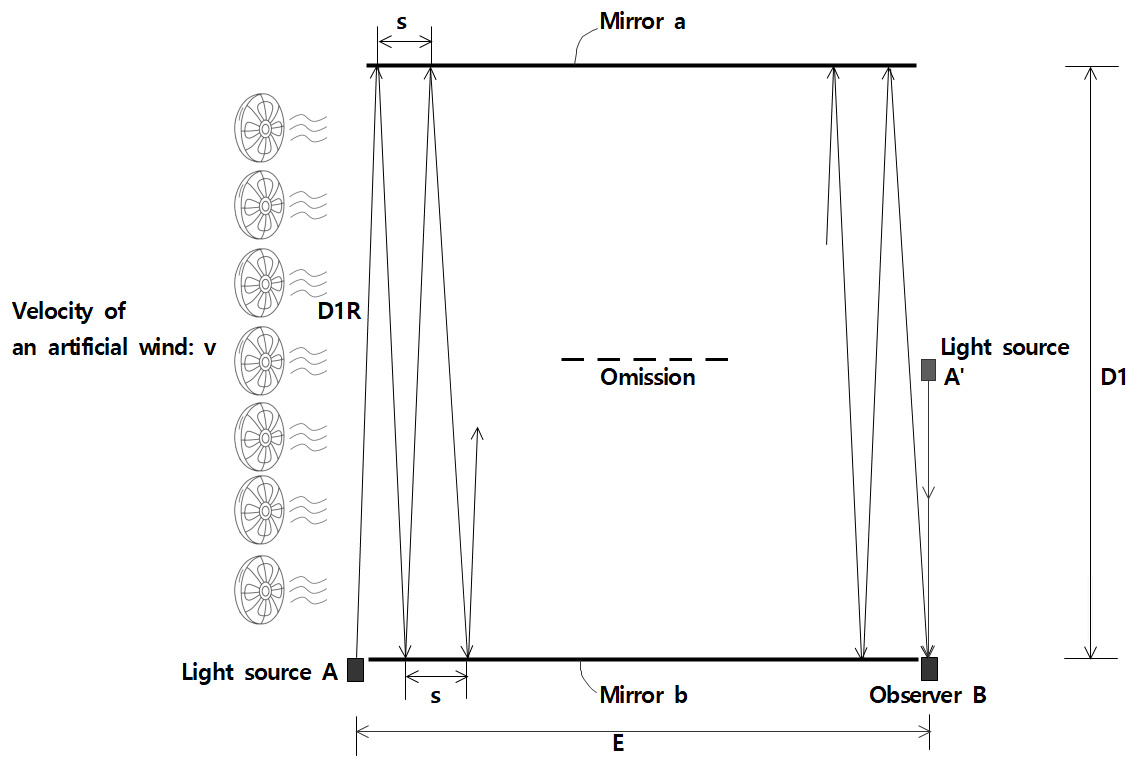
Mirrors facing each other at a certain distance (D1) are set up. The two mirrors are perpendicular to the surface and reflect each other. When light source A is illuminated at a certain angle (θ) on mirror a, light source A reaches observer B by reciprocating with mirror b, which faces each other. At this time, light source A’ is projected onto observer B and the interference pattern between light source A and light source A’ is measured.
- When there is no artificial wind: Check the wavelength of light when light source A reaches observer B in an indoor or windless space. At this time, light source A’ is projected onto observer B and the interference pattern between light source A and light source A’ is measured and a reference point is set.
- When there is artificial wind: Under the same conditions as when there is no artificial wind, artificial wind is blown at a speed v perpendicular to the direction of travel of light source A moving back and forth. Check the wavelength of light when light source A reaches observer B. At this time, light source A’ is projected onto observer B and the interference pattern between light source A and light source A’ is measured. Compare with the reference point of the interference pattern measured when there is no artificial wind. The number of interference fringes (ΔN) is $$ \Delta N = \frac {\Delta D}{\lambda} \tag {9} $$ Here, △D is the distance difference in wavelengths and λ is the wavelength.
The reference point is the number of interference fringes (ΔN) of the two light wavelengths when the light source moves along path A→B and when it moves along path A’→B when there is no artificial wind in Figure 2). The average speed of the artificial wind affecting the light source A moving back and forth is v. If there are technical limitations to maintain the average speed of the artificial wind, the speed and location of the artificial wind can be changed. When the light source A moves along path A→B, the distance travelled along path A→B is changed so that the number of interference fringes (ΔN) can be derived well through the time difference (Δt) at the observer B when the wind blows and when it does not blow. c is the speed of light. λ is the wavelength of light.
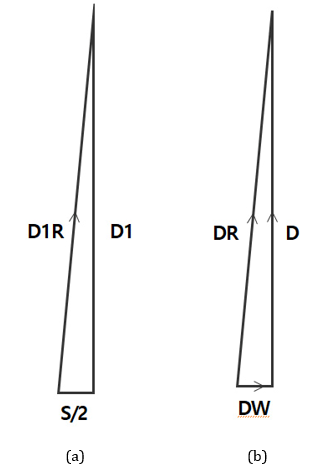
Figure 3: (a) D1R is the one-way distance travelled by light source A from mirror b to mirror a without any external influence. (b) D is the total distance travelled by light source A without any external influence. DW is the total distance travelled by the wind. DR is the total distance travelled by light source A actually due to the external influence (wind). Here, the travel times (t) of D, DW, and DR are the same.
The equation for calculating the distance difference ΔD between DR and D is as follows. The equation below is derived from Figure 3).
( ) $$ D 1 R = \sqrt {D 1 ^ {2} + \left(S / 2\right) ^ {2}} \tag {10} $$
Here, D1R is the distance that light source A travels one way from mirror b to mirror a without any external influence, D1 is the distance between mirrors, and S is the distance between the arrival points when light source A travels back and forth between mirror a and mirror b.
$$ t = \frac {D}{c} \tag {11} $$
Here, D is the total distance travelled by light source A in time t at the speed of light c without any external influence.
$$ D W = v t \tag {12} $$
Here, DW is the total distance travelled by the wind at the wind speed v in time t. The equation below is derived from Figure 3) (b).
$$ D R = \sqrt {D ^ {2} + D W ^ {2}} \tag {13} $$
Here, DR is the total distance that light source A moves due to external influences (wind). The distance difference ΔD between DR and D is expressed by the equation below.
$$ \Delta D = D R - D \tag {14} $$
• First experimental conditions and calculation examples: The distance D1 between the mirrors is 50m, the distance E between the light source A and the observer B is 40m, and the distance s between the arrival points when the light source A moves back and forth between mirror a and mirror b is 0.01m (1cm, the angle of the light source A is θ≈0.005729578°). If E is 40m, the total number of round trips is 4,000. If the distance of D1R in Figure 3) is calculated, D1R is 50.00000025m. If the light source A moves back and forth from mirror a to mirror b without external influence, the total travel distance D is 50.00000025m×4,000 times×2=400,000.002m (400.000002km).
When the average wind speed v = 5 m/s and D is 400,000.002 m (400.000002 km), the time (t) for light to travel distance D is 0.0013333 sec. The distance DW travelled by the wind that affected the direction of movement of light source A is 0.0066666 m. Now, we can find the distance (DR) that light source A travels due to external influences. DR is 400,000.00200000004 m. The distance difference between DR and D (ΔD) is 0.00000000004 m (4×10⁻² nm). If the light source is an excimer laser with a short laser wavelength of 193 nm, the number of interference fringes (ΔN) of the light source is 0.0002. When the laser wavelength of the light source is 632 nm, the number of interference fringes (ΔN) is 0.000063.
• Second experimental conditions and calculation example: The distance D1 between the mirrors is 100 m, the distance E between the light source A and the observer B is 100 m, and the distance s between the arrival points when the light source A goes back and forth between mirrors a and b is 0.01 m (1 cm, the angle θ of the light source A is ≈ 0.002864789°). If E is 100 m, the total number of back and forth is 10,000. If the distance of D1R in Figure 3) is calculated, D1R is 100.000000125 m. If light source A moves back and forth from mirror a to mirror b without any external influence, the total distance travelled D is 100.000000125 m x 10,000 times x 2 = 2,000,000.0025 m (2,000.0000025 km).
When the average wind speed v = 15 m/s and D = 2,000,000.0025 m (2,000.0000025 km), the time (t) for light source A to move D is 0.006666 sec. The distance travelled by the wind that affected the direction of movement of light source A when it moved, DW, is 0.100000000125 m. Now, we can find the distance (DR) that light source A actually moved due to external influence. DR is 2,000,000.0025000025 m. The distance difference (ΔD) between DR and D is 0.0000000025 m (2.5 nm). When the light source laser wavelength is a short excimer laser of 193 nm, the number of interference fringes (ΔN) of the light source is 0.013. When the light source laser wavelength is 632 nm, the number of interference fringes (ΔN) is 0.004 (Table 3).
| D1(m) | E(m) | S(m) | D(m) | v(m/s) | ΔD (nm) | ΔN (Light 193 nm) | ΔN (Light 632 nm) |
|---|---|---|---|---|---|---|---|
| 50 | 40 | 0.01 | 400,000.002 | 5 | 4 ×10⁻² | 0.0002 | 0.000063 |
| 20 | 500 | 0.01 | 2,000,000.06 | 15 | 1 | 0.0052 | 0.0016 |
| 50 | 200 | 0.01 | 2,000,000.01 | 15 | 2.3 | 0.012 | 0.0036 |
| 100 | 100 | 0.01 | 2,000,000.003 | 15 | 2.5 | 0.013 | 0.004 |
| 200 | 200 | 0.01 | 8,000,000.002 | 15 | 11 | 0.057 | 0.017 |
| 200 | 200 | 0.01 | 16,000,000.001 | 15 | 21 | 0.109 | 0.033 |
Table 3: It shows the number of interference fringes (ΔN) calculated by changing variables such as the distance between mirrors (
The distance between the mirrors (D1), the distance between the light source A and the observer B (E), and the distance (s) between the arrival points when going back and forth between mirror a and mirror b must be appropriately considered according to the actual experiment. The mirrors must be adjusted precisely so that they reflect regularly. It will never be an easy task to stably fix the mirrors so that they do not affect the wavelength of light. In order to find ether (dark matter), the distance between the mirrors (D1), the distance between the light source A and the observer B (E), and the distance (s) between the arrival points when going back and forth between mirror a and mirror b were changed, and the number of interference fringes (ΔN) at that time was calculated. The wavelengths of the laser light source were 193 nm and 632 nm. The respective values used in the calculation are as follows. The distance between the mirrors (D1) is 20 m to 200 m, the distance (E) between the light source (A) and the observer (A’) is 40 m to 500 m, the distance the light travels (D) is approximately 400,000 m (400 km) to 16,000,000 m (16,000 km), the wind speed is 5 m/s to 15 m/s, and the distance (s) between the arrival points when the light travels back and forth between mirrors a and b is 0.005 m to 0.01 m. When the wavelength of the light source is 193 nm, the number of interference fringes (ΔN) was calculated to be 0.0002 to 0.109. When the wavelength of the light source is 632 nm, the number of interference fringes (ΔN) was calculated to be 0.000063 to 0.033. The larger the number of interference fringes (ΔN), the easier it will be to see the interference fringes. If interference patterns appear, it would be another confirmation that the ether has the mass we are looking for. Setting up an actual experiment would not be easy, with many variables.
For reference, the variables D1, E, etc. applied to the experimental values above are for when the sensitivity of the interferometer is around 10-12 m/√Hz. If the Michelson interferometer (sensitivity: 10-23 m/√Hz at around 100Hz) used to detect gravitational waves is used, it is expected that the interference pattern can be easily measured even if the values of variables D1, E, etc. are set much smaller.
Conclusion
If ether with mass exists, it will be an important key to solving the dark matter that has not been known until now.
In this paper, we studied two themes, and the conclusions are as follows.
First, We calculated the deflection angle of starlight in a gravitational field by assigning mass to the unit volume of the medium (ether) through which light propagates. As a result, the calculated value (θSun: 0.77”~3.46”) for the deflection angle of starlight passing through the perigee distance (2R~10R) was derived, which is almost identical to the observed value (θSun: 0.93”~2.73”). On the other hand, the calculated value of the deflection angle of starlight passing through the perigee distance of the Sun (2R~10R) in the gravitational field equations of the general theory of relativity, which theoretically has no ether, is θSun 0.173”~0.867”, which does not match the observed value. The results of the starlight deflection angle calculations we conducted showed that the ether, the medium of light, was accurately calculated when it had mass. Through this, we can suggest that the ether has mass and is close to the dark matter we were looking for. Also, if the ether had mass, the interference pattern of light in the Michelson-Morley experiment conducted in the stone cellar could not have occurred.
Second, when light is incident from the atmosphere to water and from the atmosphere to glass, the direction and speed of light refracting change depending on the type and density of the medium. The experimental method proposed in this paper is a design of an experimental method that is expected to generate an interference pattern when light travels through the same medium, the atmosphere. When the atmosphere is stationary on the surface of the Earth, the light that has travelled a long distance and the light that has been incident in front of the observer are incident at the same point. The interference pattern that occurs at that time is confirmed and a reference point is set. Another condition is to blow the wind perpendicular to the direction of travel of the light traveling the same long distance above, so that the light that has interfered with the direction of travel of the light and the light that has been incident in front of the observer are incident at the same point. The number of interference patterns that occur at that time is compared with the interference patterns of the reference point set when the atmosphere is still. The number of interference patterns (ΔN) calculated when the wind blows is 0.0002~0.109 (when the light source is 193 nm) and 0.000063~0.033 (when the light source is 632 nm). If interference patterns of light occur or do not occur depending on whether the atmosphere (wind) moves at a constant speed or not, it can be suggested that there is an ether with mass, which is a medium for light, in the atmosphere.
In this study, the deflection angle of starlight was calculated to find an ether with mass, and another experimental method is proposed. The ether with mass (dark matter) will be distributed in a higher density toward stars and galaxies and their surroundings where gravity exerts a large influence in space. Problems that require the existence of dark matter with mass, such as gravitational lensing in the universe, faster-than-expected rotation speeds of galaxies, and the structural formation of galaxies, will be easily solved when the ether, the medium of light (electromagnetic waves), has mass. This study proposes that dark matter and ether are the same.
References
-
Tipler PA, Llewellyn R (2008) Modern Physics. In: 5th (Edn.), 1(1-3).
-
Kamionkowski M (1997) WIMP and Axion Dark Matter. High Energy Physics-Phenomenology pp: 1-18.
-
Kim H (2023) Gravitational interaction of ultralight dark matter with interferometers. Journal of Cosmology and Astroarticle Physics pp: 1-30.
-
Wu Y (2023) The dark matter and dark energy. SHS Web of Conferences 174: 03014
-
Denis O (2023) Informational nature of dark matter and dark energy and the cosmological constant. IPL Letters 1(1): 66-77.
-
Sciama DW (1969) The physical foundations of general relativity. Physics Today 23(3): 85-86.
-
Lee HC (2022) A review of The Theory of Relativity and The Speed of Light by The Ether (Dark Matter). Journal of Physics & Astronomy Research 10(8): 290.
-
Lee HC (2024) Calculation of the deflection angle of starlight in a gravitational field. B P International, Current Perspective to Physical Science Research 8: 95- 102.
-
Wang Q (2024) Experimental measurement for the optical power of interference between two coherent Gaussian laser beams. Research Square 1.
-
He S, Bai L, Zhou H, Tian Y, Huang D, et al. (2024) Analysis and Suppression of Range-Domain Periodic Interference in High-Frequency FMICW Radar. IEEE Journal of Oceanic Engineering 49(3): 883-904.
-
Tian X, Shen C, Liu Y, Zhang T, Liang L, et al. (2024) Multiplexing Sensing Based on Spectrum-Sliced Microwave Photonic Filter Utilizing Optical Path Difference Matching December. Journal of Lightwave Technology 42(24): 8926-8932.
-
Elliott DJ (1988) Sub-micron lithography at 248nm and 193nm excimer laser wavelengths. Proceedings of SPIE - The International Society for Optical Engineering 922: 476-482.
-
Martynov DV, Hall ED, Abbott BP, Abbott R, Abbott TD, et al. (2016) The Sensitivity of the Advanced LIGO Detectors at the Beginning of Gravitational Wave Astronomy. Phys Rev D 93: 112004.
-
Bistafa SR (2018) On the development of the Navier– Stokes equation by Navier. History of Physics and Related Sciences, Revista Brasileira de Ensino de F´ısica 40(2).
- Asymmetry Irreversible Heterogeneity Quantum Cosmology Grand Mathematical PHYSICS
- Early Universe: Hadronic Crystals Coherent Micro Gravitational Wave Emitters PHYSICS Part II
- The Solar System Constraint Maze: A Scientific Dead-End Revealing the Interuniversal Machine
- Assessment of Radiofrequency Radiation from 2G and 3G Mobile Phone Handsets
- Early Universe Magneto-Gravitational Coupling Genesis Physics: Part I
- Falsifiability of the Classical Law of Gravitation and Unveiling the Time-temperature Entanglement of the Universe