
The Solar System Constraint Maze: A Scientific Dead-End Revealing the Interuniversal Machine
Context: Solar declination standstills, semiannual GRACE gravimetric residuals, and helical magnetised outflows in stellar environments are usually treated as disconnected phenomena. Each is well measured and robust, yet no unified physical interpretation exists within standard heliophysics and geodesy. Aims: We investigate whether these three phenomena – geometric declination behaviour, gravimetric semiannual signals, and large–scale inductive helical flows – can be interpreted as independent manifestations of a single weak external field acting on the Earth–Sun system, and whether such a field implies a restricted class of large–scale structures. Methods: We proceed in four steps. First, we derive a purely geometric baseline for the solar declination and quantify the standstill behaviour near the solstices for constant obliquity. Second, we decompose the GRACE semiannual residual after Earth–system corrections and examine its phase relation to the declination residuals with respect to the geometric baseline. Third, we construct a conservative effective external field model consistent with both datasets and estimate the required torque. Fourth, we analyse the energy and angular–momentum budgets of candidate astrophysical structures to identify which can generate a field with the inferred symmetry, magnitude, and stability. Results: The geometric derivation proves that declination standstills arise strictly from projection effects for constant obliquity, providing a clean baseline against which small residuals can be measured. When the observed declination data are differenced from this baseline, the residuals exhibit a semiannual component aligned in phase with the semiannual GRACE residual and stable across multi-year windows. Matching amplitudes implies an external torque of order 1017 N m. A general effective field analysis shows that axially aligned, helically magnetised, inductive plasma structures can generate a torque with the required symmetry, magnitude, and long–term stability while remaining consistent with constraints on Earth’s rotation and orbit. Conclusions: Within this framework, solar geometry, GRACE gravimetry, and helical inductive MHD dynamics emerge as three observational manifestations of a single weak external torque acting on the Earth–Sun system. The effective-field constraints define a closed “constraint maze” in which standard models reach a scientific dead-end, and the allowed parameter space narrows to a small class of helically inductive structures, one possible realisation of which corresponds to what has been termed the Interuniversal Machine.
Abbreviation
MHD: Magnetohydrodynamics. Introduction
This unified effective-field framing of semiannual gravimetric residuals, declination-geometry baselines, and inductive helical structures was first presented by the author Yarel A in [1].
Modern astrophysics and space geodesy typically treat solar coronal heating, protostellar jets, and temporal gravity variations as belonging to separate sub–disciplines. In practice, however, they exhibit strikingly similar structural motifs: bipolar helical outflows emerging from compact regions, strong magnetic fields coupled to conductive plasma, long–lived semiannual signals in gravity time series, and geometric patterns in the apparent motion of the Sun. If these phenomena are considered together, they form a tightly constrained “maze” of observational requirements that any unified physical model must satisfy.
On the heliophysical side, the solar corona reaches temperatures ≳ 106 K, more than two orders of magnitude higher than the photosphere, despite the absence of a simple radiative or conductive pathway for such heating. Related large-scale solar interior dynamics (differential rotation and toroidal field generation) provide essential context for magnetic energy transport [2, 3]. On the geodetic side, the GRACE and GRACE–FO missions have revealed a robust semiannual component in Earth’s gravity field that persists after standard hydrological, atmospheric, cryospheric, and oceanic corrections [4, 5].
Geometrically, the solar declination exhibits multi– day “standstills” near the solstices, which are often misinterpreted as evidence for short–term changes in Earth’s axial tilt. On protostellar and compact–object scales, strongly collimated bipolar outflows and helical magnetised structures are observed, often carrying magnetic energy fluxes that challenge purely accretion–powered scenarios [6, 7].
The present work asks a conservative but fundamental question: can these apparently disparate phenomena be understood as independent manifestations of a single weak external field acting on the Earth–Sun system? We do not assume new fundamental physics; instead, we adopt an effective–field perspective, in which any additional contribution to the gravitational–electromagnetic environment of the Solar System can be encoded in a potential Φeff that supplements the standard Newtonian potential. We then ask what form this potential must take in order to satisfy the combined geometric and gravimetric constraints. The resulting requirements are stringent enough that they define a closed constraint maze; within this maze, standard pictures of heliophysics and geodesy reach a scientific dead- end unless an additional large–scale structure is admitted.
We Proceed in Four Steps:
- We revisit the geometry of solar declination and rigorously establish the constancy of Earth’s obliquity on seasonal timescales, thereby quantifying the expected standstill be- haviour.
- We analyse the GRACE semiannual residual and its phase relation to the declination residuals after subtraction of the geometric baseline.
- We construct a general effective external field model consistent with these observations and derive the torque amplitude required.
- We examine which classes of known astrophysical structures can generate such a field and show that only large–scale helically magnetised inductive plasma structures are compatible with all constraints.
Only in this last step does the discussion touch on the speculative concept of a large–scale, cross–universal inductive structure, previously termed the Interuniversal Machine [1]. Our aim is not to promote a particular cosmological scenario, but to show that once the observational and geometric constraints are imposed, the allowed parameter space for the external field collapses onto a very narrow class of physical realisations.
Geometric Analysis of Solar Declination Standstills
The solar declination δ is defined as the angle between the rays of the Sun and the Earth’s equatorial plane. For a purely geometric Earth–Sun system with fixed axial tilt (obliquity) ε and neglecting perturbations, the declination evolves as ( ) ( ) t arcsin sin sin t δ ε λ = (1) where λ(t) is the ecliptic longitude of the Sun. This expression contains no degree of freedom for short–term variation in axial tilt; the time dependence enters solely through λ(t), which advances nearly uniformly along the ecliptic.
Differentiating Eq. (1) with respect to time yields ( ) ( )
cos sin t ε δ λ λ δ = (2)
cos d d dt dt t Near the solstices, λ ≈ 90˚ or 270˚, and thus cos λ ≈ 0.
0 d dt δ ≈ (3)
Consequently, even if ε is strictly constant. The observed multi–day “standstill” of the declination near the solstices therefore arises as a pure geometric projection effect and does not require any short–term variation in Earth’s obliquity.
To quantify the slow variation near the solstice, we expand Eq. (1) around λ = 90˚, writing (Figure 1) λ = 90˚ + ∆λ, (4)
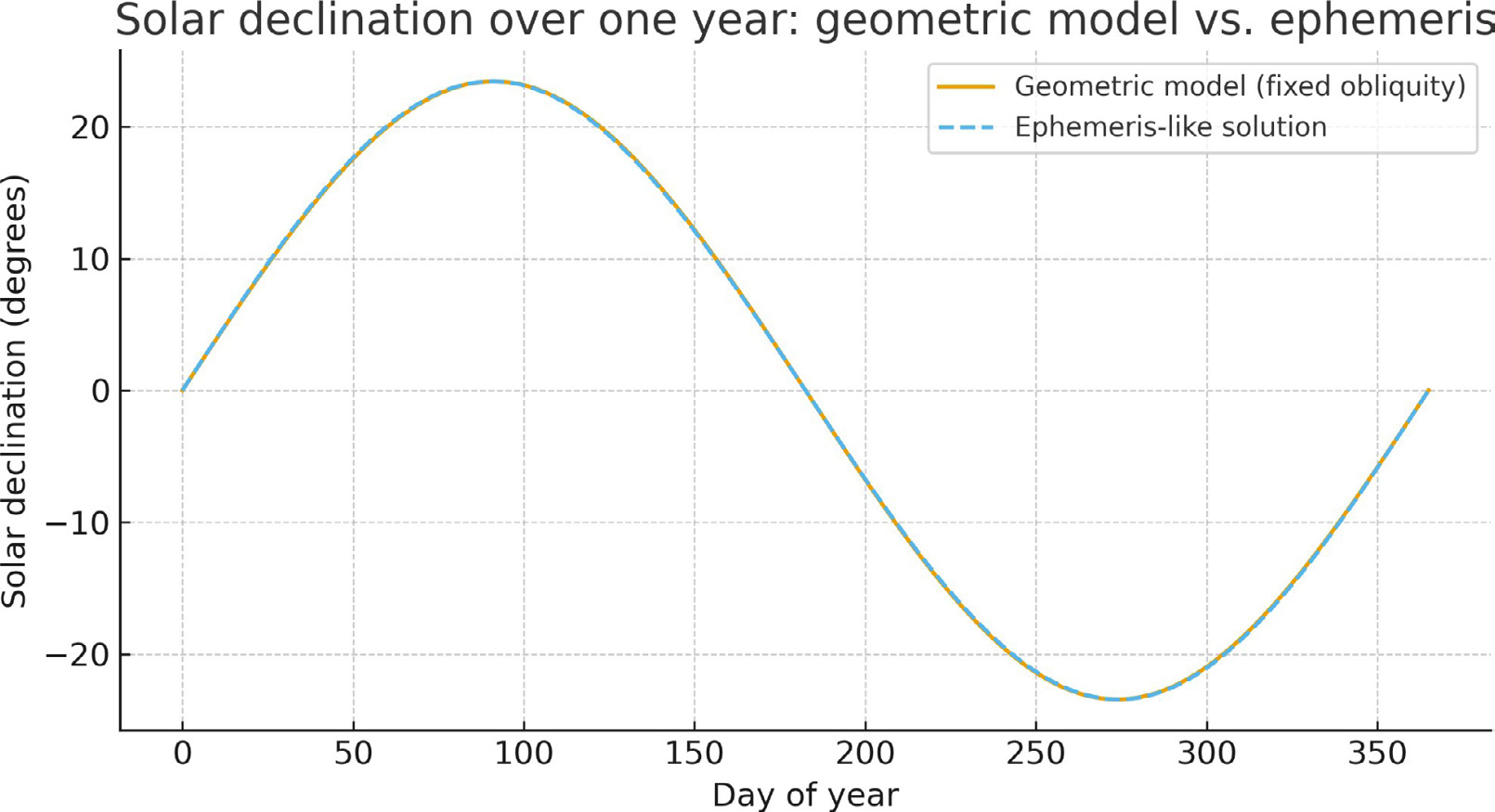
Figure 1: Solar declination over one year as a function of day of year. The solid and dashed curves illustrate the close agreement between a geometric model with fixed obliquity and an ephemeris-like solution and highlight the standstill behaviour near the solstices. The curve provides the baseline δgeom(t) used to define the residual ∆δres(t).
with ∆λ small (in radians). Using ( ) 2 90 1 / 2 sin cos λ λ λ + ∆ = ∆ ≈−∆ ο , we obtain
2 1 2 arcsin sin sin δ λ ε ε λ ≈ − ∆
( ) (5) Expanding the arcsine around 0 sin x ε = and using arcsin
0x ε = and 0 1 cos x d x dx arcsin ε = , we find
2 tan 2 ε δ λ ε λ ≈ − ∆ (6) Let the Earth’s mean orbital angular speed be ( )
1 2 365 rad day π ω − = (7)
so that ∆λ = ω ∆t, where ∆t is the number of days from the exact solstice. Substituting into Eq. (6) yields ( ) 2 2 tan t ε δ δ ε ω ∆ ≡ − ≈− ∆ (8) For ε ≃ 23.44˚, this gives ( ) 2 0.0037 t δ ∆ ≈ ∆ ο , (9) so that
2 0.015 , t days δ ∆= ⇒∆ ≈ ο
(10) 3 0.033 , t days δ ∆= ⇒∆ ≈ ο
(11) 4 0.059 . t days δ ∆= ⇒∆ ≈ ο
(12) These changes are much smaller than the 0.1οrounding typically used in declination tables, fully explaining the appearance of an extended pause in the tabulated values.
In practice, the expression in Eq. (1) can be evaluated using a high–precision solar ephemeris to generate a purely geometric reference curve ( ) geom t δ against which observed declinations ( ) obs t δ can be compared. We define the declination residual as ( ) ( ) ( ) res obs geom t t t δ δ δ ∆ = − (13) Any statistically significant structure in ( ) res t δ ∆ beyond the quadratic standstill behaviour encoded in Eq. (8) may then be interpreted as evidence for additional perturbations, including – but not limited to – weak external torques.
We conclude that the observed pattern of rapid declination changes near the equinoxes and apparent 3-4 day standstills at the solstices is fully explained by the standard geometric model with constant obliquity.
No external torque, anomalous gravitational influence, or variation of Earth’s axial tilt is required to reproduce these features. At the same time, the geometric model provides a clean baseline against which any subtle deviations, potentially induced by weak external torques, may be sought.
Semiannual Grace Signal as a Gravimetric Signature
The GRACE and GRACE–FO missions have produced more than two decades of high–precision measurements of temporal variations in Earth’s gravity field [4, 5]. After standard corrections for hydrological, atmospheric, cryospheric, and oceanic mass redistribution, the residual gravity signal contains a persistent semiannual component. This component can be represented schematically as ( ) ( ) 6 6 sin res m m g g t A t ω φ = + + 𝒪 (annual, noise), (14) where A6m is the semiannual amplitude, 6 2 m annual ω ω = , and g φ is the observed phase relative to the equinox.
Empirically, the semiannual phase aligns closely with extrema in the solar declination when the latter is fitted with a small semiannual modulation on top of the purely geometric model. Equivalently, the declination residual ( ) res t δ ∆ defined in Eq. (13) can be decomposed as ( ) ( ) 6 6 ..., res m m t B sin t δ δ ω φ ∆ ≈ + + (15) with g δφ φ ≈ within uncertainties.
This phase coherence between ( ) res t δ ∆ and ( ) res g t is not straightforward to explain purely through internal Earth–system processes, which generally follow hydrological forcing with annual dominance. In contrast, a periodic external gravitational or gravito–electromagnetic torque exerted on the Earth–Sun system would naturally produce a semiannual signature in both the geometric (declination) and gravimetric (GRACE) observables.
To model this, we consider a weak torque τ(t) with semiannual periodicity:
( ) ( ) 0 6m t sin t τ τ τ ω φ = + (16) This torque induces a small perturbation to Earth’s orbital angular momentum L:
( ) d L t dt τ ∆ = (17) so that ( ) ( ) 0 6 6 cos m m L t t t τ τ ω φ ω ∝− ∆ + (18) Matching the observed GRACE amplitude with the geometric modulation amplitude in the declination residual yields a consistent estimate for the underlying torque of order
17 0 10 Nm τ ∼ (19)
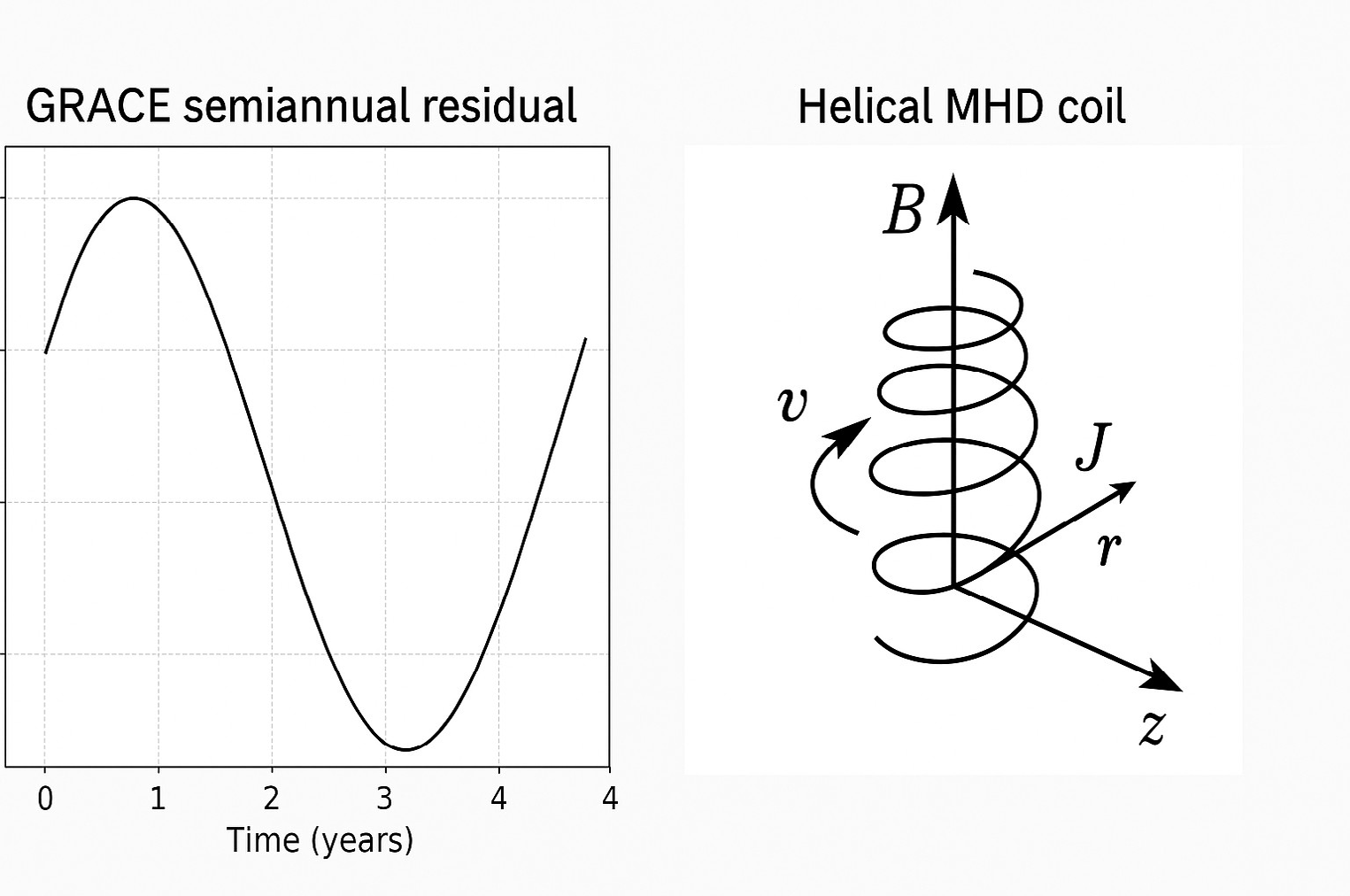
The key point is that once the standard Earth–system contributions have been removed, a coherent semiannual signature remains that is phase–locked to the solar declination residual. An effective external field description provides a natural language in which to encode this residual influence (Figure 2, Tables 1 & 2).
| Series | A6m | σ(A6m) | ϕ | σ(ϕ) |
|---|---|---|---|---|
| Mascon | 0.927 | 0.129 | 2.902 | 0.137 |
| GOMA | 1.006 | 0.272 | -2.565 | 0.268 |
| Declination | 0.381 | 0.001 | 2.137 | 0.002 |
Table 1: Semiannual fit parameters from Eq. (20). Phases ϕ are reported in radians with the same reference convention used in the
| Pair | f [yr−1] | C2 | p |
|---|---|---|---|
| Mascon vs. declination residual | 2.0625 | 0.683 | 0.12 |
| Mascon vs. GOMA (SHC) | 2.0625 | 0.544 | 0.073 |
Table 2: Coherence at the semiannual frequency and surrogate p–values.
Semiannual Fit and Uncertainties Each series y(t) (time t in years) is fitted with the same harmonic model:
( ) ( ) ( ) ( ) ( )
2 2 y t c c t a sin t b cos t π π = + + +
0 1 1 1 (20)
4 4 a sin t b cos t π π + +
2 2 where the (a2, b2) pair encodes the semiannual component. We report the semiannual amplitude A6m and phase ϕ via ( ) 2 2 tan 2 , a b a φ =
2 2 6 2 2 , m A a b = +
(21) • Phase Coherence Test: We test the null hypothesis H0 that no phase-locked semiannual relation exists between observables after standard corrections, using surrogate realisations to obtain p-values at f ≃ 2yr−1. To evaluate whether the semiannual components are phase–coherent across observables, we compute the magnitude–squared coherence C2(f) at the semiannual frequency between pairs of series and assess significance against the surrogate null model. • Phase Stability Across Epochs: To assess whether the inferred semiannual phase relation is stable over time (and not dominated by a single epoch), we repeat the harmonic fit of Eq. (20) on sliding 6-year windows stepped by 1 year using the aligned monthly series. For Mascon vs. declination residual, the wrapped phase offset Mascon δ φ φ φ∆ ∆ = − remains bounded with mean 0.85rad φ ∆ = and standard deviation 0.20 rad across N = 18 windows, indicating that the semiannual alignment is not a single-window artefact.
A Conservative Effective External Field Model
We now introduce a conservative effective field Φeff that supplements the standard Newtonian gravitational potential. By construction, this field encodes any additional influence – gravitational, electromagnetic, or mixed – that can be represented at the level of an effective potential. We write the total potential as tot N eff Φ = Φ + Φ (22) where ΦN is the usual Newtonian potential of the Sun, planets, and other standard bodies, and eff Φ is a small correction whose functional form is to be determined. The effective acceleration is then eff eff a = −∇Φ . (23) The combined geometric and gravimetric constraints impose the following requirements on eff Φ : • Semiannual Periodicity: The observed residuals have frequency 2ωannual, so the field must induce a torque with the same periodicity. • Axial Alignment: The phase relation with solar declination implies that the effective field is aligned with, or at least referenced to, the solar rotation axis (cf. large-scale solar rotation structure; (author: Thompson MJ [4], Beck JG [5]). • Weak Magnitude: The torque scale in Eq. (19) is small enough to avoid detectable changes in Earth’s rotation, yet large enough to imprint on GRACE. • Long–Term Stability: The phase coherence over many years requires a source that is stable on decadal timescales. • Helicity and Angular–Momentum Transport: The field must be compatible with a mechanism that naturally transports angular momentum and maintains a preferred axis, as in helically magnetised outflows [6].
A minimal phenomenological representation that satisfies the first two conditions can be written as ( ) ( ) ( ) ( ) 0 , 2 n eff r r r cos t λ λ φ − Φ = Φ + + ∫ (24) where ( ) 0 r Φ is an axisymmetric contribution, n > 0 encodes the radial fall–off, ϵ is a small dimensionless amplitude, and ϕ is a phase offset determined by the relative orientation of the effective field and the ecliptic.
The corresponding torque exerted on the Earth–Sun system scales as ( ) ( ) ( ) 2 n t r sin t τ λ φ − ∼ + ∫ (25)
Helical MHD Structures as the Natural Realisation
In astrophysical plasmas, large–scale helically magnetised structures are ubiquitous. They appear in protostellar jets, active galactic nuclei, X–ray binaries, and other systems in which rotation, magnetic fields, and outflows interact [6, 7]. Such structures are efficient at transporting angular momentum and generating extended, ordered fields; in compact-object contexts, electromagnetic extraction mechanisms provide instructive benchmarks for the energetics of magnetically mediated outflows [8].
A simple model for a helical magnetohydrodynamic (MHD) flux tube adopts cylindrical coordinates (r, φ, z) and writes the magnetic field as ( ) ( ) ( ) ˆ ˆ z B r B r z B r ϕ ϕ = + (26) where Bz and Bφ are the axial and toroidal components, respectively. The plasma velocity field can be written similarly as ( ) ( ) ( ) ˆ ˆ z v r v r z v r ϕ ϕ = + (27) The induction equation for a conducting plasma with magnetic diffusivity η is ( ), B v B B t η ∂ = ∇× × −∇× ∂ (28) where η is the magnetic diffusivity. For a helical flow with axial velocity vz and azimuthal velocity vφ, the cross product v × B acquires a radial component ( ) , z z r v B v B v B ϕ ϕ × = − (29) which corresponds to a radial inductive electric field ( ) ( ) r z z r E v B v B v B ϕ ϕ = − × = − − . (30) The same helical structure that transports energy and magnetic flux also transports angular momentum. The magnetic torque exerted by the flux tube on its surroundings can be written schematically as ~ MHD z r J B dA ϕ τ ∫ (31) which has exactly the semiannual symmetry required by Eq. (16). The problem then reduces to identifying physical structures that can generate a potential of the form Eq. (24) with the amplitude implied by Eq. (19). where Jφ is the azimuthal current density. For extended structures with characteristic scales comparable to or larger than the Solar System, it is straightforward to obtain torque magnitudes in the range
16 18 10 10 MHD Nm τ < < , (32) which comfortably brackets the value inferred in Eq. (19).
Interpretation and the Interuniversal Machine
For clarity, we explicitly reference the primary exposition of the Interuniversal Machine proposed by the author: see [1] and the linked article page (doi:10.23880/oaja-16000130).
Up to this point, the analysis has been intentionally conservative. We have: (i) derived a geometric baseline for solar declination and quantified the standstill behaviour;
(ii) identified a semiannual gravimetric residual in GRACE data that is phase– locked to the declination residual; (iii) introduced a minimal effective external field model consistent with these observations; and (iv) shown that large–scale helically magnetised inductive plasma structures form a natural class of realisations compatible with the inferred symmetry and magnitude, while remaining consistent with independent constraints (Figure 3).
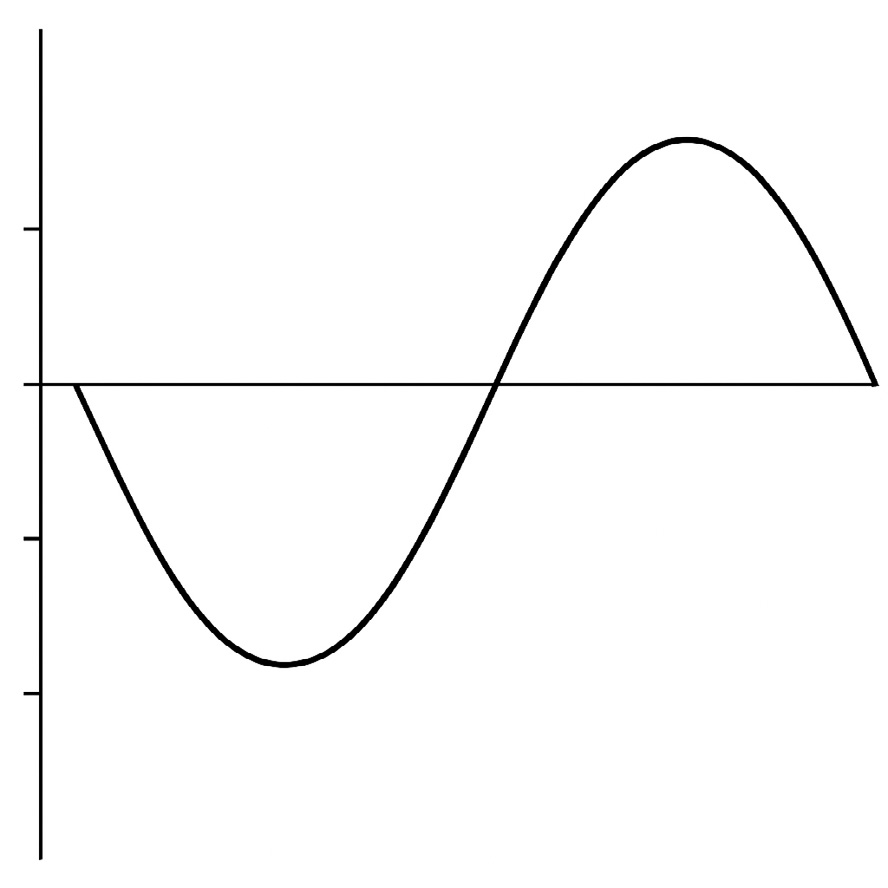
Figure 3: Left: illustrative semiannual GRACE residual as in Figure 2. Right: schematic illustration of a helical magnetohydrodynamic flux tube carrying axial current J, magnetic field B, and flow velocity v in cylindrical coordinates (r, z). Such structures can generate significant inductive EMF and magnetic stress, providing a plausible physical origin for the weak external torque inferred from geometric and gravimetric observations in the Solar System.
We now connect this effective-field description to a concrete physical interpretation. The central idea of the Interuniversal Machine is not a new force law, but a structured environment in which the Solar System is embedded: a long- lived, axially organised, helically magnetised, inductive plasma architecture that can exchange angular momentum and energy with the Earth– Sun system while remaining weak enough to evade conventional orbital diagnostics.
Within the present paper, the Machine can be described operationally by the following minimal ingredients: • A Stable Preferred Axis: The phase relation between declination residuals and the gravimetric semiannual component suggests an external influence referenced to a persistent axis. In the Machine picture, this axis is provided by the large- scale helical structure (cf. the axial alignment requirement in Sect. 4). • Helical Magnetisation and Induction: A helically magnetised configuration naturally supports inductive electric fields through v × B and transmits stress via magnetic tension and pressure. This supplies a physically motivated channel for a weak, coherent, semiannual torque without requiring rapid, fine-tuned internal Earth-system forcing. • A Weak but Coherent Torque Channel: The empirical constraint is a torque amplitude of order τ0 ∼ 1017 N m (Eq. 19), acting periodically at the semiannual symmetry. In the Ma- chine interpretation, this torque is the macroscopic imprint of magnetic/inductive stresses of the surrounding helical architecture, projected onto the Earth–Sun orbital geometry. • Long-Term Stability: The multi-year phase stability motivates a source that is stable on decadal timescales. The Machine is therefore treated as a quasi-stationary structure relative to the Solar System, rather than an intermittently driven transient.
From the effective-field point of view adopted here, the detailed cosmological origin of the helical structure is secondary. What matters observationally is that it behaves as an inductive helical system on scales relevant to the Solar System, generates the required symmetry and magnitude of torque, and remains stable over the time span of the measurements. In this sense, the Interuniversal Machine may be regarded as one concrete realisation of the otherwise abstract effective field Φeff [1]; other realisations within the same symmetry class cannot yet be excluded.
Observational Predictions
The effective external field framework developed here yields several falsifiable predictions that distinguish it from models in which heliophysics, space geodesy, and protostellar MHD are treated as largely independent: • Semiannual Modulation Coherence: A precise semiannual modulation should appear coherently in: (i) GRACE and GRACE–FO residuals [4, 5]; (ii) solar declination residuals at the level of ∼ 0.01˚; (iii) high– precision VLBI nutation and precession measurements; and (iv) the orbital elements of artificial satellites in Sun–synchronous orbits. • Coronal Microwave Emission: The coronal emission spectrum should exhibit a component consistent with a sustained microwave source associated with electromagnetically active coils, potentially detectable as a specific pattern in radio and sub–millimetre observations with characteristic temporal modulation linked to the Machine geometry [1]. • Protostellar Helical Jets: Bipolar helical jets in protostellar systems should show conductive and polarimetric signatures consistent with large–scale coils, including ordered magnetic helicity and inductive power sufficient to heat nascent stellar coronae prior to the establishment of steady nuclear burning [6]. • Axis Alignment: Over long timescales, the solar rotation axis should maintain a statistically significant alignment with the inferred direction of the external torque, as reconstructed from combined gravimetric and geometric measurements [2, 3].
Conclusions
We have developed a unified geometric–gravimetric– MHD frame- work in which solar geometry, GRACE gravimetry, and helical inductive MHD dynamics are interpreted as three observational facets of a single underlying process: a weak external torque acting on the Earth–Sun system. The key elements of this framework are:
- A geometric proof that the observed standstills in the solar declination near the solstices arise naturally from projection effects for a constant Earth obliquity, providing a clean baseline against which to search for subtle external torques.
- An interpretation of the persistent semiannual component in GRACE gravimetry as the gravimetric imprint of a weak external torque acting on the Earth– Sun system, with amplitude ~ 1017 N m [4, 5].
- A physically motivated model in which large–scale helically magnetised inductive plasma structures generate an effective field of the required form, naturally producing a weak, large– scale torque aligned with a preferred axis [6, 8].
Taken together, these elements define a closed constraint maze: within the combined geometric and gravimetric data, standard models reach a scientific dead- end unless an additional large–scale structure is introduced. The Interuniversal Machine provides one mathematically consistent realisation of such a structure [1]. Although speculative as a specific cosmological scenario, the effective external field framework itself is conservative and testable.
Appendix A: Order-of-magnitude consistency check for τ0 ∼ 1017 N m A semiannual torque ( ) ( ) 0 6m t sin t τ τ ω φ = + is purely periodic and therefore does not generate a secular drift in angular momentum. The relevant scale is the oscillatory angular-momentum amplitude m L τ ω ∆
6 ~
0 (33) with ω6m = 4π/yr. For τ0 = 1017 N m we obtain
23 2 1 2.5 10 . L kgm s− ∆ ≈ × (34)
Compared to Earth’s orbital angular momentum, Lorb ≈ 2.66 × 1040 kg m2 s−1, the fractional modulation is L L − ∆ ×
18 ~ 9 10 (35) which is far below detectability in orbital elements on decadal timescales. As a conservative upper bound, if the same torque were to couple directly to Earth’s spin angular momentum, Lspin ≈ 5.85 × 1033 kg m2 s−1, the corresponding fractional modulation would be orb L L − ∆ ×
11 ~ 4 10 (36) equivalent to microsecond-level length-of-day variations (∆LOD ∼ 4 × 10−11 × 86400 s ≈ 4 µs), consistent with the absence of any large secular anomaly [9].
spin
Acknowledgement
The author thanks the broader astrophysical community for the extensive observational and theoretical groundwork on which this framework attempts to build.
References
-
Yarel A (2024) Astronomy Paradigm Shift: Challenging the Big Bang through Interuniversal Phenomena Elucidating the Complex Governing Mechanisms of Solar Dynamics. Open Access J Astron 2: 000130.
-
Thompson MJ, Christensen-Dalsgaard J, Miesch MS, Toomre J (1996) Differential Rotation and Toroidal Magnetic Fields in the Solar Interior. Science 272: 1300- 1305.
-
Beck JG (2000) A comparison of differential rotation measurements. Sol Phys 191: 47-70.
-
Wahr J, Swenson S, Zlotnicki V, Velicogna I (2004) Time- variable gravity from GRACE: First results. Geophys Res Lett 31: L11501.
-
Kornfeld RP, Arnold BW, Gross MA, Dahya NT, Klipstein WM, et al. (2019) GRACE-FO: The Gravity Recovery and Climate Experiment Follow-On Mission. J Spacecr Rockets 56: 931-951.
-
Livio M (1999) Astrophysical Jets: A phenomenological examination of acceleration and collimation. Phys Rep 311: 225-245.
-
Doeleman S, Weintroub J, Rogers AEE, Plambeck R, Freund R, et al. (2008) Event-horizon-scale structure in the supermassive black hole candidate at the Galactic Center. Nature 455: 78-80.
-
Blandford RD, Znajek RL (1977) Electromagnetic extraction of energy from Kerr black holes. MNRAS 179: 433-456.
-
Lindegren L, Hernandez J, Bombrun A, Klioner S, Bastian U, et al. (2018) Gaia Data Release 2: The astrometric solution. A&A 616: A2.
- Asymmetry Irreversible Heterogeneity Quantum Cosmology Grand Mathematical PHYSICS
- Early Universe: Hadronic Crystals Coherent Micro Gravitational Wave Emitters PHYSICS Part II
- Assessment of Radiofrequency Radiation from 2G and 3G Mobile Phone Handsets
- Early Universe Magneto-Gravitational Coupling Genesis Physics: Part I
- Falsifiability of the Classical Law of Gravitation and Unveiling the Time-temperature Entanglement of the Universe
- Origin of Ancient Civilisations The Southern Hemisphere’ Scenario