
Falsifiability of the Classical Law of Gravitation and Unveiling the Time-temperature Entanglement of the Universe
Newton’s laws of gravitation, proposed about three to four decades ago, are still widely used in most fields of modern physics. Although the gravitational equation put forward by Newton, [F = Gm1m2/r2] (where F represents the force, m1 and m2 are the masses of the interacting objects, r is the distance between the two objects, and G is the gravitational constant), is purely empirical; it eventually took the form of a law. In fact, it was an intuitive equation formulated by Newton based on his observations of various natural phenomena, such as the falling of an apple from a tree, the motion of planets in the solar system, the Earth's rotation on its axis, and the periodic tides in rivers and oceans. Newton believed that his proposed equation (or the gravitational model as he envisioned it) was the best fit for the experimental data available at the time. This data included the relationship between the height and time of an object's fall towards the Earth, the symmetry of an object's time of ascent and descent, and the escape velocity required for an object to leave Earth's gravitational influence. However, in formulating his law, Newton entirely ignored or overlooked four fundamental aspects of the universe: Thermodynamics, The perpetual motion phenomena, The cancellation of the g parameter between the ‘acceleration parameter’ and ‘time’ in his proposed equations and the ‘time temperature’ entanglement of the universe. So, this paper relooked at classical physics with these four above fundamental aspects of the universe and presented new outputs.
Abbreviations
SHM: Simple Harmonic Motion; GTR: General Theory of Relativity.
Introduction
The mathematical statement of Newton’s law of gravitation is:
( ) 2 1 2 F Gm m r = (1) [F, m1 and m2, r and G stand for the force, m1 and m2 masses of the interacting objects, r the distance between the objects] Equation 1 can be written in the following form:
1 2 F Gm m r r × =
( ) (2) As per equation (2), the LHS represents energy (since energy = force x distance), and so equation (2) can be written as:
1 2 Gm m Energy r =
(3) Now, when r tends to zero, energy (being a composite variable of force and distance) becomes infinite. This violates the laws of thermodynamics since the conservation of energy is no longer maintained under such circumstances. Given that m₁ and m₂ are constants; to preserve the conservation of mass, the gravitational constant (G) must change its value accordingly. Once the value of G changes, it no longer remains constant. Consequently, when G loses the constancy attributed to it by Newton, Newton’s gravitational model collapses entirely.
The energy expression of physics in the form of (energy = force x distance), in fact converges to ( ) ( ) Energy Force Distance Pressure Area Distance PV = × = × × = (4) Where [P is pressure and (area x distance = volume = V] Based on equation (3), equation (4) can be written as,
1 2 Gm m Energy PV r = = (5) Or
1 2 Gm m P Pressure rV = = (6) Now when r is tending to zero, the pressure tends toward infinity, and when r tends to infinity, then the pressure becomes zero. All such occurrences are thermodynamically forbidden, and the pressure is not at all a function of the distance between two celestial bodies or massive objects.
In this article, many famous equations in conventional physics will be discussed, and some of those equations are being shown below [1, 2, 3]:
P mf = (7) v u ft = + (8) 2 ½ S ut ft = + (9) F mg = (10) ( ) 8 / v RT M π = (11) ( ) 2 1/ 3 P c ρ = (12) 2 E mC = (13) ( ) 2 / T L g π = (14) According to Newton’s equation (1) of gravitational force, the force (F) experienced by a mass, say m, resting at a height r above the Earth’s surface is equal to the force experienced by the Earth (mass M, for example). If a perpendicular is drawn from the center of mass of the object to the surface of the Earth, this line intersects the Earth’s surface at a certain point and that does extend to the center of the earth. Along this straight line, the two forces, F (one exerted by the Earth on the object and the other by the object on the Earth), act in opposition to each other and effectively cancel out, resulting in a net force of zero on both the Earth and the object.
What Newton did to introduce the parameter g was to express the force F again in terms of mass and acceleration using equation (1), as follows:
2 GMm F mg r = = (15)
2 GM g r = (16)
So,
1 2 GMm F Mg r = = (17)
So, ( ) 2 1 / g Gm r = (18) [g and g1 stand for the acceleration due to gravity of the earth to the object and acceleration due to gravity of the object to the earth, respectively].
Newton argued that since M is significantly larger than the mass, m, of the object, g₁ would be immeasurably low in magnitude compared to g. Hence, the object would accelerate towards the Earth, while the Earth would not accelerate towards the object.
Newton’s second law of motion, given by the equation: Force = mass × acceleration is applicable only when a net force is acting on an object. Since the net force acting on the object is zero, as explained above, applying this equation to the Earth and the object would result in a zero value for both g and g₁, as shown below:
For the earth, net force = (M x g1) = 0, so g1= 0; For the object, net force = (m x g) = 0, so g = 0 Therefore, the parameter g should be reconsidered or excluded from gravitational physics, as the preceding arguments and logical analysis suggest that its validity is questionable.
A highly pertinent question that arises in this context is: Why does an object fall towards the Earth? The explanation lies purely in the thermodynamics of the surrounding space. Space possesses an inherent property where any energy imparted to it from a source is eventually returned, and any energy extracted from space must be replenished. This principle ensures the law of conservation of energy is upheld across the universe.
When an object is raised to a certain height h above the Earth’s surface by applying a force F, the work done is given by [W = F × h] This work corresponds to the amount of energy transferred to space from the source be it a machine, a human, or a robot. So, energy is being converted to work while taking the object at a height h. Upon releasing the object from height h, it returns to the Earth through the same path, during which they said ‘work-done’ is being converted back to energy. So, the space returns the energy back, either directly or indirectly, to the source.
In thermodynamic terms, when the object is lifted, heat is converted into work, and as the object descends, the work is reconverted into heat. Therefore, the reason an object falls back to the Earth is fundamentally thermodynamic in nature. This phenomenon negates the need for conventional gravitational forces between objects, whether they are terrestrial bodies or celestial entities.
A significant issue with the non-compliance of Newton’s Law of Gravitation is that the gravitational equation fails to explain why astronauts begin to float in a spacecraft as soon as it travels to a height of about 100 km above the Earth’s surface. For example, when an object of mass m is resting on the Earth’s surface, the gravitational pull on the object is given by:
gravitational pull on the object F
=
1 GMm r =
at the Earth’s surface
(15)
2 Here, M is the mass of the Earth, R is the distance from the Earth’s centre to the point where the mass m is resting (along a straight line), and G is the gravitational constant.
When the same mass m is taken to a height of approximately 100 km above the Earth’s surface (which is the average distance where space begins), the gravitational force weakens, and its magnitude becomes:
gravitational pull on the object F
=
2 GmM at 100 km above the Earth’s surface 100
= + (16) Dividing equation (2) by equation (1), we get:
( )
2 R
2 2 2 1 100 F R F R = +
( ) Since the average radius of the Earth, R, is approximately 6400 km, the ratio becomes:
( ) ( )
2
6400 0.97 6400 100 F F = ≈ +
2 2 1 This means that the gravitational pull on the object of mass m decreases by only about 3% at a height of 100 km compared to its position on the Earth’s surface. Such a minor reduction in gravitational pull is insufficient to cause objects or astronauts to float in space. Therefore, Newton’s law of gravitation, or the gravitational equation, fails to explain this phenomenon.
The reason why objects float in space above the Earth is purely thermodynamic in origin. In space, there is no atmosphere, and the pressure (P) is zero. Since energy is given by the equation:
E PV = (where V represents volume), the energy in space is nearly zero. As a result, regardless of the position of an object, there is no significant change in energy, allowing objects to float freely in space.
The following points should be noted, as they do not support Newton’s empirical equation of gravitation: The problematic equation of force in motion in physics is the one proposed by Newton, expressed as:
( ) ) Force mass accele ( rat o ) ( i n F m f = ×
Both mass and acceleration are variables.
F mf = (19) The Charles’s law relating the volume and absolute temperature of a gas is V PT = (20) Here, P, V, and T represent the pressure, volume, and temperature of the gas, respectively. However, in this equation, P is treated as a constant, unlike m in equation (19), where m is a variable.
When the volume of a gas increases according to equation (20), it is solely attributed to the effect of rising temperature, as pressure remains constant. In contrast, when the force acting on an object increases, it is difficult to ascertain whether the increase is due to a change in mass, acceleration, or a simultaneous increase in both. Since force is a compound function of mass and acceleration, it becomes challenging to disentangle the effects of these two variables and express them independently. This complexity is reflected in expressions in physics derived from equation (19).
force Acceleration mass =
(21) or force Mas mass s =
(22) While the dimensionality of ‘acceleration’ is defined as L/T2, the dimensionality of mass, in terms of length (L)
and time (T), remains unexplored in conventional physics. Consequently, it is unclear whether a change in mass influences the acceleration parameter or vice versa.
• Under conditions of free fall towards the Earth, if a heavier object and a lighter object are dropped simultaneously from the same height (h) above the Earth’s surface, they strike the ground at the same time. This indicates that the acceleration of both objects must be identical. Let the masses of the two objects be m1 and m2 (where m1 > m2), and the gravitational forces acting on them be F1 and F2, respectively. If M denotes the mass of the Earth, then according to Newton’s equation (18), [acceleration of the object towards the earth] we can express the forces as follows, considering the corresponding accelerations as f1 and f2:
1 2 GM f h = (23)
2 2 GM f h = (24) So,
1 2 f f = (25)
As per equation (24) and equation (25) then, the higher mass object should hit the earth simultaneously with the lighter mass object. However , it is to say here that since the gravitational attractive force be the same on the object and on the earth, then along the line joining the center of mass of the earth and the object , the equal and opposite forces would be cancelling each other and so the above equations (23) to equation (26) have no validity at all.
The falling of objects on the earth takes place because any object being left in the atmosphere above the earth, would be looking for a ‘resting position’ or ‘equilibrium position’ since in the said position, all the forces acting on the object are being rightly balanced. However, the question is what are the forces acting on it? Under the fall of an object towards the earth, the atmosphere puts pressure on an object from all the sides (or all angles) in practice. The pressure of the atmosphere from the top of the object does act downwards, the pressure from the bottom acts upwards, the pressure from the sideways are not also being the same. However, when the object attains a resting position on the surface of the earth all the said forces are being well balanced from all the angles.
The falling of the objects towards the earth’s surface is a phenomenon arising out of unbalancing of atmospheric forces to begin with and ending with a fully balancing of the forces on the surface of the earth. The reason why the objects irrespective of their mass falls on the surface of the earth simultaneously is being explained below.
The terminal velocity (Vt) equation in physics [3] for a falling object of mass m in any fluid (drag coefficient Cd) of density, ρ, and the projected surface area being A and the gravitational acceleration being g, is, ( ) 1/2 2 / t d V mg AC ρ = (25a) Now since velocity = (distance/time) , the above equation can be written as, ( ) ( ) [ ] 1/2 / 2 / t d V S t mg AC S being distance ρ = = (25b) Now putting the expression for t in the form of, 2π(L/g)1/2 (the equation of time period of oscillation of a pendulum) in the above equation (25b), the term g does cancel between each other in the LHS and the RHS of the said equation, and the above equation converges to, [ρ = M/L3, A = L2, Cd = dimensionless = L0 and S = L, in dimensional forms]
( ) 1/2 2 2 S L π = (25c) So, the factor of gravitational expression (g) has no significance being left.
The terminal velocity as is being shown in equation (25a), is being proportional to the mass. The said equation had been derived considering the gravitational factor. However, since the factor of gravitation is being ruled out, the new amended concept which is being offered here is given below.
Terminal velocity mass of the object ∝ (25d) 1/ Rate of energy dissipation of the Terminal velocity object per unit of height per unit time ∝ (25e) To lift an object of mass m to a height h above the ground, energy is being converted to work, and the energy is being stored in the object. Now, when the said mass m is higher, the work done would be higher too and the energy would be higher as well. When two objects of different masses are allowed to fall at the same instant of time (freely from a certain height h), the higher mass would be moving faster because of its higher energy or work content. At the same time, the energy dissipation per unit height per unit of time, to the space or the surroundings, of the higher mass object would be higher too. While the higher mass object’s velocity would be higher, it will be retarded by the effect of higher loss of energy as a function of time. On the other hand, for the lower mass object, the rate of energy dissipation per unit length per unit time would be lower too. So for the same height, the terminal velocity of the objects would be a constant one. So, the mathematical expression for ‘Terminal velocity’ would be, Terminal velocity
tV = Mass of the object Drag coefficient Rate of energy dissipation of the ( ) = × object per unit of height per unit time (25f) Now the drag coefficient [4] (an index of how much an object resists motion through a fluid like air or water) is dependent on the size, shape and the orientation of the object and in air, the said coefficient typically does vary in the range of 0.04 to 1.28. For vacuum the said co-efficient falls almost in the same range.
So, when two objects, irrespective of their masses, if being dropped from the same height, strike the ground simultaneously at the same velocity.
- The weightlessness as is being felt when a person goes downwards in an elevator is arising out of air - drag (of the air-volume of the elevator) , which , however, does act in the opposite direction of the movement of the elevator and as result of this a (the effect of buoyancy of air) weightlessness feeling is being encountered. The reverse would be true in case of a person travelling upwards in an elevator, when a heaviness feeling is being encountered since the said air drag acts downwards. The reason of weightlessness of the astronauts in the ‘spaceships’ (which is orbiting in a specific orbital in space) , the equableness but oppositeness of the centripetal forces and the centrifugal forces respectively, give rise to the said weightlessness and is also not being connected to the phenomenon of microgravity or the others. The same weightlessness is being felt by the swing riders since it is also an orbiting one [5].
- People climbing through stairs upwards do often sweat. In the event of climbing upwards, people must convert their own energy to work. As a result of that, the basal temperature decreases and the heat from the environment enters the basal and because of that people sweat. While going downwards through stairs, the atmospheric pressure exerts a pushing pressure which facilities the descending.
- One of the major contributors to air pollution on Earth is particulate matter, consisting of extremely fine solid particles. If gravitational principles were strictly applicable, these particles should have settled on the Earth’s surface over time.
- The most intriguing paradox that challenges Newton’s law of gravitation is the evolution of ‘differing pressure’ at a fixed point above the Earth’s surface (at any distance within the Earth’s atmosphere) when objects of the same mass but different densities are placed at that point. This phenomenon is illustrated in Figures 1 & 2 below. In these Figures, it is demonstrated that when three metal sheets each 4 mm thick and made of aluminum, iron, and gold—are placed at a height h above the Earth’s surface along the horizontal line AB in space, they exert different pressures at corresponding points on the sheets, despite having the same mass of 1 kg each.
The mass of the metal sheet 1
kg = ( ) ( ) ( ) ( ) ( )
surface area thickness density of the metal sheet ×
= × surface area 0.004 density of the metal sheet = ×
× The gravitational force on any of the metal sheets as per Newton’s gravitational force formula is:
( ) ( ) = × =
2
2 Force mass of the object mass of the earth / h Gx
( ) ( ) ( )
× × × Or
Gx surface area 0.004 density of metal sheet mass of the earth,M / ]
h ( ) 2 / 0.004 / Pressure Force surface area GMx x h ρ = =
M = mass of the earth, ρ is the density of the metal (Table 1). So pressure, [ ] ( ) 2 , 0.004 / P K K GMx h ρ = = × (26)
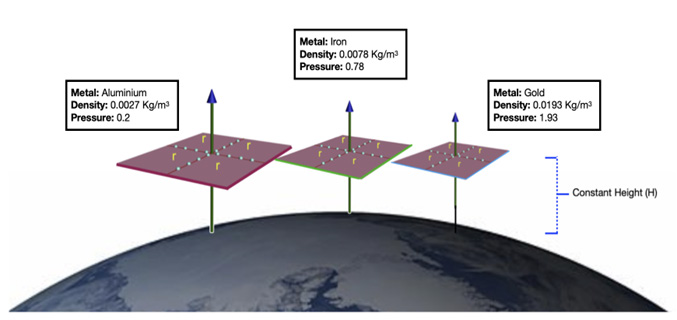
| S/No. | Metal | Density (Kg/m3) | Surface Area of the Metal Sheet | Pressure (Pascal) |
|---|---|---|---|---|
| 1 | Aluminium | 0.0027 Kg/m3 | 92592.59 m2 | 0.2 Pa |
| 2 | Iron | 0.0078 Kg/m3 | 32051.28 m2 | 0.78 Pa |
| 3 | Gold | 0.0193 Kg/m3 | 12953.36 m2 | 1.93 Pa |
| 4 | Osmium | 0.0262 Kg/m3 | 9541.98 m2 | 2.62 Pa |
Table 1: Calculation of Pressure on Rectangular Metal Sheets (Composed of materials of varying densities).
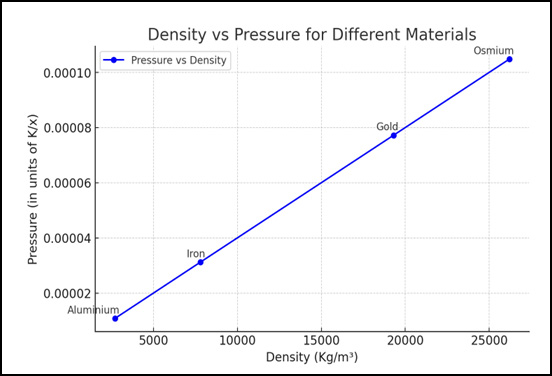
This reasoning completely invalidates the phenomenon of gravitation as proposed by Newton. Newton and Einstein had fundamentally different perspectives on gravity. Newton conceptualized gravitation as an attractive force between objects in the universe, whereas Einstein’s view was that gravity is a property of spacetime curvature, arising solely due to acceleration and not a force. However, despite this divergence, Einstein continued to incorporate Newton’s gravitational constant G in his General Theory of Relativity (GTR), as he was constrained by the framework of continuous spacetime and had no alternative but to use G to formalize his equations.
Newton’s expression of force is,
( ) Force mass acceleration = × (26) Now multiplying both sides of the above equation by distance (or L), one gets Force distance distance mass acceleration × = × × (27) [Now since (force x distance) = energy, equation (27) can be rewritten as], ( ) Distance energy / mass acceleration = × (28) For a moving object, as acceleration increases, the distance travelled increases. However, according to Newton’s equation of force, for a constant mass, an increase in acceleration should lead to a decrease in distance, as inferred from equation (28). Only under the condition of, (energy >> acceleration), such that the ratio of the two is very high, the distance would increase with acceleration. In that case, conservation of energy would have to be violated, since the energy must be infinitely higher. So, Newton’s mathematical formulation of force, defined as F= (mass × acceleration), is not suitable for describing the behavior of objects in motion regarding the aspect of energy.
If the application of force on an object led to a generation of acceleration in an open system (such as objects in motion), it would result in what is known as perpetual motion. For instance, if a mass m, resting on the Earth’s surface, is subjected to a force F to generate acceleration f as per Newton’s equation, it would theoretically travel an infinite distance over time, potentially crossing the boundaries of the universe. This, however, is not physically feasible and contradicts both the laws of thermodynamics and the principle of conservation of energy.
Newton’s expression for force is applicable only to closed systems, where a well-defined boundary separates the system from its surroundings. This concept is further elaborated in the subsequent sections.
Newton’s expression of force in relation to mass and acceleration is applicable to the expansion or contraction of gases, liquids, and solids, as demonstrated by the following example:
Consider the compression of a gas in a cylinder fitted with a piston an adiabatic or isolated system where no energy is exchanged between the system and its surroundings, with no mass transfer too. As the gas would be compressed, the piston would be moving downward, increasing the pressure, decreasing the volume and increasing the temperature. As the pressure on the piston increases, the force also increases since:
( ) ( ) Force Pressure on the piston Surface area of the piston = × (28a) The expression, force being equated to the product of mass and acceleration (as given by Newton), even in an adiabatic system will not be a simple equivalence like this. The force would be directly proportional to the product of (mass x acceleration) and the constant of proportionality would be ‘hard core volume of the molecules of the system (HCV)’. Upon compression or expansion of a fixed mass of a substance, what it changes is the ‘volume’ and ‘free volume’ but the “HCV” remains constant. So the expression of force would be.
( ) ( ) Force constant mass acceleration HCV m f = × × = × × (28b) The gas molecules experience acceleration due to the rise in temperature, but the mean free path of the molecules decreases as the piston moves downward. The increase in force/pressure leads to volume contraction, while the rise in temperature accelerates the molecules, as their average velocity is directly proportional to the square root of the absolute temperature (T), according to the kinetic theory of gases:
) 8 ( / avg V RT M π =
where R is the universal gas constant and M is the molecular weight of the gas.
The above example (analogous to Newton’s equation) holds true for any stationary system (gas, liquid, or solid) undergoing expansion or contraction in a thermodynamically isolated system, where the change in temperature (vis-à-vis acceleration) has a limiting value only. Any attempt to make the temperature further higher than the maximum possible temperature of the system will destroy the system and it will not remain to be any further isolated one, it will transform to an open system. Newton presented his equation.
Force mass acceleration = × but did not establish its validity through a physical example of a moving object. As per this equation the acceleration can be infinite even, theoretically, and which is thermodynamically being forbidden. The example provided here offers a comprehensive understanding of the physical significance of this equation, but it is not directly applicable to moving objects. Unfortunately, this critical distinction is often overlooked in physics education, leading to misconceptions about the mechanics of moving bodies.
Two Fundamental Mathematical Equations Dominate the World of Physics [1, 2, 3]:
- Newton’s second law of motion, expressed as: F = ma or P = mf
- Einstein’s mass-energy equivalence equation, given by: E = mc2 However, this study demonstrates that both equations are, in fact, allotropic (or equivalent) forms of the same underlying principle. Not only are these equations fundamentally the same, but they also do not accurately describe the phenomena for which they were originally proposed.
Newton’s equation was intended to describe the accelerated motion of an object resulting from an applied force in the direction of motion, while Einstein’s equation describes the relativistic energy of a mass moving at the speed of light. However, as demonstrated in this work, neither Newton’s nor Einstein’s equations adequately capture the phenomena associated with motion. Instead, both equations converge to a unified expression that relates the pressure of an ideal gas to its density and the average velocity of its molecules. Newton’s equation is, ( ) ( ) Force pressure area mass acceleration = × = × Or mass acceleration mass acceleration length Pressure P area area length × × × = = = × Or ( ) ( )
2 2 2 mass velocity density velocity volume ( P v ρ × = = × =
(29) [acceleration = (L/T2), length = L, T = time and volume =
(area x length), ρ = density and v = (L/T) = velocity]
Einstein’s equation is, [to note, pressure = P = (energy/ volume) and m = mass and C = velocity of light]
Energy E PV
= = ( ) ( ) 2 ]
since energy,E energy / volume volume P [ V mc
= = × = Or
( ) ( ) 2 2 2 / P mC V density velocity C ρ = = × = (30)
So, both the equations are converging to the same relation between pressure (P), density (ρ) and velocity (v or C). The derived equation of pressure of an ideal gas is,
2 1/ 3 P c ρ = (here c stands for the average velocity of the molecules) (31) This article establishes that neither Newton’s equation of motion nor Einstein’s mass-energy equivalence equation adequately serves the purposes for which they were originally developed and presented to the global scientific community.
Revisiting the Laws of Pendulums in regard to Conventional Physics
The pendulum (horizontal) laws have been presented in the following way [2]:
( ) 2 / T L g π = (32) [T, L and g stand for ‘time period’, ‘length of the pendulum wire’ and the so called ‘acceleration due to gravity’, respectively].
The value of g is being determined through laboratory experiments using a stopwatch and a laboratory pendulum. However, this is a Falsifiable Experiment, as is Being Explained below: • The time period (Ti) of oscillation of a horizontal pendulum is being expressed in regard to the length (Li) of the pendulum and the acceleration due to gravity parameter (g) by the well-known pendulum equation.
( ) 2 / i i T L g π = (33) • For the different lengths of pendulum, for example, L1, L2, L3.. respectively their time period (T1, T2, T3 respectively) of oscillation will be in the ratios of,
| L 1 | L 2 | L 3 |
|---|
are very small-length pendulums too and the time in the clocks is being set as per equation (33) as shown above. The normal practice of determining g value by laboratory experiments using higher-length pendulum and the time period of oscillation of the said higher-length pendulum is measured from a stopwatch clock as discussed above.
Now if the time period of oscillation of the higher length pendulum (Li) is measured to be for example Ti and the time period of oscillation of the stopwatch clock pendulum (length li) is ti, then Ti must be the positive multiple of ti and let that multiple be m, then it can be written, i i T mt = (35) Now putting the mathematical expression of Ti and ti as per equation (33) above, it is being found that,
2 / 2 ) / ( ( ) i i L g m l g π π = (36) So the parameter g does cancel from the RHS & the LHS of equation (4) and one is left with, ( ) ( ) 2 i i L m l = (37) The value of g is being determined by noting the time period of oscillation of a laboratory pendulum. The time period of oscillation is obtained from a stopwatch clock which is already being set to a g parameter. If the time period of oscillation of a laboratory pendulum (of length L) is recorded to be x (for example) from a stopwatch clock, then ( ) Time period of oscillation of laboratory pendulum 2 / x L g π = = (38) Now from equation (38), the value of g is determined as, ( ) 2 2 4 / g L x π = (39) Now; ( ) 2 2 ( ) 2 / 4 / i x m l g and x L g π π = = (40) So, comparing equation (39) and (40) one gets, ( ) 2 2 2 / (4 4 i g Lg m l π π = or, g = g [since m2 li = L, as shown in equation (5)].
So, the determination of g value by laboratory experiments as explained above is totally faulty and is a misleading experiment in physics.
The following points are to be noted in regard to the above equation (32) and the gravitational laws of Newton: • The problem in equation (32) is, the parameter g had been introduced as a variable first in the form:
1 T g ∝ Since T is a variable, g must also be treated as a variable. However, over time, g was established as a constant parameter, with a footnote indicating that it varies from place to place across different regions of the Earth, depending on the average height above sea level. Despite this acknowledgment no precise mathematical relationship was proposed to describe how g changes with altitude.
• The laws governing pendulum motion have not introduced any novel concepts beyond Newton’s equations of motion. However, it is well-documented in the literature that Newton’s equations themselves are not universally valid due to the non-constancy of the acceleration parameter, denoted as f. Superseding laws have been proposed to address these inconsistencies. Empirical data have demonstrated that f can never remain constant, thereby rendering the classical equations of motion invalid.
v u ft = + (9)
( ) 2 1 2 S ut ft = +
(10) 2 2 2 v u fS = + (11) [u = initial velocity, v = final velocity, S = distance travelled in time t, f = uniform acceleration] Equation (10) was reformulated by Newton in the following manner, where f was replaced by g (denoting acceleration due to gravity) and S was substituted with h (representing height), to describe the motion of objects moving upward or downward in the space just above the Earth’s surface:
( ) 2 ½ h ut gt = + (12) Following the same approach used to demonstrate the non-constancy of the parameter f, it can be similarly concluded that g cannot be considered a constant, as asserted in Newtonian classical physics.
• The simple harmonic motion (SHM) of a pendulum is traditionally considered valid only for angular displacements up to approximately 10 degrees from its mean position. Within this range, the motion can be approximated as nearly linear. If equation (12) is applied to describe this pendulum motion from the mean position, the parameter u should be set to zero. Under these conditions, the equation can be expressed as:
( ) 2 1 2 h gt =
(13) [or, time = t = 2(h/g)1/2 and is in the form of pendulum equation of Newton, T =2π √l/g]
• Since the era of the renowned Dutch scientist Christiaan Huygens—a mathematician [6] engineer, physicist, and inventor in 1673, clocks have been designed based on the equation T=2π√L/g. In fact, the first clock operating on this principle was fabricated by Huygens himself. It is worth noting that Newton’s laws of gravitation were proposed approximately one and a half decades after Huygens’ pioneering work on the modern pendulums clock.
• Galileo Galilei (1602) was the first to attempt to correlate distance with time (t) in the form of the law of the pendulum:
t L ∝ (14) In this context, L represents distance. However, during Galileo’s era, the measurement of time was challenging due to the unavailability of suitable clocks. Galileo often relied on his pulse rate or the rhythm of musical sounds to estimate time, but these methods lacked precision. He deduced the afore mentioned relationship by conducting experiments involving the rolling of a ball down an inclined plane and measuring the time of fall relative to the distance traversed.
In the case of the pendulum law proposed by Galileo, L denotes the length of the pendulum and not the distance traversed by the pendulum bob (S) during a complete oscillation (from the extreme left to the mean position, to the extreme right, and back to the extreme left through the mean position). Logically, the law should have been expressed as:
2 S T g π =
However, to this day, the equation continues to be represented as dependent on √L. This model of square root dependency of time on distance is fundamentally questionable, considering that the measurement of time itself was neither accurate nor reliable during Galileo’s time.
• In 1687, Newton proposed his renowned Law of Gravitation, introducing the parameter of acceleration due to gravity (g) into the forefront of physics. Over the years, numerous attempts have been made to measure the value of g using pendulum experiments, where g is evaluated in relation to the period of oscillation (T) by applying standard equations, such as equation (16). However, it is crucial to recognize that the time measured by these clocks is already calibrated to align with the accepted value of g (9.8 m/s²). Consequently, the value of g obtained from these experiments is inherently biased to match the preset value encoded in the time measurement. This raises a significant concern — conducting pendulum experiments to determine g using time (T) recorded from pre-calibrated clocks serves no scientific purpose. Despite this limitation, physics students are still taught this method at the school level, perpetuating an experiment that lacks empirical validity. It is essential to acknowledge this fundamental error and rectify the misconception propagated by this approach in classical physics.
• A critical flaw in the conventional pendulum law is the assertion that the time period of oscillation is independent of the mass of the bob. However, every physical phenomenon in the universe operates on the principles of ‘time-space’ or the interrelation between energy, volume, time, and distance. When a heavier pendulum bob is raised to a fixed height above the horizontal line compared to a lighter one, the energy required is proportionally higher for the heavier bob. Although both bobs traverse the same distance during one complete oscillation, the heavier bob operates at a higher level of energy than the lighter bob. Neglecting this energy perspective sends an incorrect message to learners of physics by suggesting that the time period (T) is entirely independent of the mass of the bob. This oversimplification overlooks the intricate energy dynamics involved in the pendulum’s motion. Therefore, this notion should either be revised or explained in a more nuanced manner, considering the energy implications as outlined above.
Quantum Concept of Time, Temperature, Energy, Work and Entropy
In this section, ‘time’ and ‘temperature’ will be defined through three distinct approaches [7]:
- Thermodynamically,
- In regard to quantum concept
- Through the phenomenon of rheology.
These three concepts will be demonstrated to converge, providing a unified framework for understanding these variables. It is essential to note that defining any physical variable in the universe requires at least two other physical variables. Without this interdependence, a third variable cannot be precisely defined. Some illustrative examples include: Force = Pressure × Area (both pressure and area are variables) Mass = Density × Volume (both density and volume are variables) Energy = Force × Distance (both force and distance are variables)
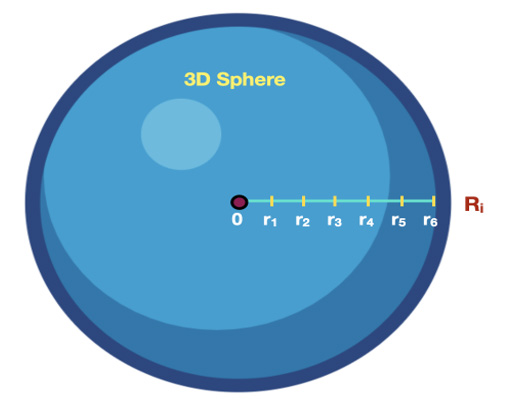
‘Time’ can be defined as the duration of an event. For instance, consider the movement of a point originating from the center of a 3D quantum sphere and progressing towards its circumference or surface. The volume of the quantum sphere is given by V = 4πr3/3, where r is the radius. As the point traverses through the sphere, its distance from the origin at various instances can be denoted as r1, r2, r3,…, ri as illustrated in Figure 3.
At any given moment during this movement, if the ratio of ri to V is found to be higher, it implies that the duration spent by the point within the sphere is shorter. Conversely, if this ratio is lower at any instant, the duration is relatively longer. Therefore, the measurement of ‘duration’ or ‘time’ can be effectively mapped through this ratio, providing a quantifiable framework for analyzing the temporal characteristics of the point’s motion.
Duration of time = (_Distance/Volume) So, in regard to ‘dimension’ or in regard to ‘dimensionality’ time passes out to: (Distance/Volume) = (L/πL_3) = (_1/πL_2) So, ‘time’ or ‘duration’ is an ‘inverse area’ which is holding pulling the point back the point towards the center of the sphere than to go forward.
The concept of ‘temperature’ can be inferred from the above example. If the ratio (ri/V) is found to be higher at any given instant, it indicates that the system is advancing more rapidly, implying higher push-forward energy. Thermodynamically, an increase in kinetic energy corresponds to an increase in temperature. Hence, ‘temperature (T)’ can be represented in the form of: (just the inverse of the concept of time) T = (Volume/Distance) The dimensionality of ‘temperature’ turns out to be: (Volume/Distance) = (πL_3_/(_L) = (πL2)_ Temperature can be conceptualized as a forward- driving force that propels the point ahead, analogous to the expansion observed when a substance is being heated.
In classical physics, one major state of affairs has been avoided and that is the inter-relationship between ‘temperature’ and ‘time’. The expression of Energy in the kinetic theory of gas and the quantum physics are, ( ) 3 2 Energy NkT = (41) Kinetic Theory:
Quantum Physics: v Energy h = (42)
[N, k, h and ѵ are the Avogadro number, Boltzmann constant, Planck’s constant and the frequency of the wave respectively. The unit of h is energy-sec and R = NK, the unit of R and k are energy/ kelvin. The unit of ѵ is time-1].
Equation (41) and (42) can be expressed in the following manner too, ( ) ( ) 3 Energy energy / temperature temperature 2 × = (43) ( ) ( ) Energy energy time 1/ time × × = (44) Comparing equation (43) and (44), an inter-relationship between T and t could be obtained as, ( ) ( ) 1/ 1/ T t or t T = = or
1 Tt = (45) Hence Time (t) and Temperature (T) are multiplicative inverse to each other since the product of the two is unity only. This T-t relationship remained hidden in science but only through the analytical approach as being made here the said relationship is being explored.
The notion of time can also be derived from the principles of rheology, involving two fundamental rheological parameters of the universe surface tension and viscosity as discussed below: The classical definition of Surface tension and viscosity are:
2 2 2 2 Force Energy Surface Tension of a liquid Distance Area L MT MT L
− − = = = =
(46)
2 2 1 − − = × = = × (47) If the dimension of surface tension (ST) is divided by the dimension of viscosity (VSC), the resulting dimension is expressed as: (ST/VSC = LT-1). The parameter LT−1 corresponds to the dimension of velocity. However, the physical interpretation of this velocity remains an unresolvxed question in science. Despite several attempts, no satisfactory explanation has been provided to justify the apparent emergence of a velocity dimension in this context. Interestingly, this velocity dimension appears to transform into a concept of ‘volume,’ as demonstrated below.
2 Viscosity of a liquid / Force Distance L MT MT Area Velocity L L L T Surface tension is an intricate phenomenon arising from a balance between ‘order’ and ‘disorder.’ While ‘volume’ represents a manifestation of randomness, ‘intermolecular attractive forces’ serve as an indicator of order. These two physical variables volume and intermolecular attractive forces collectively contribute to the emergence of surface tension. Consequently, surface tension can be expressed in a hybrid form that integrates these underlying physical variables.
ST volume intermolecular attractive forces = × (48) The viscosity of a liquid is directly influenced by intermolecular attractive forces, which establish order among the physical variables. However, when considering the flow of a liquid, pressure emerges as the dominant physical variable driving the flow. Consequently, viscosity can be viewed as a hybrid phenomenon of ‘order-disorder.’ While pressure introduces randomness, the intermolecular attractive forces strive to maintain order. Therefore, viscosity, in its hybrid form, can be expressed as:
( ) Pressure difference/original pressure
[ VSC = intermolecular attractive forces ]
× ( ) / intermolecular attractive forces P P x
= ∆
(49) [Equation (49) is being based on the following facts:
( ) 1/ VSC P ∝ (49a) ( ) / VSC K P = (49b) K is the proportionality constant and it is the constant pressure difference during a flow of a fluid and would be equal to ∆P].
Based on the preceding discussion, it can be concluded that, [dividing dimensional part of equation (48) to that of the dimensional part of equation (49), to note (∆P/P) is dimensionless but is a multiple and is being neglected for the simplified presentation of dimensional part]
Dimensionally, ST / VSC
( ) ( ) ]
Volume 48 byequation
[ ( ) 49 dividing equation = (50) Since pressure is a dimensionless parameter, the ratio of ST to VSC inherently represents a parameter with the dimension of ‘volume.’ Upon comparing the classical definition of the ratio of ST to VSC with equation (50), derived above, the following relationship is obtained:
1 3 / ST VSC LT volume L − = = = (51)
So, ( ) 2 1/ T time L = = (52) The true dimension of ‘time’ emerges from the above analysis, revealing that ‘time’ is, in fact, an inverse area phenomenon. Re-evaluating the Laws of the Pendulum in the Context of Conventional Physics This is essential to highlight the shortcomings of the conventional pendulum laws in classical physics first.
2 L T g π =
(14) will be discussed now as under: [T is the time period, L is the length of the pendulum and g is the acceleration due to gravity parameter of Sir Isaac Newton]. The parameter g, as demonstrated in this article, does not represent a tangible entity concerning the phenomenon of gravitation. No celestial object in the universe inherently attracts another celestial object, thereby rendering the conventional gravitational equation devoid of its complete significance.
Moreover, the square root dependency of T on the square root of L remains enigmatic, as the underlying reason for the inverse proportionality between time and length has not been thoroughly investigated.
Setting the ‘time’ of clocks using the equation, 2 L T g π =
and subsequently determining the value of g through laboratory experiments by measuring the time period of a pendulum using the preset clock is highly questionable and lacks scientific rigor.
Ideally, the time period of oscillation should be proportional to the distance traversed by the bob during one complete oscillation, rather than the length of the pendulum. However, in conventional physics, this distance is considered to be directly proportional to the length of the pendulum, a notion that will be critically examined below in the context to the different points although the points along the length of the pendulum.
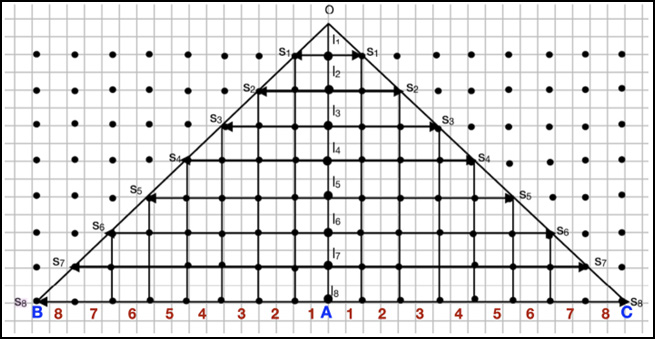
In Figure 4 below the translations of the different equidistant points (smallest unit length) although the length of the pendulum is being shown. Since the angle of a pendulum is low the path between the positions of the pendulum bob from the extreme left to the extreme right position of the displacement has been considered to be linear.
| S.No | Length | Displacement (the distance travelled by the pendulum bob in 1 cycle, back to mean position) | Time |
|---|---|---|---|
| 1. | L = 1 1 | S = (4) = 4 1 | t = (1)½ = 1 1 |
| 2. | L = 2 2 | S = (4+8) = 12 2 | t = (2x1)½ = √2 2 |
| 3. | L = 3 3 | S = (4+8+12) = 24 3 | t = (3x1)½ = √3 3 |
| 4. | L = 4 4 | S = (4+8+12+16) = 40 4 | t = (4x1)½ = √4 4 |
| 5. | L = 5 5 | S = (4+8+12+16+20) = 60 5 | t = (5x1)½ = √5 5 |
| 6. | L = 6 6 | S = (4+8+12+16+20+24) = 84 6 | t = (6x1)½ = √6 6 |
| 7. | L = 7 7 | S = (4+8+12+16+20+24+28) = 112 7 | t = (7x1)½ = √7 7 |
| 8. | L = 8 8 | S = (4+8+12+16+20+24+28+32) = 144 8 | t = (8x1)½ = √8 8 |
Table 3: The displacement of a pendulum bob (S) as a function of the length of pendulum (L) and the calculation of time (T) as pe
In Figure 4, a schematic representation of a pendulum in relation to the equidistant points is illustrated. The minimum length of the pendulum is taken as unity, which corresponds to the distance between two consecutive points, also equal to unity. As shown in Figure 4, as the length of the pendulum increases, the distance traversed by the pendulum increases proportionally. However, in conventional physics, only the distance travelled by the point at the tip of the pendulum had been considered, which is inappropriate.
Figure 4 highlights that the motion of all the points along the pendulum length must be accounted for, as each point contributes to time, since time and distance are inherently linked to each other. When the distances travelled by all these points are considered (as shown in Figure 4 and the empirical data of (Table 2), the following mathematical relationship between the total distance travelled and the pendulum length is being obtained:
( ) 2 S L L = + (53) The ‘time period of oscillation’ of a pendulum (T), in accordance with the principles of conventional physics, is typically expressed as a function of length (L). However, considering that distance is directly proportional to the square of time, T should instead be expressed as a function of S (displacement or distance travelled) rather than L.
Cancellation of ‘g’ Parameter from the Mathematical Equation of Projectile Motion: The parameter representing acceleration due to gravity, as proposed by Newton, is fundamentally flawed and does not align with the established principles of physics, as will be demonstrated below.
In Newton’s following formula of projectile motions, the g parameter has got no significance at all,
2 1 2 h ut gt = +
(54)
(49) [h, u, v, t, L, and g represent height, initial velocity, final velocity, time, length of the pendulum, and acceleration due to gravity, respectively. Hmax denotes the maximum height attained by a projectile when thrown vertically upward. T denotes the time period of oscillation of a pendulum in a clock.]
Equation (54) can be expressed as: Considering its relationship with Equation (56) and the relation u = h/t
2 1 2 h ut gt = +
( ) 2 1 2 / 2 ) h t g L g t π = +
In the right-hand side (RHS) of equation (50), the first term shows that t and t cancel each other out, as t is related to g according to equation (49), effectively resulting in the cancellation of two g terms. Similarly, in the second term of equation (50), two g terms cancel each other out again. Therefore, in the resulting value of h in this equation, the parameter g has no contribution whatsoever.
In the equation of Hmax [equation (55)], the u is being calculated from equation (56) as,
0 v u gt = = − (since the projectile is going upwards, g is negative) or u gt = (57) putting the value of u as obtained from equation (57) in the equation (55), one get ( )
2 2 2 2 / ) 2 2 ( 2 max gt u g l g H g g g π × √ = = =
2 2 2 ( ) g l g π √ × ×√ =
2 2 g l g π × × =
2 l π = (58) Hence, Hmax is not connected to the gravitational parameter g, as clearly demonstrated by this analysis. Consequently, Newton’s g parameter is eliminated from the equations he proposed, given that the ‘time’ variable in the classical formula, T=2π√L/g, was inherently defined using the same g parameter. Therefore, none of Newton’s findings concerning projectile motion hold valid under these circumstances. The g parameter, having no intrinsic significance in the realm of gravitational physics, must be reconsidered and ultimately discarded.
Furthermore, another physical parameter, the escape velocity (ve) of an object with mass m defined as the minimum velocity required for an object to overcome the gravitational pull of the Earth is expressed in physics by the following mathematical formula [2]:
( ) 2 / ev GM r = (53) [G = gravitational constant of Newton, M and r are the mass and radius of the earth respectively].
This formula has been derived in the following manner:
The gravitational potential energy of an ( )
object of mass m at height(h) mgh = (59)
The kinetic energy of the object when it escapes the earth gravitational field is,
2 ½ e KE of escape mv = (60)
Now, the kinetic energy has to be equal to the gravitational potential energy (mgh) for the escape and so,
2 ½ e mv mgh = (61) Or
2 ev gh = √ (62)
Another expression for ve is now derived from equation (61) by replacing the term mg with a force term, F (since F = mg). The resulting expression is:
2 ½ e mv F h = (63)
Now F is being expressed in the form of gravitational law of Newton, (F = GMm/h2), equation (61) becomes,
2 ½ e mv Fh =
( ) 2 / GMmh h =
( ) / GMm h =
Or,
( ) 2 / ev GM h = √ (64) From the above analysis, it is evident that equation (56) and equation (57) are essentially equivalent. The former expresses the escape velocity in terms of g, while the latter expresses it in terms of G. The relationship between g and G is defined by the following equation:
( ) 2 / g GM h = (65) Since the mass of the earth M is constant and under a specific case of h being constant, one can write, ( ) 2 / g kG k constant M h = = = (66) Now if the LHS and RHS of equation (66) is being split further, keep in mind that ( ) velocity distance/time and in the clocks = ( ) 2 Distance gh T = Or, ( ) the time is being set as,T=time 2 / L g π = √
| 2π | (L /g) |
|---|
Or
( ( ) / 2 ) ( 2 Distance g L g h π × = × × (67)
In equation (67), the parameters g on both the left-hand side (LHS) and the right-hand side (RHS) effectively cancel each other out, demonstrating that the escape velocity (ve) is not dependent on g, the acceleration due to gravity as defined by Newton. Furthermore, since the gravitational constant G is related to g as indicated by equation (66), it follows that G also cancels out between the LHS and RHS of equation (67). Hence, neither g nor G plays a role in determining the escape velocity of an object from Earth. This analysis clearly eliminates both g and G from the domain of gravitational physics in this context.
Conclusion
Newton’s concept of gravitation, which postulates attractive forces among celestial objects, is fundamentally flawed. It violates the principle of conservation of energy and fails to explain phenomena such as the floating of objects in space. The concept of microgravity as is being found in the literature is not at all convincing since no concrete theoretical model does exist for the said ‘microgravity’. The classical explanation of an apple falling from a tree, often attributed to gravitational attraction, is instead a thermodynamic process. As the apple tree grows, the energy supplied by the earth is converted to work, raising the apple to a higher position. When the apple falls, this work is reconverted into energy, which the space returns to the earth. This phenomenon is driven by thermodynamic processes, not gravitational forces. Both Newton’s gravitational constant (G) and the acceleration due to gravity (g) lose their relevance when Newton’s equations of motion and projectile motions are properly decomposed, as demonstrated in this article. Consequently, G and g no longer hold any place in modern physics. Newton’s laws of motion are not applicable to objects that change their position as a function of time. The equation Force = Mass x Acceleration (F = ma) is valid only for closed systems that remain stationary or do not change their position over time. Both Newton’s and Einstein’s equations (P= mf and E= mc2) ultimately converge to the pressure-density relation of an ideal gas, expressed as: P = (1/3)ρ C2 where C denotes the average velocity of the molecules.
The classical pendulum law is highly empirical and should be replaced by the quantum concept in the form of Tt =1 as shown in this article, which signifies the equilibrium between the quantum of time (t) and the quantum of temperature (T). This research signals the dawn of a paradigm shift in physics from traditional theories to more robust and logically consistent frameworks. However, the ultimate validation and acceptance of the ideas as are being presented in this article would rest with the global scientific community, which will shape the course of future scientific progress.
Dedication
This research article is dedicated to one of the most distinguished and visionary scientists, Professor Jagadish Chandra Bose, whose pioneering work laid the foundation for many modern scientific concepts.
Ethical Statement
Funding
This research did not receive any specific grant from funding agencies in the public, commercial, or not-for-profit sectors.
Conflict of Interest
The authors declare no conflict of interest.
Ethical Approval
Ethical approval was not applicable for this study.
Informed Consent
Informed consent was not required for this study.
Data Availability Statement
Data sharing is not applicable to this article as no datasets were generated or analyzed during the study.
References
-
Einstein A (1916) Annalen der Physik 354(7): 769-822.
-
Young HD, Lewis FA, Freedman RA (2014) University Physics. Addison-Wesley Longman, Incorporated.
-
Haim K, Erez M (2022) Terminal velocity and drag coefficient for spherical particles. Powder Technology 396: 181-190.
-
Clancy LJ (1975) Aerodynamics. Pitman Publishing Limited, UK.
-
Howell E (2017) Weightlessness and Its Effect on Astronauts. Human Spaceflight
-
Huygens Christian (1673) Horologium Oscillatorium.
-
Bhattacharya C (2023) TTQG (Topological Theory of Quantum Gravity) Driven New Theory of Color Physics. Advances in Theoretical and Computational Physics 6(1): 1-9.
- Asymmetry Irreversible Heterogeneity Quantum Cosmology Grand Mathematical PHYSICS
- Early Universe: Hadronic Crystals Coherent Micro Gravitational Wave Emitters PHYSICS Part II
- The Solar System Constraint Maze: A Scientific Dead-End Revealing the Interuniversal Machine
- Assessment of Radiofrequency Radiation from 2G and 3G Mobile Phone Handsets
- Early Universe Magneto-Gravitational Coupling Genesis Physics: Part I
- Origin of Ancient Civilisations The Southern Hemisphere’ Scenario