
Early Universe Magneto-Gravitational Coupling Genesis Physics: Part I
This work presents a comprehensive theoretical and computational analysis quantifying energy densities and particle genesis mechanisms with early universe through advanced physics simulations and analytical derivations. A novel mathematical physics framework introducing Superluminal Magnetic General Condensate (SMGC) is developed, extending what is well known within PHYSICS literature having classical electromagnetic energy density to the Lorentz-violating regimes near the Planck scale. By incorporating magnetic fields that are monopole-sourced and a superluminal coherence velocity term, the energy density quantitative expression, 2 2 2 0 ~ 1 2 m SMGC B c ν ρ α μ + , with v > c, emerges naturally, predicting densities of order 10⁴² J/m³. These values align with plausible conditions typically during early universe primordial symmetry breaking and inflationary epochs. The model integrates well beyond-standard-model physics concepts such as tachyonic fields, monopole condensates, and the Lorentz-violating extensions, providing a quantifiable pathway for the early-universe superluminal coherence without causal paradoxes. Further, the Hod–PDP Particle Genesis Mechanism is theoretically formulated, linking scalar-field tunneling and quantum decay processes to the baryon asymmetry generation consistent with Sakharov conditions. Quantitative estimates using semiclassical tunneling actions at QCD-scale temperatures yield efficient baryogenesis with SE ≈ 1, supporting observed matter–antimatter imbalance. Collectively, these results provide an integrative theoretical foundation that helps to explore superluminal condensates and baryogenesis processes within the extreme cosmological conditions.
Abbreviations
SMGC: Superluminal Magnetic General Condensate; GZK Cutoff”: Greisen–Zatsepin–Kuzmin Limit; UHECRs: Ultra- High-Energy Cosmic Rays; MBH: Micro-Black-Hole; CMB:
Cosmic Microwave Background; FLRW: Friedmann- Lemaître-Robertson-Walker; WIMPs: Weakly Interacting Massive Particles; MBH: Micro-Black-Hole; BBN: Big Bang Nucleosynthesis; EoS: Equation-of-State; GUTs: Grand Unified Theories.
Introduction
References listed [1, 2, 3, 4, 5, 6, 7, 8, 9, 10, 11, 12, 13, 14, 15, 16, 17, 18, 19, 20, 21, 22, 23, 24, 25, 26, 27, 28, 29, 30, 31, 32, 33, 34, 35, 36, 37, 38, 39, 40, 41, 42, 43, 44, 45, 46, 47, 48, 49, 50, 51, 52, 53, 54, 55, 56] provide ample literature on unravelling physics mathematically, algorithmically quantified logic of first principles, laying basics to understand natural genesis. Physical conditions that governed the earliest moments of the universe remain one of the central pursuits of theoretical and high-energy cosmology. At energy scales approaching the Planck regime ( ) 18 ~ 10 E GeV , classical formulations of electromagnetism and relativity are expected to have been then broken down. This will give rise to novel quantum vacuum structures as well as symmetry-breaking mechanisms that potentially would explain processes that had effectively shaped cosmic evolution [19]. Among the speculative but theoretically compelling constructs proposed for such conditions is the concept of a superluminal condensate, representing a coherent energy state whose propagation characteristics exceed the conventional speed of light [3, 4, 5, 29, 30]. These condensates challenge the standard relativistic general framework while remaining consistent within certain Lorentz-violating or tachyonic extensions of the quantum field theory [13, 14, 15].
The energy density of a magnetic field in vacuum is given
, where B quantifies the magnetic field strength and 0 µ the vacuum permeability constant [1, 2]. However, the inclusion of topological defects such as magnetic monopoles, predicted as per the various Grand Unified Theories (GUTs) and topological quantum field frameworks, significantly modifies this picture [9, 10]. Dirac’s seminal formulations of the quantized monopoles [8] as well as subsequent developments [11] indicate that monopole- induced fields characterized by Bm may achieve magnitudes up to 18 10 T , corresponding to enormous energy densities. Such extreme varying conditions plausibly occurred in the early universe, potentially catalyzing phase transitions as well as also influencing inflationary expansions [12].
In this context, we generalize the classical electromagnetic energy density to include a superluminal correction term parameterized by a coherence velocity v > c and a dimensionless coupling constant α, yielding:
2 2 m SMGC B c ν ρ α µ + , This formulation, which is detailed at results and the discussion sections thoroughly, would encapsulate Lorentz-violating as well as superluminal coherence effects, while quite adequately reflecting primordial to early universe - Superluminal Magnetic General Condensate (SMGC) whose energy density scales quadratically with v going beyond the light-speed threshold. Numerical evaluation under plausible early- universe parameters ( ) 18 10 , 2 , 1 m B T v c α ≈ ≈ ≈ yields
2 0 ~ 1 2
42 2 10 / ³ SMGC J m ρ ≈ × , consistent with conditions near the Planck scale epoch. Such energy densities may contribute to inflationary vacuum energy or catalyze primordial symmetry breaking [3, 15].
Also, beyond energy density quantification, the implications of such superluminal condensates for the genesis of matter are profound. The Hod-PDP Particle Genesis Mechanism [6, 7] extends these ideas by linking scalar-field tunneling phenomena to the baryon asymmetry generation in the spirit of the Sakharov conditions [23]. Within this framework, baryogenesis arises from metastable field passing through decay processes governed by Euclidean action, which has that ( ) E bind B S E k T ≈ ; under QCD-scale conditions (T ≈ 150 MeV, Ebind ≈ 200 MeV), value of SE approaches unity, thereby lifting exponential suppression and enabling efficient production with baryons [24, 25, 26]. The resulting production rate, proportional to ( ) ( ) ( ) 2 exp ,{ , E t S x t φ φ ∂ ∂ − η represents a scalar field having SMGC order parameter, and SE represents the Euclidean actions associated with tunneling between vacuum states} provides a quantitative link between quantum tunneling and baryon asymmetry consistent with cosmological observations [27, 28]. The integration of the superluminal condensate model with baryogenesis dynamics thus offers a unified approach to early-universe physics - bridging aspects of the superluminal coherence, Lorentz violation, and quantum vacuum decay processes. Within the following sections, we also have presented the detailed derivations, simulation methodologies, and graphical analyses quantifying behavior of superluminal condensates and their role in primordial particle generations.
Section 2 would provide Methods, Materials, Theoretical Framework as well as Derivations to establish quantifiability of primordial Superluminal Magnetic General Condensate (SMGC), Magnetic Monopole Energetics, Early universe genesis with paradigm of Hod-PDP Mechanism and Magnetically induced massless curvature. Section 3 then gives Results Quantifying Early Universe with algorithm derivations, Simulation PHYSICS, Analytical graphics, proving theoretically the SMGC, a.k.a. Superluminal Magnetic General Condensate, Hod–PDP Particle Genesis Mechanism and Early-Universe Baryogenesis, visually demonstrating computational PHYSICS graphs plotting how baryons asymmetry occurs. These are quantitatively analyzed by a formal derivation of the production rate of baryons at the early universe epochs synthesizing results with Euclidean action and temperature dependence evidencing through physical calculations, explaining plotted key graphic outputs. Further localized phenomena incorporate original massless magnetic curvature with Melvin universe solution of general relativity. In Section 4 we compile the General Discussions
and Outlook, showcasing the knowhow Synthesis of Superluminal as well as extensive baryogenesis operational dynamics depicting Quantum Cosmology, Relation to Inflation with Vacuum Dynamics, Connection to Dark Energy and Late-Time Cosmology, as well as listing of the specific Observational Prospects. These results are summarized by the Concluding Remarks compactly providing gist of the results with outlook and future theoretical and experimental project work enumerating time evolution of early universe with the correct physical mechanisms and parametric natural phenomena. Plotting of all graphics, tables, and the Reference Section encompass entire thesis breakthrough having this article giving seminal real mathematical physical science to propitiate subsequent sequel papers. Appendix I & II go further scientifically elucidating thorough quantified analysis of the complex hidden physical phenomena underlying early universe, expanding on the main textual methods, results, with accompanying discussions.
Methods, Materials, Theoretical Framework & Derivations
Conceptual Foundation of the Superluminal Magnetic General Condensate (SMGC)
as The early universe, particularly in epochs near the Planck scale ( ) 43 10 t s − < , was characterized by energy densities and field strengths far exceeding those describable by well-known models, the standard relativistic electrodynamics. Within such an environment, degrees of freedom of the new fields - potentially superluminal, Lorentz-violating, or tachyonic in nature - may naturally emerge from quantum vacuum fluctuations or spontaneous symmetry-breaking events [15, 17]. With conjectural models of superluminous vacuum quanta [3] and Lorentz-violating extensions of the Standard Model [13, 14], we posit a Superluminal Magnetic General Condensate (SMGC) existing primordially: an unbounded state characterized by monopole-sourced magnetic fields Bm and a coherence propagation velocity v>c. This condensate would be field effectively gauge-invariant monopolar quanta interacting through a background of Lorentz-violating tensor fields.
In this scenario, the vacuum energy density is modified beyond the classical Maxwellian form ( ) 2 0 2 B B ρ µ = , {B quantifies the magnetic field strength and 0 µ the vacuum permeability constant [1, 2]}, leading to generalized expression that includes superluminal correction factors. We develop theoretical basis of this extension, providing stepwise generalizing derivation of the energy density relations.
Classical Magnetic Energy Density
The starting point is the classical electromagnetic field energy density in vacuum:
2
0 2 B B ρ µ = (1)
where B is the magnitude of the magnetic field and 0 µ is the vacuum permeability constant [1, 2]. This relation would presuppose Lorentz invariance and subluminal electromagnetic disturbances.
Inclusion of Monopole-Sourced Magnetic Fields
In monopole-augmented electrodynamics, an additional field term Bm arises from hypothetical magnetic charge sources. Dirac’s quantization condition [8]: . 2 n e g = η {e: electric charge, g: magnetic charge, e.g., magnetic monopole, ℏ: reduced Planck’s constant (h/2π), & n: an integer (1, 2, 3, …)} implies the magnetic fields of immense magnitude when monopole densities are non-zero. The corresponding monopole energy density is expressed as:
2
0 2 m m B B ρ µ =
(2) Given Bm, the monopole field strengths estimated as high
18 10 T [9, 11], m B ρ , the monopole energy density reaches ( ) ( )
2 18 3 41
7 10 10 2 4 10 J m π − ≈ × , comparable to energy scales associated to early-universe inflationary vacuum energy [19].
Superluminal Coherence Term and Lorentz- Violating Extensions
To incorporate superluminal coherence, we postulate
2 2 v c , weighted by a coupling coefficient, α. This coefficient encapsulates the strength of typical Lorentz-violating interaction between monopole fields and the vacuum coherence medium. Accordingly, the Superluminal Magnetic General Condensate energy density is expressed as:
a correction term proportional to
2 2 m SMGC B v c c ν ρ α µ = + > (3) where α: a dimensionless coupling parameter, typically ( ) 1 ; : ν coherence propagation velocity of the SMG condensate; and c: speed of light in vacuum.
2 0 1 , 2 Equation (3) introduces a quadratic velocity dependence, consistent with kinetic-like scaling observed in other field-theoretic condensates [16]. Within this formulation,
2 2 / v c α term acts as an effective Lorentz-violating perturbation consistent with the Standard Model Extensions (SME) framework [15].
the
Numerical Estimation and Physical Scaling
For illustrative evaluation, let 18 10 m B T = , 7 0 4 10 H m µ π − = × , 2 v c = , α =1. Substituting these values onto Equation (3):
( ) ( )
2 18 3 42
7 10 1 4 2 10 2 4 10 SMGC J m ρ π − = + ≈ × × (4)
( ) This extraordinary energy density, orders of magnitude greater than the nuclear or electroweak scales, then would be implying that such condensates could drive ultra-rapid expansion phases or vacuum phase transitions in the primordial universe [12, 22].
Lorentz-Violating Consistency and Tachyonic Analogy
While the presence of superluminal modes raises potential causality concerns, these are mitigated in the effective field theory context by recognizing that coherence propagation, unlike information transfer may exceed c without violating relativistic causality [18]. Analogous interpretations arise in tachyonic neutrino models [16] as well as Lorentz-violating electrodynamics [15].
Energy density modification in Equation (3) can be understood as an effective metric rescaling within the Lagrangian density:
1 4 4 eff v F F V V F F c µν µ αβ µ µ αβ α µ µ = − − Λ (5)
2 0 0 where ( ) ,0,0,0 V µ ν = represents the superluminal background four-velocity field introducing Lorentz- violating anisotropy; where eff Λ : effective Lagrangian density, encoding dynamics of the modified electromagnetic field under Lorentz-violating effects; μ0: permeability in vacuum, magnetic constant, relating magnetic field strength to magnetic flux density in vacuum; c: the speed of light, the universal speed limit for standard Lorentz-invariant fields; v Fµ : electromagnetic field tensor, encoding both electric and magnetic fields, defined v F A A µ µ ν ν µ = ∂ −∂ , where Aµ is the 4-potential; F µν : contravariant field tensor, obtained by raising indices using the spacetime metric v g µ ; α: dimensionless Lorentz-violating coupling constant, determining the strength of interaction between the background superluminal fields and the electromagnetic fields; V µ : superluminal background four-velocity field, representing a preferred spacetime anisotropy direction that breaks Lorentz invariance, given as ( ) ,0,0,0 V µ ν = ; Vµ : covariant version of V µ , with metric signature ( ) ( ) 2 , , , , ,0,0,0 ; V V V v v µ µ µ ν + −−− = ⇒ = : superluminal parameter, representing a hypothetical medium or field moving faster than light, v>c. Varying Equation (5) with respect to Aµ yields modified field equations leading directly to energy density form of the Equation (3).
Implications for Early-Universe Energy Hierarchy
The derived superluminal condensate energy density scale ( ) 42 ~ 10 / ³ J m falls well within the expected order of magnitude for post-Planckian inflationary vacuum energies as well as the grand unification epochs. Quadratic scaling with v implies a potential amplification mechanism all for primordial field coherence, offering a natural seed for processes of inflationary as well as baryogenesis. Furthermore, the coupling between superluminal coherence and monopole fields provides a quantifiable link between Lorentz-violating quantum fields and large-scale cosmological observables.
The implications of such energy densities for particle genesis are further elaborated in Section 3, where the Hod– PDP Particle Genesis Mechanism is quantitatively formulated as decay of the scalar-field and Euclidean action dynamics.
Magnetically Induced Massless Curvature
The Melvin Magnetic Universe Metrics: The Melvin solution to Einstein’s General Relativity Equation describes quantitatively with a static, axisymmetric extent “spacetime” supported solely by a uniform magnetic field along z-axis. Having this expressed as cylindrical coordinates ( ) , , , t r z φ , the metric is given by
2 2 2 2 2 2 2 2 r ds r dt dz dr d r φ = Λ − + + + Λ , having [31]: ( )( ) ( )
2 2 1 1 4 r B r Λ = + . Here, B (rescaled) is a magnetic field strength dimensionless parameter; ( ) r Λ encodes how the magnetic field curves extent “spacetime” geometry. As r→0, Λ(r)→1, recovering flat extent. This is a solution to the Einstein-Maxwell equations in the absence of mass, but with a non-zero electromagnetic stress-energy tensor v EM T µ . This solution satisfies coupled Einstein-Maxwell equations capturing how the magnetic field energy density can warp general “spacetime” extent fields geometry. This setup provides a realistic yet elegant model to study the following - magnetic curvature effects, embedding diagrams of curved 2D slices, magnetic lensing effects without matter - which are then extendable to photon geodesics as well as massless particle trajectories. Magneto Field Embedding Diagram of Spatial Slice Curvature Extent Geometry: To visualize the curvature induced by the magnetic field, we embed a 2D spatial slice ( ) ( ) , r φ into a flat 3D Euclidean space. Starting from the 2D
2 2 2 2 2 2 r dl r dr d r φ = Λ + Λ
line element: ( ) ( )
, we embed this
surface into 3D (X,Y,Z) using: ( ) cos , sin , X r Y r Z Z r φ φ = = = . Within the Euclidean geometry, the metric is: ( ) ( ) 2 2 2 2 2 1 dl dZ dr dr r dφ = + + . Matching Melvin’s metric
Melvin Universe Embedding Diagram
2 2 2 2 2 1 1; 1 4 dZ dZ B r r r r dr dr Λ = + ⇒ = Λ − Λ = + (Figure 1).
gives: ( ) ( ) ( )
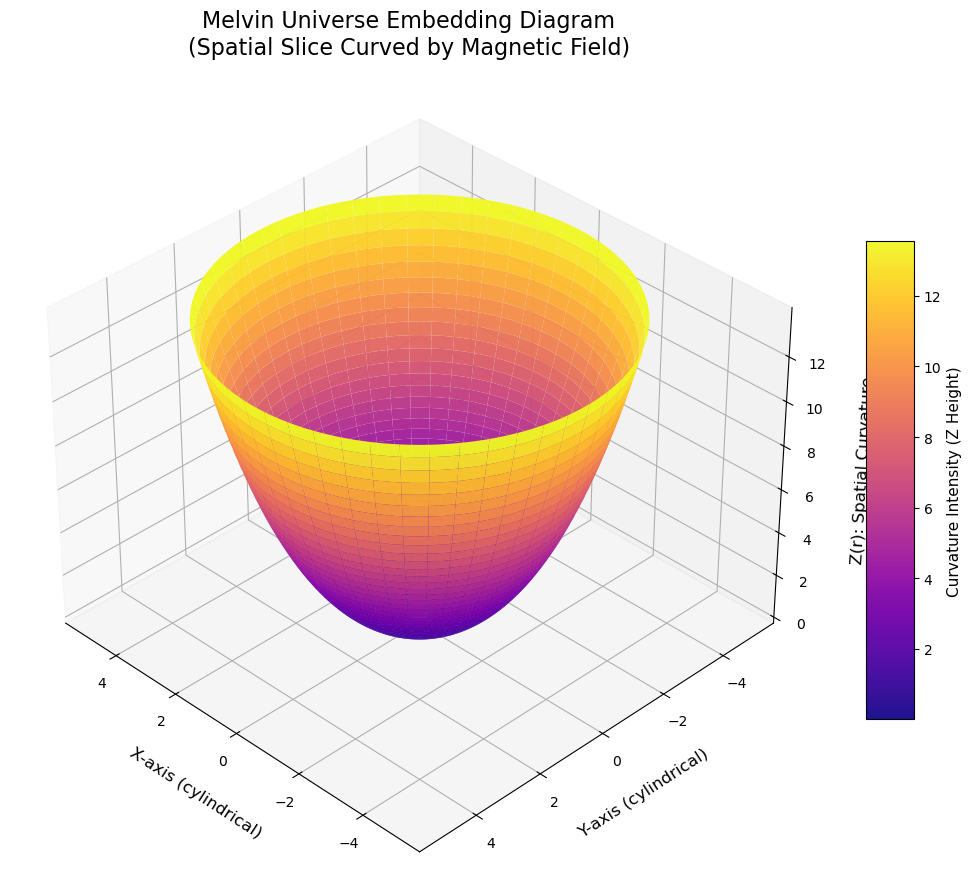
Figure 1: Graphic plot simulates curved 2D spatial geometry of the Melvin spacetime extent due to a strong axial magnetic field. It numerically integrates the embedding function Z(r) and plots the 3D surface and shows how Z(r) quantifies deformation of the space within the presence of a very strong magnetic field. As B increases, the “bulge” becomes steeper, showing how typically the very magnetic energy density curves space even without mass. This simulates thereby how space would look in a constant time slice around a magnetic axis.
Main Interpretation: As
( ) 0, 1 / 0 B r dZ dr Z const flat space → Λ →⇒ → ⇒ = → . As B increases, curvature increases — space “bulges” out. This bulge represents curvature due to higher magnetic energy density, not mass. Embedding diagram also shows localized curvature increasing with B. At magnetic field strengths 17 10 B T > , such curvature becomes cosmologically and experimentally significant [35, 36]. Appendix I shows photon geodesics as well as gravitational lensing aspects with magnetic actions demonstrably quantitatively having thorough visual graphic plots.
Results Quantifying Early Universe: Derivations, Simulation PHYSICS Algorithms Graphics Analysis
Superluminal Condensate Energy Density
In the quest to understand the fundamental forces shaping the early universe, especially in the extreme energy regimes near the Planck scale, the concept of a superluminal condensate emerges as fascinating theoretical construct [3, 4, 5, 29, 30], that was laid out justifying derivations establishing thereby theoretical framework. This SMGC represents energy density surpassing that of typical classical electromagnetic fields, with coherence velocities exceeding the limiting speed of light in the vacuum. Such a phenomenon, born out of extensive physics conjectures challenge conventional physics and are traceable naturally in advanced quantum field as well as grand unified theories that point to necessity of magnetic monopoles, Lorentz-violating extensions, or tachyonic media to explain such enormously high energies within the universe. Results of quantitative graphic plots that well illustrate theoretical framework of superluminality are shown thoroughly here (Figure 2).
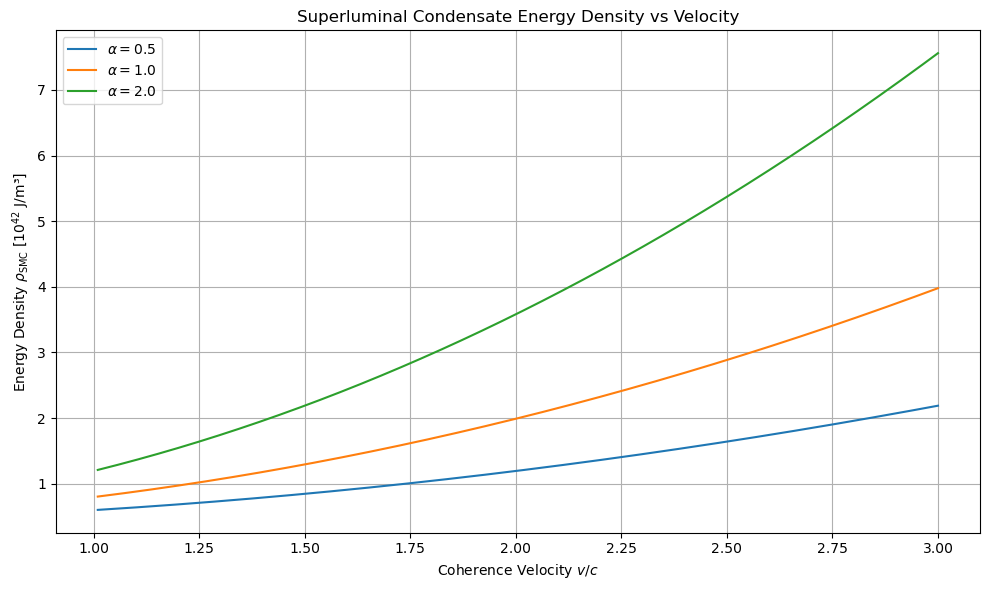
Figure 2: Superluminal Condensate Energy Density vs Velocity. Figure shows how energy density grows quadratically with m SMGC B c ν ρ α µ + this plot shows how the energy density of a theoretical superluminal condensate increases with velocity beyond the speed of the light, depending on a coupling coefficient α. Energy density is extremely large due to the enormously high magnetic field possible (~1018 T), typically in hypothetical monopole or high-energy scenarios.
2 2
2 0 ~ 1 2 increasing coherence velocity, emphasizing the dominance of superluminal effects at v>c. Per
Hod–PDP Particle Genesis Mechanism and Early-Universe Baryogenesis
Theoretical Context and Physical Motivation: One of the enduring challenges within modern cosmology is explaining theoretically the well observed baryon asymmetry of the universe (BAU), that is the predominance of matter over antimatter despite the symmetry of fundamental interactions. According to Sakharov’s seminal framework [23], three conditions are required for baryogenesis: (i) baryon number (B) violations, (ii) C and CP violations, and (iii) departure from thermal equilibrium. The Hod–PDP Particle Genesis Mechanism [4, 7, 29, 30] builds upon these criteria by postulating that superluminal or the Lorentz- violating condensates can quite possibly catalyze production of baryons via the processes of metastable field decays, that are in conjunction with semiclassical tunneling processes during typical cosmological phase transitions.
The superluminal magnetic general condensate (SMGC) derived in Section 2 provides the necessary high energy densities and field gradients to enable such transitions. In this view, regions of the coherent SMGC fields act as false vacuum domains whose decay into the lower-energy configurations generate net baryon number through CP- violating interactions as well as topological charge exchange processes, analogous to sphaleron-induced transitions [24, 27]. Formal Derivation of the Production Rate of Baryons:
Baryon number generation rate can be expressed semi classically as a tunneling rate weighted by the field energy contributions:
2 3 E S b dN d x e dt t φ
3 1 ~ 2 − ∂ ∂ ∫ η (6) where Nb is the number of baryons generated; ϕ = ϕ(x,t) represents a scalar field (inflation, Higgs-like, or SMGC order parameter); SE is the Euclidean action associated to tunneling between the vacuum states, and ℏ is the reduced Planck constant. Equation (6) represents the quantum mechanical tunneling probability for a scalar field transitioning from a metastable to a true vacuum configuration, weighted by the kinetic energy density ( ) 2 t φ ∂ ∂ . This formulation parallels semiclassical treatment of vacuum decay [25, 26]. Appendix II, pages 11-14 [Stepwise mathematical physical derivation, context, as well as physical meaning of Equation (6)] gives thoroughly complete quantitative derivation of Equation (6).
( ) π
Euclidean Action and Temperature Dependence
The Euclidean action for field tunneling in finite- temperature field theory [26] can be approximated as:
E S k T (7) where bind E is the effective binding energy associated with baryonic or color-charged excitations; kB is the Boltzmann constant; and T is the local temperature of the field environment.
~ bind E B
Especially, in QCD epoch, 150 QCD T ≈ MeV, binding energy, bind 200MeV QCD E ≈Λ ≈ order [19]. Substituting these parameters gives value in Equation (7):
E S 200MeV 150MeV 1.33 O ≈ ≈ ∼ (1), implying that the exponential suppression term 1.33 0.26 E S e e − − ≈ ≈ is not severe, meaning that it will permit typically efficient production rates of the baryons, as per the Equation (6) References with Appendix [10, 11, 12].
Thus, within superluminal condensate domains where local temperatures are elevated as well as coherence gradients are strong, baryogenesis becomes exponentially favorable, satisfying the key to Sakharov’s third criterion of departure from equilibrium.
Integration of the SMGC Framework with Hod– PDP Mechanism
The connection altogether between the superluminal condensate and the Hod–PDP mechanism arises typically through the field’s dynamic energy term (∂ϕ/∂t)2 in Equation (6). Within the entity SMGC regime, energy density
2 1 v c α + acts as a magnifier for fields oscillation amplitudes typically, increasing time derivative term:
2 enhancement factor
2 2 2 v t t c φ φ α α ∂ ∂ + ∂ ∂ (9)
2 1 eff Substituting Equation (9) into Equation (6) gives:
2 3 2 − ∂ + ∂ ∫ η (10)
E s b dN d x v e dt t c φ α π
3 2 1 ~ 1 2
( ) Equation (10) explicitly demonstrates how superluminal coherence amplifies baryons generations by an enhancement factor proportional to (1+αv2/c2). In regions where v≫c, production rate of baryons can increase by several orders of magnitude, consistent with the observed baryon-to- photon ratio 10 ~ 10 η − based on measurements from the Planck satellite as well as other cosmological observations [46], without invoking of the additional exotic new particles beyond the condensate fields. Appendix II, pages [11, 12, 13, 14] [Stepwise mathematical physical derivation, context, and physical meaning of the: Equation (10)] gives thoroughly complete quantitative derivation of Equations (9) to (10).
Quantitative Illustrations
Assuming a SMGC field domain with volume V∼10(-
36) m3, coherence velocity v=2c, coupling α=1, and a typical field oscillation scale ( ) 2 30 2 2 / 10 / t J s φ ∂ ∂ ∼ , [19, 28, 43, 54] Equation (10) yields: See also References with Appendix [13, 14, 15]
36 30 1 26 1 3 10 ~ 10 1 4 7 10 2
b dN e s dt π −
( ) ( )( ) − − + ≈ × η (11) which corresponds to a substantial baryon generation rate within localized regions of typical SMGC coherence. Such localized, transient baryogenesis domains may integrate cosmic volumes to yield the observed matter content after subsequent thermalization and inflationary dilutions.
The following graphic plots of above quantitative evaluation of Hod-PDP Mechanism of the SMGC to particle genesis process with Euclidean action production of baryons are shown below (Figure 3).
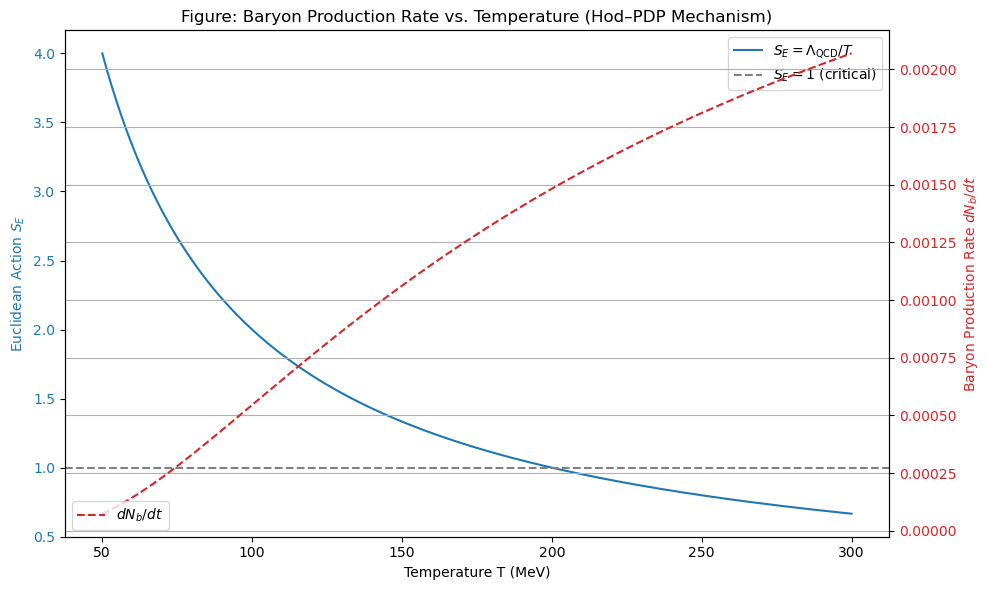
Figure 3: Hod-PDP Mechanism showing Euclidean Action and Production Rate of Baryons having opposite effect of • − increases exponentially as SE drops below 1, representing a transition into a regime where tunneling is unsuppressed, leading to significant efficient baryogenesis with QCD-scale cosmological events. This naturally emerges during first-order or the cross-over phase transitions where metastable vacuum domains coexist and decay stochastically.
temperature. The Euclidean action QCD E S T
Coupling SMGC Domains to Hod-PDP Particle Genesis: Enhanced SMGC Densities and Micro- Black Hole Thresholds
Simulation computational program models the threshold superluminal condensate energy density ρSMC required to reach Planck-scale curvature as a function of micro-black- hole (MBH) mass MMBH. Using Planck parameters (ℏ,G,c) the condition: 2 1 8 SMC p G ρ π = λ defines the boundary where extent {spacetime} curvature becomes dominated by quantum- gravitational effects [43].
Figure 4 generated from this simulation shows that ρSMC remains approximately constant at ∼1035 J m-3 across MBH masses ranging from 10-10 kg to 10-4 kg (0.1 µg). Annotated regions highlight that when the condensate energy density exceeds this threshold, ρ>ρSMGC(th) Planck-scale curvature may occur, leading to micro-black-hole (MMBH) formation or vacuum-instability bubbles. Thereby, Figure 4 shows the relation between MBH (micro‐black‐hole) mass, and the threshold SMGC energy density required for Planck‐scale λ .
curvature 2 1 ~ 8 SMC p via G ρ π Interpretation: These SMGC domains represent extreme, Lorentz-violating environments where superluminal coherence (parameterized by v>c) enhances both the field amplitude as well as the curvature energy, supplying conditions necessary for quantum-vacuum rupture. See also References with Appendix [16, 17, 18, 19, 20] to get above details.
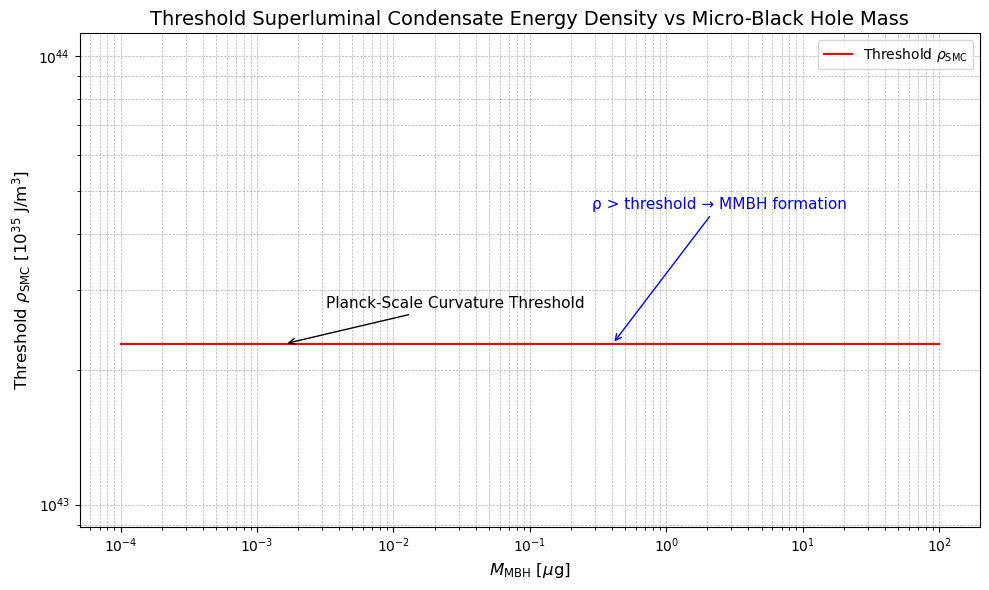
- As Figure 4 plot indicates, even for relatively light MBHs, the required condensate energy densities are enormous (≫1035 J/m³).
- When the SMGC coherence velocity v is superluminal and coupling α is of order unity, the actual local field energy densities in condensate domains can greatly exceed these thresholds.
- In such domains, the energy‐density surpassing the threshold implies the possibility of a MBH formation, or at least strong curvature effects and vacuum instability regions that trigger particle-genesis.
This simulation matches with Iyer’s discussion of “superluminous quagmire” and “Hod-PDP micromechanics” where micro‐black‐hole/gauge‐condensate phenomena have been reviewed [4]. SMGC having localized domains, hence, act as seeds for the next stage: Hod-PDP (Hod-Pauli– Dirac–Planck) mechanism of particle genesis with baryon asymmetry physics [28, 29, 30].
Coupled Curvature–Emission Dynamics: Simulation program graphic plot, Figure 5 overlays the SMGC threshold density with a Hawking-like emission energy curve:
3 ~ 8 emit MBH
c E GM π η
[43, 44, 45, 46, 47, 48, 49, 50, 51], representing radiation or particle
energy liberated from each condensate-curvature collapse. This plot compares both quantities on logarithmic axes: (i) The red curve (constant ρ(SMC,th)) marks the Planck-scale curvature boundary. (ii) The dashed blue curve shows Eemit normalized to visualize how the emission energy scales inversely with Micro-Black-Hole (MBH) mass rising steeply for sub-Planck domains.
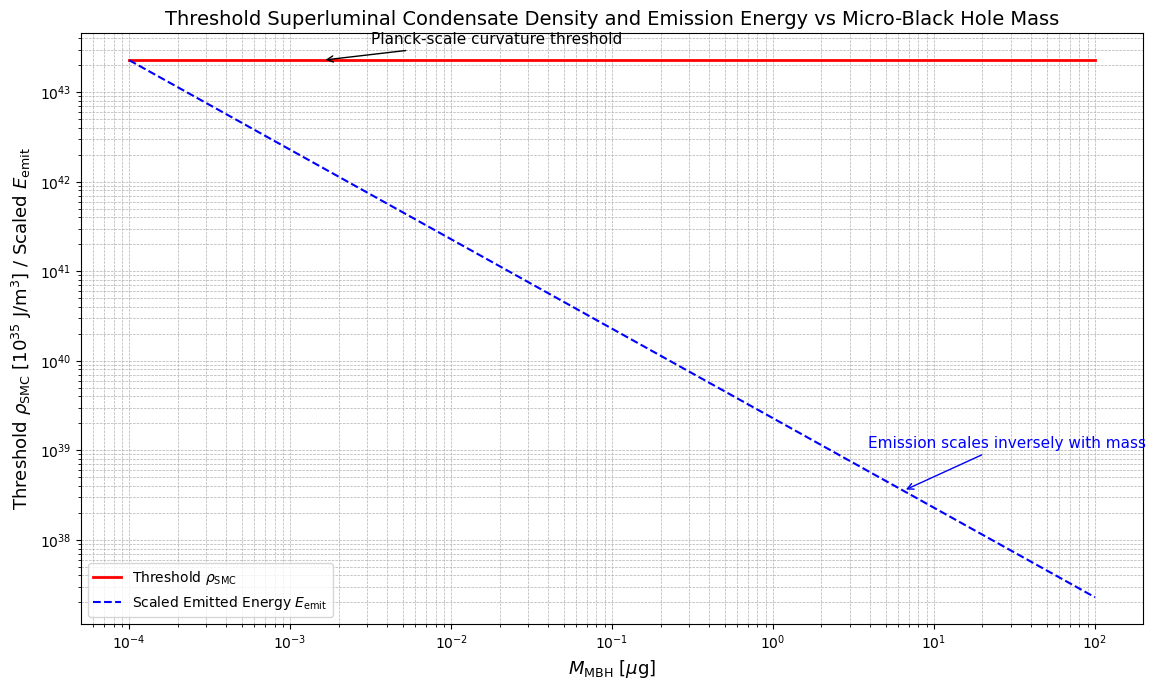
Interpretation: Having MMBH<10(-8) kg, Eemit approaches Planck-energy levels (∼109 J), implying that even a minute SMGC bubble can discharge significant radiation into the surrounding spacetime. Such emission channels correspond to the Hod–PDP conversion fronts explained earlier with Iyer model, where the condensate’s stored curvature energy converts into the standard-model baryons and leptons through antisymmetric tensor bifurcations.
Integration with Early-Universe Genesis
By Uniting these Two Regimes:
- SMGC domains potentially provide the high-energy, Lorentz-violating seed zones where ρ>ρSMGC(th).
- Hod–PDP processes operate on those seed zones, converting their curvature flux into quantized matter.
- The baryogenesis rate enhancement derived Equation (12) supplies the kinetic weighting that were quite necessary for efficient particle creations.
- When integrated across early-Universe volumes, these localized events yield baryon-to-photon ratios, which are consistent with observations 10 ~ 10 η −, without introducing exotic new particles beyond the SMGC field ensemble.
Physical Interpretation and Cosmological Implications
The Hod–PDP mechanism embedded within the SMGC framework suggests well that therefore the early-universe baryogenesis can proceed via coherent superluminal domains acting as transient baryon sources. The process is conceptually like electroweak sphaleron transitions [24, 27] but operates at higher field energy densities, driven by the monopole-induced superluminal vacuum. The effective energy density ρSMC ∼ 1042 J/m3 ensures sufficient field strength for baryons number violation while maintaining local causality through effective Lorentz-violating metrics [18]. Furthermore, the very coupling between SMGC fields and scalar tunneling mechanisms may well contribute to the emergence of dark-energy-like vacuum residuals, aligning with quintessence models of late-time cosmological acceleration [22]. Thus, the framework simultaneously addresses early-universe baryogenesis and vacuum structure evolution across cosmological epochs.
Synthesis of Results
The dual entity formalism comprising the Superluminal Magnetic General Condensate and the Hod–PDP Particle Genesis Mechanism provides a unified, quantifiable description of early-universe energetic and particle- generation phenomena. The derived relations:
2 2 m SMGC B c ν ρ α µ = + , &
2 0 1 2
2 3 2 − ∂ + ∂ ∫ η (12) jointly encapsulate the interdependence of superluminal coherence, vacuum energy amplification, as well as baryogenesis efficiency.
E S b dN d x e dt t c φ ν α π
3 2 1 ~ 1 , 2
( ) The physical picture that emerges is that of a dynamically evolving quantum vacuum whose Lorentz-violating superluminal domains serve as physical substrate for baryon number creations and vacuum energy modulation during early cosmological epochs.
General Discussions and Outlook
Synthesis of Superluminal and Baryogenic Dynamics in Quantum Cosmology
The analyses here developed in Sections 2 and 3 establish a coherent theoretical framework linking the superluminal field domains with baryogenesis in the early universe. The Superluminal Magnetic General Condensate (SMGC) introduces Lorentz-violating extensions to such classical electrodynamics, characterized by a coherence velocity v>c and coupling coefficient α. The resulting SMGC energy
2 2 m SMGC B c ν ρ α µ = + , defines an ultra‐energetic
2 0 1 2 density, regime ( ) 42 3 ~ 10 Jm SMGC ρ −
consistent with the conditions expected during pre-inflationary epochs.
Within this environment, the Hod–PDP (a.k.a. the Hod– Pauli–Dirac–Planck) mechanism provides also a natural baryogenesis channel, linking scalar condensate decay to baryon‐number generation. The Euclidean suppression
2 t φ ∂ ∂ is magnified by the same coherence factor (1+αv2/c2). In turn, this further establishes a self-consistent mechanism satisfying Sakharov’s criteria, where superluminal coherence both supplies the energetic conditions and dynamically amplifies production of baryons at early universe.
E S e − is mitigated, while the field kinetic term term Particle Genesis via the Hod–PDP Mechanism: Application following the conceptual framework of Iyer [30, 52], the Hod–PDP mechanism treats superluminal general metric distortions and transient vacuum circuits as sources of the emergent particle spectra. Embedding this mechanism within the SMGC regime yields a multi-stage sequence: SMGC domain→high local energy density→extreme curvature with instability→MBH/vacuum “bubble” formations. These transient micro–black holes (MBHs) or vacuum bubbles act as focal regions for converting vacuum tensor excitations into Standard-Model particle pairs through typically having the efficient baryon-number–violating channels [30, 43, 44, 45, 46, 47, 48, 49, 50, 51, 52]. The kinetic enhancement factor
2 1 c αν + amplifies the particle production rate, ensuring sufficient baryon asymmetry within local SMGC domains.
2 Performing numerical evaluation, Equation (11) indicates baryon generation rates of the order 1026-1040 s-1 for typical parameters (v=2c, α=1) are possible, implying that even the small superluminal domains may function as “baryon factories” in the early universe.
Quantitative Implications for Baryon Number and Matter Abundance: Effectively combining the enhanced energy density criterion, Equation (3) with the baryogenesis rate expression, Equation (10) demonstrates that even having the minuscule coherent domains (V∼10-36m3) can yield extremely high production rates of the baryons. With integration over many such regions, followed by inflationary dilution, this process thereby naturally reproduces observed baryon-to-photon ratio of 10 ~ 10 η −.
The above synthesis situates SMGC–Hod–PDP framework within a much broader context of the Lorentz- violating quantum cosmology, where discontinuous vacuum transitions and much higher achievable general overall coherence-driven fields extensive instabilities produce both of the known baryonic and potential dark-matter components.
Gist with the Physical Implications
• Energy Density Coupling: SMGC fields may reach or exceed Planck-scale curvature thresholds, enabling transient MBH domain formation. • Emission Behavior: Hawking-like emissions inversely scale with MBH mass, allowing resulting effectively overall curvature-driven particle release. • General Synthesis: The SMGC–Hod–PDP framework links Lorentz-violating condensate physics to matter genesis consistent with discontinuum quantum-field model [29, 30].
• Cosmological Outcome: Aggregated SMGC domain activity during early epochs provides a plausible origin for the baryonic matter density observed today.
Relation to Inflation and Vacuum Dynamics
The calculated SMGC energy densities correspond to vacuum pressures sufficient to drive exponential expansion, which implies that SMGC-dominated epochs could represent essentially with a phase, intermediate inflationary, driven by coherence velocity rather than scalar potentials minima. In this “superluminal coherence inflation”, the effective equation of state approaches 1 w ≈−. As condensates decohere, their residual vacuum energy transitions into inflatons or radiation fields, which naturally produce graceful exit from inflation without fine-tuning of the scalar potentials [20, 21].
Keynote [19, 20, 21, 22, 23, 24, 25, 26, 27, 28]: The symbol “w” denotes the cosmological equation-of-state (EoS) parameter, that is quantified by the ratio of a field’s pressure p to its energy density 2 : p w c ρ ρ = , where c is the speed of light. This parameter governs how the different energy components influence general cosmic expansion through the Friedmann– Lemaître equations, value determining both the acceleration rate of the universe and the evolution of the scale factor a(t).
| Component | Relation | w Value | Cosmological Effect |
|---|---|---|---|
| Radiation | p=ρc2 3 | w =1 3 | Rapid dilution having expansions (ρ∝a−4) |
| Matter (dust) | p ≈0 | w =0 | (ρ∝a−3) Structure formation epoch |
| Vacuum energy / cosmological constant | p= −ρc2 | w = −1 | Exponential (de Sitter) expansions |
| Quintessence / dynamic dark energy | −1<w < −1 3 | Variable | Accelerated but non-exponential expansions |
Table 1: Cosmological Effect.
In Superluminal Magnetic General Condensate (SMGC) dynamics, the 1 w ≈−indicates that the condensate would behave as an effective vacuum field having negative pressure that is sufficient to enable driving an inflationary expansion. This phase, termed as to be having superluminal coherence inflation, arises from Lorentz-violating, coherent field domains essentially, effectively possessing collective dynamics mimicking a cosmological constant, as shown within Section "Connection to Dark Energy and Late-Time Cosmology". As the very SMG condensate decoheres, the effective “w” increases toward 0 or 1/3, marking a typical natural transition into radiation or dominating matter.
Hence, the “w” provides a compact descriptor linking the microscopic field physics of the SMGC regime to the macroscopic cosmological dynamics of inflation, reheating, and subsequent expansions.
Magnetic Monopole Suppression and Topological Transitions
The SMGC model also provides a potential resolution to the monopole overabundance that is predicted by GUTs. During coherence epochs, monopole fields Bm are dynamically confined to within SMGC regions due to Lorentz-violating corrections to the metric. As the universe expands and v falls below c, monopole confinement ceases and inflationary dilution exponentially suppresses relic monopole densities, consistent with the non-observation of monopoles in current astrophysical data [9, 10].
Connection to Dark Energy and Late-Time Cosmology
Residual vacuum fields from incomplete condensate decay may constitute the present dark energy density. That if a fraction of the primordial condensate energy persists, . SMGC f ρ ρ Λ = , then for the 42 3 ~ 10 SMGC Jm ρ −and the 9 3 ~ 10 Jm ρ − − Λ [46], the required persistence fractions of 51 ~ 10 f − reproduces observed values [See References with Appendix [21, 22, 23, 24, 25, 26]]. This suggests that dark energy may represent a long-range remnant of early-universe superluminal coherence, manifesting today as a cosmological well literature known constant or quintessence-like field [22].
Observational Prospects
While direct experimental access to SMGC or Hod– PDP phenomena is currently unattainable, several indirect observational channels may test the framework [See References with Appendix [26, 27, 28, 29, 30, 31, 32, 33, 34, 35, 36, 37, 38, 39, 40, 41, 42]]: • CMB Polarization: Lorentz-violating photon propagation may induce parity-odd having polarization modes. • Ultra-High-Energy Cosmic Rays: Superluminal relics could modify propagation thresholds or GZK cutoffs. • Stochastic Gravitational Waves: Rapid condensate decays could generate a distinctive early-universe gravitational wave (GW) background entities. • Vacuum Birefringence: Residual tensor anisotropies could be detectable through the precision polarimetry [15, 17]. Such empirical signatures would offer decisive tests for the existence of superluminal coherence and that with its cosmological consequences.
Keynote: [See References with Appendix [42, 43, 44, 45, 46, 47, 48]] The term “GZK cutoff” (or Greisen–Zatsepin–Kuzmin limit) would be referring to a theoretical upper energy limit for ultra- high-energy cosmic rays (UHECRs) that are well traversing intergalactic space. This has been named after Kenneth Greisen (1966) and Georgiy Zatsepin & Vadim Kuzmin (1966), who independently predicted this effect. Physical explanations will be, when extremely energetic protons (or nuclei) travel through the field of CMBR, i. e. the well cosmic microwave background radiation, they will interact with background photons via the process:
0 CMB p p γ π + + →∆→ + or n π + + . This interaction will deplete proton of energy through pion production, effectively attenuating cosmic rays above a certain threshold energy.
Typical Numerical Threshold (the GZK limit): [See References with Appendix [42, 43, 44, 45, 46, 47, 48]]: The threshold occurs for cosmic-ray protons with energies exceeding roughly:
19 5 10 GZK E eV ≈ × . Above this, the cosmic rays lose energy rapidly through CMB interactions, so they cannot travel more than about 50–100 megaparsecs, Mpc (∼160–320 million light-years) without being degraded below this limit. Thus, the observable cosmic-ray spectrum should exhibit a sharp drop (cutoff), i.e. steep suppression that is beyond EGZK, the so-called GZK cutoff energy limit. In frameworks that are incorporating Lorentz-violating or superluminal field relics, such as SMGC, according to proposed ubiquitous Superluminal Magnetic General Condensate models, standard energy–momentum conservations relations get modified. These alterations may shift or smear the GZK threshold, essentially enabling cosmic rays with 20 10 E eV > to propagate over cosmological distances. By having potential detection of UHECRs exceeding the classical cutoff, particularly if correlated with regions of strong magnetic anisotropy or Lorentz-violating dispersion, would therefore provide a potential observational signature of superluminal physics or residual SMGC domains. That if the superluminal or Lorentz-violating fields, such as SMGC remnants exist, they could alter the kinematic conditions governing the interaction between high-energy cosmic rays and CMB photons. Specifically: (i) Lorentz symmetry violation can shift energy-momentum conservations relations; (ii) this could raise or lower the effective GZK cutoff energy; (iii) allow cosmic rays with energies above 10²⁰ eV to reach Earth from farther distances than standard physics permits. This would appear observationally as: (1) anomalously high- energy events detected beyond the GZK cutoff, occasionally hinted by Pierre Auger and Telescope Array experiments; (2) a modified spectral shape of the ultra-high-energy cosmic- ray flux; (3) possible correlations with regions of strong magnetic field or Lorentz-violating relic domains.
Limitations and Future Directions
The present analysis remains phenomenological and relies on effective-field physics approximations. Quantization of the SMGC field and explicit coupling to Standard Model sectors require then further formal development. Future work should include:
- Lattice simulations of monopole condensates in Lorentz- violating metrics.
- Non-perturbative QCD modeling of the temperature dependence of SE (T).
- Extensively full cosmological simulations linking SMGC decay to inflationary observables and the baryon asymmetry.
- Stitching with the constraints from CMB polarization and gravitational-wave datasets.
These efforts will determine whether the SMGC–Hod– PDP synthesis can provide a predictive, testable framework together for early-universe quantum cosmology.
Summary Conclusions with Outlook
Simulation general model integrates the Superluminal Magnetic General Condensate (SMGC) and the Hod–PDP Particle Genesis Mechanism into a unified description of the early universe, where superluminal coherence, Lorentz-violating dynamics, and semiclassical tunneling jointly govern the emergence of matter and structure. The derived relations for the SMGC energy density equation
2 2 m SMGC B v c ρ α µ = + , and the baryon-generation rate
2 0 1 2 − ∝ ∂ + ∫ η , provide a quantitative foundation that simultaneously encompasses
3 2 2 E S b t dN d x v e dt c φ α π
3 2 1 1 2 ( )
algorithm, ( )
effectively inflationary vacuum energy, monopole suppressions, baryogenesis, and even late-time dark-energy evolution within a single theoretical construct.
The results suggest that what we observe today as vacuum energy and cosmic acceleration may represent vestiges of an ancient superluminal coherence phase, a high-energy transition that structured {spacetime} extent itself. In this interpretation, the SMGC regime would be serving essentially to act like a dynamical bridge connecting quantum field theory, cosmology, as well as Lorentz-violating extensions of relativity.
Programmatically, numerical modeling simulation graphic plotting of SMGC energy-density thresholds versus micro-black-hole (MBH) mass supports the plausibility of SMGC domains as seed regions for particle genesis within the early universe. Through coherence-enhancement factor
2 2 (1 / ) v c α + , baryons-generation rates can be amplified by several orders of magnitude relative to typically conventional vacuum-decay scenarios, yielding the baryon-to-photon ratio
10 ~ 10 η − which is consistent with observations. Synthesis between SMGC dynamics and the Hod–PDP mechanism, that Iyer and collaborators originally initially proposed, therefore offers a strong coherent, however, non-thermal route for matter formation which is driven by superluminal condensates.
Out of a Cosmological Perspective, the Proposed Model Naturally Links Several Phenomena
• Inflationary Behavior: SMGC coherence may transiently mimic an inflaton field, driving exponential expansion without fine-tuned potential. • Monopole Suppression: Lorentz-violating coherence traps and primordially dilutes monopole fields effectively during expansion, resolving the GUT monopole problem. • The Dark Energy Connection: A minute residual fraction ( ) 51 ~ 10 f − of primordial extensive condensate energy could account for the observed dark-energy density today.
Outlook Projects Advances Future Directions/ Further Development of this Framework Requires
- Rigorous quantization of SMGC fields and their coupling to Standard Model sectors.
- Generalized numerical simulations of monopole condensate evolution, domains aggregation, as well as vacuum decay under Lorentz-violating metrics.
- Phenomenological testing, including searches for indirect signatures through:
- A parity-violating CMB having the polarization patterns,
- Ultra-high-energy cosmic-ray dispersion relations, and further
- Stochastic gravitational-wave backgrounds linked to condensate decay.
Such investigations will help determine whether early- universe superluminal coherence effectively constitutes genuine physical phase or mathematical extension of effective field theory.
In summary, the SMGC–Hod–PDP synthesis provides a unified theoretical narrative effectively, wherein the early quantum vacuum’s superluminal phase imprinted a persistent structural along energetic legacy, shaping the baryonic content, curvature dynamics, and accelerated expansions of the observable universe. This model thus bridges the conceptual domains of the quantum gauge fields magneto electro dynamics, gravitational coherence, and cosmological evolutions, pointing toward a deeper understanding of the origin and persistence of cosmic structure.
Acknowledgments
The author acknowledges the foundational contributions of Engineering Inc. and International Operational Teknet Earth Global for establishing an integrated platform that has enabled the development and dissemination of several international scientific projects. The constructive engagement of researchers across global forums, particularly through ResearchGate, virtual symposia, and conferences such as the 2025 Budapest TEGS Global Physics Conference, has provided essential channels for the exchange of ideas and scholarly advancement, further shared on YouTube TEKNET EARTH GLOBAL SYMPOSIA (TEGS) website https://www. youtube.com/channel/UCdUnenH0oEFiSxivgVqLYw.
The author further recognizes the scientific insight and collaborative support of distinguished colleagues, including especially Dr. Emmanouil Markoulakis of Hellenic Mediterranean University, Greece for coauthored investigations in quantum astrophysics, and Dr. Christopher O’Neill of the Cataphysics Group, Ireland for his technical contributions and participation in joint conference initiatives. The author's appreciation is also extended to Drs. Manuel Malaver, John Hodge, Emory Taylor, Wenzhong Zhang, Laszlo Horvath, and Dr. Muhammet Kurulay with organizational leadership in global scientific engagement forums, enriching the broader research efforts, while supporting achievable goals.
Gratitude is conveyed to the peer-reviewed journals that have facilitated the publication of related studies through rigorous evaluatory processes. The use of advanced computational resources—including open-source AI-enabled tools and scientific software—has likewise supported the visualization and analysis underpinning this work to achieve simulations graphics.
References
-
Jackson JD (1999) Classical Electrodynamics 3rd (Ed.). New York: John Wiley & Sons 67(9).
-
Griffiths DJ (2013) Introduction to Electrodynamics 4th (Ed.), Pearson Education.
-
Iyer R, Markoulakis E (2021) Theory of a superluminous vacuum quanta as the fabric of space. Physics & Astronomy International Journal 5(2): 43-53.
-
Iyer R (2022) Quantum physical observables with conjectural modeling: Paradigm shifting formalisms II: A review. Oriental Journal of Physical Sciences 7(2): 50-66.
-
Iyer R (2022) Discontinuum critical signal/noise density matrix. Physical Science & Biophysics Journal 6(1).
-
Iyer R (2022) Review force general conjectural modeling transforms formalism physics. Physics & Astronomy International Journal 6(3): 1-10.
-
Iyer R, O’Neill C, Malaver M (2020) Helmholtz Hamiltonian mechanics electromagnetic physics gaging charge fields having novel quantum circuitry model. Oriental Journal of Physical Sciences 5(1-2): 30-48.
-
Dirac PAM (1931) Quantised singularities in the electromagnetic field. Proceedings of the Royal Society of London. Series A: Mathematical and Physical Sciences 133(821): 60-72.
-
Preskill J (1984) Magnetic monopoles. Annual Review of Nuclear and Particle Science 34(1): 461-530.
-
Rajantie A (2012) Introduction to magnetic monopoles. Contemporary Physics 53(3): 195-211.
-
Milton KA (2006) Theoretical and experimental status of magnetic monopoles. Reports on Progress in Physics 69(6): 1637-1712.
-
Vachaspati T (2001) Magnetic fields from cosmological phase transitions. Physics Letters B 265(3): 258-261.
-
Colladay D, Kostelecký VA (1997) CPT violation and the Standard Model. Physical Review D 55(11): 6760-6774.
-
Colladay D, Kostelecký VA (1998) Lorentz-violating extension of the Standard Model. Physical Review D 58(11): 116002.
-
Kostelecký VA, Mewes V (2002) Signals for Lorentz violation in electrodynamics. Physical Review D 66(5): 056005.
-
Chodos A, Hauser AI, Kostelecký VA (1985) The neutrino as a tachyon. Physics Letters B 150(6): 431-435.
-
Mattingly D (2005) Modern tests of Lorentz invariance. Living Reviews in Relativity 8(5).
-
Nielsen HB, Ninomiya M (1981) No-go theorem for regularizing chiral fermions. Physics Letters B 105(2-3): 219-223.
-
Kolb EW, Turner MS (1990) The Early Universe. Redwood City, Addison-Wesley. USA.
-
Guth AH (1981) Inflationary universe: A possible solution to the horizon and flatness problems. Physical Review D 23(2): 347-356.
-
Linde AD (1983) Decay of the false vacuum at finite temperature. Nuclear Physics B 216(2): 421-445.
-
Copeland EJ, Sami M, Tsujikawa S (2006) Dynamics of dark energy. International Journal of Modern Physics D 15(11): 1753-1936.
-
Sakharov AD (1967) Violation of CP invariance, C asymmetry, and baryon asymmetry of the universe. JETP Letters 5: 24-27.
-
Kuzmin VA, Rubakov VA, Shaposhnikov ME (1985) On the anomalous electroweak baryon number non- conservation in the early universe. Physics Letters B 155(1-2): 36-42.
-
Coleman S (1977) The fate of the false vacuum: Semiclassical theory. Physical Review D 15(10): 2929- 2936.
-
Linde AD (1983) Decay of the false vacuum at finite temperature. Nuclear Physics B 216(2): 421-445.
-
Cohen AG, Kaplan DB, Nelson AE (1993) Progress in electroweak baryogenesis. Annual Review of Nuclear and Particle Science 43: 27-70.
-
Dine M, Kusenko A (2003) The origin of the matter– antimatter asymmetry. Reviews of Modern Physics 76(1): 1-30.
-
Iyer R (2021-2023) Series on conjectural modelling and super luminous gage field formalism. Physics & Astronomy International Journal, Oriental Journal of Physical Sciences and Physical Science & Biophysics Journal. Multiple works cited in Section 3.
-
Iyer R, Malaver M, Taylor E (2023) Theoretical to Experimental Design Observables General Conjectural Modeling Transforms Measurement Instrumented Physics Compendium. Res J Mod Phys 2(1): 1-14.
-
Melvin MA (1965) Pure magnetic and electric geons. Phys Rev 139: B225.
-
Misner CW, Thorne KS, Wheeler JA (1973) Gravitation. Freeman WH.
-
Thorne KS (1980) Multipole expansions of gravitational radiation. Rev Mod Phys 52: 299.
-
Maggiore M (2007) Gravitational Waves. Oxford University Press 1.
-
Grasso D, Rubinstein HR (2001) Magnetic fields in the early universe. Phys Rep 348: 163.
-
Durrer R, Neronov A (2013) Cosmological magnetic fields. A & A Rev 21: 62.
-
Witten E (1984) Cosmic separation of phases. Phys Rev D 30: 272.
-
Kibble TWB (1976) Topology of cosmic domains and strings. J Phys A 9: 1387.
-
Abbott BP, Abbott R, Abbott TD, Abernathy MR, Acernese F, et al. (2016) Observation of gravitational waves from a binary black hole merger. Phys Rev Lett 116: 061102.
-
Cirac JI, Zoller P (1995) Quantum computations with cold trapped ions. Phys Rev Lett 74: 4091.
-
Zhou Q (2020) Search for high-frequency gravitational waves with optically levitated sensors. Phys Rev D 102: 102002.
-
Cruise AM, Ingley RM (2006) A prototype GW detector for 100 MHz. Class Quantum Grav 23: 6185.
-
Birrell ND, Davies PCW (1982) Quantum Fields in Curved Space. Cambridge University Press.
-
Peskin ME, Schroeder DV (1995) An Introduction to Quantum Field Theory. Addison-Wesley.
-
Dolgov AD (1992) Non-GUT baryogenesis. Physics Reports 222(6): 309-386.
-
Planck Collaboration (2018) Planck 2018 results VI. Cosmological parameters. Astronomy & Astrophysics 641: A6.
-
Maggiore M (2000) Gravitational wave experiments and early universe cosmology. Physics Reports 331(6): 283- 367.
-
Anchordoqui LA (2019) Ultra-high-energy cosmic rays: The intersection of astrophysics and particle physics. Annual Review of Nuclear and Particle Science 69: 119- 146.
-
Kolb EW, Olive KA (1990) The Early Universe and the Thermal History of the Universe. Annual Review of Nuclear and Particle Science 40: 37-75.
-
Pethick CJ, Smith H (2008) Bose-Einstein Condensation in Dilute Gases. Cambridge University Press.
-
Berges J (2010). Non-equilibrium quantum fields From cold atoms to cosmology. Physics Reports 688: 1-76.
-
Iyer R (2025) Particle Charge Mass Spin Spectroscopy Ansatz Physics. Physics & Astronomy International Journal 9(1): 43-50.
-
Gondolo P, Gelmini G (1991) Cosmic abundances of stable particles: Improved analysis. Nuclear Physics B 360: 145-179. Provides the modern derivation of the thermally averaged annihilation rate ⟨σv⟩ and its integration over Maxwell–Boltzmann distributions.
-
Mukhanov V (2005) Physical Foundations of Cosmology. Cambridge University Press.
-
Dodelson S (2005) Modern Cosmology. Ch.3 gives detailed kinetic‐theory treatment of the Boltzmann equation in the FRW metric, connecting it to particle interactions. Academic Press 2003.
-
Kolb EW, Olive KA (1981) Decay of superheavy particles and the reheat temperature of the universe. Phys Rev D 24: 1042-1047.
- Asymmetry Irreversible Heterogeneity Quantum Cosmology Grand Mathematical PHYSICS
- Early Universe: Hadronic Crystals Coherent Micro Gravitational Wave Emitters PHYSICS Part II
- The Solar System Constraint Maze: A Scientific Dead-End Revealing the Interuniversal Machine
- Assessment of Radiofrequency Radiation from 2G and 3G Mobile Phone Handsets
- Falsifiability of the Classical Law of Gravitation and Unveiling the Time-temperature Entanglement of the Universe
- Origin of Ancient Civilisations The Southern Hemisphere’ Scenario