
Comments to the Article Physics of Black Holes: A Closed Cycle of Transformation of Matter in the Universe
The proposed article is a development of the topics of gravity, the inverse temperature dependence of gravity, the action of the inverse temperature dependence of gravity and the second law of thermodynamics, dark matter, gravity and inertial forces. All interaction schemes are based on the laws of classical mechanics of Newton and the planetary model of the structure of the Rutherford atom. The structure of the planet Earth is taken as a model of the structure of the Black Hole. Namely, gravitational and thermodynamic phenomena in the structure of the planet Earth are taken as a model. Based on this model, assumptions are made about the processes inside the Black Hole. Moreover, a version is put forward, a scheme of a closed cycle of transformation of matter in the Universe.
Introduction
The proposed article is a development of the direction with comments presented in the article [1]. Gravitational forces, inertial forces are presented in this direction as reaction forces to external influence.
For gravitational forces, the external influence is the expansion of the Universe, for inertial forces and centrifugal forces, the external as such is accepted on the object. The reaction mechanism is absolutely identical and has an inverse temperature dependence. The inverse temperature dependence is that when heated, the gravitational and inertial forces decrease, and when cooled, they increase. This article considers the processes shown in Figures 1-3 (all these figures correspond to the figures in the article “Physics of Black Holes...”). The picture of the change in gravitational forces inside the planet Earth is adopted as a model of the structure of a Black Hole.
Main Part
Schemes of Gravitational and Thermodynamic Processes inside the Earth
In brief, the nature of gravity forces: “Gravity is the combined reaction of the gyroscopic forces of electron rotation to the external effect of the expansion of the Universe.” The expansion of the Universe is original, constant, ubiquitous, isotropic. Accordingly, the reaction (gravity) is original, constant, ubiquitous, isotropic [1, 2, 3, 4]. To understand the nature of gravity, it is also necessary to constantly keep in mind that the main property of a gyroscope is the desire to maintain its original position. To understand the nature of gravity, the original position of everything that exists was originally a certain common clot of matter.
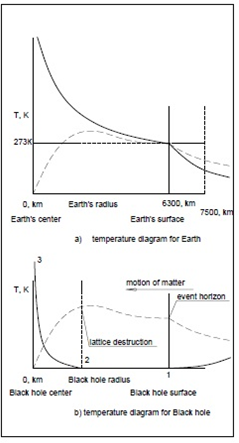
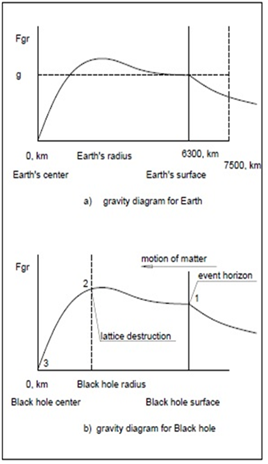
Since everything that exists is currently in the expansion phase, the reaction (gravity) resists this expansion, creating the effect of mutual attraction of everything that exists based on the desire to return to its original position. Figure 1 shows the identity of the distribution of gravity forces inside the Earth and inside a Black Hole depending on the distance to the center. Figure 2a shows the change in the temperature of the Earth’s matter with distance from the center. From the Earth’s surface to the center, the temperature of the matter increases. The decrease in temperature from the center to the surface is explained by the removal of heat from the Earth into space. The diagrams of gravitational and thermodynamic processes inside the Earth are based on and from sources of various authors. The diagrams of gravitational and thermodynamic processes inside the Earth are accepted as a model for drawing up similar diagrams for Black Holes.
Schemes of Gravitational and Thermodynamic Processes inside a Black Hole
So, to consider the gravitational and thermodynamic processes inside the Black Hole, the scheme of these processes for the Earth is adopted as a model. The main points of this model for gravitational forces are the growth of gravitational forces up to a certain distance from the surface, and a sharp decrease in forces to “0” closer to the center, Figure 1b. The main points of this model for the temperature of matter are a slow increase in temperature from the surface up to a certain distance, and a sharp increase in temperature closer to the center, Figure 2b.
The application of this model does not contradict the existing results of research for Black Holes. Further consideration will be performed based on the model and physics of gravitational forces.
In the growth of gravitational forces when approaching a Black Hole and inside, the main role is played by the inverse temperature dependence, the action of the inverse temperature dependence and the second law of thermodynamics. The mechanism and physics of this process are considered in the articles [2, 3].
The main role in these processes is played by the gyroscopic effect and interatomic and intermolecular bonds of matter. Interatomic and intermolecular bonds act as the static part of the gyroscope, the static lattice of matter. The change in gravitational forces depends on the rigidity of this lattice. As the temperature of matter decreases, the rigidity increases, and the gravitational forces increase. When approaching a Black Hole and inside, up to a certain distance, the temperatures approach “0”, and the gravitational forces reach a maximum. It is quite possible that the growth of gravitational forces increases the load on interatomic and intermolecular bonds. It is quite possible that there comes a moment when the interatomic and intermolecular bonds cannot withstand the load, the lattice is destroyed, the structure of matter is destroyed. As a result of the lattice destruction, matter turns into mince, mince of the destroyed structure of matter, mince of elementary particles of matter. This phenomenon occurs closer to the center of the Black Hole. This phenomenon can be considered as a phase transition of matter.
It is quite possible that as a result of the formation of mince, a collision of particles occurs, a collision of electrons and positrons. It is not at all necessary that all particles will be participants in the collisions, a certain number of these particles is enough. Physics knows the results of such collisions - the release of a huge amount of energy. In the case of a Black Hole, it is more appropriate to talk not about the release of energy, but about the generation of energy. The complete absence of gravity in the center of the Black Hole, the generation of enormous energy leads to a sharp increase in the temperature of matter, the ejection of matter, the ejection of matter at a superluminal speed beyond the Black Hole over enormous distances.
A Closed Cycle of Transformation of Matter in the Universe
Consideration of gravitational and thermodynamic processes inside the Black Hole provides grounds for asserting the possibility of forming a closed thermodynamic cycle of transformation of matter in the Universe. A model for such a process can be the process of boiling water in a saucepan. When water boils in a saucepan, phase transitions occur simultaneously in different places in space. The processes of evaporation and condensation occur simultaneously, phase transitions of liquid into gas and gas into liquid occur simultaneously, but in different places in space. Here, we will consider one complete thermodynamic cycle. Just as when water boils, the phase of the beginning of evaporation occurs at one point in space, the phase of condensation occurs at another point in space. That part of matter that participates in this particular process is considered. Here it makes sense to imagine the Multiverse as a set of the visible and invisible Universe, as a set of many participants in the process. In the presented scheme, the invisible Universe is dark matter, matter that moves in space at a superluminal speed relative to us. Visible matter is our fellow travelers in the Multiverse (relative speed sub-light).
When constructing a diagram, it is necessary to decide on the type or types of thermodynamic processes at each individual stage of the process in Figure 3.
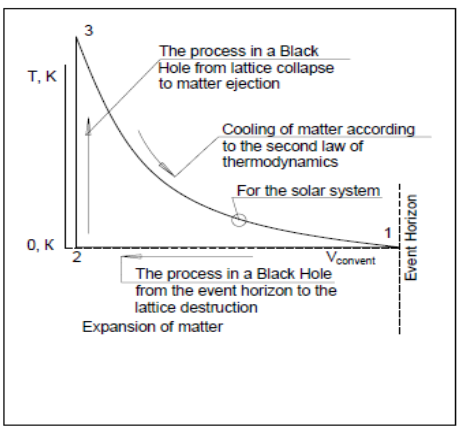
The most visual is the construction of the diagram in T, V coordinates, Figure 3. Points 1, 2, 3 in Figure 3 correspond to points 1, 2, 3 in Figures 1 & 2. It should be noted here that the process 3-1 in Figure 3 has a very long duration in time. The process 1-2-3 has a very short duration in time. In Figures 1 & 2 the process 1-2-3 is shown only inside the Black Hole. The process 3-1 in Figure 3 is the process in the entire visible and invisible Universe. In Figure 3, the value of volume “V” conditionally corresponds to the inverse density in physical terms. Process 1-2 takes place inside the Black Hole.
In section 1-2, the process is isothermal with temperatures close to 0K. This is the section inside the Black Hole - the transition from the boundary of the event horizon to the destruction of the lattice of interatomic and intermolecular bonds.
Section 2-3 is accepted as isochoric. In this section, thermal energy is generated, matter is ejected, and the temperature of matter significantly increases [4]. This section inside the Black Hole includes the process of matter ejection. The most probable ejection of matter (mincemeat) is at a superluminal speed. As a result of the ejection, dark matter is formed. Ejection at a superluminal speed excludes the possibility of visual observation of this process from Earth.
Section 3-1 is conditionally accepted as adiabatic. This section corresponds to the cooling of matter.
Galaxies, star systems, and planets are formed in this section. As it cools down at this stage, Black Holes are formed. The action in combination with the inverse temperature dependence of gravity forces and the second law of thermodynamics triggers the processes of separation of matter, stars, and galaxies are formed. The cycle of transformation of matter in the Universe begins and closes at point 1, on the event horizon.
Comments on Separate Points of the Diagrams
Process 1-2 in Figure 3 takes place inside the black hole. The black hole is located inside the Galaxy. The closed cycle in all the figures reflects the process for a certain part of matter (for example, the Solar System). For example, the Galaxy simultaneously contains different parts of matter at different stages of cooling. The distance of matter from the black hole can be taken as a measure of cooling. In relation to the black hole, matter is in rotational motion. It is proposed to consider the processes of the cycle from the current state of the Solar System.
The Solar System is currently in process 3-1. At this stage, the matter of the Solar System is in rotational motion as part of the Galaxy around the Black Hole. The trajectory of motion is a spiral. According to the second law of thermodynamics, the process of cooling of matter is simultaneously taking place.
The process of cooling of matter increases the force of gravity, the force of attraction of the matter of the Solar System to the black hole. It is this increase in the force of gravity that forms a spiral trajectory of motion, the approach of matter to the Black Hole. In this case, the gravitational forces act as centripetal forces of rotational motion. In rotational motion, the centripetal forces are compensated by centrifugal forces. The approach of matter to the center of rotation increases the angular velocity. An increase in angular velocity increases the linear velocity [5].
Linear velocity increases the centrifugal forces. If gravitational forces were constant, the centrifugal forces would compensate for the gravitational forces and the trajectory of matter would stabilize on a trajectory close to a circle. It should also be noted that the quadratic dependence of gravitational forces on the distance between the centers of mass [6]. Accordingly, the rotation of matter around a Black Hole has a constant increment of gravitational forces, centripetal forces. Centrifugal forces cannot completely compensate for this increment. In addition, one can assume the occurrence of a certain hydraulic siphon effect, i.e. the movement of one matter contributes to the movement of another matter, a “chain” reaction occurs. Thus, according to the presented schemes, when matter approaches the event horizon of a Black Hole, the matter has rotational motion around the black hole, has a minimum temperature, has a maximum gravitational force, has a maximum angular and linear rotation speed, has a maximum centrifugal force, and has a maximum load on interatomic and intermolecular bonds.
In process 1-2, it is quite possible that the linear velocity of matter movement exceeds the speed of light in the reference frame associated with the Solar System. At point 1, the gravitational forces reach their maximum values. At the beginning of process 1-2, the process of destruction of interatomic and intermolecular bonds begins. Section 1-2 shows the change in the volume V (specific volume V=1/ρ is the inverse density per unit space) of matter.
The physical meaning of this indicator in this case reflects the compaction of matter. A decrease in V shows the compaction of matter. The compaction of matter occurs due to the destruction of interatomic and intermolecular bonds, the formation of minced matter. Most likely, it is this process that forms the effect of a hydraulic siphon in the movement of matter. Closer to the center of the black hole, certain processes occur associated with the generation of enormous energy. It is this generation (process 2-3) that is the engine of all processes in the visible and invisible Universe.
This stage is characterized by a significant increase in temperature while maintaining a relatively small volume. It remains only to assume that the emission of new energy and matter occurs from the black hole in the direction perpendicular to the plane of the Galaxy. Most likely, the aggregate state of the new matter is plasma. Most likely, the emission of matter from the black hole occurs at superluminal speeds.
Section 3-1 Figure 3 shows the change in V on the scale of the Universe. Section 3-1 on the scale of the Galaxy must be represented as a compression process. Overall the process is 3-1 two-pronged process. On the scale of the Universe we have a process of expansion, on the scale of the Galaxy - compression. Compression on the Galaxy scale is shown in Figure 4.
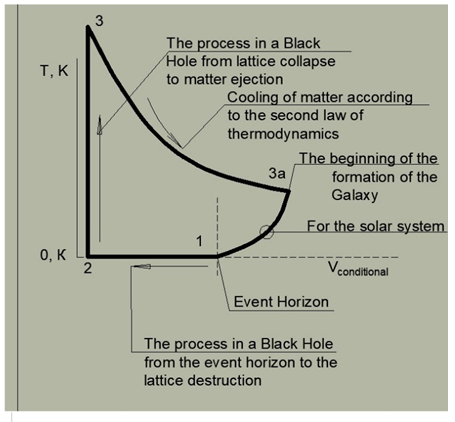
At this stage, separation and condensation of matter occurs [3]. Gravity is indirect evidence of dynamic processes in the Universe.
Conclusion
This article aims to give a new direction in the study of the Universe. The thermodynamic cycle of matter transformation is considered. The cycle of matter transformation in a volume corresponding to the volume of the solar system is considered. In general, on the scale of the Multiverse, the process of boiling water in a saucepan can be taken as a model. When water boils, the processes of evaporation and condensation of water occur simultaneously, but in different places in space. A similar picture is observed in the Multiverse. Isotropy is explained by the fact that many expansion processes are taking place at different stages at the same time. Therefore, it is pointless to look for some epicenter of the Big Bang, and the explosion itself [5]. The absence of such an epicenter is indirect evidence that multiple expansion processes are occurring simultaneously. Boiling water does not have a single epicenter. The formation of steam bubbles occurs simultaneously at many points.
References
-
Kuzminov IV (2024) Physics of Black Holes. A Closed Cycle of Transformation of Matter in the Universe. WASET, Conference Molecular Physics and Astrophysics.
-
Kuzminov IV (2024) Inverse temperature dependence of gravitational and inertial forces. Schemes and comments. WASET, International Journal of Physical and Mathematic Science.
-
Kuzminov IV (2024) Picture of the World by the Second Law of Thermodynamic. WASET Conference, code paper.
-
Kuzminov IV (2024) Physics of Gravity. The Inverse Temperature Dependence. Experiments. Physics of Gravity. Comments, Explanations and Additions. Journal of Physics and Chemistry Research 5(3).
-
Sanad MR (2024) Universe Center and Dark Matter. Open Access Journal of Astro 2(2): 000146.
-
Kuzminov IV (2024) The Physics of Gravity. Breakthrough Hypothesis. WASET Conference, code paper.
- Asymmetry Irreversible Heterogeneity Quantum Cosmology Grand Mathematical PHYSICS
- Early Universe: Hadronic Crystals Coherent Micro Gravitational Wave Emitters PHYSICS Part II
- The Solar System Constraint Maze: A Scientific Dead-End Revealing the Interuniversal Machine
- Assessment of Radiofrequency Radiation from 2G and 3G Mobile Phone Handsets
- Early Universe Magneto-Gravitational Coupling Genesis Physics: Part I
- Falsifiability of the Classical Law of Gravitation and Unveiling the Time-temperature Entanglement of the Universe