
Modified Gravitation and Mach's Principle: An Alternative to the Dark Matter and Dark Energy Cosmological Paradigm
The general approach is that all particles with non-null rest mass are subject to the force of gravity through the inverse square law of gravitation, plus an additional term that varies with the comoving distance (UYF-Field). The model is an ΛFRW-Cosmology starting from the modification of the gravity by explicitly incorporating Mach's Principle through an additional term large-scale in the gravitation; the source of this field is the ordinary baryonic matter. It`s deduced from the Matter-radiation decoupling in the early universe. This additional term of gravity UYF result null in the inner solar system, weakly attractive in interstellar ranges, very attractive in ranges comparable to the clusters of galaxies, and repulsive in cosmic scales, in agreement with astronomical and laboratory observables. This term explains dark energy, removes the incompatibility between the density of matter and the flatness of the universe in ᴧFRW-Cosmology; allows the theoretical deduction of the Hubble-Lemaitre Law, between other relevant consequences. Additionally to discuss other relevant astrophysics consequences: Birkhoff Theorem, Virial Theorem, the missing mass of Zwicky, gravitational lenssings, the BAO and the gravitational redshift in AGN, provides an additional contribution for the gravitational redshift that increase the until an factor of ~4, which has resolved the Arp controversy. Also we show the crude explanations of Pioneer anomaly, we obtain as the additional contribution of the acceleration of gravity due to UYF-Field. It is concluded that the dark energy and the missing dark mass can be approached with the usual physics as the large-scale modification of the Gravitation.
Introduction
Dark Cosmologies
To describe the dynamics of the Universe, on astronomical and cosmological scales, it is considered that the only interaction between bodies is the gravitation. More specifically, the universal validity of Newton’s Law is assumed a priori, according to which the force of gravity is given by the inverse of the square of the distance. Let us remember that even General Relativity assumes Newton’s Law of gravitation to be valid, when to consider that this is the limit to which gravitational interaction tends in the weak field approximation.
This assumptions leads to serious difficulties in describing of the Universe: (i) Cannot explain the rotation curves of galaxies, which show its incompatibility with the virialized masses of the galaxies, (ii) Into of the rich clusters of galaxies, the mass inferred from the X-ray diffuse emission is significantly less than that required to maintain these systems gravitationally stable (Zwicky’s missing mass problem), and (iii) in cosmological scales, the observed baryonic matter density is much lower than predicted by the FRW models with cosmological constant and null curvature. On cosmological scales, the accelerating expansion of the universe, inferred from the observation of distant SNI- type supernovae, leads to the “Dark Energy” problem, the understanding of which is far from complete. As Capozziello and Gurzadyan says: “In other, dark energy and dark matter could be nothing else but the signal that Einstein General Relativity, working extremely well at the scales where it has been tested so far, could be modified or extended to address these further phenomena” [1].
By other hand, the Law of the inverse square of the distance assumes an infinite range for the gravitational interaction, even though current Cosmology prescribes the observable universe, of finite radius (Hubble radius). How can an interaction have a range greater than the own universe? Apart from the epistemological problem, there is the concrete difficulty that the infinite range of gravitation necessarily implies a zero mass for the graviton at rest, which contradicts the existence of detected gravitational waves. Indeed, the mass of the graviton must be non-zero and of the order of 23 2 810 eV c − [2]. Also if local inertia is somehow tied to the large-scale distribution of matter in the Universe (March´s Principle), then Newton’s law of gravitation is insufficient to describe it. The gravitational field at any point in our galaxy or at any other point in space (for example, a point in the Local Group of galaxies) would be the sum of the gravitational contributions of all other galaxies at that point; and although these contributions were insignificant, their total sum is not necessarily null. Similarly, any point in space in the vicinity of the Local Group of galaxies will be subject to the gravitational interaction of the baryonic mass, corresponding to clusters of galaxies and large-scale structures. As a result, there must be a global gravitational interaction that adds to the force between any pair of galaxies, not prescribed by Newton’s law of gravitation. So the gravitational interaction between two stars would be the one prescribed by inverse-square Newton’s Law plus an additional contribution from the distant masses, which does not have to be the same for different points in space; since, on a large scale, the distribution of masses is not spherical with its center in the local frame of observation. Clearly, it is not possible to explicitly calculate that global contribution (due to the large-scale distribution of matter) in the gravitational force between two particles. Einstein tried it, through the cosmological term Λ, but it remained pending how to model his equivalent in stellar distances within a given galaxy, and within galaxy clusters.
To resolve the incompatibilities between astronomical observations and gravitation, on scales larger than the solar system, the existence of exotic matter has been conjectured under the name of Dark Matter, more precisely non-baryonic Dark Matter. This Dark Matter would not be composed of chemical elements of the periodic table neither subatomic particles of the standard model of quantum chromo dynamics; in open contradictions with terrestrial experiments and spectral stellar observations. In relation to the hypothesis of non-baryonic Dark Matter, the history of the Physics has shown many examples of paradigmatic assumptions that were then non-existent and replaced by measurable alternatives. Remember the epicycles of Ptolemy, the ether before the Theory of Relativity, the “caloric” as a chemical element before the works of Joule and Carnot, among other examples of paradigms; whose critical revision, supposed its abandonment and the advance in the understanding of the nature.
While it is true that the validity of inverse square law of Newton’s gravity is verified with precisions greater than 10-8 for Eötvös-like experiments there is no empirical evidence of their validity beyond the Solar System [3, 4, 5]; it is assumed true for estimating the mass of binary stars. The universal character of Newton’s Gravitation law was given by Kant in 1755, considering the deductive character of the planetary motion and the Leverrier’s prediction for the discovery of Neptune. Recall that galaxies acquire identity after the great debate Shapley-Curtis in 1920. Also Laplace and Seeliger theorized in the eighteenth century, modifications to the Law of gravitation [6, 7, 8].
It is worth asking, then, if it is possible to modify the Law of Gravitation that resolves on a large scale the dynamics observed in the universe (including cosmic acceleration: dark energy), and also agrees with the certainties of Newtonian gravitation. Such a modification of gravitation should agree, at the scale of the solar system, with the inverse square law, be compatible with terrestrial experiments (Eövos-like experiment) and the observables of the Big Bang model; such as the Cosmic Microwave Background (CMB), the age of the universe in terms of the Hubble constant, primordial nucleosynthesis (baryogenesis) and the formation of structures that initiate primordial fluctuations (such as Baryon Acoustic Oscillations, BAOs) The general idea is that all particles with non-null rest mass are subject to the force of gravity through the inverse square law of gravitation, plus an additional term that varies with the comoving distance [9, 10, 11]. This complementary contribution to the inverse square law would be caused by the large-scale distribution of baryonic mass, in the sense of Mach’s principle. The additional force term would be zero at comoving distance ranges on the order of the Solar System, weakly attractive at interstellar distance ranges, very attractive at distance ranges comparable to galaxy clusters, and repulsive at cosmic scales.
To do this, in the section 2 presents the basic ideas of the model; starting with physical arguments and preliminary deduction, in the early universe, of the term at large scale of the gravitation. The cosmological consequences of the inclusion of a large-scale term in the a ᴧFRW-Cosmology model (section 3), then several astrophysical implications are discusses (section 4) such as the Virial Theorem, Zwicky’s mass problem, large-scale variation of Kepler’s third law, the gravitational redshift, together a preliminary study of its implications for BAOs and CMB-anisotropies, and the Pioneer anomaly. Finally, the conclusions are shown in the last section.
Phenomenology and Physical Argument
We assume that any particle with nonzero rest mass is subject gravitational inverse-square law, plus an additional force that varies with distance. Thus the net force of gravitation varies as the law of Inverse Square in scales in order of the interstellar distance but it varies in a very different way when the comoving distance is about of the order of kiloparsec or more. In this sense, our argument is a large-scale modification of the gravitation. The origin of this field (UYF) is the baryonic mass, like in the Newtonian gravity, and represents gravitational contribution caused by the large-scale distribution of baryonic mass, in the sense of Mach’s principle. This additional term potential UYF(r) was constructed phenomenologically to explain the astronomical observables. We call this term, due to its shape, as Inverse Yukawa-like field (UYF). This potential per unit mass (in units of J/kg) as function of the comoving distance [9, 10, 11] is: null in the inner solar system, weakly attractive in ranges of interstellar distances, very attractive in distance ranges comparable to the clusters of galaxies and repulsive to cosmic scales (Figure 1). The general expression is:
( ) ( )( ) r YF 0 0 U r U M r r e α − ≡ − (1)
Where r is the comoving distance in Mpc, ( ) 1 0 0 4 U M l GM r π − ≡ is the constant, 1 1 l m− ≡ is a dimensional parameter. In the next subsection we obtain (1) beginning by the crude description of Hydrogen synthesis during the Matter-radiation decoupling in a primordial proto galaxies.
The coupling constants, as derived in the next subsection, are: 0r ~ 50_Mpc_ (the average distance between clusters of galaxies) and ~ 2.5_Mpc_ α . We understand that an exact model would fit the precise values of the coupling constants without modifying the phenomenology.
![Figure 1: Modification at Great Scale of the Gravity Thought of the Inverse Yukawa-like Field (UYF) in Astronomical Scale for Different Ranges of the Comoving Distance [11].](/fulltextimages/11553/fig_1.png)
Matter Radiation Decoupling
During recombination, in the first moments of the formation of the Universe, when the material is separated from radiation and hydrogen is synthesized (surface of last scattering), the average energy per unit mass (U) can be expressed for each nucleon (N) the temperature T of the plasma, using the Boltzmann distribution, as the work required to move the proton from the initial position to the comoving distance r relative to the center of the protogalactic cloud of mass M, as:
ε − ≡ ≡− − (2)
( )( ) B k T 0 0 U u N U M r r e Where kB is the Boltzmann`s constant, Uo is a constant, and ε is the proton energy. This energy is only kinetic energy, which could be expressed in terms of the gravitational energy of the protogalactic clouds, thus
2 1 2 2 p p m V Gm M
r ε = ≅ (3) Where, mp is the rest-mass of proton. Notice that we can use Virial theorem in its usual form, because we are at z = 1100 and the first protostars and protogalaxy have not yet formed, there to appear much later around of z = 6. Using (2) and (3), then ( ) ( ) 0 0 r YF U r U U r r e α − ≡ = − (4) With
4 Gm Gm M= r k T 3k T
π α ρ = (5) p 3 P m c B d B d Where Td is the average plasma temperature at the moment of the decoupling; it`s the minimum binding energy of the electron-proton for the synthesis of Hydrogen B d K T 13,6eV ≈ . M and rm is the mass and average radius of protogalaxy respectively, and ρc is the critical density. As before, ( ) -1 0 0 0 4π = = U U M lGMr is a coupling constant in units of J/kg (l≡ 1 m-1 is a dimensional parameter) because it is the gravitational potential in upper limit when 0 ε Τ → in the protogalaxy of mass M.
By other hand, the energy balance in the protogalaxy demands that B d p 0 K T Gm M r ≈ . Using the critical density 12 3 1.86 10 pc c ρ ≅ Μ Μ ε [10], Falcon [11] obtain
0 47.12 ~ 50 r Mpc Mpc = and 2.47 ~ 2.5 Mpc Mpc α ≅ .
The Eövos-like Experiments and Rotation Curves of Galaxies
Thus the force per unit mass (acceleration), complement to large-scale of the Newtonian gravitation is:
( ) ( ) ( ) 0 2 YF 0 2 U M r U r r r e r r YF F α α − = −∇ = − + − ρ (6) The Figure 2 shows that the maximum occurs by the core of the Abell radius, 1.2 mr Mpc ≈ as in the typical clusters of galaxies.
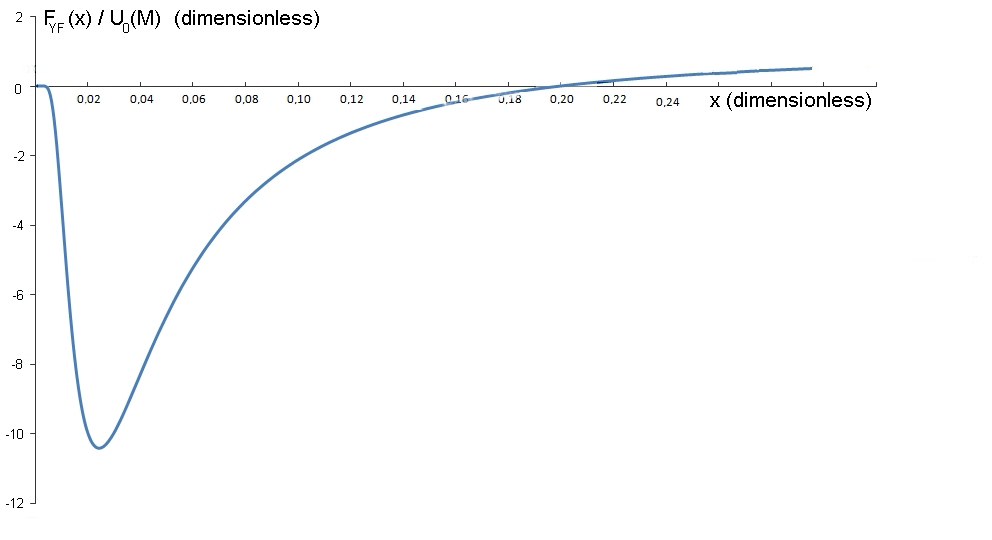
Notice that if r is negligibly small compared to a=2.5 Mpc then FYF is null, and the gravity is only prescribed by the inverse square law of Newtonian gravitation, in accordance with Eövos-like experiments. For ranges the comoving distances, between objects gravitationally bound, with r small Falcon, et al. [10] we obtain the result the Milgrom assumption according to which the gravitational force depending as 1 r− solving the galaxy rotation curves problem and recovers the Tully-Fischer law. From Figures 1 & 2 it is clear that U(r) gives a constant repulsive force per unit mass, at cosmological scales providing an asymptotic cosmic acceleration for ranges of comoving distance much greater than 50 Mpc [10, 11, 12, 13].
For ranges the comoving distances, between objects gravitationally bound, with r smaller we obtain ( ) ( ) ( ) 0 0 0 0 1 0 2 2 YF U M r U M r F r r r r α − ≈ ≈ + = (7) Thus 1 ~ YF F r − recovers the MoND-Milgrom model Falcon [10], Milgrom [13] proposed a phenomenological modification of Newtonian dynamics which fits galaxy rotation curves solving the galaxy rotation curves problem and recovers the Tully-Fischer law. We get the result the Milgrom according to which the gravitational force depending as r-1 [12, 13].
The maximum attractive force FYF occurs at 1.2 mr Mpc ≈ , as in core of the Abell radius for the clusters of galaxies. From Figures 1 & 2 it is clear that U(r) gives a constant repulsive force per unit mass, at cosmological scales providing an asymptotic cosmic acceleration. This cosmic acceleration, on a large scale, remains constant as it is observed when taking the limit of s very large, for ranges of comoving distance much greater than 50 Mpc, as shown in the Figure 2.
For the average value of smooth transition to strong agglutination in galaxy’s distribution ~10 cr Mpc the FYF is null, it suggests that the range of the force of gravity is finite; and the graviton rest mass is 0 29 2 10 g m eVc − − ≅ [11], in according to the results of LIGO and VIRGO project of gravitational waves [14]. Massive gravity were origin in the 1930s when Wolfgang Pauli and Markus Fierz first developed a theory of a massive spin-2 field propagating on a flat space- time background where the massive graviton could be decay in two photon [2, 15].
The large scale structures with characteristic dimensions much greater than 10 Mpc; e.g. Sloan Great Wall and Voids; do not show symmetric axial distribution that would be expected if gravitation had infinite range.
Neither have spherical distribution the hot gas in the superclusters of galaxies found by means of the Suyaev- Zel`dovich [16]. In large-scale structures with dimensions greater than 10 Mpc, there is a gravitational bond between the galaxies, by a sequential chain of gravitational attractions between their neighboring components, but not by a common center. Assuming an infinite range for gravity, would imply among other things, to imagine colossal masses for the attractor center in the superclusters of galaxies, which are unobservable (Hypermassive Black Hole).
Birkhoff’s Theorem
The general solution to the gravitation Poisson equation, under spherical symmetry, depends on the mass distribution outside of r:
0 1 4 r r U r G r r dr r r dr r π ρ ρ ∞ ′ ′ ′ ′ ′ ′ = − + ∫ ∫ (8) ( ) ( ) ( ) 2 In the Newtonian gravity approach it is easily understood that the second term in (8) is canceled because of the fact that the solid angles extending from one point within a sphere to opposite directions have areas in the sphere that escalade as r2, while The gravitational force per unit the dough scales such as r-2, so that the gravitational forces of the two opposing areas are canceled exactly. Thus, it`s no true that the second term in (8) are null. Therefore, Birkhoff’s theorem could not be applied In general approach, if the gravitation field has a large scale contribution, then:
( ) ( )( ) 0 0 r N YF GM U r U U U M r r e r
α − = + = − + − (9)
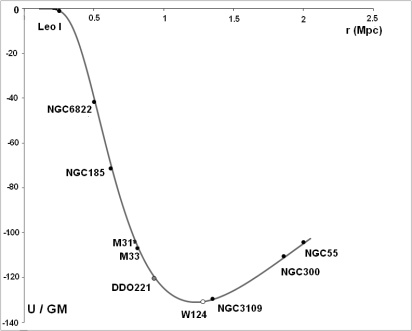
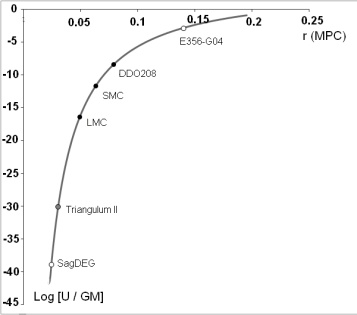
As example, in Figure 3 is plotted the effective gravitational energy (9), per unit mass, for various members of the local group of Galaxies. In the left panel, for very close satellite galaxies (in logarithmic scale). In the right panel, other notable members of the Local Group of galaxies are shown, over linear scale. The galaxy VV124 (UGC4879) maybe the most isolated dwarf galaxy in the periphery of the Local Group, near of the minimum of gravitational energy in accord with present description. Also M31, M33, NGC 300 and NGC55 they have a gravitational potential energy per unit mass, 100 times greater than the spheroid satellite galaxies of the Milky Way. The consequences of this, in dynamic stability and in the description of the rotation curves, is outside the scope of this communication, and would be interesting as an additional test for the approach to the large-scale modification of gravity.
Result
Cosmological Consequences
Let us now consider a usual FRW ∧ model, with homogeneous and isotropic FRW-metric together energy- momentum tensor for a perfect fluid, then we obtain the usual Friedmann equations [9, 11] with cosmological constant L and null curvature (k=0) :
2 2 8 c 3 3 R t G R t π ρ ∧ = +
( ) ( ) (10)
2 ( ) ( ) ( ) ( )
2 2 2 8 c R t R t G P R t R t c π + = − + ∧
(11) Now, we assumed L as a cosmic variable respect to the comoving distance. Note that the covariance is guaranteed because at cosmological scales (ranges of the comoving distance: r > 50 Mpc) the FIY is constant (Figure 2). Note that on cosmological scales, galaxies are described as dust particles through the impulse energy tensor for perfect fluid. Thus the Dark Energy can be thought of as a “cosmic force” in the sense of the Mach Principle, caused by ordinary matter, through the L cosmological term.
( ) ( ) 0 0 3 3
YF YF H d F r U r c dr ∧≡∧ = − (12)
Alternative to Dark Matter
By other hand, when m r r → , i.e. 1.2 mr Mpc ≈ (Figure 2), and using (1) into (12), we obtain ( ) r ∧ in the intergalactic scale, as:
( ) ( ) ( ) 2 0 0 3 3 10.55 4 m m YF r r H r F r Gkg m c π − → ∧ ≡∧ (13) Now, the Friedmann equations are [11]:
( ) 2 2c 8 3 3
( ) ( ) m R t r G R t π ρ ∧ = +
(14)
2 ( ) ( ) ( ) ( ) ( )
2 2 2 8 c m R t R t G P r R t R t c π + = − + ∧
(15) Where we used the standards notation for the density of matter, cosmological and deceleration parameters respectively; and the definition ( )
2 2 0 3 IY mr c H Ω ≡∧ .The remarkable result is that: if k=0 and ΩIY ≠ 0 does not require the assumption of the non-baryonic dark matter, neither requires exotic particles of cool dark matter. I.e. using 0.0223 Ω≈ b and 0.6911 ∧ Ω≈ as in the CMB measurements of the Planck Collaborations [16, 17] we obtain 0.255 Ω ≈ m and 0.255 0.6911 1 ∧ Ω+ Ω= + ≈ m .
Theoretical Deduction of Hubble-Lemaître’s Law
Consider the photons emitted from a remote galaxy with recession velocity v, and their observation in the reference local frame. Therefore, we should evaluate (2) at r >> 50Mpc, with initial condition v = 0 in t = 0. We obtain de Hubble- Lemaître’s Law [10]:
( ) ( ) ( ) 1 0 lim 4 YF r dr v adt F r G c r H r c π −
→∞ = = = ∫ ∫ λ
(16) Where we used, as before 2 0 4 U G kg m π − = and 2 1 l kg m ≡ is a dimensional parameter.
Notice that the value of H0 is the theoretical upper limit, evaluate for most distant objects 50 r Mpc . The Planck Collaborations obtain 1 1 0 67.15 H km s Mpc − − ≅ ; but they are not a direct measure of the Hubble constant. Most recent direct measurements of the constant of Hubble which Space Telescope (HST), are H0 = 75.8 and 78.5 km s−1 Mpc−1, furthermore Riess had found that H0 = 74.22 km s−1 Mpc−1 in Large Magellanic Cloud (LMC) [18, 19, 20].
Interpretation of the Dark Energy
In the cosmological range of the comoving distance c r r → , i.e. when 0.2 r → (Figure 2), the ∧ parameter using (1) into (12), is
2 0 0 2 3 0.623 c c YF r r H r F r c → ∧ = ∧ ≅ (17)
( ) ( ) And the Friedmann equations [3] are ( ) 2 2c 8 3 3
( ) ( ) c R t r G R t π ρ ∧ = +
(18)
2 ( ) ( ) ( ) ( ) ( )
2 2 2 8 c c R t R t G P r R t R t c π + = − + ∧
(19) Thus, the dark energy would be interpreted as the cosmic acceleration in local frameworks, caused by the large scale distribution of the ordinary baryonic matter. Thus, the cosmological density parameter is now 1 0.623_h_− ∧ Ω≅ . The upper limit for Hubble parameter (h=0.863), we obtain
0.72 ∧ Ω≈ in good agreement with the measurements of SNIa [11, 20].
Discussion
Astrophysical Implications
In a previous report, we Falcon [11] discussed how the UYF-Field affects the calculation of the age of the universe, the rotation curves of galaxies, the Angular Diameter Distance Distributions, and the length and mass of Jeans; as well as other important topics. In particular, the contribution to the local gravitational field due to the large-scale distribution of matter (UYF-Field) implies an increase in the average gravitational energy; then the Clasius Virial Theorem would contain an additional term due to the energy associated with the UYF-field [11], it’s solved the problem about the Zwicky’s missing mass, and consequently the Kepler’s third law results:
( ) ( ) 2 2 3 1 2 0 0 4 1 4 exp T GMr r r r r r π π α α α − − − = − + − − λ (20) For interstellar ranges (comoving distance in order of 10-40 kpc), both the Newtonian potential and UYF-Field are comparable, being able to explain the missing mass in the rotation curves. In the range of distances greater than 50 kpc the Newtonian force is negligible compared to the inertia caused by UYF-Field. As said before, at cosmological distance scales the FYF force is repulsive and manifests itself as the cosmic acceleration (Dark Energy). In ranges of comoving distances much less than 10 pc, FYF is negligible and the gravitational force is prescribed by the law of the inverse square of the distance.
Arp Controversy and Gravitational Redshift
The total astronomical redshift is the addition of the: Doppler redshift due to the emitter-receiver movement, gravitational redshift, and plus the cosmological redshift due the cosmic expansion. The photons emitted in the gravitational potential source( ) φ , when r is sufficiently large compared to the Schwarzschild radius, would also be affected by the large-scale distribution of matter, so α φ π − − ≅− = − + = − − +
1 1 4 2 r s g N YF R r r z U U le c c R r
( ) 0 2 2 0
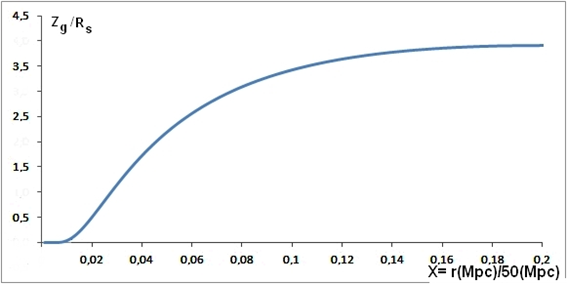
(21) Where use the Schwarzschild’s radius: Rs=2GM/c2. R is the physical radius of the massive object. As before, in section 2, l is the dimensional parameter equal to m-1. Beyond 10 Mpc the gravitational redshift remains constant in accordance with the previous assumption of the massive graviton. Then Figure 4 shown the additional contribution to the redshift gravitational due to UYF and zg increases by a factor until 4. This result is interesting to understand the problem of AGN at High-redshift and the nature of Quasars.
Gravitational Lensing
Let us consider the deflection of a point-like lens of mass M, under the assumption of basic thin gravitational lent, when gravitational potential is small, the effect of the space- time curvature on light trajectory can be described as an effective refraction index η, given by:
2 2 2 2 1 1 c c η = − Φ ≅+ Φ (22)
But now, if the gravitational field F is small, given for (9).
( ) 0 4 N YF GM GM U r U U r r π α Φ = = + ≅− + , i.e. 1 r α = , so the deflection angle ( ) ζ of the light rays which traveling in a gravitational field is given by the integration of the gradient component of η orthogonal to the trajectory [21]:
R dl dl c R ς η = −∇⊥ = ∇⊥Φ ≅ ∫ ∫ ρ ρ ρ (23)
2 5 2 3 s p
Where RP denote the radius of galaxies and Rs is the Schwarzschild radius. Note that the inclusion of the UYF-Field leads to twenty percent reduction in the calculation of the angle of deflection. Consequently, estimates of the deflecting mass in gravitational lenses observed at long distances would have been twenty percent underestimated. Obviously, these do not affect the observation of the deflection of light, in the case of a total solar eclipse, because the UYF is null at the scale of the solar system.
BAO and CMB Anisotropies
The early universe consisted of hot plasma of photons, electrons and baryons closely coupled by Thomson
scattering, with oscillations in the photon fluid, due to radiation pressure and gravity. The essential physics of Baryonic Acoustic Oscillations can be study from non- relativistic hydrodynamic approach, through equations of continuity, Euler`s and Poisson`s equations, in Lagrangian form. Now consider a small perturbation (first order) superimposed on the “background” fluid, then the fractional density perturbation 0 δ δρ ρ ≅ obeys the relations [22]:
2 2 2 0 2 2 4 0 s s d d H c k R t G dt dt δ δ π ρ δ − + + − = (24) ( ) Where cS the sound speed and kS is a comoving wave number of a plane-wave disturbance. In a ΛCDM model, the growing modes of the time-dependence are given by the growth function:
2 5 1 2 m G z H z H z z dz ∞ − Ω ′ ′ ′ = + ∫ (25)
( ) ( ) ( )( ) 3 3
Where the Hubble parameter:
1 2 3 4 1 1 m rad H z z z ∧ = + Ω+ + Ω + Ω (26)
( ) ( ) ( )
In usual formalist of growth of structure and galaxies formation, beginning by the oscillations acoustic adiabatic (BAO), it`s used m b c Ω= Ω+ Ω in (26). So the large-scale modification of gravitation would give an identical result for BAO, by the arithmetic identity: ( ) 1 m b c Ω= Ω+ Ω + ΩIY as previous discussion in section 3. In the present UYF -field formalist, the dependence of density and pressure remain unchanged on the scale factor of expansion R(t). Thus, the primordial fluctuations and the anisotropies in the CMB, the nucleosynthesis (baryogenesis), should remain unchanged. Remark that UYF is forty orders of magnitude higher than the average distance per nucleon in the primordial plasma. Also the Sachs-Wolfe effect also does not change, because the size of the horizon at the time of recombination is approximately 100 kpc, much less than the maximum range of the gravitational force with massive graviton (~10 Mpc) and at such ranges, the graviton would travel the entire universe inside the horizon without decay.
Pioneer Anomaly
Another interesting controversy is the anomalous acceleration from de Pioneer 10/11 spacecraft when traveling through the outer reaches of the solar system. Indicated the presence of a drift of Doppler frequency, in blue-shift, small and anomalous, interpreted as a sunward acceleration of ( )
1 2 0 8.74 1.33 10 p m a s − = ± × [23], this signal has become known as the Pioneer anomaly. Another possible interpretation of the Pioneer anomaly is to consider the additional contribution of the acceleration of gravity due to UYF-Field, i.e. (15). In the average distance between 20 to
70 UA, i.e. r=45 UA, can be used (7):
( ) ( ) 1 0 0 0 1 4
π − − = ≈
2 2 p lGr M U M r a r r
ε (27)
1 2 0 7.610 p s a m − ≈ in order of ( )
We obtain
1 2 0 8.74 1.33 10 p m a s − = ± × [23], in agreement with the estimations, for the solar system, due to the massive graviton [24]. This is certainly a very crude approximation but it`s easy to see in figure 2 that in the range of 20- 40 UA the UYF varies very slowly and therefore its contribution to the acceleration is almost constant in this range of distance (very small compared with r0).
Conclusions
- The consequences of adding a UYF-field as a large-scale contribution of gravity implies that:
- The minimum of the potential energy of the UYF-field, in order of the comoving distance of 10 Mpc implies the nullity of the force of gravity, and predicts a graviton mass of at least 10-64 kg.
- Resolved the incompatibility between the flatness of the Universe and the density of matter in the Friedmann equation, without invoking the non-baryonic dark matter.
- The dark energy would the cosmic acceleration in local frameworks, caused by the large scale distribution of the ordinary baryonic matter, as prescribed the Mach’s principle. So Hubble-Lemaître’s law would be the manifestation in cosmic scale of the UYF- Field
- The Virial theorem and Kepler’s third law now including an additional term that solve the Zwicky’s paradox, so the “missing mass” is reinterpreted as the energy of the UYF-field, and rotation curves of galaxies problem could be modeled similarly to the Milgrom models.
- The UYF provides an additional contribution for the gravitational redshift that increase the until an factor of ~4, it´s solvent the Arp’s controversy, and would help understand the problem of AGN at High-redshift and the nature of quasars.
- The UYF-field leads to a reduction in the angle of deflection of the gravitational lensing so the deflecting mass at long distances would have been twenty percent underestimated.
- The large-scale modification of gravitation given an identical result for BAO, but it does not require assuming the existence of non-baryonic exotic particles. While the CMB and primordial nucleosynthesis remain unchanged
References
-
Capozziello S, Gurzadyan VG (2021) Focus point on modified gravity theories and cosmology. Eur Phys J Plus 136(871).
-
Bergshoeff EA, Hohm O, Townsend PK (2009) Massive Gravity in Three Dimensions. Phys Rev Lett 102(20).
-
Diaferio A (2008) The evidence for unusual gravity from the large-scale structure of the Universe. arXiv preprint pp: 1-15.
-
Bertolami O, Páramos J (2014) The Experimental Status of Special and General Relativity. In: Ashtekar A, Petkov V (Eds.), Springer Handbook of Spacetime, Berlin, Heidelberg, Germany, pp: 1-15.
-
Lee JG, Adelberger EG, Cook TS, Fleischer SM, Heckel BR (2020). New test of the gravitational 1/r2 law at separations down to 52 μm. Phys Rev Lett 124(10).
-
Bondi H (1960) Cosmology. Cambridge Univ Press, UK.
-
Laves K (1898) On Some Modern Attempts to Replace Newton’s Law of Attraction by Other Laws. Popular Astronomy 5: 513-518.
-
Seeliger H (1895) Ueber das Newton’sche Gravitationsgesetz. Astronomische Nachrichten 137(9): 129-136
-
Falcon N (2013) Modification of the Newtonian Dynamics in ΛFRW-Cosmology an Alternative Approach to Dark Matter and Dark Energy. JMP 4(8): 10-18.
-
Falcon N, Aguirre A (2014) Theoretical Deduction of the Hubble Law Beginning with a MoND Theory in Context of the ΛFRW-Cosmology. International Journal of Astronomy and Astrophysics 4(4): 551-559.
-
Falcon N (2021) A large-scale heuristic modification of Newtonian gravity as an alternative approach to dark energy and dark matter. J Astrophys Astron 42(102).
-
Debono I, Smoot GF (2016) General Relativity and Cosmology: Unsolved Questions and Future Directions. Universe 2(4): 23.
-
Milgrom M (2001) MOND – A Pedagogical Review. Acta Phys Polon B 32: 3613.
-
LIGO Scientific Collaboration and Virgo Collaboration (2017) GW170104: Observation of a 50-Solar-Mass Binary Black Hole Coalescence at Redshift 0.2. Physical Review Letters 118(22): 221101.
-
Gazeau JP, Novello M (2011) The nature of Λ and the mass of the graviton: a critical view. IJMP 26(22): 3697- 3720.
-
Ade PAR, Aghanim N, Alves MIR, Armitage-Caplan C, Arnaud M, et al. (2014) Planck 2013 results. I. Overview of products and scientific results. A & A 571(1): 48.
-
Aghanim N, Akrami Y, Arroja F, Ashdown M, Aumont J, et al. (2020) Overview and the cosmological legacy of Planck. A & A 641(1):56.
-
de Jaege T, Stahl BE, Zheng W, Filippenko AV, Riess AG, et al. (2020) A measurement of the Hubble constant from Type II supernovae. MNRAS 496(3): 3402-3411.
-
Riess AG, Casertano S, Yuan W, Macri LM, Scolnic D (2019) Large Magellanic Cloud Cepheid Standards Provide a 1% Foundation for the Determination of the Hubble Constant and Stronger Evidence for Physics beyond ΛCDM. ApJ 876(85): 13.
-
Riess AG, Yuan W, Macri LM, Scolnic D, Brout D, et al. (2022) A Comprehensive Measurement of the Local Value of the Hubble Constant with 1 kms-1 Mpc-1 uncertainty from the Hubble Space Telescope and the SHOES Team. ApJL 934(7): 52.
-
Jetzer P (2002) Gravitational lensing, in Bonometto S, et al. Modern Cosmology IOP Pub: UK Kovács et al (2017). Imprint of DES superstructures on the cosmic microwave background, MNRAS 465(4): 166-4179.
-
Peacock J (2002) Cosmological Physics. In: Peebles PJE, Rastra B (Eds.), The cosmological constant and dark energy. Cambridge University Press, Cambridge (2003). RvMP 75: 559.
-
Turyshev SK, Toth VT (2010) Pionner Anomaly. Living Reviews in Relativity 13(4).
-
Clifford MW (2018) Solar system versus gravitational- wave bounds on the graviton mass. Class Quantum Gravity 35(17).
-
Bassett BA, Hlozek R (2009) Baryon Acoustic Oscillations. Dark Energy Ed Pilar Ruiz-Lapuente pp: 1-42.
-
Bonamente M, Joy MK, LaRoque SJ, Carlstrom JE, Reese ED, et al. (2006) Determination Of The Cosmic Distance Scale From Sunyaev-Zel’dovich Effect And Chandra X-Ray Measurements Of High-Redshift Galaxy Clusters. ApJ 647: 25-54.
-
Wondrak MF (2017) The Cosmological Constant and its Problems: A Review of Gravitational Aether. Arxiv pp: 1-10.
- Asymmetry Irreversible Heterogeneity Quantum Cosmology Grand Mathematical PHYSICS
- Early Universe: Hadronic Crystals Coherent Micro Gravitational Wave Emitters PHYSICS Part II
- The Solar System Constraint Maze: A Scientific Dead-End Revealing the Interuniversal Machine
- Assessment of Radiofrequency Radiation from 2G and 3G Mobile Phone Handsets
- Early Universe Magneto-Gravitational Coupling Genesis Physics: Part I
- Falsifiability of the Classical Law of Gravitation and Unveiling the Time-temperature Entanglement of the Universe