
Spectral Energy Distribution of Flares in the Variable Star AO Serpentis
Here we report on the flaring variable star AO Ser which was observed with the 0.4m SBIG optical telescope from Las Cumbres Obervatory Global Telescope Network remotely on 25/09/2022. The Spectrometric analysis was carried out with the SIMBAD Digital Sky Survey (DSS) menu from the VizieR GUI on the Aladin Software to obtain flux density, flare energy, flare wavelength and flare frequency. The light curve of AO Ser shows that the source has a strong presence of flares. Hence, we estimated the flare energy, flare wavelength and flare frequency of AO Ser at peak flares so as to deduce its spectral energy distribution. From the spectral energy distribution, the Aladin software automatically estimated the Flare Energy of AO Ser at(as) 1.09e − 2eV , the Flare flux density of AO Ser F (ν ) at 3.27e +1Jy and Flare Flux Energy of AO Ser F (λ ) at 7.55e −12erg −1cm− 2μm−1. We conclude that AO Ser is an eclipsing binary variable flaring stars that is losing mass in form of heat.
Introduction
AO Ser is a star that has an 11-year activity cycle, just like our Sun does. During this cycle, the number of sunspots regions where the star’s magnetic field is strong) increases and decreases over time [1]. This is thought to be related to the star’s “dynamo,” which is a process that generates the star’s magnetic field. As the activity cycle progresses, the star’s magnetic field lines can become twisted and tangled, which eventually leads to the release of energy in the form of solar flares [2]. AO Ser flares had been extensively studied by previous investigators Chisom, et al. [1], Chika, et al. [2], Brancewiez, et al. [3], Hoffman, et al. [4]; Yang, et al. [5], Alton, et al. [6], Koch, et al. [7], Wood, et al. [8]. These authors all discovered visible flares on the light curve of AO Ser. Approximately 70% of stars in our Galaxy are red dwarfs. Majority of stars in that group exhibit flare activity. Such a bright and intriguing form of light variations has drawn attention of many researchers. Consequently, there are published many papers on that subject and thousands of red dwarfs were investigated up to now. For few objects the phenomena of flare light variations were observed in the full range of wavelengths [9, 10, 11]. Our understanding of the nature of such light variations of red dwarfs was extended by the analogy to similar events observed on the Sun. Models
comprehensively describing eruptions were presented by Katsova, et al. [11], Hawley, et al. [12], Katsova, et al. [13], Shibata, et al. [14, 15], Stepanov, et al. [16] and others. However, there exist new observational data which cannot be explained by the existing models.
The main purpose of this study is to observe AO Ser with V-filter and B-filter. Plot the light curves to verify the presence of flares and estimate the spectrometric flare energy, flare frequency and flare wavelength.
Methods
Methods of Spectroscopy using Aladin for Spectrum and Spectral Energy Distribution
Spectroscopic stellar identification of the binary star and that of the comparison stars was done with Aladin software to allow us visualize the digitalized astronomical images superimposed entries from astronomical catalogue in the database. The AstroLab computers with window version 11.0 of the Aladin Software was launched and the option ‘File’ was initiated to open the ‘Load directory’ URL of the Aladin GUI. We clicked the Digital Sky Survey (DSS) menu from the Aladin GUI on the Left hand side of the software pane view. For the digital stellar identification analysis, the target name e.g ‘AO Ser’ was entered for all variable stars under consideration. The SIMBAD application for the digital sky survey on the RHS of the software pane view of the Aladin GUI was also launched to modify the radius as 15’ followed by clicking on ‘Display Filter’. The dialogue box ‘Star’ was activated because the analysis is specifically on stars and not any other source and finally the data was submitted.
Spectral Energy Distribution Analysis
For the Spectral Energy Distribution analysis, the VizieR GUI on the Aladin Software was activated to obtain flux density, energy density, Target Right Ascension RA and Declination DE in Julian date, frequency, and wavelength of AO Ser for further analysis. We processed the VizieR plot of AO Ser on the Aladin GUI to obtain the Spectral energy distribution data to obtain the spectral energy distribution (SED) data of AO Ser from the Aladin software which is a plot of brightness or flux density (power) against the frequency or wavelength from a target. The light curve of the continuum flux of the star and the spectral signatures of the target produces all parametric information needed from the target. The astropy api codes in python program was written to run the spectral analysis of the source and produce the light curve and spectral stellar parameters for AO Ser. Python version 2022 was used to generate the Spectral energy distribution plots and for the spectral analysis of the flare energy, wavelength and frequency for AO Ser. For AO Serpentis, from our VizieR GUI on the Aladin Software data reduction, the flux density, energy density, Target Right Ascension RA and Declination DE in Julian date, frequency, and wavelength were obtained.
Results
We obtained the spectral energy distribution (SED) data of AO Ser from the Aladin software which is a plot of brightness or flux density (power) against the frequency or wavelength from a target. The light curve of the continuum flux of the star and the spectral signatures of the target produces all parametric information needed from the target.
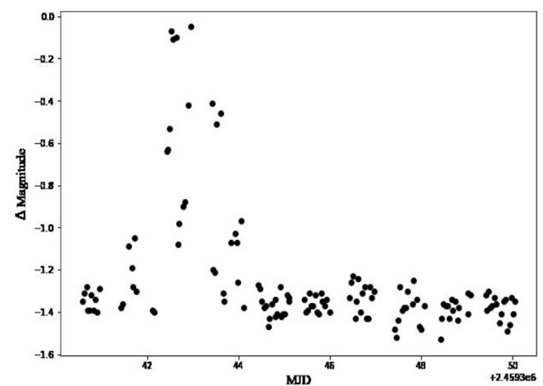
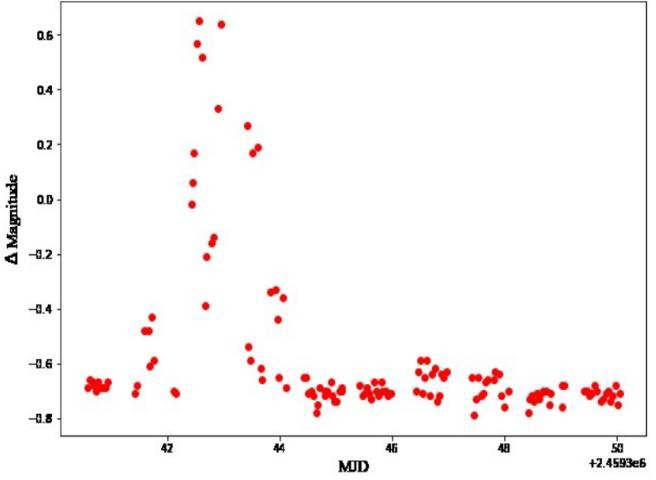
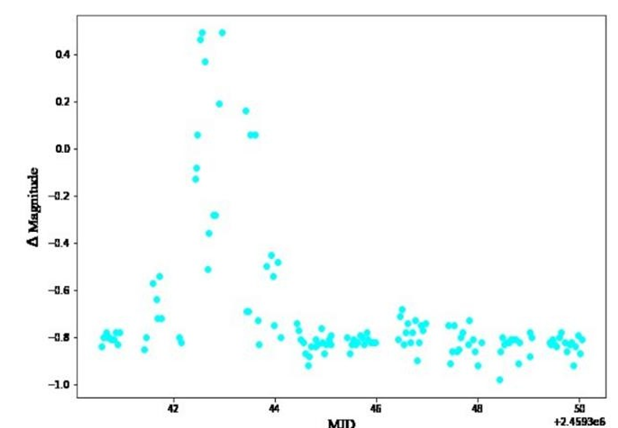
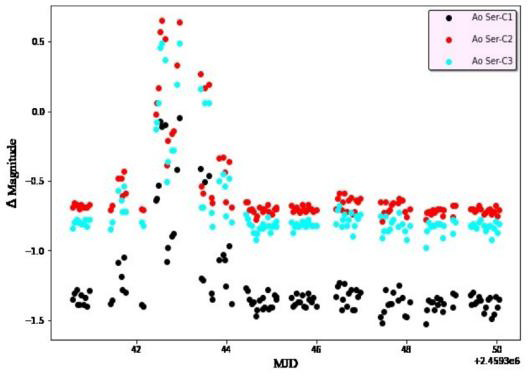
Spectrum for Spectral Energy Distribution in Observed Variable Stars
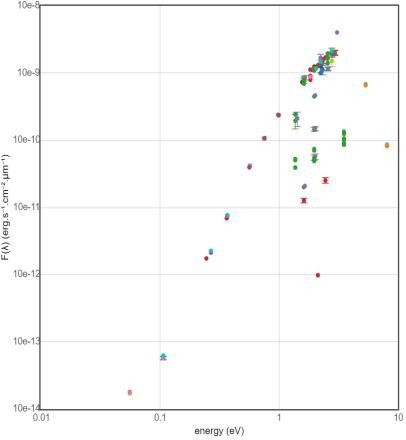
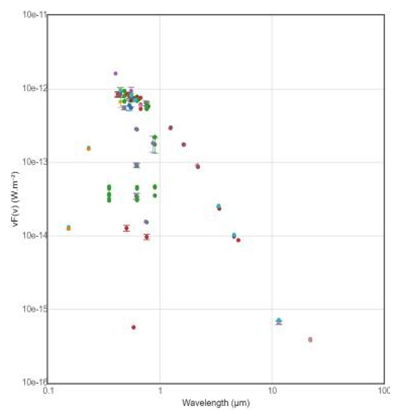
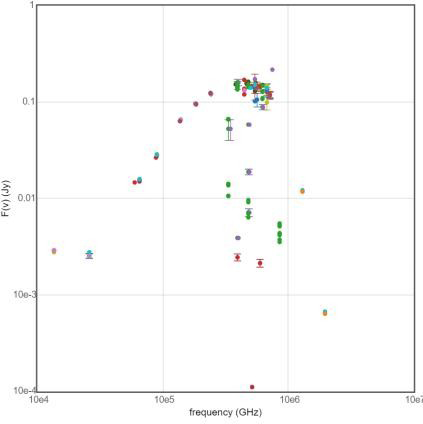
Figures 1-4 is the spectrum of AO Ser, Figures 5-7 is the spectrum for WW Cnc and CZ Aqr for the estimation of energy, wavelength and frequency distribution in the stellar flares.
Discussion
Light Curve for Flare Detection in AO Ser
Figures 1-4 represents the light curve for V and B filters for the background separation for AO Ser showing clear evidence of flares in the target. The Figures are visible plots of the stellar magnitude (∆Magnitude) vs Stellar Phase of AO Ser revealing a strong presence of flares in the background separation of comparative star C1, C2 and C3. From the target star decompressed as AO Ser – C1 through the V and B Filter in Figure 1, there is evidence of flare. Figure 3 is also revealing a strong presence of flares in the light curve of the background separation of comparative star C2 from the target star decompressed as AO Ser – C2 through the V and B Filters. The flare on the V and B filter is also very prominent in Figure 3. The average combined results on Figure 4. is an express indication that the flare on AO Ser is intrinsic. From this results obtained, it be seen that AO Ser is a flaring Eclipsing- Variable Star which agrees with Chisom, et al. [1].
Spectral Energy Distribution of AO Ser
Figure 5 is the plot of flux density versus Energy of the eclipsing variable star AO Ser. The star was identified as V* EB AO Ser which is a binary eclipsing variable star belonging to the family of flaring stars with centre right ascension RA and declination DE for V* AO Ser as (150 58’ 18.410” + 170 16’ 10.006”) respectively using an instrumental radius of 5 arcsec. From the light curve, the Aladin software used automatically estimated the Flare Energy of AO Ser at1.09 2 e eV − , the Flare flux density of AO Ser at 3.27 1 e Jy + and Flare Flux Energy of AO Ser at 7.55 12 1 2 1 e erg cm m µ − − − −. Furthermore, Figure 6 is the plot of flux density versus wavelength of the eclipsing variable star AO Ser. From the spectral energy distribution analysis, AO Ser flare wavelength was measured at 2.19 0 e m µ + . Figure 7 is the plot of flux density versus frequency of the eclipsing variable star AO Ser. The spectral energy distribution flare frequency of AO Ser obtained during flare is 6.75 5 e GHz + .
Conclusion
A real time observation on Flaring Variable stars AO Serpentis, had been remotely conducted to investigate their observed data using B and V-filters from Las Cumbres Observatory Global 0.4m Optical Telescope (LCGOT) and the Very Large Baseline Optical Interferometry VLBOI. The LCOGT data were collected and analysed using Spectrometric methods. From these analysis and data reduction, it detected a binary star systems in all variable star light curve observed. The results show that the observed stellar pulsation and variability in AO Ser is intrinsic and not extrinsic.
Results of the research clearly achieved a visible detection of flares in all light curve of AO Ser. The measurement of all flare energies, flare frequencies, flare wavelengths, and its energy flux density had be done spectrometrically. This study clearly demonstrate the spectrometric plot of flux density versus wavelength, flux density versus Energy and flux density versus frequency. The graph clearly reveals the flare energy, flare wavelength and flare frequency of the stars.
References
-
Ejiofor CS, Onuchukwu CC, Anekwe FN (2022) Photometric Study of an Eclipsing Binary Star CZ Aqr. Astronomical Society of Nigeria (PASN), pp: 1-10.
-
Onuchukwu CC, Onu MC, Anekwe FN (2022) Photometric Study of an Eclipsing Binary Star AO Serpentis. Astronomical Society of Nigeria (PASN), pp: 1-10.
-
Brancewiez HK, Dworak TZ (1980) A catalogue of parameters for eclipsing binaries. Acta Astron 30: 501- 524.
-
Hoffman, Irving D (2009) Automated Variable Star Classification and the Pulsation Properties of Eclipsing & Scuti Stars. New Mexico State University, New Mexico, US, pp: 1-24.
-
Yang P, Bi L, Baum BA, Liou KN, Kattawar GW, et al. (2010) Spectrally consistent scattering, absorption, and polarization properties of atmospheric ice crystals at wavelengths from 0.2 to 100 µm. J Atmos Sci 70(1): 330- 347.
-
Alton KB, Prisa A (2012) Proceedings of Society for Astronomical Science Annual Symposium. Symposium on Telescope Science, Society for Astronomical Sciences, Rancho Cucamonga, California, USA, 31: 127.
-
Koch JC, Koch RH (1962) Light elements of some eclipsing binaries. Astronomical Journal 67: 462-463.
-
Wood BD, Forbes JE (1963) Ephemerides of eclipsing stars. Astronomical Journal 68: 257-269.
-
Gershberg RE, Katsova MM, Lovkaya MN, Terebizh AV, Shakhovskaya NI (1999) Catalogue and bibliography of the UV Cet-type flare stars and related objects in the solar vicinity. Astronomy and Astrophysics Supplement 139: 555.
-
Gershberg RE, Terebizh AV, Shlyapnikov AA (2011) Stars with solar-type activity: GTSh10 catalogue. Bulletin of the Crimean Astrophysical Observatory 107: 11-19.
-
Katsova MM, Drake JJ, Livshits MA (1999) New Insights into the Large 1992 July 15-17 Flare on AU Microscopii: The First Detection of Posteruptive Energy Release on a Red Dwarf Star. The Astrophysical Journal 510: 986-998.
-
Hawley SL, Fisher GH, Simon T, Cully SL, Deustua SE, et al. (1995) Simultaneous Extreme-Ultraviolet Explorer and Optical Observations of AD Leonis: Evidence for Large Coronal Loops and the Neupert Effect in Stellar Flares. Astrophysical Journal 453: 464.
-
Katsova MM, Livshits MA (2001) Generalized concept of flares on late-type stars. Astronomical and Astrophysical Transactions 20(3): 531-537.
-
Shibata K, Yokoyama T (1999) Origin of the Universal Correlation between the Flare Temperature and the Emission Measure for Solar and Stellar Flares. The Astrophysical Journal 526(1): 49.
-
Shibata K, Yokoyama T (2002) A Hertzsprung-Russell- like Diagram for Solar/Stellar Flares and Corona: Emission Measure versus Temperature Diagram. The Astrophysical Journal 577: 422.
-
Stepanov AV, Kopylova Yu G, Tsap Yu T, Kupriyanova EG (2005) Oscillations of optical emission from flare stars and coronal loop diagnostics. Astronomy Letters 31: 612-619.
- Asymmetry Irreversible Heterogeneity Quantum Cosmology Grand Mathematical PHYSICS
- Early Universe: Hadronic Crystals Coherent Micro Gravitational Wave Emitters PHYSICS Part II
- The Solar System Constraint Maze: A Scientific Dead-End Revealing the Interuniversal Machine
- Assessment of Radiofrequency Radiation from 2G and 3G Mobile Phone Handsets
- Early Universe Magneto-Gravitational Coupling Genesis Physics: Part I
- Falsifiability of the Classical Law of Gravitation and Unveiling the Time-temperature Entanglement of the Universe