
Zwicky's Missing Mass: Dark Matter versus Modified Gravity
Zwicky postulates the dark matter approach, based on the incompatibility between Newtonian gravity and the residual velocity measured in galaxy clusters. This approach to dark matter has been prioritized over other theoretical alternatives, although dark matter remains undetected directly. We discuss missing mass through large-scale modification of gravity, with the potential for an inverse Yukawa-type field (UYF), varying with comoving distance (null in the inner solar system, weakly attractive at interstellar distances, very attractive in galaxy clusters and repulsive on cosmic scales). The UYF is caused by the large-scale distribution of baryon mass, in the sense of Mach's principle. We obtain that the UYF resolved the incompatibility between the flatness of the Universe and the density of matter in Friedmann-Robertson-Walker cosmology, provides an explanation for dark energy as the cosmic acceleration caused by the large-scale distribution of matter. Also solves the Zwicky's missing mass because Virial's theorem includes an additional term, such that the virial mass is of the order of , five hundred times less than that calculated by Zwicky. X-ray emissions and Faber-Jackson and Tully-Fisher relationships are discussed.
Abbreviations
HST: Space Telescope; UYF: Yukawa-Like Field; BAO: Baryon Acoustic Oscillations; ΛFRW: Friedman-Robertson-Walker Cosmological Model.
Introduction
Zwicky’s Missing Mass
In the 1930s, Fritz Zwicky reported a significant discrepancy between the visible mass of galaxy clusters and the mass necessary to explain their gravitational dynamics [1, 2]. The application of the Virial theorem to the galaxies in the Coma cluster yielded a mass-to-light ratio of one hundred times greater than that observed in the local group and in the solar stellar neighborhood [3]. While studying the Coma cluster, Zwicky realized that the galaxies were moving at such high speeds that, according to Newton’s theory of gravitation, the visible mass of the cluster was not enough to hold them together. Furthermore, in the 1970s several studies were carried out on the dynamical motion of individual stars that suggest that the total mass of galaxies is about an order of magnitude greater than the mass of their visible parts [4], studies were also carried out on the rotation curves of galaxies showing incompatibility with the expected Keplerian motion in Newtonian gravity [5].
The problem of the incompatibility between astronomical observations and the formalism of gravitation turned the dark matter conjecture into a paradigm after the observations of the anisotropies of the cosmic background radiation by the COBE satellite. Measurements of the angular size of the anisotropies showed that the Universe is asymptotically flat and, consequently, the observed density of matter should coincide with the critical density according to Einstein’s field equations in the Friedmann-Robertson-Walker cosmology of the hot Big Bang. However the observed density of baryonic matter is an order of magnitude lower than expected.
All these astronomical observations, together with the measurements of gravitational lenses have in common their incompatibility with the formalism of gravitation on larger scales of the solar system [6]. After several decades of fruitless search for subatomic particles of exotic matter as a constituent of Dark Matter [7], and of new fundamental interactions (quintessence theories) the problem of missing mass has become a paradigm [8], similar to the ether paradigm, before the advent of special relativity in the 19th century, to the Phlogiston paradigm in the 18th century or even to the Ptolemy epicycles paradigm in the 16th century.
The lack of direct observation of the components of dark matter together with the manifestation of gravitational effects constitutes a paradox in itself. Zwicky’s paradox is based on the assumption that Newton’s Law is universally valid to describe the dynamics of the Universe, on astronomical scales, according to which the force of gravity is given by the inverse of the square of the distance and therefore the Virial theorem requires that the average kinetic energy be half the average potential energy. Let us remember that even General Relativity assumes Newton’s Law of Gravitation as valid, considering that this is the limit to which the gravitational interaction tends in the weak field approximation.
On the other hand, the Inverse Square Law of distance assumes an infinite range for gravitational interaction, although Cosmology prescribes the finite radius of the universe, (Hubble radius) then an epistemological problem arises: How can an interaction have a range greater than the universe itself?.
The infinite range of gravitation necessarily implies zero mass for the graviton, which contradicts the existence of detected gravitational waves. In the last two decades, the observation of gravitational waves emitted by the merger of a binary system was carried out through the LIGO-Virgo collaboration [9]. In these observations, the mass range of the graviton in the GW170104 event was determined to be on the order of 7.7 × 10⁻²³ eV [9], and observation of binary black holes with space gravitational wave detectors was less constraining on the mass of the graviton less than 10-60 kg [10], it suggests that the range of the force of gravity is finite in contradiction to the Newtonian law of gravitation.
While it is true that the validity of inverse square law of Newton’s gravity is verified with precisions greater than 10-8 for Eötvös-like experiments there is no empirical evidence of their validity beyond the solar system [11]; it is assumed true for estimating the mass of binary stars. When we use Newtonian gravity (the inverse square law of gravitation) to describe the dynamics of objects within the solar system, we use the two-body approximation and neglect the contributions of the other stars. This is justified, first of all, because the mass of the Sun is much greater than that of all the other components of the solar system and, consequently, the reduced two-body problem can be addressed perturbatively. And second, because the motion within the solar system is such that the comoving distance is negligibly small relative to the interstellar distance and therefore the gravitational contributions from the other stars in the galaxy are approximately the same at all points of the trajectory, that is, in a Gaussian sphere with a radius much smaller than the average interstellar distance (of the order of four light years). But these assumptions do not hold for comoving distance ranges on the order of kiloparsecs and megaparsecs (Figure 1). Within a galaxy cluster, the gravitational field caused by mass m1 on mass m2 (located at the edge of the yellow Gaussian) must also contain contributions from all other nearby galaxies, their total sum is not necessarily null, since galaxies within clusters do not have a homogeneously spherical distribution and comoving distances are not much smaller than the mean separation between galaxies.
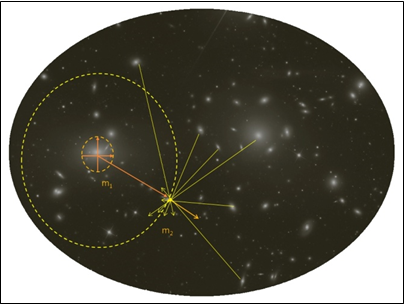
So, local inertia is somehow linked to the large-scale distribution of matter in the Universe (March’s Principle), then Newton’s law of gravitation is insufficient to describe it. So the gravitational interaction between two stars or between two galaxies would be the one prescribed by Newton’s inverse square law plus an additional contribution from distant masses, which need not be the same for different points in space; since, on a large scale, the mass distribution is not spherical with its center in the local observation frame. Clearly, it is not possible to explicitly calculate that global contribution (due to the large-scale distribution of matter) to the gravitational force between two particles. Einstein tried it, through the cosmological term Λ, but it remained pending how to model his equivalent in stellar distances within a given galaxy, and within galaxy clusters.
Then, the general assumption is that all particles with mass are subject to the force of gravity through the inverse square law of gravitation, plus an additional term that varies with the comoving distance caused by the large-scale distribution of baryonic mass, in the sense of Mach’s principle [12, 13, 14, 15]. This complementary contribution would be zero at comoving distance ranges on the order of the solar system, weakly attractive at interstellar comoving distance ranges (kiloparsec), very attractive at intergalactic comoving distance ranges (Megaparsec) and repulsive at cosmic scales. It is proposed to address the Zwicky paradox of missing mass in galaxy clusters by modifying Newtonian gravity on a large scale with an inverse Yukawa-like term that varies with comoving distance [16].
To this end, a summary of modified large-scale gravity with a Yukawa-like inverse term, astrophysical implications and consequences for FRW-cosmology are presented in Section 2. Next, we use the general derivation of the Clausius virial theorem and its application to data from the ESO nearby Abell cluster survey [17] (Section 3). The last section is a brief discussion on the linkage of the generalized Virial theorem (in the large-scale modification of Newtonian gravity) with the empirical relations between luminosity and residual velocity, in galaxies and galaxy clusters (Tully- Fischer and Faber-Jackson relations). Conclusions are given in the last section.
Methodology
Large-scale Modification of Newtonian Gravity
We assume that the net force of gravitation varies as the law of Inverse Square in scales in order of the interstellar distance, but it varies in a very different way when the comoving distance is about of the order of kiloparsec or more. In this sense, our argument is a large-scale modification of the gravity. The origin of this field (UYF) is the baryonic mass, like in the Newtonian gravity, and represents the contribution caused by the large-scale distribution of mass, in the sense of Mach’s principle. This additional term was constructed phenomenologically to explain the astronomical observables. We call this term, due to its shape, as Inverse Yukawa-like field (UYF) [12].
![Figure 2: Modification at great scale of the gravity thought of the Inverse Yukawa-like field (UYF) in astronomical scale for different ranges of the comoving distance [12].](/fulltextimages/13810/fig_2.png)
This potential per unit mass (in units of J/kg) as function of the comoving distance is: null in the inner solar system, weakly attractive in ranges of interstellar distances, very attractive in distance ranges comparable to the clusters of galaxies and repulsive to cosmic scales (Figure 1) [14]. The general expression is:
− ≅ − (1)
0.05 45 2,571 0 1 s YF M J U s s e M kg
( ) ( ) Where s is the dimensionless scale of the comoving distance s≡r⁄r0 =r⁄50Mpc and M is the mass of the object expressed in solar masses M⨀. It`s obtain beginning by the crude description of Hydrogen synthesis during the Matter- radiation decoupling in a primordial proto galaxies [15]. The coupling constants (as derived from previous report [15]) are: r0~50 Mpc (the average distance between clusters of galaxies) and α~2.5 Mpc. We understand that an exact model would fit the precise values of the coupling constants without modifying the phenomenology.
The force per unit mass, complement to large-scale of the Newtonian gravitation (Figure 2), is:
( ) ( ) 2 0.05 21 2 1 1.67 10
$$ ) \cong - 1. 6 7 1 0 ^ {- 2 1} \left[ \frac {M}{M _ {\square}} \right] \frac {\left[ s ^ {2} + \alpha (s - 1) \right]}{s ^ {2}} e ^ {- 0. 0 5 / s} \left(\frac {N}{m}\right) \tag {2} $$ s YF s s M N F s e M m s Notice that the maximum occurs in Abell radius, rm≅1.2 Mpc as in the typical core of galaxies clusters.
![Figure 3: Force FYF in dimensionless scale of the comoving distances [15].](/fulltextimages/13810/fig_3.png)
From Figures 2 & 3 it is clear that U(r) gives a constant repulsive force per unit mass, at cosmological scales providing an asymptotic cosmic acceleration. This cosmic acceleration, on a large scale, remains constant as it is observed when taking the limit of s very large, for ranges of comoving distance much greater than r0~50 Mpc.
For the average value of smooth transition to strong
agglutination in galaxy’s distribution (rc~10 Mpc) the FYF
is null, it suggests that the range of the force of gravity is
finite; and the graviton rest mass is
$$ m _ {g} ^ {0} \cong 1 0 ^ {- 2 9} e V c ^ {- 2} [ 1 4 ], $$
in according to the results of gravitational waves [10]. The
large scale structures with characteristic dimensions much
greater than 10 Mpc; e.g. Sloan Great Wall and Voids; do not
show symmetric axial distribution that would be expected
if gravitation had infinite range. Neither have spherical
distribution the hot gas in the super clusters of galaxies found
by means of the Suyaev-Zel’ dovich. In large-scale structures,
the gravitational bond between the galaxies, maybe by a
sequential chain of gravitational attractions between their
neighboring components, but not necessarily by a common
center. Assuming an infinite range for gravity, would imply
among other things, to imagine colossal masses for the
attractor center in the super clusters of galaxies, which are
unobservable (Hypermassive Black Hole).
Cosmological Implications
Let us now consider a usual Friedman-Robertson- Walker cosmological model (ΛFRW), with homogeneous and isotropic FRW-metric together energy-momentum tensor for a perfect fluid, then we obtain the usual Friedmann equations [12, 13, 14] with cosmological constant L and null curvature (k=0):
$$ \left(\frac {\dot {R} (t)}{R (t)}\right) ^ {2} = \frac {8 \pi G}{3} \rho + \frac {\Lambda c ^ {2}}{3} $$ (3) ( )
2
2 2 2 ( ) 8 ( ) ( )
$$ \frac {2 \ddot {R} (t)}{R (t)} + \left(\frac {\dot {R} (t)}{R (t)}\right) ^ {2} = - \frac {8 \pi G}{c ^ {2}} P + \Lambda c ^ {2} $$ (4) Where R(t) is the Riemann curvature tensor, P and ρ denote the pressure and density respectively. As usual, c denotes the speed constant of light and G the acceleration constant of gravity.
Now, we assumed Lambda Λ as a cosmic variable respect to the comoving distance. Note that the covariance is guaranteed because at cosmological scales (ranges of the comoving distance: r > 50 Mpc) the FYF is constant (Figure 3). Then in these cosmological scales, the galaxies are described as dust particles through the impulse energy tensor for perfect fluid. Thus the Dark Energy can be thought of as a "cosmic force" in the sense of the Mach Principle, caused by ordinary matter, through the Lambda Λ cosmological term.
$$\Lambda \equiv \Lambda_0 F_{YF}(r) = -\frac{3H_0}{c^3} \frac{d}{dr} U_{YF}(r)$$
By other hand, when $r \rightarrow r_m$, i.e. $r_m \cong 1.2$ Mpc (Figure 3), and using (1) into (5), we obtain $L(r)$ in the intergalactic scale, as:
$$\Lambda(r_m) = \Lambda_0 F_{YF}(r) \bigg|_{r \rightarrow r_m} \approx 10.55(4\pi G kg m^{-2}) \frac{3H_0}{c^3}$$
With $H_0$ is the Hubble constant in km/s Mcp-1. Remember that $s \equiv r/r_0 = r/50$ Mpc. Now, the Friedmann equations are [14]:
$$\left( \frac{\dot{R}(t)}{R(t)} \right)^2 = \frac{8\pi G}{3} \rho + \frac{\Lambda(r_m) c^2}{3}$$
$$\frac{2\dot{R}(t)}{R(t)} + \left( \frac{\dot{R}(t)}{R(t)} \right)^2 = -\frac{8\pi G}{c^2} P + \Lambda(r_m) c^2$$
The Friedmann equations are:
$$\frac{kc^2}{R^2(t)} = H_0^2 \left[ \Omega_b(1 + \Omega_{YF}) + \Omega_\Lambda - 1 \right]$$
$$q_0 = \frac{\Omega_b}{2} \left( 1 + \Omega_{YF} \right) \left( 1 + \frac{3P}{c^2} \rho \right) - \Omega_\Lambda$$
Where and we used the standards notation for the matter density $\Omega_m$, baryonic density $\Omega_b$, and deceleration parameters $\Omega_\Lambda$.
The remarkable result in (9) is that: if $k=0$ no need to the dark matter. I.e. using $\Omega_0 \approx 0.0223$ and $\Omega_\Lambda \approx 0.6911$ [7, 15] we obtain $\Omega_m \approx 0.255$ and $\Omega_\Lambda = 0.255 + 0.6911 \approx 1$.
Now consider the photons emitted from a remote galaxy with recession velocity $v$, and their observation in the reference local frame. We should evaluate (2) in $r \gg 50$ Mpc, with initial condition $v(0)=0$. We obtain de Hubble-Lemaitre’s Law [13]:
$$v = \int adt = \int \limits_{r \rightarrow \infty} F_{YF}(r) \frac{dr}{c} = \left( \frac{4\pi G}{c} \ell \right) r = H_0 r$$
here $\ell \approx 1$ kg m$^{-2}$ is a dimensional parameter.
Notice that the value of $H_0$ is the theoretical upper limit, evaluate for most distant objects ($r \gg 50$ Mpc). Planck collaborations obtain indirect measurement $67.15$ km s$^{-1}$ Mpc$^{-1}$; Riess had found that $74.22$ km s$^{-1}$ Mpc$^{-1}$ in Large Magellanic Cloud and other recent direct measurements which Space Telescope (HST), are $75.8$ and $78.5$ km s$^{-1}$ Mpc$^{-1}$ [18, 19].
In the cosmological range of the comoving distance, $r^* r_e$, i.e. when $s^* 0.2$ (Figure 3), the L parameter using (1) into (5), is
$$\Lambda(r_c) = \Lambda_0 F_{YF}(r) \bigg|_{r \rightarrow r_c} \approx 0.623 \frac{3H_0^2}{c^2}$$
And the Friedmann equations are
$$\left( \frac{\dot{R}(t)}{R(t)} \right)^2 = \frac{8\pi G}{3} \rho + \frac{\Lambda(r_c) c^2}{3}$$
$$\frac{2\dot{R}(t)}{R(t)} + \left( \frac{\dot{R}(t)}{R(t)} \right)^2 = -\frac{8\pi G}{c^2} P + \Lambda(r_c) c^2$$
Thus, the dark energy would be interpreted as the cosmic acceleration in local frameworks, caused by the large scale distribution of the ordinary baryonic matter. Thus, the cosmological density parameter is now WL@ 0.623h$^{-1}$. The upper limit for Hubble parameter ($h=0.863$), we obtain $\Omega_\Lambda \approx 0.72$ in good agreement with the measurements of SN1a [14].
Other important astrophysical implications have been presented in previous reports: we discussed how the UYF affects the calculation of the age of the universe, the rotation curves of galaxies, the Angular Diameter Distance Distributions, and the length and Jeans’s mass [14]; also the inclusion of the UYF in Arp Controversy, the Gravitational redshift. Gravitational Lensing, baryon acoustic oscillations (BAO) and Cosmic Microwave Background anisotropies (CMB) and Pioneer Anomaly were presented in [15].
**Result**
**Clausius’s Virial Theorem**
Let us consider the Clausius’s Virial expression $G \equiv \sum_i \vec{p}_i \cdot \vec{r}_i$ when deriving with respect to time, and then averaging with respect to a complete period ($\tau$), we obtain the well-known virialized expression between kinetic energies and power; that in the case of a particle subjected only to the Newtonian gravitational potential is:
$$\frac{1}{\tau} \int \frac{dG}{dt} dt' = \frac{1}{\tau} \int \vec{\nabla} U_i \cdot \vec{r}_i dt' + \frac{1}{\tau} \int \frac{p^2}{2m_i} dt'$$
$$\frac{G(\tau) - G(0)}{\tau} = -\frac{1}{\tau} \int \frac{GMm_i}{r_i} dt' + \frac{1}{\tau} \int \sum_i T_i dt'$$
$$0 = -\langle U \rangle + 2\langle T \rangle$$
where T is the kinetic energy. The virial theorem is often used to calculate the mass-to-light ratio in the Zwicky missing mass problem. Using the projected virial radius (RPV) and projected radial velocity (σp) [17], then
2 3 2 $$ = \frac {3 \pi}{2} \frac {\sigma_ {p} ^ {2}}{G} $$
p PV M R G (17)
If now the particles are subjected to a gravitational potential that have an additional long-range term, we have using (1) and (2) that:
r GMm GMm GMm r r e T e dt r r
4 0 4 2 α π π α τ $$ \begin{array}{l} 0 = - \frac {G M m}{r} - 4 \pi G M m \ell \left(r - r _ {0}\right) e ^ {- \alpha / r} + 2 T + \frac {4 \pi G M m \ell}{\tau} \int_ {0} ^ {\tau} \left(\alpha - \frac {\alpha r _ {0}}{r}\right) e \\ 0 = - \frac {G M m}{r} - U _ {Y F} + 2 T + \frac {4 \pi G M m \ell}{\tau} \int_ {0} ^ {\tau} \left(\alpha - \frac {\alpha r _ {0}}{r}\right) e ^ {- \alpha / r} d t \\ \end{array} $$ λ λ τ α α ( ) ∫ / / 0 0 0 r r − − r GMm GMm U T e dt r r
4 0 2 α π α τ λ
τ α ∫ / 0 r YF
−
0 (18) Remember that 0 / / 50 s r r r Mpc ≡ = , 0 0 / r α α ≡ and ℓ ≡ 1 m-2 is a dimensional parameter.
Thus, the energy balances results:
$$ = G M \left[ \frac {1}{r _ {0} s} - 4 \pi \ell r _ {0} \left(e ^ {- \alpha / r} (s - 1) + \alpha_ {0}\right) \right] $$
1 4 1 r v GM r e s r s ( ) ( ) 2 / 0 0 0
(19) Then the generalized expression of the Virial Theorem in a cluster of galaxies of radius R is:
$$ v ^ {2} = G M R ^ {- 1} \left[ 1 - 4 \pi \ell r _ {0} ^ {2} s \left(e ^ {- \alpha_ {0} / s} (s - 1) + \alpha_ {0}\right) \right] $$ (20) A preliminary calculation of virial mass is carried out for some nearby bright galaxy clusters in the Abell Catalogue, together with data reported in optical [17]. Then (20) can be writing as:
2 1 2.5/ 3 1 4 50 2.5 2
$$ V = \frac {3 \pi}{2} \frac {\sigma_ {p} ^ {2}}{G} R _ {P V} \left[ 1 - 4 \pi \ell R _ {P V} \left(e ^ {- 2. 5 / R _ {P V}} \left(R _ {P V} - 5 0\right) + 2. 5\right) \right] ^ {- 1} $$ ( ) ( ) PV p R PV PV PV M R R e R G (21) Where σP is the radial component speed for spherical systems, and RPV is the projected virial radius.
Observation data for the bright Abell galaxy clusters are shown in Table 1. The galaxy clusters are listed in the first column, followed by the radii, redshift, radial component speed and the projected virial radius in the second to fifth columns respectively. In the penultimate column, we have shown the calculation of mass according to Newtonian gravitation. And in the last column we show the modified gravity mass. Note that the estimated mass is now, on average, 500 times less than originally calculated [17]; thus resolving the Zwicky paradox without invoking non-baryonic dark matter.
| Cluster | R (Mpc) [17] max | Z [17] | σ km/s [17] P | R h-1 (Mpc) pv [17] | M (17) (101 4M ) vir | M (YF) (21) vir (101 1M ) |
|---|---|---|---|---|---|---|
| A13 | 1.17 | 0.0972 | 515 | 1.03 | 2.99 | 4.45 |
| A16 | 1.94 | 0.0467 | 759 | 1.28 | 8.07 | 9.22 |
| A26 | 1.2 | 0.0693 | 179 | 0.27 | 0.1 | 0.584 |
| A37 | 1.1 | 0.0389 | 508 | 0.76 | 2.15 | 4.55 |
| A85 | 1.75 | 0.056 | 969 | 1.31 | 13.5 | 14.9 |
| A87 | 0.74 | 0.0558 | 224 | 0.55 | 0.3 | 0.91 |
| A151 | 1.56 | 0.0537 | 714 | 0.88 | 4.91 | 8.8 |
| A168 | 1.1 | 0.0469 | 118 | 0.25 | 0.04 | 0.25 |
| A194 | 1.97 | 0.0184 | 341 | 0.55 | 0.7 | 2.1 |
| A229 | 1.31 | 0.1137 | 506 | 1 | 2.8 | 4.32 |
| A256 | 1.8 | 0.0885 | 545 | 0.56 | 1.82 | 5.37 |
| A262 | 3.95 | 0.0169 | 525 | 0.87 | 2.63 | 4.77 |
| A295 | 1.4 | 0.0427 | 359 | 0.64 | 0.9 | 2.31 |
| A367 | 1 | 0.0882 | 394 | 0.68 | 1.16 | 2.77 |
| A399 | 1.56 | 0.0718 | 1116 | 1.19 | 16.2 | 20.3 |
| A400 | 1.22 | 0.0237 | 599 | 0.7 | 2.75 | 6.38 |
| A401 | 2 | 0.0737 | 1152 | 1.1 | 16 | 22 |
| A420 | 1.05 | 0.086 | 360 | 0.67 | 0.95 | 2.31 |
| A426 | 2.7 | 0.0178 | 1026 | 1.35 | 15.6 | 16.6 |
| A458 | 0.88 | 0.1057 | 736 | 1.1 | 6.52 | 8.97 |
| A514 | 1.77 | 0.0714 | 882 | 1.05 | 8.94 | 13 |
| A524 | 0.89 | 0.0797 | 250 | 0.37 | 0.25 | 1.14 |
| A539 | 2.47 | 0.0284 | 629 | 0.68 | 2.95 | 7.06 |
| A548NE | 0.88 | 0.0397 | 571 | 0.76 | 2.71 | 5.75 |
| A548SW | 1.36 | 0.0439 | 583 | 0.77 | 2.87 | 5.98 |
| A569 | 3.03 | 0.0201 | 327 | 0.46 | 0.54 | 1.95 |
| A576 | 1.74 | 0.0383 | 914 | 1.22 | 11.2 | 13.5 |
| A754 | 2.6 | 0.0539 | 662 | 0.98 | 4.7 | 7.43 |
| A957 | 5.17 | 0.0416 | 254 | 0.3 | 0.21 | 1.18 |
| A1016 | 1.44 | 0.0319 | 273 | 0.4 | 0.33 | 1.36 |
| A1060 | 2.06 | 0.0126 | 610 | 0.69 | 2.81 | 6.63 |
| A1069 | 1.2 | 0.0662 | 360 | 0.61 | 0.87 | 2.33 |
| A1142 | 2.4 | 0.035 | 486 | 0.93 | 2.41 | 4.04 |
| A1146 | 1.72 | 0.1422 | 929 | 0.84 | 7.94 | 15 |
| A1185 | 3.97 | 0.03 | 536 | 0.38 | 1.2 | 5.24 |
| A1314 | 1.17 | 0.0329 | 277 | 0.47 | 0.4 | 1.4 |
| A1367 | 3.08 | 0.0221 | 570 | 0.73 | 2.6 | 5.75 |
| A1631 | 1.95 | 0.0464 | 702 | 1.13 | 6.1 | 8.11 |
| A1651 | 1.23 | 0.0863 | 685 | 0.5 | 2.57 | 8.52 |
| A1656 Coma | 3.9 | 0.0233 | 821 | 1.08 | 7.97 | 11.2 |
| A1689 Virgo | 2.19 | 0.0038 | 632 | 1.05 | 4.59 | 6.68 |
| A1736 | 1.82 | 0.0347 | 415 | 0.92 | 1.73 | 2.95 |
| A1795 | 1.81 | 0.0632 | 834 | 0.91 | 6.93 | 11.9 |
| A1809 | 1.65 | 0.079 | 765 | 0.79 | 5.06 | 10.3 |
| A1983 | 1.7 | 0.0452 | 494 | 0.79 | 2.11 | 4.28 |
| A1991 | 0.81 | 0.0593 | 631 | 0.48 | 2.09 | 7.24 |
| A2029 | 1.57 | 0.0766 | 1164 | 0.48 | 7.12 | 24.6 |
| A2040 | 1.85 | 0.0454 | 458 | 0.92 | 2.11 | 3.6 |
| A2048 | 1.19 | 0.0972 | 664 | 0.84 | 4.06 | 7.67 |
| A2052 | 1.15 | 0.0346 | 207 | 0.47 | 0.21 | 0.78 |
| A2063 | 3.87 | 0.035 | 667 | 0.66 | 3.22 | 7.95 |
| A2079 | 2.76 | 0.0662 | 670 | 1.12 | 5.51 | 7.41 |
| A2092 | 1.64 | 0.0673 | 536 | 0.45 | 1.42 | 5.23 |
| A2107 | 1.02 | 0.0415 | 622 | 0.71 | 3.01 | 6.87 |
| A2124 | 1.22 | 0.0661 | 878 | 0.88 | 7.43 | 13.3 |
| A2199 | 3.29 | 0.0314 | 801 | 0.96 | 6.74 | 10.9 |
| A2256 | 1.19 | 0.0589 | 1348 | 1.32 | 26.3 | 28.8 |
| A2319 | 1.04 | 0.0553 | 1545 | 1.83 | 47.8 | 34.8 |
| A2353 | 1.9 | 0.1213 | 597 | 0.61 | 2.38 | 6.41 |
| A2362 | 0.81 | 0.0616 | 331 | 0.57 | 0.68 | 1.98 |
| A2401 | 0.63 | 0.0581 | 395 | 0.69 | 1.18 | 2.78 |
| A2426 | 1.35 | 0.0886 | 332 | 0.49 | 0.59 | 2 |
| A2500 | 0.96 | 0.0904 | 477 | 0.58 | 1.45 | 4.1 |
| A2538 | 0.74 | 0.0858 | 326 | 0.68 | 0.79 | 1.9 |
| A2554 | 0.68 | 0.1118 | 840 | 0.82 | 6.34 | 12.3 |
| A2569 | 1.16 | 0.0816 | 491 | 0.88 | 2.32 | 4.16 |
| A2589 | 0.59 | 0.0423 | 470 | 0.33 | 0.8 | 4.03 |
| A2593 | 1.41 | 0.0424 | 698 | 0.43 | 2.29 | 8.88 |
| A2634 | 0.86 | 0.0316 | 700 | 1.03 | 5.53 | 8.23 |
| A2666 | 0.55 | 0.028 | 383 | 0.29 | 0.47 | 2.68 |
| A2670 | 2.22 | 0.0767 | 852 | 0.99 | 7.87 | 12.3 |
| A2715 | 1.22 | 0.1145 | 463 | 0.85 | 2 | 3.72 |
| A2717 | 1.16 | 0.0498 | 541 | 0.8 | 2.56 | 5.13 |
| A2721 | 1.6 | 0.1152 | 805 | 1.01 | 7.17 | 10.9 |
| A2734 | 1.77 | 0.0625 | 628 | 0.98 | 4.23 | 6.69 |
| A2755 | 1.23 | 0.0957 | 768 | 1.21 | 7.81 | 9.56 |
| A2798 | 2.21 | 0.1129 | 711 | 0.41 | 2.27 | 9.21 |
| A2799 | 0.73 | 0.064 | 422 | 0.75 | 1.46 | 3.14 |
| A2800 | 0.96 | 0.0643 | 404 | 0.78 | 1.39 | 2.87 |
| A2819 | 2.01 | 0.0876 | 282 | 0.64 | 0.56 | 1.43 |
| A2854 | 0.77 | 0.0619 | 130 | 0.25 | 0.05 | 0.31 |
| A2877 | 1.08 | 0.0248 | 887 | 0.59 | 5.08 | 14.2 |
| A2911 | 1.06 | 0.0816 | 547 | 0.72 | 2.36 | 5.31 |
| A3093 | 0.9 | 0.0836 | 440 | 0.85 | 1.8 | 3.36 |
| A3094 | 1.71 | 0.0677 | 653 | 1.26 | 5.88 | 6.85 |
| A3111 | 1.08 | 0.0774 | 159 | 0.24 | 0.06 | 0.46 |
| A3112 | 1.2 | 0.0735 | 86 | 0.13 | 0.01 | 0.13 |
| A3122 | 1.76 | 0.0648 | 775 | 1.1 | 7.23 | 9.95 |
| A3126 | 0.58 | 0.0862 | 1053 | 0.67 | 8.13 | 19.8 |
| A3128 | 2.42 | 0.0605 | 789 | 1.28 | 8.73 | 9.96 |
| A3142 | 1.13 | 0.1036 | 737 | 1.02 | 6.07 | 9.14 |
| A3151 | 0.56 | 0.0662 | 237 | 0.4 | 0.25 | 1.02 |
| A3158 | 1.67 | 0.0597 | 976 | 1.06 | 11 | 15.9 |
| A3182 Eridani | 1.94 | 0.0058 | 264 | 0.72 | 0.55 | 1.24 |
| A3194 | 1.25 | 0.0977 | 805 | 1.2 | 8.52 | 10.5 |
| A3223 | 1.74 | 0.0603 | 647 | 0.87 | 3.99 | 7.24 |
| A3266 | 1.34 | 0.0599 | 1107 | 1.91 | 25.6 | 17.6 |
| A3202 | 0.74 | 0.0708 | 250 | 0.68 | 0.47 | 1.11 |
| A3334 | 0.54 | 0.097 | 696 | 0.85 | 4.51 | 8.41 |
| A3341 | 0.93 | 0.0389 | 351 | 0.58 | 0.78 | 2.22 |
| A3354 | 1.68 | 0.0586 | 358 | 0.72 | 1.01 | 2.27 |
| A3360 | 0.49 | 0.0848 | 835 | 1.46 | 11.1 | 10.8 |
| A3376 | 2.29 | 0.0465 | 688 | 0.89 | 4.61 | 8.16 |
| A3381 | 1.6 | 0.0382 | 293 | 0.45 | 0.42 | 1.56 |
| A3389 | 0.52 | 0.0272 | 595 | 0.74 | 2.87 | 6.26 |
| A3391 | 0.87 | 0.0553 | 663 | 0.92 | 4.43 | 7.54 |
| A3395 | 1.14 | 0.0506 | 852 | 0.76 | 6.04 | 12.8 |
| A3526 | 4.56 | 0.0108 | 447 | 0.78 | 1.71 | 3.51 |
| A3528N | 1.71 | 0.0547 | 461 | 0.56 | 1.3 | 3.84 |
| A3532 | 0.66 | 0.0559 | 738 | 1.19 | 7.1 | 8.86 |
| A3556 | 1.04 | 0.0477 | 642 | 1.02 | 4.6 | 6.93 |
| A3558 Shapley | 1.99 | 0.048 | 977 | 1.25 | 13.1 | 15.4 |
| A3559 | 1.75 | 0.0469 | 456 | 0.74 | 1.68 | 3.68 |
| A3562 | 2.15 | 0.0478 | 736 | 1.22 | 7.24 | 8.77 |
| A3571 | 0.98 | 0.0395 | 1045 | 0.73 | 8.73 | 19.3 |
| A3574 | 1.26 | 0.0158 | 491 | 0.8 | 2.11 | 4.22 |
| A3651 | 1.8 | 0.061 | 626 | 1.11 | 4.76 | 6.48 |
| A3667 | 2.22 | 0.0566 | 971 | 1.55 | 16 | 14.4 |
| A3693 | 1.06 | 0.0921 | 478 | 0.86 | 2.15 | 3.96 |
| A3695 | 1.97 | 0.0903 | 779 | 1.3 | 8.64 | 9.67 |
| A3703 | 1.04 | 0.0743 | 472 | 0.96 | 2.34 | 3.79 |
| A3705 | 1.08 | 0.0906 | 877 | 1.07 | 9.01 | 12.8 |
| A3716N | 1.42 | 0.0493 | 466 | 0.78 | 1.85 | 3.82 |
| A3716S | 1.91 | 0.0458 | 803 | 0.85 | 6 | 11.2 |
| A3733 | 0.72 | 0.0399 | 610 | 0.92 | 3.75 | 6.38 |
| A3806 | 2.17 | 0.0762 | 502 | 1.1 | 3.04 | 4.17 |
| A3809 | 1.48 | 0.0631 | 478 | 0.9 | 2.25 | 3.93 |
| A3822 | 1.86 | 0.0769 | 810 | 1.49 | 10.7 | 10.1 |
| A3825 | 1.66 | 0.076 | 699 | 1.2 | 6.42 | 7.94 |
| A3879 | 1.74 | 0.0679 | 398 | 0.5 | 0.87 | 2.88 |
| A3880 | 0.79 | 0.0588 | 827 | 0.92 | 6.89 | 11.7 |
| A3921 | 1.33 | 0.0944 | 490 | 0.93 | 2.45 | 4.11 |
| A4008 | 0.69 | 0.0558 | 427 | 0.66 | 1.32 | 3.26 |
| A4010 | 1.44 | 0.0966 | 625 | 0.88 | 3.76 | 6.75 |
| A4038 | 0.42 | 0.0285 | 413 | 0.43 | 0.8 | 3.11 |
| A4067 | 1.45 | 0.0998 | 499 | 0.83 | 2.26 | 4.34 |
| Average | 1.63 | 0.0606 | 606 | 0.83 | 4.73 | 7.3 |
Table 1: Virial Mass in Abell bright clusters of galaxies.
Discussion
New Cosmological Paradigm
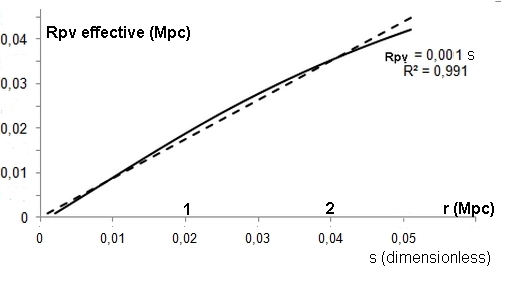
The total gas mass in clusters is generally larger than the total mass of the luminous parts of the galaxies Mgas ~ 1013-1014 M⨀ [20]. The increase in the effective potential, through the UYF term in the Virial equation (20), decreases the virial mass of the galaxy clusters, necessary to maintain hydrostatic balance, consequently the gas fraction and the baryon density increase, without the need of assuming halos of exotic dark matter (non-baryonic dark matter), as in the Table 1. Also, we can see (Figure 4) that the correction in the projected radial velocity is the order of 10-3 for the comoving distance ranges in galaxy clusters.
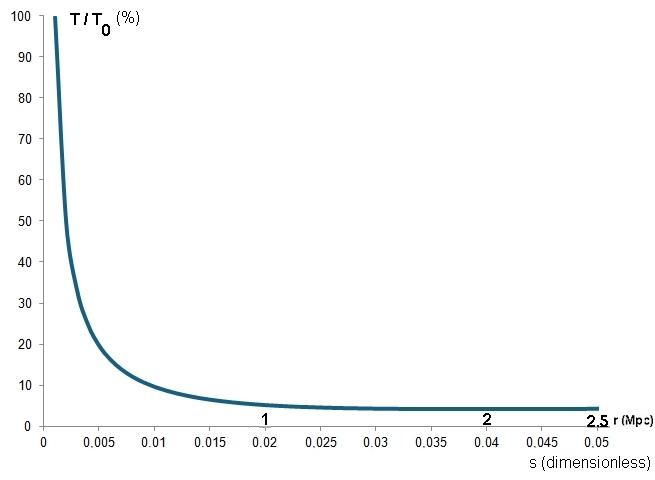
Yet, in the atmosphere of galaxy clusters, the hot gas emitting X-rays. Given the old of the galaxies clusters, and considering that global eruptive events in most galaxies are sporadic, we can assume hydrostatic equilibrium, therefore the energy balance prescribes that the temperature of the gas follows the variation of velocities, analogously to the distribution of matter, then:
2 B eff p P k T m µ σ ≅ (22)
where μ is the metallicity of the order 0.6 times that of the solar, mp is the mass of the proton, and kB is the Boltzmann constant. The Virial theorem (20) implies that $$ T _ {e f f} \cong \left(\mu m _ {p} k _ {B} ^ {- 1} G r _ {0} ^ {- 1}\right) M s ^ {- 1} \left[ 1 - 4 \pi \ell r _ {0} ^ {2} s \left(e ^ {- \alpha_ {0} / s} (s - 1) + \alpha_ {0}\right) \right] \tag {23} $$ The plasma temperature turns out to be non-uniform (Figure 5), but beyond the core of the galaxy cluster the isothermal hypothesis is valid. On the other hand, the mass of the gas, deduced from X-ray observations and the Sunyaev- Zel’dovich effect, gives masses of the order of 13 14 10 10 M − , and ( ) 7 8 21 0 10 X ray eff T K − ≈ − [20]. So consideration of the Virial Theorem in a modified gravity scenario predicts that the gas fraction is much larger than the mass of the stars and, therefore, the Baryon density parameter increases according to the Friedmann’s equation (9) without to invoke exotic dark matter.
On the other hand, the Faber-Jackson relation [21] is the observed relationship between the luminosity (L) and the random speed (σ) of stars near to center elliptical galaxy: L∝σ^4. This empirical relationship can be deduced from the virial theorem for Newtonian gravitation. In effect using (16):
$$ \frac {3}{5} \frac {G M ^ {2}}{R} = M \sigma^ {2} $$
(24) And the assumption that L∝M, and L=4πR2 B, with B superficial briskness, then:
$$ L = 4 \pi \left(\frac {3}{5} \frac {G L}{\sigma^ {2}}\right) ^ {2} B \rightarrow L \propto \sigma^ {4} \tag {25} $$ Let us now consider the large-scale modification of Newtonian gravity, using the generalized Virial theorem (20) into (26) then:
2 2 / 2 4 0 0 2 3 4 1 4 1 5
s GL L r s e s B L α π π α σ σ $$ L = 4 \pi \left(\frac {3}{5} \frac {G L}{\sigma^ {2}}\right) ^ {2} \left[ 1 - 4 \pi \ell r _ {0} ^ {2} s \left(e ^ {- \alpha_ {0} / s} (s - 1) + \alpha_ {0}\right) \right] ^ {2} B \rightarrow L \propto \sigma $$ ( ) ( ) 0 (26) Also in spiral galaxies there is an empirical relationship between the mass or intrinsic luminosity of a spiral galaxy and its asymptotic rotation velocity or emission line width; known as the Tully–Fisher relation [22]. More precisely, the baryonic Tully–Fisher relation says that the baryonic mass is proportional to velocity to the power of roughly 3.5-4, [23, 24]. Therefore, the Tully-Fisher relationship suggests that the luminous mass in stars and gas accounts for almost all of the associated baryons in each individual galaxy and its halo. Therefore this is a strong argument against dark matter in these systems [25]. The generalization of the Virial Theorem in an scenarios of modified gravity allows know the basic physics in Tully–Fisher and Faber-Jackson relations (26) without invoke the paradigm of dark matter.
Finally, a note is necessary on the validity of Mach’s Principle in gravitation (Figure 1). The general solution to the gravitation Poisson equation, under spherical symmetry, depends on the mass distribution outside of $r$:
$$U(r) = -4\pi G \left[ \frac{1}{r} \int_{0}^{r} \rho(r') r^{-2} dr' + \int_{r}^{\infty} \rho(r') r' dr' \right]$$
(27)
Newton’s first theorem: a body that is inside a spherical shell of matter experiences no net gravitational force from that shell. The equivalent in general relativity is called Birkhoff theorem. In the Newtonian approach to gravity it is easily understood that the second term in (27) cancels due to the fact that solid angles, extending from a point inside a sphere in opposite directions, have areas on the sphere that vary as $r^2$. While the angles sustained by the gravitational forces vary as $r^2$, so that the gravitational forces of the two opposite areas exactly cancel. But, when the gravitational force is different from Newton’s inverse square law of gravity, the two opposite areas no longer change as $r^2$ and, consequently, it is not true that the second term in (15) is null. Therefore, Birkhoff theorem could not be applied.
**Summary and Conclusions**
Almost a century ago, Zwicky introduced the dark matter approach, based on the incompatibility between Newtonian gravity and the residual velocity measured in galaxy clusters. The incompatibility between the observed matter density with the flatness of the Universe in FRW-cosmology; and non-Keplerian rotation-speed curves in galaxies and galaxy clusters, show that our formulation of gravity is far from complete. However, the dark matter approach has been prioritized over other theoretical alternatives (quiescence, bigravity, modified gravity, etc.), turning dark matter into an uncritically assumed paradigm, despite the lack of detection of exotic matter, in terrestrial laboratories and astronomical observations, during of the last thirty years.
A plausible alternative is the large-scale modification of gravity, through a potential as an inverse Yukawa-like field (UYF-field), which varies with comoving distance (null in the inner solar system, weakly attractive at interstellar distances, very attractive in galaxy clusters and repulsive on cosmic scales). The UYF-field is caused by the large-scale distribution of baryon mass, in the sense of Mach’s principle, and can explain astronomical observables, particularly
- Resolved the incompatibility between the flatness of the Universe and the density of matter in the FRW-Cosmology without dark matter (9).
- Provides a explanation for dark energy (14), The dark energy would the cosmic acceleration caused by the large scale distribution of the ordinary baryonic matter, as prescribed the Mach’s principle.
- It allows us to theoretically deduce the Hubble-Lemaitre’s law (11).
- The Virial theorem and Kepler’s third law now including additional terms (18) that solve the Zwicky’s paradox, so the "missing mass" is reinterpreted as the potential energy associated with the UYF-field (21).
- The virial mass in the galaxy cluster is the order of $10^{11} M_{\odot}$. This is five hundred times less than that calculated by Zwicky (Table 1).
- It is compatible with the empirical relations of Faber-Jackson and Tully-Fisher (25).
**References**
1. Zwicky F (1933) The redshift of extragalactic nebulae. Helvetica Physica Acta 6: 110-127.
2. Zwicky B, Meyling J, Appell D (2021) Fritz Zwicky and the earliest prediction of dark matter. Phys World 34(5): 24.
3. Zwicky F (1937) On the Masses of Nebulae. ApJ 86: 217.
4. Einasto J, Saar E, Kaasik A, Chernin AD (1974) Missing mass around galaxies: morphological evidence. Nature 252: 111-113.
5. Rubin V, Ford W (1970) Rotation of the Andromeda Nebula from a Spectroscopic Survey of Emission Regions. ApJ 159: 379.
6. Overduin J, Wesson PS (2008) The light/Dark Universe. World Scientific Publishing: Danvers.
7. Freese K (2000) Death of baryonic dark matter. Phys Reports 333: 183-201.
8. Bertone G, Hooper D (2018) History of dark matter. Rev Mod Phys 90: 045002.
9. LIGO Sc. Collaboration and Virgo Collaboration (2017) GW170104: Observation of a 50-Solar-Mass Binary Black Hole Coalescence at Redshift 0.2. Physical Review Letters 118(22): 221101.
10. Gao Q (2022) Constraint on the mass of graviton with gravitational waves. Mechanics & Astronomy 66: 220411.
11. Lee JG, Adelberger EG, Cook TS, Fleischer SM, Heckel BR (2020) New test of the gravitational 1/r2 law at separations down to 52 $\mu$m. Phys Rev Lett 124: 101101.
12. Falcon N (2013) Modification of the Newtonian Dynamics in ΛFRW-Cosmology an Alternative Approach to Dark Matter and Dark Energy. JMP 319: 10-18.
13. Falcon N, Aguirre A (2014) Theoretical Deduction of the Hubble Law Beginning with a MoND Theory in Context of the ΛFRW-Cosmology. IJAA 4: 551-559.
14. Falcon N (2021) A large-scale heuristic modification of Newtonian gravity as an alternative approach to dark energy and dark matter. J Astrophys Astron 4: 102.
15. Falcon N (2023) Modified Gravitation and Mach’s Principle: An Alternative to the Dark Matter and Dark Energy Cosmological Paradigm. OAJA 1(1): 000103
16. Falcon N (2017) Incorporation of Mach’s principle in LFRW-Cosmology that depends dynamically of the distance range. RevMexAA (C) 49: 118-118.
17. Girardi M, Giuricin G, Mardirossian F, Mezzetti M, Boschin W (1998) Optical Mass Estimates of Galaxy Clusters. ApJ 505: 74È95.
18. Tully RB (2024) The Hubble Constant: A Historical Review. In: Di Valentino E, Brout D (Eds.), The Hubble Constant Tension. Astrophysics and Cosmology, Springer, Singapore.
19. Abdalla E, Abellán GF, Aboubrahim A, Agnello A, Akarsu O, et al. (2022) Cosmology intertwined: A review of the particle physics, astrophysics, and cosmology associated with the cosmological tensions and anomalies. Journal of High Energy Astrophysics 34: 49-211.
20. Bahcall A (1999) Clusters and Superclusters of Galaxies. In: Dekel A, Jeremiah P, et al. (Eds.), Formation of Structure in the Universe. Cambridge University Press, USA.
21. Faber SM, Jackson RE (1976) Velocity dispersions and mass-to-light ratios for elliptical galaxies. ApJ 204: 668.
22. Tully R, Fisher J (1977) A New Method of Determining Distances to Galaxies. AA 54(3): 661-673.
23. Said K (2023) Tully-Fisher relation. arXiv, pp: 16.
24. Ristea A, Cortese L, Fraser-McKelvie A, Catinella B, van de Sande J, et al. (2024) The Tully–Fisher relation from SDSS-MaNGA: physical causes of scatter and variation at different radii. MNRAS 527(3): 7438-7458.
25. Chan MH (2022) Two mysterious universal dark matter– baryon relations in galaxies and galaxy clusters. Physics of the Dark Universe 38: 101142.
References
-
Zwicky F (1933) The redshift of extragalactic nebulae. Helvetica Physica Acta 6: 110-127.
-
Zwicky B, Meyling J, Appell D (2021) Fritz Zwicky and the earliest prediction of dark matter. Phys World 34(5): 24.
-
Zwicky F (1937) On the Masses of Nebulae. ApJ 86: 217.
-
Einasto J, Saar E, Kaasik A, Chernin AD (1974) Missing mass around galaxies: morphological evidence. Nature 252: 111-113.
-
Rubin V, Ford W (1970) Rotation of the Andromeda Nebula from a Spectroscopic Survey of Emission Regions. ApJ 159: 379.
-
Overduin J, Wesson PS (2008) The light/Dark Universe. World Scientific Publishing: Danvers.
-
Freese K (2000) Death of baryonic dark matter. Phys Reports 333: 183-201.
-
Bertone G, Hooper D (2018) History of dark matter. Rev Mod Phys 90: 045002.
-
LIGO Sc. Collaboration and Virgo Collaboration (2017) GW170104: Observation of a 50-Solar-Mass Binary Black Hole Coalescence at Redshift 0.2. Physical Review Letters 118(22): 221101.
-
Gao Q (2022) Constraint on the mass of graviton with gravitational waves. Mechanics & Astronomy 66: 220411.
-
Lee JG, Adelberger EG, Cook TS, Fleischer SM, Heckel BR (2020) New test of the gravitational 1/r2 law at separations down to 52 $\mu$m. Phys Rev Lett 124: 101101.
-
Falcon N (2013) Modification of the Newtonian Dynamics in ΛFRW-Cosmology an Alternative Approach to Dark Matter and Dark Energy. JMP 319: 10-18.
-
Falcon N, Aguirre A (2014) Theoretical Deduction of the Hubble Law Beginning with a MoND Theory in Context of the ΛFRW-Cosmology. IJAA 4: 551-559.
-
Falcon N (2021) A large-scale heuristic modification of Newtonian gravity as an alternative approach to dark energy and dark matter. J Astrophys Astron 4: 102.
-
Falcon N (2023) Modified Gravitation and Mach’s Principle: An Alternative to the Dark Matter and Dark Energy Cosmological Paradigm. OAJA 1(1): 000103
-
Falcon N (2017) Incorporation of Mach’s principle in LFRW-Cosmology that depends dynamically of the distance range. RevMexAA (C) 49: 118-118.
-
Girardi M, Giuricin G, Mardirossian F, Mezzetti M, Boschin W (1998) Optical Mass Estimates of Galaxy Clusters. ApJ 505: 74È95.
-
Tully RB (2024) The Hubble Constant: A Historical Review. In: Di Valentino E, Brout D (Eds.), The Hubble Constant Tension. Astrophysics and Cosmology, Springer, Singapore.
-
Abdalla E, Abellán GF, Aboubrahim A, Agnello A, Akarsu O, et al. (2022) Cosmology intertwined: A review of the particle physics, astrophysics, and cosmology associated with the cosmological tensions and anomalies. Journal of High Energy Astrophysics 34: 49-211.
-
Bahcall A (1999) Clusters and Superclusters of Galaxies. In: Dekel A, Jeremiah P, et al. (Eds.), Formation of Structure in the Universe. Cambridge University Press, USA.
-
Faber SM, Jackson RE (1976) Velocity dispersions and mass-to-light ratios for elliptical galaxies. ApJ 204: 668.
-
Tully R, Fisher J (1977) A New Method of Determining Distances to Galaxies. AA 54(3): 661-673.
-
Said K (2023) Tully-Fisher relation. arXiv, pp: 16.
-
Ristea A, Cortese L, Fraser-McKelvie A, Catinella B, van de Sande J, et al. (2024) The Tully–Fisher relation from SDSS-MaNGA: physical causes of scatter and variation at different radii. MNRAS 527(3): 7438-7458.
-
Chan MH (2022) Two mysterious universal dark matter– baryon relations in galaxies and galaxy clusters. Physics of the Dark Universe 38: 101142.
- Asymmetry Irreversible Heterogeneity Quantum Cosmology Grand Mathematical PHYSICS
- Early Universe: Hadronic Crystals Coherent Micro Gravitational Wave Emitters PHYSICS Part II
- The Solar System Constraint Maze: A Scientific Dead-End Revealing the Interuniversal Machine
- Assessment of Radiofrequency Radiation from 2G and 3G Mobile Phone Handsets
- Early Universe Magneto-Gravitational Coupling Genesis Physics: Part I
- Falsifiability of the Classical Law of Gravitation and Unveiling the Time-temperature Entanglement of the Universe